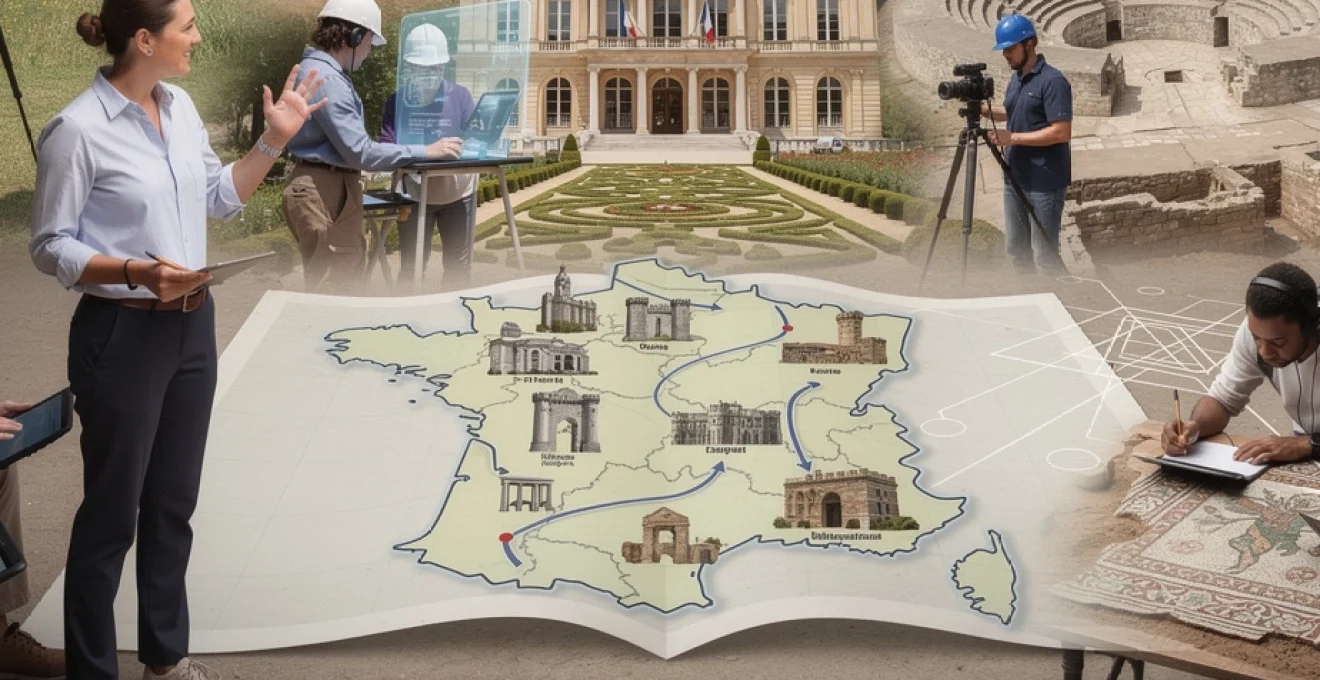
France stands as Europe’s premier destination for historical exploration, housing over 40,000 officially classified historic monuments that span millennia of human achievement. From prehistoric cave paintings in the Dordogne to Roman amphitheatres in Provence, medieval fortresses throughout the Loire Valley to Renaissance châteaux, the country offers an unparalleled journey through time. Each region reveals distinct historical layers, architectural styles, and cultural influences that have shaped French civilisation. Whether you’re drawn to the engineering marvels of ancient Rome, the spiritual grandeur of Gothic cathedrals, or the opulent palaces of French royalty, France provides an extraordinary canvas for understanding European heritage and its global impact.
UNESCO world heritage site classification and documentation requirements
France currently maintains 49 sites on the UNESCO World Heritage List, representing the most comprehensive collection of protected cultural and natural heritage in Europe. These sites undergo rigorous evaluation processes that assess their Outstanding Universal Value, ensuring they meet the highest international standards for preservation and management. The classification system distinguishes between cultural heritage sites, natural heritage locations, and mixed properties that combine both cultural and natural significance.
Outstanding universal value assessment criteria for french historic sites
The evaluation of French historic sites follows six primary cultural criteria established by UNESCO’s World Heritage Committee. Sites must demonstrate exceptional testimony to cultural traditions, represent masterpieces of human creative genius, or exhibit unique characteristics of architectural and technological ensembles. The Château de Versailles, for instance, meets multiple criteria through its architectural innovation, artistic achievement, and historical significance as the seat of absolute monarchy. Assessment teams examine authenticity, integrity, and the site’s contribution to understanding human history and cultural development.
Cultural landscape documentation at Mont-Saint-Michel and causeway
Mont-Saint-Michel exemplifies the complex documentation required for cultural landscapes that combine natural and human-made elements. The site’s inscription encompasses not only the medieval abbey but also the surrounding bay, tidal patterns, and traditional land management practices. Documentation includes detailed mapping of architectural elements, environmental monitoring data, and historical records of monastic life spanning over a millennium. The causeway’s recent replacement required extensive archaeological surveys and environmental impact assessments to ensure the site’s Outstanding Universal Value remained intact.
Archaeological site preservation standards at pont du gard
The Pont du Gard demonstrates exemplary archaeological preservation standards through its comprehensive management approach. Conservation protocols include regular structural monitoring using laser scanning technology, weathering assessments of the limestone blocks, and controlled visitor access to prevent deterioration. The site’s documentation encompasses Roman construction techniques, hydraulic engineering analysis, and the aqueduct system’s broader regional context. Preservation efforts extend beyond the monument itself to include protection of the surrounding landscape and archaeological deposits that provide context for understanding Roman urban planning.
Architectural heritage evaluation methods for palace of versailles
Versailles represents one of the most complex architectural heritage evaluation challenges, requiring multidisciplinary approaches to assess its various components. The evaluation process examines the palace’s evolution from hunting lodge to royal residence, documenting architectural phases, artistic programmes, and garden design principles. Digital documentation techniques include 3D modelling of interior spaces, analysis of decorative arts collections, and mapping of the extensive garden hydraulic systems. The site’s management plan addresses conservation of diverse materials including marble, bronze, textiles, and painted surfaces, each requiring specialised preservation techniques.
Medieval fortress architecture and defensive structures analysis
Medieval fortress architecture in France represents over six centuries of military engineering evolution, from simple motte-and-bailey constructions to sophisticated concentric castle designs. These defensive structures reflect changing warfare tactics, siege technologies, and political power structures throughout the Middle Ages. French castles demonstrate remarkable innovation in defensive design, incorporating natural topography, advanced stonework techniques, and complex defensive systems that influenced fortress construction across Europe.
Romanesque construction techniques at carcassonne citadel
Carcassonne’s double-wall defensive system showcases advanced Romanesque military architecture dating from the 12th and 13th centuries. The construction techniques employed massive limestone blocks, sophisticated mortar compositions, and innovative drainage systems to ensure structural stability. Archaeological analysis reveals the builders’ understanding of siege warfare, evidenced by the carefully calculated angles of wall sections, strategic placement of towers, and the integration of earlier Roman fortifications. The restoration work by
Viollet-le-Duc in the 19th century further illustrates how modern conservation philosophy balances historical accuracy with the need to stabilise and interpret a complex fortified ensemble. For visitors interested in medieval fortress architecture, Carcassonne offers a living textbook: as you walk the curtain walls and climb the towers, you can literally trace the transition from early Romanesque masonry to later Gothic and post-medieval adaptations.
Gothic military engineering at château de vincennes
Château de Vincennes, on the eastern edge of Paris, represents one of the most complete examples of Gothic royal fortress design in France. Its 52‑metre keep, begun in the 14th century, was conceived both as a last line of defence and a visible symbol of Capetian authority. Military engineers combined thick masonry walls with pointed-arch vaulting, allowing for higher, more spacious interiors while maintaining defensive strength.
The surrounding enceinte and moat at Vincennes illustrate how Gothic principles of verticality and light coexisted with hard military requirements. Arrow slits were carefully angled to provide overlapping fields of fire, and machicolations allowed defenders to target attackers at the base of the walls. When you walk the ramparts today, notice how the geometry of towers, gatehouses, and wall segments creates a series of controlled spaces, designed to slow and expose an enemy long before they reached the inner courtyard.
From a heritage perspective, Château de Vincennes is also important for understanding how medieval military architecture was reused over centuries. The fortress became a royal residence, a state prison, and later a military arsenal, with each phase leaving architectural traces. Current conservation work focuses on stabilising Gothic stonework, documenting later interventions, and improving visitor circulation without compromising the defensive logic that defines this historic site.
Renaissance fortification evolution at fort de salses
Fort de Salses, in northern Roussillon, marks a decisive moment in European military architecture: the response to the advent of powerful gunpowder artillery. Built by the Spanish crown at the end of the 15th century to guard the route between France and Spain, it abandons high medieval walls in favour of low, thick ramparts designed to absorb cannon fire. Instead of soaring towers, you find angular bastions and earthen embankments that deflect and dissipate energy.
The fort’s ground plan reveals Renaissance thinking in geometry and ballistics. Bastions are positioned to provide flanking fire along every curtain wall, eliminating dead zones where attackers could shelter. Deep ditches, counterscarps, and covered ways create successive defensive rings, while casemates within the ramparts allow artillery to be deployed under protection. Walking through the galleries feels like moving through a three-dimensional chessboard, each angle calculated to control the battlefield.
For travellers interested in how historic fortifications adapted to new technologies, Fort de Salses is particularly instructive. On-site interpretation panels and guided tours explain firing angles, powder storage, and communications tunnels, making complex engineering ideas accessible. Conservation teams prioritise the consolidation of earth-and-masonry structures, careful drainage management, and monitoring of salt efflorescence in underground spaces, all of which are critical for preserving this transitional Renaissance fortress.
Vauban’s star fort system implementation at citadelle de besançon
The Citadelle de Besançon is one of the masterworks of Sébastien Le Prestre de Vauban, Louis XIV’s chief military engineer, and a key example of the pré carré defensive strategy that reshaped France’s borders. Perched on a rocky spur high above the Doubs River, the citadel integrates a star-shaped envelope of bastions and ravelins with the dramatic natural topography. This combination of natural and artificial defences is central to understanding Vauban’s approach.
Vauban’s design here employs multiple layers of defence: hornworks shield the main enceinte, while detached outworks command the valley approaches. The characteristic angular bastions reduce blind spots and allow artillery to sweep the foot of the walls. When you look at a plan of Besançon’s citadel, it resembles a carefully folded piece of paper; each fold represents a calculated line of fire, demonstrating how geometry became a defensive weapon.
Today, the Citadelle de Besançon, inscribed on the UNESCO World Heritage List as part of the “Fortifications of Vauban,” is also a model for star fort conservation. Structural monitoring of retaining walls, slope-stability assessments, and controlled vegetation management are essential, as root systems and water infiltration can quickly undermine masonry. Visitor pathways are routed along historic circulation routes, allowing you to experience the logic of the fortification system while limiting wear on vulnerable earthworks and parapets.
Gallo-roman archaeological excavation sites and interpretation methods
France’s Gallo-Roman heritage is visible in dozens of archaeological sites where urban planning, entertainment architecture, and domestic life have been excavated and interpreted. From monumental amphitheatres to intimate villa mosaics, these sites allow us to reconstruct how Roman and local Celtic traditions merged to form a distinctive provincial culture. For anyone exploring historic sites in France, understanding how archaeologists investigate and present these remains adds a valuable layer of context.
Modern excavation methods emphasise meticulous stratigraphic recording, environmental sampling, and non-invasive survey techniques such as ground-penetrating radar. Once data is collected, interpretation teams create digital reconstructions and on-site displays that help visitors visualise vanished streetscapes and buildings. As you move through a Gallo-Roman town or villa today, you are often following interpretive routes shaped by decades of research and evolving heritage policies.
Amphitheatre structural analysis at arles and nîmes
The Roman amphitheatres of Arles and Nîmes are among the best-preserved in the former Western Empire, and both play a central role in understanding Roman engineering in France. Structural analysis of these arenas reveals sophisticated load-distribution systems: radial and concentric barrel vaults support the seating tiers, while a dense network of corridors and staircases manages the flow of tens of thousands of spectators. The design is not unlike a modern stadium, relying on repeated structural modules for strength and efficiency.
Engineers and archaeologists use laser scanning, photogrammetry, and finite element modelling to assess how these stone shells behave under stress. This helps conservation teams identify vulnerable joints, cracked voussoirs, or areas where water infiltration threatens stability. For visitors, interactive models and augmented-reality apps increasingly show not only how the amphitheatres looked in the 1st and 2nd centuries AD, but also how they functioned mechanically, from the arena floor to the upper cavea.
Both Arles and Nîmes also illustrate adaptive reuse, a key theme in the story of historic sites in France. Over the centuries, these arenas became fortresses, housing quarters, and event spaces, each phase adding walls, houses, and chapels. Today’s conservation strategies must decide which layers to highlight and which to remove or stabilise, balancing archaeological integrity with the need to accommodate modern cultural events and large visitor numbers.
Thermal bath complex archaeology at thermes de cluny
The Thermes de Cluny in Paris preserve substantial remains of a 3rd‑century Roman bath complex, integrated into the later medieval Hôtel de Cluny. Here, archaeology sheds light on the social and technological dimensions of bathing culture in Roman Gaul. Excavations have revealed hypocaust heating systems, water channels, and massive masonry that once supported vaulted ceilings over the frigidarium and caldarium.
Investigating a site like Cluny’s baths is a bit like reading a palimpsest: Roman foundations support medieval and early modern structures, requiring careful differentiation of construction phases. Archaeologists rely on brick stamps, mortar analysis, and construction techniques to date walls and floors, while environmental samples from drains and latrines provide insight into diet and health. Visitor interpretation uses lighting, scale models, and overlays to help you imagine steam-filled halls and bustling social spaces where politics, business, and leisure intersected.
Conservation challenges at Thermes de Cluny include managing humidity in partially underground spaces, preventing salt crystallisation in stone, and protecting fragile plaster and painted surfaces. The site demonstrates how urban archaeological remains can be integrated into dense modern cities, offering an immersive historical experience just steps away from contemporary Parisian streets.
Urban planning reconstruction techniques at Vaison-la-Romaine
Vaison-la-Romaine, in northern Provence, offers one of the most complete pictures of a Gallo-Roman town in France. Large sectors of the ancient city have been excavated, revealing streets, houses, shops, and public buildings. To reconstruct the urban plan, archaeologists combine excavation data with aerial photography, geophysical surveys, and archival research, gradually piecing together the layout much as you might solve a complex jigsaw puzzle.
One of the key questions at Vaison is how Roman planning principles, such as orthogonal street grids and standardised building plots, adapted to local topography and pre-existing settlements. The result is a hybrid townscape: you can walk along broad, colonnaded streets that feel textbook Roman, then turn into winding lanes that recall earlier Gallic patterns. Interpretation paths and site museums use plans, 3D models, and immersive media to help visitors visualise multistorey houses, gardens, and public squares.
Urban reconstruction is not only an academic exercise; it directly shapes how you experience the site. Decisions about which walls to re-erect, which floors to protect with shelters, and where to place explanatory panels influence your perception of scale and density. Vaison-la-Romaine shows how careful planning can turn extensive but fragmentary ruins into a coherent, readable ancient city while respecting archaeological authenticity.
Mosaic conservation protocols at villa Gallo-Romaine de loupian
The Villa Gallo-Romaine de Loupian, near the Étang de Thau in Occitanie, is renowned for its polychrome mosaics dating from the 4th and 5th centuries AD. These floor decorations, with intricate geometric patterns and marine motifs, are both artworks and fragile archaeological documents. Conservators follow strict protocols to stabilise tesserae, manage moisture, and protect pigments from light damage.
Initial documentation includes high-resolution photography, condition mapping, and microscopic analysis of stone and glass cubes. Where mosaics are lifted for conservation, each section is carefully numbered and supported, a process somewhat like dismantling and reassembling a vast pixelated image. At Loupian, many mosaics remain in situ under a protective shelter, allowing you to see them within their original villa setting—a rare opportunity when exploring historic sites in France.
Preventive conservation is central to long-term preservation: controlled visitor walkways, stable temperature and humidity, and regular inspections reduce the need for invasive interventions. Interpretive panels explain iconography and workshop techniques, inviting you to look more closely at details that are easy to overlook at first glance. If you have ever wondered how ancient floor art survives two millennia, a visit to Loupian offers clear, engaging answers.
Renaissance and classical architecture heritage conservation
Renaissance and Classical architecture in France reflects a period when royal power, humanist ideas, and advances in building technology combined to produce some of Europe’s most celebrated monuments. From Loire Valley châteaux to Parisian hôtels particuliers, these structures demand conservation approaches that address both their structural complexity and their rich decorative programmes. When you tour these sites, you are encountering not just stone and slate, but elaborate systems of symbolism, proportion, and spatial hierarchy.
Conserving Renaissance and Classical heritage involves interdisciplinary collaboration among architects, art historians, engineers, and scientists. Structural assessments of timber roofs, stone façades, and staircase systems are paired with detailed studies of paintings, stuccowork, and tapestries. Increasingly, digital tools such as BIM (Building Information Modelling) and 3D laser scanning are used to create comprehensive records, allowing teams to test restoration scenarios virtually before intervening on the real building.
Key conservation priorities include the stabilisation of load-bearing walls, the repair of historically significant carpentry, and the cleaning of façades darkened by pollution. At châteaux like Chambord or Chenonceau, water management—both from rivers and from rising damp—is a constant concern, requiring improved drainage and discreet technical installations. For visitors, this means that scaffolding and protective coverings are sometimes part of the experience, but they are also signs of a living heritage that is actively cared for.
Another important dimension is the adaptation of Renaissance and Classical buildings to contemporary use. How do you install climate control, fire safety systems, and accessible routes in a 16th‑century palace without compromising its character? French conservation practice increasingly favours reversible solutions: lightweight ramps, minimally invasive wiring, and removable exhibition structures that respect historic fabric. As you walk through restored galleries and ceremonial halls, you benefit from these upgrades—better lighting, improved comfort—while the underlying architecture remains legible and intact.
Prehistoric cave art documentation and digital preservation technologies
France’s prehistoric caves, from Lascaux and Chauvet to Font-de-Gaume and Pech Merle, contain some of the world’s most important Palaeolithic artworks. Their preservation has become a defining challenge for heritage management in France, as the very act of visiting can alter the delicate microclimates that protect pigments and calcite layers. Digital documentation and virtual replicas now play a central role in safeguarding these fragile sites while still allowing you to experience their artistic and scientific value.
High-resolution 3D laser scanning, structured-light scanning, and gigapixel photography are used to capture every contour and pigment trace on cave walls. These datasets form the basis for physical replicas like Lascaux IV and Chauvet 2, as well as for immersive digital experiences. Think of it as creating a detailed “digital twin” of the cave: a model accurate enough that researchers can study brushstrokes and engraving techniques without re-entering the original cavern.
Environmental monitoring is equally crucial. Sensors continuously record temperature, humidity, CO₂ levels, and microbial activity, alerting teams to changes that might threaten the paintings. Where past visitation led to algae growth or pigment alteration, strict access controls are now in place, sometimes limiting entry to a handful of specialists each year. As a visitor, you might feel disappointed not to enter an original cave, but the replicas you tour are the result of cutting-edge science designed to protect irreplaceable Ice Age art.
Digital technologies also open new avenues for interpretation. Virtual reality headsets, interactive walls, and online platforms allow you to explore caves from multiple perspectives, zooming in on details invisible in dim torchlight. Multispectral imaging can reveal underdrawings and overlapping figures, helping archaeologists reconstruct the sequence of painting episodes. In this way, documentation and preservation are not only defensive measures; they actively deepen our understanding of prehistoric societies and their symbolic worlds.
Historic site accessibility infrastructure and visitor management systems
As historic sites in France attract millions of visitors each year, accessibility and visitor management have become central to sustainable heritage practice. How can we ensure that everyone—regardless of mobility, age, or background—can experience these places, while also protecting fragile structures and landscapes? The answer lies in carefully designed infrastructure, clear circulation plans, and thoughtful interpretation strategies.
Physical accessibility starts with transport links, parking, and pathways. Many major sites now provide shuttle buses from remote car parks, reducing congestion near sensitive monuments. Ramps, lifts, and handrails are added where feasible, often using reversible or minimally intrusive solutions. At steep or uneven locations like Mont-Saint-Michel or hilltop fortresses, alternative experiences are developed: panoramic viewing platforms, virtual tours, and detailed models that give those unable to climb a meaningful sense of the architecture and setting.
Visitor management systems also rely on timed ticketing, capacity limits, and zoning. Popular attractions such as the Palace of Versailles or the Pont du Gard increasingly use online reservations and staggered entry slots to smooth out peak crowds. This not only improves your comfort—shorter queues, less crowding in narrow corridors—but also reduces wear on floors, steps, and delicate interiors. Some sites implement one-way circulation routes, turning your visit into a curated journey that follows the monument’s historical logic.
Interpretation plays a key role in both accessibility and conservation. Multilingual audio guides, mobile apps, and easy-to-read panels help diverse audiences engage with complex histories, from Roman engineering to Vauban’s fortifications. At the same time, clear messaging about why certain areas are restricted or why replicas are used instead of originals encourages visitors to become partners in preservation. When you understand that your footsteps, breath, or camera flash can affect a site, you are more likely to respect guidelines and help protect it for future generations.
Finally, data-driven management is transforming how French heritage sites operate. Attendance statistics, visitor flow tracking, and feedback surveys inform decisions about staffing, opening hours, and infrastructure upgrades. Just as archaeologists layer evidence to reconstruct the past, site managers layer contemporary data to plan the future. For you as a traveller, this means that exploring historic sites in France is increasingly seamless, informative, and responsible—an experience where enjoyment and preservation go hand in hand.