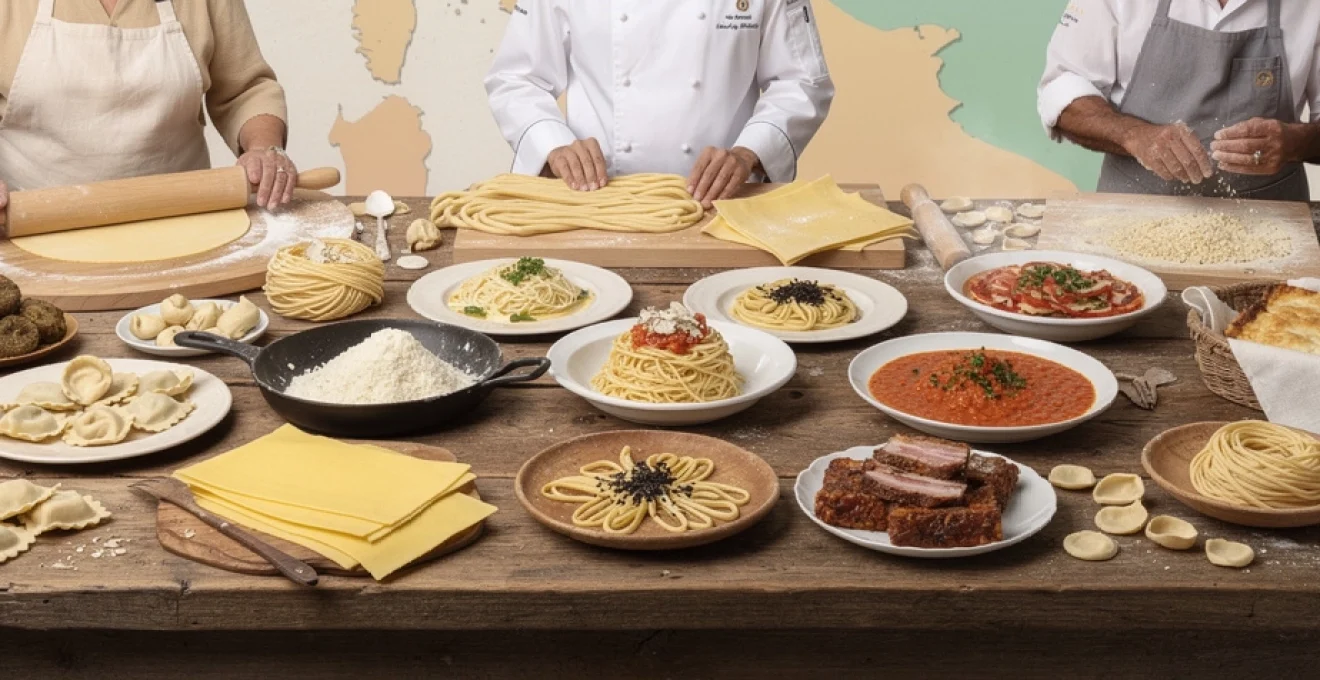
Italian pasta represents far more than simple sustenance—it embodies centuries of culinary evolution, regional identity, and cultural heritage. From the sun-drenched hills of Sicily to the Alpine valleys of Piedmont, each of Italy’s twenty regions has developed distinctive pasta traditions that reflect local ingredients, historical influences, and geographical characteristics. Understanding these regional variations offers insight into Italy’s remarkable gastronomic diversity, where a seemingly simple dish of flour and water transforms into hundreds of unique shapes, sauces, and preparations.
The pasta landscape of Italy reveals a fascinating north-south divide. Northern regions traditionally favour fresh egg pasta made with soft wheat flour, while southern areas predominantly use dried semolina pasta crafted from durum wheat. This fundamental distinction arose from agricultural realities: soft wheat thrives in the cooler, wetter northern climate, whereas hard durum wheat flourishes in the hot, dry Mediterranean south. Beyond these broad patterns, countless micro-regional variations exist, with neighbouring towns sometimes claiming entirely different pasta specialties.
Historical origins of regional italian pasta traditions and denominazione di origine protetta (DOP) classifications
The history of pasta in Italy stretches back to ancient times, with references to laganum—flat sheets of dough—appearing in Roman texts as early as the 1st century AD. However, the pasta we recognise today began evolving during the Middle Ages, particularly after the introduction of durum wheat cultivation in southern Italy. By the 13th century, dried pasta had become a Sicilian specialty, with the island’s Arab influences contributing techniques for drying pasta that enabled long-term storage and transportation.
The Renaissance period witnessed significant refinements in pasta-making techniques, particularly in wealthy northern courts where elaborate filled pastas became symbols of culinary sophistication. Cities like Bologna, Ferrara, and Mantua developed distinct filled pasta traditions that showcased local ingredients and culinary artistry. These preparations were often reserved for festive occasions and demonstrated the wealth and status of noble families who could afford expensive ingredients like meat, cheese, and exotic spices.
Today, Italy protects its traditional pasta preparations through the Denominazione di Origine Protetta (DOP) and Indicazione Geografica Protetta (IGP) certification systems. These designations guarantee that specific pasta products are produced in defined geographical areas using traditional methods and ingredients. For example, Pasta di Gragnano IGP must be made in the Gragnano area near Naples using specific bronze dies and slow-drying methods. Similarly, several traditional filled pastas have obtained recognition, ensuring their recipes and production methods remain authentic and traceable to their regions of origin.
The establishment of these protected designations has become increasingly important in an era of industrial food production. They preserve centuries-old techniques that might otherwise disappear, support local economies, and educate consumers about authentic Italian culinary heritage. Currently, approximately fifteen pasta products hold DOP or IGP status, with applications for additional recognitions pending as regions seek to protect their unique pasta traditions from imitation and dilution.
Northern italy’s Egg-Based fresh pasta: from Emilia-Romagna’s tagliatelle al ragù to piedmont’s agnolotti del plin
Northern Italian pasta traditions centre on pasta fresca all’uovo—fresh egg pasta made from soft wheat flour and eggs. The rich, golden dough created from this combination produces tender, delicate pasta that pairs beautifully with the region’s cream-based sauces, butter preparations, and meat ragùs. The higher proportion of eggs in northern pasta dough—sometimes using only egg yolks—creates a luxurious texture and vibrant colour that distinguishes these preparations from their southern counterparts.
Emilia-romagna’s sfoglia technique: crafting tagliatelle, tortellini, and lasagne alla bolognese
Emilia-Romagna stands as Italy’s undisputed pasta capital, with Bologna alone claiming over thirty registered pasta recipes at its Chamber of Commerce. The foundation of this pasta tradition is the sfoglia—a thin sheet of egg pasta dough rolled by hand using a long wooden rolling pin called a mattarello. Mas
sime sfogline (pasta makers) still insist can never be replicated by machines. The classic ratio in much of Emilia-Romagna is roughly 1 medium egg for every 100 grams of 00 flour, though Bolognese “golden” doughs may include extra yolks for richness. The dough is kneaded until elastic, then rested and rolled into an almost translucent sheet; local lore says perfect sfoglia is thin enough that you can see Bologna’s Basilica di San Luca through it when held to the light.
From this single sheet, an entire universe of regional pasta shapes emerges. Tagliatelle are cut into ribbons precisely 8 mm wide after cooking, an official measurement preserved in Bologna’s Chamber of Commerce. They are traditionally served with ragù alla bolognese, a slow-simmered meat sauce based on soffritto, finely ground beef and pork, wine, and a touch of tomato, cooked for hours until thick and velvety. The same dough becomes tortellini, tiny navel-shaped parcels filled with a mixture of pork loin, mortadella, prosciutto, Parmigiano Reggiano, and nutmeg, most classically served in brodo—in rich capon or beef broth—especially at Christmas and on feast days.
Lasagne alla bolognese represents the region’s layered expression of egg pasta. Sheets of green or yellow sfoglia are alternated with ragù and silky besciamella (béchamel sauce), then baked until bubbling and browned at the edges. Unlike Italian-American versions heavy on mozzarella, traditional Emilia-Romagna lasagne relies on Parmigiano Reggiano for salinity and structure. If you want to cook authentic northern Italian pasta at home, mastering the sfoglia technique is an excellent starting point: the same dough, rolled thinner or thicker, can be adapted to countless traditional shapes.
Lombardy’s filled pasta heritage: casoncelli bergamaschi and tortelli di zucca mantovani
Lombardy’s pasta traditions reflect its status as a crossroads between the Alps and the Po Valley, with hearty filled pastas that blur the line between peasant ingenuity and courtly refinement. In the province of Bergamo, casoncelli bergamaschi are a beloved specialty: half-moon or candy-wrapper-shaped pasta filled with a savoury-sweet mixture of beef or pork, breadcrumbs, Grana Padano, pear or raisin, and sometimes amaretti biscuits. This apparently surprising combination mirrors the sweet-savoury balance found in many Renaissance dishes and showcases Lombardy’s historic love of delicate contrasts.
Casoncelli are typically dressed “alla bergamasca” with melted butter, crispy sage, and grated cheese—an excellent example of how northern Italian pasta dishes often rely on butter rather than olive oil. Further south in Mantua, tortelli di zucca illustrate the region’s affinity for pumpkin and squash. These large, rectangular or crescent-shaped tortelli are filled with roasted squash, mostarda di frutta (a spicy-sweet candied fruit condiment), amaretti, and Grana Padano, then served with browned butter and sage. The result is a dish that’s at once earthy, aromatic, and slightly sweet, making it a favourite for autumn and winter feasts.
For home cooks interested in traditional Italian pasta dishes by region, Lombardy’s filled pastas are a reminder that “authentic” Italian food is rarely simplistic. While these recipes use humble ingredients like breadcrumbs and leftover meat, the flavour profile is layered and complex. When you prepare casoncelli or tortelli di zucca, it helps to think like a Lombard cook of the past: nothing goes to waste, and sweetness is not the enemy of savouriness, but its complement.
Veneto’s bigoli con L’Anatra and the bronze die extrusion method
In Veneto, particularly around Vicenza and Padua, one of the most emblematic regional pastas is bigoli, a thick, rough spaghetti-like noodle made from whole-wheat or soft-wheat flour, eggs, and sometimes buckwheat. Traditionally, bigoli dough is extruded through a hand-operated press called a bigolaro, using a bronze die that gives the pasta a coarse surface. This texture is not just aesthetic; it functions like a sponge, clinging to rich, emulsified sauces far better than smooth industrial spaghetti could.
One of the most classic preparations is bigoli con l’anatra, in which the pasta is dressed with slow-cooked duck ragù, often made from the entire bird, including the liver and giblets for depth of flavour. Another historic version, bigoli in salsa, pairs the noodles with a sauce of slow-sweated onions and salt-cured anchovies. Both dishes demonstrate how Venetian pasta evolved to make the most of preserved ingredients—salted fish, long-keeping onions, and rendered duck fat—ideal for a region historically focused on trade and seasonal scarcity.
The bronze-die extrusion method used for bigoli is essentially the same technique behind many IGP-certified dried pastas across Italy, including the famed pasta di Gragnano from Campania. When pasta is pushed through bronze rather than Teflon, it emerges with a matte, porous surface that cooks more evenly and binds better with sauce. If you’ve ever wondered why certain spaghetti dishes in Italy taste so much more satisfying than their supermarket counterparts at home, that slightly abrasive, bronze-extruded texture is a big part of the answer.
Piedmont’s tajarin with white truffle and traditional pinched agnolotti
Piedmont, at the foot of the Alps, is renowned for both its wines and its luxurious pasta dishes, many of which make lavish use of eggs. Tajarin (or tagliolini in standard Italian) are ultra-fine ribbons of egg pasta, sometimes made with as many as 30–40 egg yolks per kilogram of flour. This colossal yolk content produces a vividly golden, almost custard-like noodle that cooks in seconds and boasts a rich, silky bite. During truffle season, the most iconic preparation is tajarin al tartufo bianco, where the pasta is simply dressed with butter and Parmigiano, then showered with paper-thin shavings of Alba white truffle at the table.
Alongside tajarin, Piedmont’s other great contribution to regional Italian pasta is agnolotti del plin. The term “plin” means “pinch” in local dialect, referring to the way the cook pinches the pasta sheet around the filling to create compact, rectangular parcels. Traditional fillings include a mixture of roasted meats (often beef, pork, and rabbit), greens, and cheese, all finely minced. Agnolotti can be served in broth, with a light meat jus, or simply tossed in butter and sage. In wine-producing areas like Langhe and Monferrato, it’s not uncommon to finish them al tovagliolo, served plain on a napkin so you can appreciate the flavour of the filling by itself.
If you’re exploring traditional Italian pasta dishes by region, Piedmont is where the line between everyday nourishment and high gastronomy becomes very thin. Both tajarin and agnolotti exemplify how a basic dough of flour and eggs can become, with technique and exceptional local ingredients, a vehicle for some of Italy’s most refined flavours.
Central italy’s artisanal durum wheat pastas: lazio’s cacio e pepe to tuscany’s pici all’aglione
Moving into central Italy, we encounter a bridge zone where both egg pasta and durum wheat pasta coexist. In Lazio, Umbria, Tuscany, and Marche, traditional Italian pasta dishes often favour robust, chewy shapes that stand up to assertive, peppery, or game-based sauces. While fresh egg pasta is by no means absent, especially in Tuscany and Marche, many iconic preparations here are based on simple doughs of semolina or flour and water, rolled or extruded by hand.
Lazio’s iconic roman quartet: carbonara, amatriciana, gricia, and cacio e pepe techniques
Rome’s pasta canon—often referred to as the “Roman quartet”—is a masterclass in doing more with less. Cacio e pepe, gricia, amatriciana, and carbonara all rely on a small, overlapping set of ingredients: pecorino romano, black pepper, guanciale (cured pork jowl), eggs, tomatoes, and high-quality durum wheat pasta. Yet each dish yields a completely distinct flavour and texture, underscoring how technique drives authenticity in regional Italian pasta dishes.
Cacio e pepe might appear simple—just cheese, pepper, and pasta—but achieving a creamy, lump-free emulsion is something many cooks struggle with. The key is to combine finely grated pecorino with a small amount of starchy pasta water at a moderate temperature, whisking until it forms a smooth paste before tossing with just-drained pasta. Think of it like tempering chocolate: if the mixture gets too hot, the fats separate and you end up with a grainy sauce.
Gricia is often described as “carbonara without eggs” or “amatriciana without tomato”. It pairs crisped guanciale with pecorino and black pepper, relying again on pasta water to create a silky coating. Amatriciana adds tomato (traditionally San Marzano) to the same base of guanciale and pecorino; it was born in the town of Amatrice in northern Lazio and is classically served with bucatini. Finally, carbonara incorporates egg yolks (and sometimes whole eggs) into a hot emulsion of pecorino, guanciale fat, and pasta water to create a glossy, custard-like sauce. True Roman carbonara never includes cream; the luxurious texture comes purely from controlling temperature and timing so that the eggs thicken without scrambling.
For anyone cooking Italian pasta at home, mastering these four Roman sauces is like learning the primary colours of central Italian cuisine. Once you understand how pecorino, guanciale, and pasta water interact, you can troubleshoot common issues—like clumpy cheese or greasy sauce—and replicate restaurant-level results in your own kitchen.
Tuscany’s Hand-Rolled pici and pappardelle al cinghiale with wild boar ragù
Tuscan pasta expresses the region’s rustic, land-focused character. In the hill towns around Siena, Montepulciano, and Pienza, you’ll find pici, a thick, hand-rolled spaghetti traditionally made with just flour, water, and a touch of olive oil. Each strand is irregular, slightly different in diameter and length, which gives the dish a handmade charm and a pleasantly chewy bite. Pici are often served all’aglione, with a slow-cooked sauce of tomato and a local, mild garlic variety called aglione della Valdichiana, or cacio e pepe-style with pecorino and pepper.
Alongside pici, wide ribbons of pappardelle are quintessentially Tuscan, especially when paired with game. Pappardelle al cinghiale features slow-braised wild boar ragù scented with juniper, bay, and red wine. The broad surface area of the noodles allows them to carry generous amounts of sauce, which is exactly what you want when the ragù has simmered for three or four hours. It’s a great example of how central Italian pasta shapes are designed with their sauces in mind: thin angel-hair would simply disappear under such a robust preparation.
If you like making pasta by hand, Tuscan pici are surprisingly accessible—you don’t need a machine or a rolling pin, just patience and a good sense of touch. Rolling each strand is almost meditative, and because the dough contains no egg, it is forgiving and inexpensive. For many home cooks exploring traditional Italian pasta dishes by region, pici offer an approachable way to experience true artisanal pasta-making.
Umbria’s strangozzi al tartufo nero di norcia and umbricelli pasta varieties
Umbria, often called Italy’s “green heart”, is famous for its black truffles, cured meats, and robust country cooking. Its signature pastas—strangozzi (or stringozzi) and umbricelli—are long, square-edged noodles made from just flour and water, similar to Tuscan pici but generally thinner. The name strangozzi is sometimes linked to the verb strangolare (“to strangle”), possibly recalling the cords historically used by political rebels, though etymologists continue to debate the story.
One of the most celebrated dishes is strangozzi al tartufo nero di Norcia, in which the pasta is tossed with garlic-infused olive oil and generous shavings of Umbrian black truffle. Compared to the explosive aroma of Piedmont’s white truffle, Norcia’s black truffle offers a more earthy, mushroom-like fragrance that stands up well to gentle cooking. Another common preparation is umbricelli al sugo di carne, with a slow-cooked meat sauce made from beef or mixed meats, echoing the region’s deep tradition of countryside stews.
For those interested in cooking regional Italian pasta dishes at home, strangozzi and umbricelli illustrate how much character you can coax from a very simple dough. Because they’re made without egg, these pastas pair well with strong flavours like truffle, sausage, or hearty ragù, offering a neutral but substantial base much like artisan bread complements robust cheeses.
Marche’s vincisgrassi: the ancestral lasagne with béchamel and chicken liver
In the Marche region, along the Adriatic coast, the most emblematic baked pasta is vincisgrassi, a rich, multi-layered dish that pre-dates and likely influenced the better-known lasagne of Emilia-Romagna. Traditionally associated with the cities of Macerata and Ancona, vincisgrassi consists of thin egg pasta sheets layered with a complex ragù, béchamel, and grated cheese. What sets it apart is the sauce: instead of using only ground meat, the ragù often includes offal such as chicken livers, sweetbreads, and sometimes veal brain, combined with pork and beef.
The result is a deeply savoury, almost pâté-like sauce that gives vincisgrassi its distinctive flavour and texture. Historically, this dish was reserved for feast days and important celebrations, when families could afford to slaughter animals and use every part. Modern recipes sometimes tone down the offal content to suit contemporary tastes, but in traditional trattorie you can still find the full, old-fashioned version. Béchamel, made from butter, flour, and milk, adds creaminess and helps bind the layers, much as in lasagne alla bolognese, yet the flavour profile remains uniquely Marchigiano.
Vincisgrassi is a good reminder that when we talk about “classic” Italian pasta dishes, we’re often looking at the end point of centuries of local experimentation. If you’re planning an Italian pasta road trip, tasting vincisgrassi alongside lasagne in Emilia-Romagna can be a fascinating way to compare how two neighbouring regions interpret the same basic idea—baked pasta with meat and béchamel—in distinct ways.
Southern italy and islands’ semolina extruded pasta: from campania’s scialatielli ai frutti di mare to puglia’s orecchiette con cime di rapa
In southern Italy and on the islands, the pasta story shifts decisively toward durum wheat semolina and dried, extruded shapes. The hotter, drier climate is ideal for cultivating durum wheat, and centuries of experience in drying pasta outdoors on racks have led to some of the world’s finest dried pasta traditions. Here, you’ll encounter bold sauces based on tomatoes, garlic, olive oil, chilies, and seafood, with shapes designed to trap these robust condiments.
Campania’s pasta di gragnano IGP: paccheri, ziti, and spaghetti alle vongole verace
Campania, with Naples as its capital, is the birthplace of much of the dried pasta we know today. The town of Gragnano, in particular, has been recognized with Indicazione Geografica Protetta (IGP) status for its pasta di Gragnano. To earn this designation, producers must use high-protein durum wheat semolina, extrude the dough through bronze dies, and dry the pasta slowly at low temperatures—often for up to 24–48 hours. This method preserves aroma and ensures a firm, elastic bite when cooked al dente.
Among Campania’s many shapes, paccheri (large tubes), ziti (long, hollow rods traditionally broken by hand before cooking), and classic spaghetti are especially important. Paccheri pair beautifully with chunky seafood condiments or rich ragù napoletano; their wide openings act like little cups, holding sauce and morsels of meat or fish. Ziti are integral to Sunday baked dishes like ziti al forno, layered with ragù, mozzarella, and ricotta. Meanwhile, spaghetti alle vongole verace is perhaps Campania’s most iconic seafood pasta, combining clams, garlic, white wine, parsley, and chili with perfectly cooked spaghetti.
Another Campanian speciality, scialatielli, highlights the region’s creativity with fresh semolina pasta. These short, irregular strips—often enriched with milk and cheese in the dough—are famously served ai frutti di mare, with mixed shellfish and crustaceans along the Amalfi Coast. If you’ve ever wondered why a simple plate of spaghetti with clams or paccheri with tomato sauce tastes so extraordinary in Naples, the answer lies not only in the local seafood and San Marzano tomatoes but also in the quality of the IGP-certified pasta itself.
Puglia’s Hand-Shaped orecchiette and cavatelli with turnip tops and anchovies
In Puglia, the heel of Italy’s boot, pasta-making is still very much a hands-on, domestic art. The region’s signature shape, orecchiette (“little ears”), is formed by dragging small pieces of semolina dough across a wooden board with a knife or thumb, then turning them inside-out to create concave discs. Narrow, shell-like cavatelli are made by pressing and dragging small cylinders of dough with three fingers or the edge of a knife. Both shapes have thick centres and thinner edges, which helps them cook evenly while holding onto sauce.
The most traditional Apulian dish is orecchiette con cime di rapa, pairing the pasta with turnip tops (or broccoli rabe), garlic, anchovies, and chili. The bitterness of the greens, the umami of the anchovies, and the heat of the pepper are balanced by fruity local olive oil and the sweet nuttiness of the durum wheat. It’s a perfect example of how southern Italian pasta dishes transform a few inexpensive ingredients into something deeply satisfying. Cavatelli often appear with tomato and ricotta forte (a tangy, fermented ricotta), seafood, or simple garlic and oil.
If you’re keen to try authentic Italian pasta dishes by region at home, orecchiette are a rewarding project. The dough is just semolina and water, and while shaping each “ear” takes practice, the technique is easy to learn. Many cooks describe the process as almost therapeutic, much like rolling Tuscan pici—a reminder that pasta in Italy is as much about the act of making as it is about eating.
Sicily’s pasta alla norma with ricotta salata and busiate trapanesi al pesto di trapani
Sicily’s pasta traditions bear the imprint of Greek, Arab, and Spanish influences, resulting in bold flavours and a love of sweet-savoury contrasts. One of the island’s most famous dishes is pasta alla Norma, originating from Catania and named, legend has it, after Bellini’s opera “Norma”. It combines fried eggplant, tomato sauce, basil, and grated ricotta salata (a firm, salted ricotta) over short pasta such as maccheroni or rigatoni. The dish captures the essence of Sicilian summer: ripe tomatoes, fragrant basil, and silky eggplant, all elevated by the salty tang of the cheese.
On the western side of the island, particularly around Trapani, you’ll encounter busiate, a spiral-shaped pasta traditionally formed by wrapping strands of dough around a thin rod. Busiate are classically served with pesto alla trapanese, a Sicilian counterpart to Ligurian pesto. Instead of pine nuts, it uses almonds; instead of only basil, it includes fresh tomatoes; garlic and olive oil tie everything together. The result is a chunky, aromatic sauce that clings perfectly to the spirals of the pasta.
Sicilian pasta often incorporates ingredients like raisins, pine nuts, fennel, and sardines—as in pasta con le sarde—reflecting centuries of maritime trade. For cooks interested in exploring regional Italian pasta dishes by region, Sicily offers some of the most flavour-dense and visually striking recipes, ideal for late-summer produce and generous, family-style meals.
Sardinia’s culurgiones d’ogliastra and fregola sarda con arselle
Sardinia’s relative isolation has preserved a distinct culinary identity, including unique pasta shapes rarely seen on the mainland. Culurgiones d’Ogliastra are a type of filled pasta resembling plump wheat sheaves or decorative pouches, sealed with an intricate, braided closure. The filling typically combines potatoes, pecorino sardo, mint, and sometimes garlic or onion, creating a surprisingly refined, almost gnocchi-like interior. Culurgiones are usually served simply, with tomato sauce and grated pecorino, allowing the delicate dough and aromatic filling to shine.
Another Sardinian specialty, fregola sarda, sits somewhere between pasta and grain. These small, irregular beads of toasted semolina are made by rubbing dampened semolina in a large terracotta bowl until tiny balls form, then drying and oven-toasting them for a nutty flavour. One of the most traditional dishes is fregola con arselle, in which the fregola is simmered like risotto in a broth with clams, tomatoes, garlic, and saffron. The texture is pleasantly chewy, with the toasted notes of the pasta echoing the smokiness of grilled bread.
If you’re used to thinking of pasta strictly as ribbons and tubes, Sardinia’s culurgiones and fregola expand the definition in exciting ways. Making culurgiones at home can be challenging because of the intricate seal, but even a simplified version gives you a glimpse into the island’s rich, artisanal pasta culture.
Traditional Pasta-Making techniques: brass die extrusion, Hand-Lamination, and slow drying methods
Behind every regional Italian pasta dish lies a set of time-tested techniques that determine texture, flavour, and how well the pasta “holds” its sauce. Three of the most important are hand-lamination (for fresh egg doughs like sfoglia), brass or bronze die extrusion (for dried semolina shapes), and slow, low-temperature drying. Understanding these methods helps you choose better pasta at the store and recreate more authentic results at home.
Hand-lamination, as practiced in Emilia-Romagna and elsewhere, involves rolling dough with a wooden rolling pin rather than using a machine. The wood absorbs a bit of surface moisture and gently compresses the dough, creating microscopic layers that translate into a silky but resilient bite. Many sfogline argue that machine-rolled sheets, while convenient, lack this subtle layered structure and therefore behave differently when cooked. If you’ve ever compared hand-rolled tagliatelle to machine-cut noodles, you may have noticed a difference in how they absorb and cling to sauce.
Extrusion through brass or bronze dies is central to high-quality dried pasta, from Gragnano in Campania to artisan producers in Abruzzo and beyond. When semolina dough is forced through a metal die with a specific shape, it emerges with ridges, curves, and a slightly rough surface. This roughness is like the texture of well-sanded wood versus plastic: it provides microscopic nooks where sauce can settle. Cheaper, industrial pastas often use Teflon-coated dies that yield smooth, glassy surfaces; they may look pretty but are less effective at capturing sauce.
The drying process is equally crucial. Traditional producers dry pasta slowly at relatively low temperatures (often below 60°C / 140°F), sometimes for days. This preserves the flavour of the wheat and prevents the starches and proteins from becoming overly denatured, which could lead to mushy or gummy textures when cooked. Fast industrial drying at high temperatures can cut production time dramatically but often at the cost of flavour complexity and structural integrity. When you see references to IGP designations like pasta di Gragnano, slow drying and bronze extrusion are usually part of what’s being protected.
Authentic regional sauces and condiments: ragù napoletano, sugo all’amatriciana, and pesto genovese DOP
Of course, pasta is only half of the story; the sauces and condiments that accompany it are just as regional and codified. From the long-simmered meat sauces of the south to the minimalist emulsions of central Italy and the aromatic herb-based condiments of the north, each sauce is designed with particular shapes and textures in mind. Three of the most instructive examples are ragù napoletano, sugo all’amatriciana, and pesto genovese DOP.
Ragù napoletano, distinct from Bolognese ragù, is a tomato-forward meat sauce traditionally cooked in Neapolitan households on Sundays. Large cuts of beef and pork (and sometimes braciole—rolled, stuffed meat parcels) are browned, then slowly braised for hours in a rich tomato sauce scented with wine, onions, and herbs. The meat is typically served separately as a second course, while the thickened, intensely flavoured sauce dresses pasta such as ziti or paccheri. In this way, one pot of ragù feeds the family across multiple courses, a clever example of how southern Italian cooking maximizes resources.
Sugo all’amatriciana, which we met earlier in the context of Lazio, illustrates how specific and protected a simple sauce can be. The town of Amatrice insists on guanciale (not pancetta), white wine to deglaze, chili, pecorino, and tomatoes—ideally San Marzano from nearby Campania. The traditional pairing is with bucatini or spaghetti, whose hollow or cylindrical shape captures the glossy, pork-enriched sauce. Small deviations, such as using smoked bacon or omitting pecorino, may produce a delicious dish but would no longer qualify as authentic amatriciana.
Finally, in Liguria, pesto genovese DOP is one of the most tightly regulated condiments in Italy. To bear the DOP label, it must be made with specific ingredients: Genovese DOP basil, extra virgin olive oil from the Ligurian Riviera, Parmigiano Reggiano and/or Grana Padano, Pecorino Fiore Sardo, pine nuts, garlic from Vessalico, and coarse salt. Traditionally, these ingredients are ground in a marble mortar with a wooden pestle, not blended in a food processor. The friction is gentle enough to avoid heating the basil, which could darken and turn bitter. Pesto is classically served with trofie or trenette and often accompanied by potatoes and green beans boiled in the same water as the pasta.
When you next sit down to a plate of pasta—whether it’s spaghetti alle vongole in Campania, tajarin al tartufo in Piedmont, or orecchiette con cime di rapa in Puglia—you’re tasting far more than a comforting carbohydrate. You’re experiencing a specific intersection of geography, history, technique, and protected tradition. By learning how each Italian region approaches its pasta and sauces, you gain not only new recipes for your kitchen but also a deeper appreciation for one of the world’s most intricate and beloved culinary cultures.