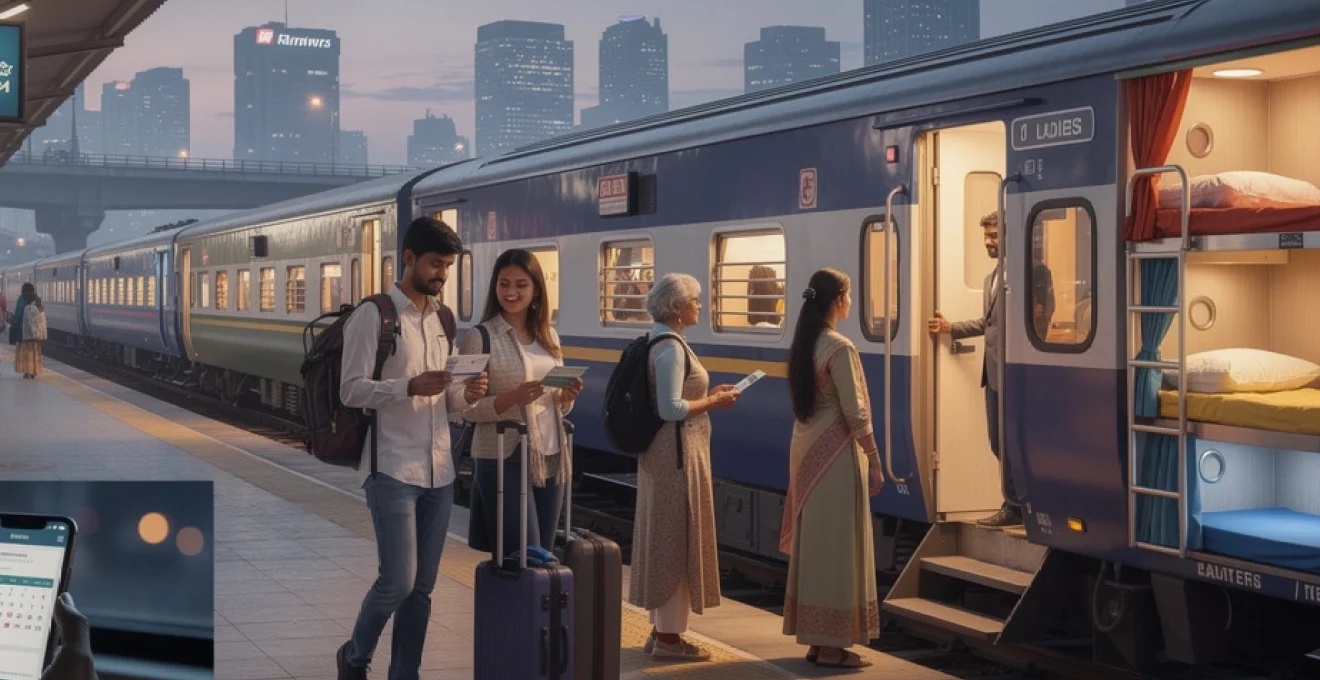
Navigating India’s extensive railway network can transform your travel experience from ordinary sightseeing into an authentic cultural immersion. With over 63,000 kilometres of track connecting 6,800 stations, Indian Railways operates one of the world’s most comprehensive rail networks, transporting 23 million passengers daily. The overnight train system offers travellers a unique opportunity to cover vast distances while experiencing the rhythm of Indian life, from bustling metropolitan cities to remote rural stations.
The sheer diversity of overnight train services can initially overwhelm first-time visitors. From luxurious air-conditioned compartments with private washbasins to budget-friendly sleeper class berths where windows open to reveal panoramic countryside views, India’s railway system caters to every comfort level and budget. Understanding these options becomes crucial for maximising both your comfort and cultural experience during extended journeys across the subcontinent.
Modern Indian Railways has evolved significantly from its colonial origins, incorporating advanced reservation systems, improved safety protocols, and enhanced passenger amenities. Yet it retains the authentic charm that makes train travel through India an adventure unlike anywhere else in the world. The experience extends far beyond mere transportation, offering opportunities for spontaneous conversations with fellow passengers, sampling regional cuisine from platform vendors, and witnessing India’s diverse landscapes unfold at ground level.
Indian railway overnight train categories and classification systems
Indian Railways operates a sophisticated hierarchy of train services, each designed to serve specific passenger demographics and route requirements. The classification system reflects both historical development and modern passenger expectations, creating distinct service levels that range from basic transportation to premium travel experiences. Understanding these categories becomes essential for selecting appropriate services that match your comfort requirements, budget constraints, and journey duration.
Rajdhani express premium AC services and route networks
Rajdhani Express trains represent the pinnacle of Indian Railways’ overnight services, connecting New Delhi with major state capitals and metropolitan centres. These fully air-conditioned trains maintain strict punctuality standards and offer the most comprehensive onboard amenities available on the network. Rajdhani literally translates to “capital” in Hindi, reflecting their primary function of linking the national capital with regional administrative centres.
The service operates on a hub-and-spoke model, with most routes originating from New Delhi and extending to cities like Mumbai, Kolkata, Chennai, and Bangalore. Journey times typically range from 14 to 28 hours, making them ideal for overnight travel between distant cities. The trains feature German-designed LHB (Linke Hofmann Busch) coaches that provide superior ride quality, reduced noise levels, and enhanced safety features compared to conventional Indian Railway rolling stock.
Meal service on Rajdhani Express trains includes breakfast, lunch, evening tea, and dinner, all served at passengers’ seats by uniformed attendants. The catering quality generally exceeds standard railway dining, featuring both vegetarian and non-vegetarian options prepared in dedicated pantry cars. Premium berths in AC First Class include personal attendant service, while AC Two-Tier and Three-Tier passengers receive standardised meal service as part of their ticket price.
Shatabdi express Day-Night hybrid operations
Shatabdi Express trains primarily operate as daytime services but include several routes with evening departures that extend into overnight journeys. These trains focus on inter-city connectivity between major commercial and tourist destinations, typically covering distances of 400 to 800 kilometres. The name Shatabdi commemorates the centenary of Jawaharlal Nehru’s birth, with the first service launching in 1988.
Unlike purely overnight services, Shatabdi trains emphasise speed and frequency rather than sleeping accommodation. However, certain routes like the Delhi-Kalka Shatabdi offer comfortable seating that can accommodate overnight travel for passengers willing to sleep upright. The trains exclusively feature air-conditioned chair car accommodation arranged in Executive Chair Class and standard Chair Car configurations.
Passenger amenities on Shatabdi services include complimentary meals, beverages, and reading materials, creating a premium travel experience despite the absence of sleeping berths. The trains achieve higher average speeds than conventional services through fewer intermediate stops and priority scheduling on busy route sections. Modern Shatabdi trains incorporate advanced features like GPS-based passenger information systems, bio-toilets, and improved lighting systems.
<h3
Duronto non-stop long-distance overnight services
Duronto Express trains were introduced to provide faster, almost non-stop connectivity between major cities, reducing overall journey times for long-distance travelers. The word Duronto means “restless” or “quick” in Bengali, reflecting their limited-stop operating pattern. These trains typically run point-to-point between origin and destination, with only technical halts for crew changes and operational requirements rather than normal passenger stops.
From an overnight travel perspective, Duronto services are particularly valuable on busy corridors such as Mumbai–Kolkata, Delhi–Kolkata, and Delhi–Secunderabad. Their timetables are designed to maximise sleeping hours, with late evening departures and morning or midday arrivals. Onboard accommodation mirrors that of Rajdhani Express trains, usually offering AC First Class, AC Two-Tier, AC Three-Tier, and in some cases Sleeper Class, all using modern LHB coaches for improved safety and ride comfort.
Unlike many Mail and Express trains, Duronto fares are inclusive of meals on AC classes, and catering quality is broadly comparable with Rajdhani standards. Because they skip intermediate commercial stops, Duronto trains are less suitable if you want to embark or disembark at secondary cities along the route. However, if your goal is the fastest possible overnight journey between two metros with minimal disruption, they are among the best options in the Indian railway network.
Mail express traditional overnight train classifications
Mail and Express trains form the backbone of Indian Railways’ long-distance overnight network, serving thousands of intermediate stations across the country. Historically, Mail trains carried postal consignments in dedicated coaches, while Express trains focused on passenger traffic with higher average speeds than local passenger services. In practice, both categories now function similarly as multi-stop long-distance trains with a mix of reserved and unreserved accommodation.
For most budget-conscious travellers, overnight Mail/Express services are the default choice, offering a wide range of classes from non‑AC Sleeper to AC First Class, depending on the route. They are particularly useful when you need to access smaller cities and regional hubs that premium trains bypass. Schedules can be longer and more prone to delays compared with Rajdhani and Duronto services, especially on congested corridors.
When booking overnight trains in India, you will encounter a large number of Mail and Express options for popular routes such as Delhi–Varanasi, Mumbai–Goa, or Chennai–Madurai. Evaluating their suitability involves checking journey duration, departure and arrival times, and available classes. If you are comfortable with a slightly less polished onboard experience, these trains provide good value and authentic interaction with local passengers, especially in Sleeper Class and lower AC tiers.
Sleeper class accommodation types and berth allocation mechanisms
Overnight trains in India offer several sleeper accommodation types, each with its own configuration, privacy level, and pricing. The Indian Railways booking system handles berth allocation centrally, assigning specific berth numbers to each passenger during the charting process. Understanding how these berths are arranged within coaches helps you interpret your ticket and make strategic decisions when selecting classes for overnight journeys.
AC first class private coupe compartment features
AC First Class (often shown as 1A or AC1) represents the highest level of comfort on standard overnight trains in India. Coaches are divided into lockable compartments, typically configured as two-berth coupés and four-berth cabins, all fully air-conditioned. Each compartment offers generous luggage space, soft bedding, reading lights, and often a washbasin, providing a degree of privacy that rivals mid-range hotel rooms on rails.
Berth allocation in AC First Class follows a charting algorithm that attempts to group passengers logically: couples are often placed in two-berth coupés, while families and single travellers are allocated to four-berth cabins. However, specific compartment type (two-berth versus four-berth) cannot be guaranteed during booking; it is only finalised when charts are prepared a few hours before departure. If you are a solo traveller who prioritises privacy, AC First Class offers the best opportunity to share with fewer people, although you should still be prepared to meet cabin-mates.
Because AC First Class is significantly more expensive than other options, coaches usually contain only a small number of seats relative to overall train capacity. This makes advance booking critical on heavily travelled routes. For long overnight journeys—such as Delhi–Kolkata or Mumbai–Delhi—AC First Class can be a worthwhile investment, especially if you value quiet surroundings, secure storage, and the ability to lock your compartment at night.
AC two-tier and three-tier berth configuration systems
AC Two-Tier (2A) and AC Three-Tier (3A) are the most popular options for travellers seeking a balance between cost and comfort on overnight trains in India. Both classes are air-conditioned and use an open-plan layout, but they differ in how many berths are stacked vertically in each bay. In AC Two-Tier, berths are arranged in pairs (upper and lower), creating bays of four berths across the width of the coach and two longitudinal berths along the aisle. AC Three-Tier adds a middle berth to each stack, producing bays of six plus two longitudinal berths, which increases capacity but reduces vertical space between berths.
Berth allocation within AC Two-Tier and AC Three-Tier follows a standardised numbering scheme. For example, in a typical six-berth bay in 3A, berth numbers might run from 1 to 6 for the transverse berths and 7–8 for the side berths along the corridor. When you receive your ticket, codes like SL (side lower), SU (side upper), or UB (upper berth) indicate your assigned position. Many travellers prefer lower or side lower berths for ease of access, while upper berths offer slightly more privacy once you are settled.
From an overnight comfort perspective, AC Two-Tier provides more headroom and fewer people per bay, reducing noise and foot traffic. AC Three-Tier is more economical and widely available, making it a good choice for budget travellers and small groups. Regardless of class, bedding sets—typically including two sheets, a blanket, and a pillow—are provided in sealed packets on most overnight AC services. If you are tall or prefer to stretch out, transverse berths (those running across the width of the coach) generally feel more spacious than longitudinal side berths.
Sleeper class non-AC compartment layout specifications
Sleeper Class (SL) is the most widely used overnight accommodation on Indian Railways, offering reserved berths without air-conditioning. Layouts mirror AC Three-Tier, with six-berth bays across the coach and two side berths along the corridor. The absence of sealed windows and climate control means you experience the outside air directly—pleasant in cooler seasons, but potentially challenging during peak summer or the humid monsoon months.
Berths in Sleeper Class do not come with complimentary bedding, so you should bring your own sleeping bag or travel sheet, along with a light blanket or shawl if travelling in winter. Ceiling fans and open windows help with ventilation, but dust and noise levels will be higher than in AC coaches. That said, many travellers value Sleeper Class for its social atmosphere and uninterrupted views of the countryside, which are sometimes obscured by tinted AC windows.
Because Sleeper Class coaches often carry large numbers of passengers and may see occasional crowding near doors and toilets, you should be prepared for a less controlled environment. For first-time visitors to India, Sleeper Class can be an eye-opening and rewarding experience if approached with realistic expectations and basic precautions, such as keeping valuables close and using a chain and padlock to secure larger bags under the lower berths.
Ladies special compartment booking protocols
To enhance safety and comfort for women travellers, Indian Railways designates specific berths or entire bays as Ladies or Women Only quotas on many overnight trains. These allocations exist primarily in Sleeper Class and AC Three-Tier, where demand from solo female passengers and women with children is highest. When booking through the IRCTC portal, selecting the appropriate gender and, where applicable, the Ladies quota flag increases the likelihood of being placed in these dedicated sections.
The underlying allocation mechanism aims to group women travellers together in the same bay or neighbouring berths. For example, if several female passengers book under the Ladies quota on a given train, the system attempts to fill one six-berth bay with them rather than dispersing them across the coach. This reduces the likelihood of women sharing close quarters with unrelated male passengers overnight, particularly in Sleeper Class.
It is important to note that Ladies quota berths are limited and can sell out quickly during peak travel periods. Additionally, the system may relax strict quota rules close to departure time if berths remain unclaimed and there is high demand from other passengers. If you are a solo female traveller concerned about overnight train safety in India, combining the Ladies quota with a top berth selection (where possible) and travelling in AC Two-Tier or Three-Tier can significantly improve both comfort and perceived security.
IRCTC reservation strategies and tatkal booking algorithms
The Indian Railway Catering and Tourism Corporation (IRCTC) manages the online reservation system that underpins most overnight train bookings in India. While the interface appears straightforward, the underlying logic for seat allocation, waitlist management, and last-minute Tatkal tickets is highly sophisticated. Learning how this system works gives you a practical edge when securing berths on popular overnight routes, especially during festivals and holiday seasons.
Advance reservation period optimisation techniques
For most long-distance overnight trains in India, reservations open 60 days before the date of departure, a window known as the Advance Reservation Period (ARP). High-demand services—such as Delhi–Varanasi, Mumbai–Goa, or Kolkata–Darjeeling connections—can see AC classes fill within days, or even hours, of booking opening. If your itinerary is fixed, setting reminders to book as soon as the ARP begins dramatically improves your chances of obtaining confirmed berths in your preferred class.
One effective strategy is to identify your target trains and classes in advance using timetable tools and then monitor availability as soon as the ARP starts. Families and groups should book all passengers under a single PNR (Passenger Name Record) wherever possible, as this allows the algorithm to allocate berths in the same bay or adjacent berths, rather than splitting the group across the coach. For solo travellers, early booking increases the likelihood of securing more desirable berths such as lower or side lower positions in AC Two-Tier and AC Three-Tier.
Because some routes offer multiple overnight options per day, another optimisation technique involves choosing trains whose origin stations are relatively close to your boarding point. For instance, a train that originates in your departure city is less likely to be delayed and offers a better chance of getting your full choice of berths. Conversely, booking short segments on very long-distance trains that started their journey one or two days earlier can expose you to higher delays and more competition for remaining berths.
Tatkal ticket release timing and premium charges
The Tatkal scheme exists to facilitate short-notice travel on fully or nearly fully booked trains, essentially acting as a premium last-minute quota. For most overnight trains in India, Tatkal bookings open one day before the date of departure—excluding the date of travel—typically at 10:00 Indian Standard Time for AC classes and 11:00 for non‑AC classes. These tickets carry a supplementary fee that can range from 10% to 30% of the base fare, making them more expensive than regular quotas but often cheaper than last-minute flights.
Tatkal tickets are highly sought after and can sell out within minutes on busy routes, so precise timing is crucial. Logging into IRCTC a few minutes before Tatkal opening time, pre-filling passenger details, and having payment options ready significantly improves your chances of success. Some travellers liken Tatkal booking to bidding for concert tickets: if you are prepared when the “virtual doors” open, you are far more likely to secure a seat.
It is important to weigh the cost-benefit ratio before relying on Tatkal. While it offers a lifeline for flexible or late-planned itineraries, the higher charges can add up if used frequently. Whenever possible, aim to book during the standard Advance Reservation Period and treat Tatkal as a backup mechanism rather than your primary strategy for securing overnight train reservations in India.
Waitlist confirmation probability calculation methods
Given the immense demand on popular routes, it is common to encounter Waitlisted (WL) status when trying to book overnight trains in India, especially closer to the date of travel. A Waitlisted ticket does not initially guarantee travel; it represents a position in a virtual queue that may move up as other passengers cancel or additional quotas are released. Assessing the likelihood of a Waitlist converting to a confirmed berth involves understanding both historical patterns and the specific train category.
Several third-party tools and apps use historical data to estimate confirmation probability by analysing past trends for the same train, class, and time of year. These tools assign a percentage chance that your current WL number will become CNF (confirmed) before chart preparation. While no prediction can be perfect—much like weather forecasts—they offer a useful indication: a low, single-digit WL number on a major overnight train is far more likely to clear than a high double-digit number on a niche route.
As a practical rule of thumb, Waitlisted numbers below WL 10 or WL 15 in AC classes on busy routes often have good odds of confirmation, particularly during non-peak periods. For higher WL positions, you should consider alternative trains, dates, or classes, or treat the ticket as a calculated risk rather than a certainty. Tracking your PNR status regularly in the days leading up to departure helps you decide when to pivot to backup options, such as buses or different train routes.
RAC status progression and berth allocation logic
Reservation Against Cancellation (RAC) represents a semi-confirmed state in the Indian Railways reservation hierarchy, positioned between Waitlist and fully confirmed (CNF) status. An RAC ticket guarantees you the right to board the train and occupy a seat, but not necessarily a full berth from the outset. Typically, two RAC passengers share a single lower berth, using it as a pair of seats facing each other until cancellations free up additional berths.
As confirmed passengers cancel their tickets or fail to show up, the system automatically upgrades RAC passengers to full berths based on priority order (RAC 1, RAC 2, and so on). This “promotion” can occur anytime up to chart preparation and even after departure, as travelling ticket examiners (TTEs) reconcile no-shows and reassign space. In practice, many RAC passengers do eventually obtain full berths, although the timing can vary from hours before departure to late in the night.
From a planning perspective, RAC status is generally safer than a high Waitlist number for overnight trains in India. You know you can board, and there is a reasonable chance of ending up with a full berth, especially on long routes with high passenger turnover. However, if uninterrupted sleep is crucial—for example, before an early morning business meeting—you may prefer to hold out for a fully confirmed berth or adjust your travel plans to reduce uncertainty.
Major overnight train routes connecting metropolitan cities
India’s metropolitan cities are linked by an intricate network of overnight trains that balance speed, frequency, and coverage. These routes form the backbone of long-distance travel for both residents and visitors, often providing a more sustainable and immersive alternative to domestic flights. Understanding the key corridors helps you design efficient itineraries that combine major urban centres with regional destinations along the way.
On the northern corridor, routes such as Delhi–Varanasi, Delhi–Lucknow, and Delhi–Jammu Tawi are served by a mix of Mail/Express, Rajdhani, and premium overnight services. The Delhi–Mumbai and Delhi–Kolkata stretches, often referred to as part of the “Golden Quadrilateral” of Indian Railways, are particularly well served, with multiple Rajdhani Express, Duronto, and Mail trains offering different levels of comfort and departure times. These sectors are ideal for first-time travellers testing overnight trains in India, as they offer redundancy and flexibility if one service sells out.
In the south, overnight connections such as Chennai–Bangalore, Chennai–Hyderabad, and Bangalore–Mumbai are essential for both business and leisure travel. Many of these routes feature robust AC Two-Tier and Three-Tier availability, making them suitable for travellers seeking mid-range comfort levels. Coastal sectors like Mumbai–Goa and Chennai–Kochi are also popular, especially during holiday seasons, when overnight trains can save you a day of travel while arriving close to beach or backwater destinations.
East–west linkages—such as Mumbai–Kolkata or Ahmedabad–Kolkata—are dominated by longer-duration overnight trains that may take one-and-a-half to two nights, depending on service type. Here, choosing faster categories like Duronto or Rajdhani can make a noticeable difference in total journey time and onboard comfort. When planning multi-city itineraries, it often helps to anchor your schedule around these key overnight corridors and then add shorter day trains or buses to reach secondary destinations.
Essential overnight journey preparation and safety protocols
Successful overnight travel on Indian trains depends as much on preparation as on the class of ticket you book. While the railway system provides the core infrastructure, you are responsible for your own comfort, hygiene, and safety. A well-thought-out packing strategy and a few simple protocols can transform an intimidating experience into a smooth and even enjoyable part of your journey.
At minimum, you should carry a small overnight kit that includes hand sanitiser, wet wipes, toilet paper, a basic first-aid kit, earplugs, and a light scarf or shawl that can double as a blanket. Even in AC classes where bedding is supplied, an extra layer helps if the air-conditioning feels too cold. A compact sleep mask and neck pillow can greatly improve rest, especially if lights stay on longer than expected or you are sensitive to movement.
Security-wise, keeping valuables close to your body is non-negotiable. Use a money belt or internal pocket for passports, cards, and cash, and place your daypack at your head or under your knees while you sleep. Larger backpacks and suitcases can be chained to the berth frame using a small padlock and steel cable, a common practice among seasoned train travellers in India. While theft on reserved overnight coaches is not rampant, these precautions act like locking your front door at home: straightforward steps that significantly reduce risk.
Personal conduct also plays a role in safety and comfort. Dressing modestly, especially in Sleeper Class and lower AC tiers, helps you blend in and reduces unwanted attention. If you are a solo female traveller, consider requesting upper berths and using Ladies quotas where available. Finally, avoid excessive alcohol consumption and keep hydrated with bottled water, particularly on long routes where you may be tempted to eat less to avoid using the toilets. Dehydration is a more common health issue for visitors than the much-feared “Delhi belly.”
Station navigation and departure procedures at key railway terminals
Major railway terminals in India—such as New Delhi, Mumbai CSMT, Howrah (Kolkata), and Chennai Central—can initially feel overwhelming due to their size, noise, and constant motion. However, once you understand the basic layout and procedures, navigating these stations becomes far more manageable. Think of them as small cities with their own logic: ticket counters, waiting rooms, food stalls, and platforms all follow patterns that you quickly learn to recognise.
Upon arrival at a station, your first priority should be confirming your train’s platform and coach position. Electronic departure boards list trains by number and name, along with platform assignments and scheduled times. Many stations also display coach composition charts indicating where each coach (for example, A1 for AC Two-Tier or S3 for Sleeper Class) will stop along the platform. Positioning yourself near your coach’s expected location can save a last-minute dash when the train pulls in.
Most large stations provide separate waiting areas for different classes, including AC lounges with more comfortable seating and charging points. If you arrive well ahead of departure—a wise practice, especially in unfamiliar cities—you can use this time to purchase snacks, refill water supplies, and locate the nearest toilets. Remember that some stations require you to pass through a basic security check at the entrance; keeping your ticket (or e-ticket) and ID handy will streamline this process.
Boarding procedures for overnight trains in India are relatively straightforward. Trains typically arrive 20–30 minutes before departure, though this can vary by route and operational constraints. Once your coach arrives, verify its number against your ticket, locate your berth, and stow your luggage securely under the seats or on overhead racks. If you are uncertain about anything—from coach numbering to where to stand on the platform—do not hesitate to ask station staff or fellow passengers; most will readily offer assistance. With a little preparation and situational awareness, even India’s busiest railway terminals become gateways rather than obstacles to your overnight train adventures.