Athens stands as the cradle of Western theatrical tradition, where the foundations of drama were laid over two millennia ago. The city’s ancient theatres represent far more than mere archaeological curiosities; they embody the birthplace of theatrical art as we know it today. From the sacred slopes of the Acropolis to the marble-clad performance spaces that hosted the greatest dramatists of antiquity, these venues continue to captivate visitors with their architectural brilliance and cultural significance. The Theatre of Dionysus and the Odeon of Herodes Atticus serve as tangible links to an era when theatrical performance held profound religious and civic importance, offering modern visitors an unparalleled glimpse into the sophisticated artistic culture of ancient Athens.
Theatre of dionysus eleuthereus: archaeological foundations and performance heritage
Nestled against the southern slopes of the Acropolis, the Theatre of Dionysus Eleuthereus holds the distinguished title of being the world’s first theatre. This sacred space, dedicated to Dionysus, the god of wine and theatre, witnessed the premieres of masterworks by Aeschylus, Sophocles, and Euripides during the golden age of Athenian drama. The theatre’s evolution from simple wooden structures to elaborate stone architecture reflects the growing importance of theatrical performance in Athenian society. Archaeological evidence suggests that the earliest performances took place in a circular dancing area called the orchestra, where the chorus would perform their ritual dances in honour of Dionysus.
The theatre’s capacity of approximately 17,000 spectators made it one of the largest performance venues in the ancient world. This massive scale was necessary to accommodate the entire citizenry of Athens during the annual City Dionysia festival, when attendance at theatrical performances was considered a civic duty. The democratic nature of Athenian society is reflected in the theatre’s design, which provided seating for all social classes, albeit with clear hierarchical distinctions that reinforced the city’s social structure.
Skene and orchestral circle configuration at the south slope of acropolis
The architectural configuration of the Theatre of Dionysus demonstrates remarkable engineering sophistication for its era. The skene, or stage building, served multiple functions beyond mere backdrop decoration. This structure provided changing areas for actors, storage space for theatrical equipment, and acoustic enhancement for performances. The building’s facade featured painted panels and architectural elements that could be adjusted to represent different settings, making it an early example of scenic design innovation.
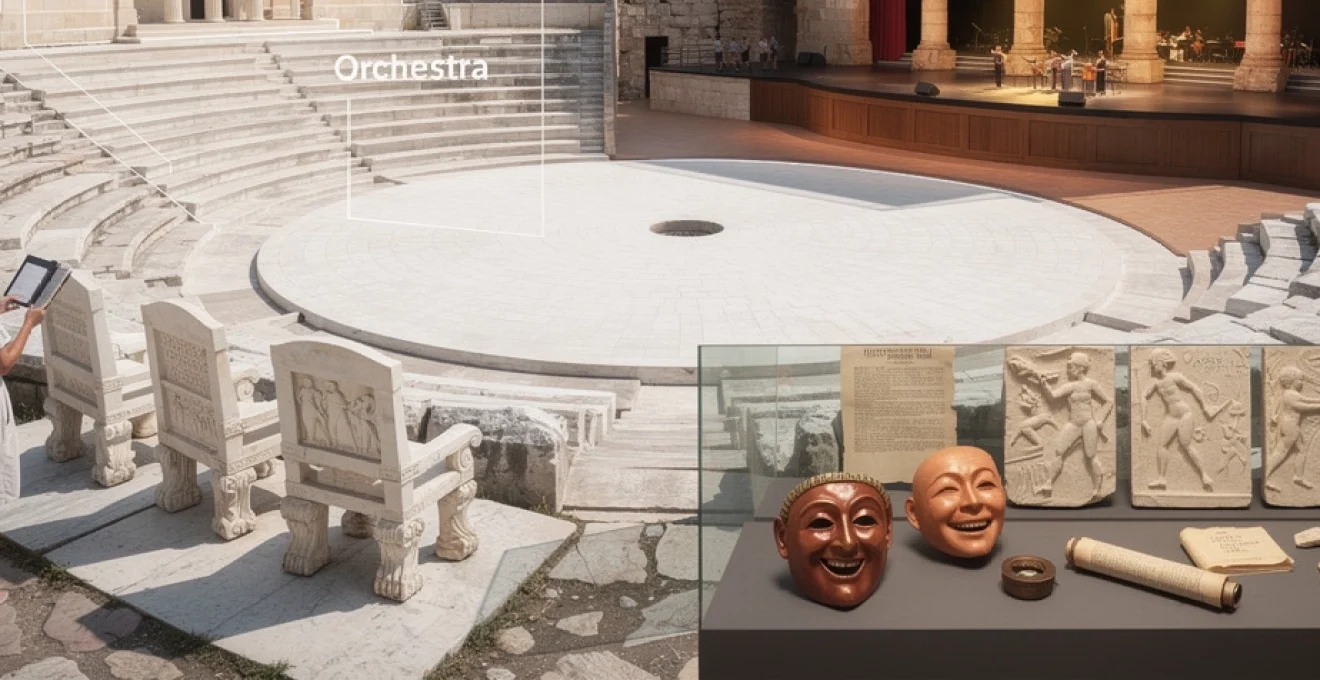
The orchestra’s circular design, measuring approximately 20 metres in diameter, formed the heart of the theatrical experience. This sacred space was paved with marble and featured an altar to Dionysus at its centre, emphasising the religious origins of Greek theatre. The precise geometry of the orchestra’s construction demonstrates the Greeks’ understanding of acoustic principles, as the circular shape helped project the voices of performers throughout the vast seating area.
Marble thrones of honour: proedria seating for athenian dignitaries
The front row of the Theatre of Dionysus featured elaborate marble thrones known as proedria, reserved for the most distinguished members of Athenian society. These ornately carved seats, each inscribed with the name and title of its designated occupant, provide fascinating insights into the social hierarchy of classical Athens. The central throne belonged to the priest of Dionysus Eleuthereus, highlighting the continuing religious significance of theatrical performances even as they evolved into sophisticated dramatic art.
Sixty-seven of these marble thrones have survived, bearing inscriptions that identify priests, magistrates, and foreign dignitaries who held honorary positions in Athenian society. The craftsmanship of these seats, featuring intricate relief carvings and comfortable armrests, demonstrates the high status accorded to their occupants. The positioning of these thrones also served practical purposes, as their elevated placement provided optimal sightlines to the performance area whilst protecting the dignity of Athens’ most prominent citizens.
Roman period modifications under emperor nero’s architectural programme
During the Roman period, particularly under Emperor Nero’s reign, the Theatre of Dionysus underwent significant modifications that reflected changing performance traditions. The most notable alteration was the construction of a raised stage platform, known as
the pulpitum, which elevated the actors and shifted emphasis from the chorus in the orchestra to individual performers on stage. This adaptation aligned the Athenian theatre with Roman taste, where spectacle, declamation, and star performers became more central to the experience. Stone seating was repaired and in some places reconfigured, while new stairways improved circulation for larger and more diverse crowds. These Roman-era layers are still visible today, allowing visitors to read the site almost like a palimpsest of changing performance traditions.
For the modern visitor, recognising these Roman modifications adds an extra dimension to exploring ancient Greek theatre in Athens. By mentally stripping away the raised stage, you can imagine the earlier classical performances where the chorus dominated the circular orchestra. At the same time, the Roman features remind us that Athens remained a vibrant cultural hub well into the imperial period, adapting Greek performance spaces to new artistic fashions. When you walk through the theatre today, you are literally stepping across several centuries of theatrical history laid one atop the other.
Pentelic marble relief sculptures depicting dionysiac ritual scenes
One of the most evocative aspects of the Theatre of Dionysus is the series of Pentelic marble reliefs that once adorned the stage building and surrounding structures. These reliefs depict Dionysus and his retinue—satyrs, maenads, and musicians—engaged in ritual dances and processions that echo the very performances that took place in the orchestra below. Carved from the same fine-grained marble as the Parthenon sculptures, they illustrate the deep connection between religious ritual and theatrical performance in classical Athens.
Although many of the original reliefs have been removed for conservation and are now displayed in museums, fragments remain in situ around the theatre, rewarding the attentive visitor. The scenes often show offerings to Dionysus, the god seated or standing in a relaxed pose, and followers playing instruments such as the aulos, reinforcing the musical dimension of ancient drama. Think of these reliefs as visual programmes or posters for the sacred drama unfolding on stage, combining piety and artistry in a single decorative scheme. Pausing to study them up close helps you appreciate how architecture, sculpture, and performance worked together to create a unified theatrical environment.
Odeon of herodes atticus: roman imperial architecture and acoustic engineering
Just a short walk uphill from the Theatre of Dionysus lies the Odeon of Herodes Atticus, perhaps the most iconic surviving performance venue in Athens today. Built in the mid-second century CE by the wealthy Athenian benefactor Herodes Atticus in memory of his wife Regilla, this stone theatre showcases the fusion of Roman engineering with Greek cultural traditions. Unlike the open-air classical theatre, the Odeon was originally roofed, making it ideal for musical performances and more intimate spectacles. Its imposing arcaded façade and steep cavea dominate the south slope of the Acropolis, offering visitors a vivid impression of Roman imperial ambition in the heart of ancient Athens.
For anyone interested in ancient Greek theatre in Athens, a visit to the Odeon provides a clear sense of how performance architecture evolved over time. Where the Theatre of Dionysus represents the open, civic nature of classical drama, the Odeon reflects a more controlled, architecturally enclosed experience. Yet both spaces remained devoted to public performance and communal gathering, reminding us that sound, sightlines, and audience experience were just as carefully considered in antiquity as in any modern theatre. Walking between the two, you move across nearly six centuries of theatrical history in only a few hundred metres.
Second-century ce construction techniques using hymettus marble
The Odeon’s construction relied heavily on local materials, particularly grey-blue Hymettus marble and limestone, expertly combined with Roman brickwork and concrete. This hybrid technique allowed builders to create a sturdy substructure, while using marble for visible surfaces such as the seating tiers and stage area. In many ways, it is the ancient equivalent of a modern theatre using reinforced concrete behind the scenes and high-quality finishes where the public sits and walks. The precision of the stonework, especially in the radial staircases and seating blocks, reveals the advanced engineering knowledge of Roman-era Athens.
As you explore the site, you can still see the carefully cut marble blocks that form the cavea and orchestra, as well as the remains of the once-towering stage building. Archaeologists have identified multiple building phases, including later repairs following earthquakes and wear. For visitors, this means that you are not just looking at a static monument, but at a living structure that was maintained and adapted over centuries. Paying attention to changes in stone colour and joint patterns can help you distinguish original second-century work from later restorations, turning your visit into a kind of architectural detective game.
Cedar wood roofing system and natural acoustical properties
One of the most remarkable features of the Odeon of Herodes Atticus was its original cedar wood roof, reportedly spanning the entire auditorium. Ancient sources, including Pausanias, describe the roof as both technically impressive and aesthetically striking, providing excellent acoustics and shelter from the elements. Imagine a vast, domed wooden canopy channelling sound the way a modern concert hall’s acoustic shell does. Although the roof no longer survives, its impact on the Odeon’s design can still be felt in the steepness of the seating and the configuration of the walls.
Today, even without the original roof, the Odeon retains outstanding natural acoustics. Performers during modern events often remark that their voices carry effortlessly to the back rows, much as they would have in antiquity. This is due in part to the careful curvature of the cavea and the use of dense materials that reflect rather than absorb sound. If you have the chance to attend a performance during your stay in Athens, you will experience firsthand how this ancient space functions like a finely tuned musical instrument, amplifying and clarifying sound in a way that many contemporary venues still strive to emulate.
Cavea design: three-tier seating arrangement for 5,000 spectators
The Odeon was designed to hold approximately 5,000 spectators, a more intimate capacity compared with the vast Theatre of Dionysus, yet still substantial by modern standards. Its cavea is divided into three horizontal sections, or diazomata, separated by walkways that allowed spectators to circulate easily. This tiered arrangement ensured clear sightlines from every seat, much like the raked seating you find in modern opera houses. Stone benches radiate outward from the orchestra, focusing attention on the stage while also distributing weight evenly across the hillside.
For visitors, the stepped layout offers multiple vantage points from which to admire both the interior of the theatre and the panoramic views of Athens beyond. Seating was also hierarchically organised, with more prestigious places located closer to the orchestra, echoing the social stratification seen at the Theatre of Dionysus. When you sit on the marble steps, you can imagine the diverse audiences that once gathered here—local elites, Roman officials, visiting dignitaries—all united by music and performance. It is a rare opportunity to inhabit the same space, in almost the same configuration, as spectators from nearly 1,900 years ago.
Modern athens festival programming and performance restoration
Unlike many archaeological sites, the Odeon of Herodes Atticus continues to function as a living theatre, hosting performances each summer as part of the Athens and Epidaurus Festival. International orchestras, ballet companies, and renowned soloists regularly appear on its stage, bringing the ancient venue back to life under the Athenian night sky. For travellers interested in ancient Greek theatre in Athens, attending one of these events offers a uniquely immersive way to experience the space. You are not just looking at ruins—you are participating in an unbroken tradition of performance.
Tickets for festival performances can sell out quickly, especially for high-profile acts, so it is wise to book well in advance. Practical considerations such as comfortable footwear, a light jacket for evening breezes, and arriving early to navigate the stone steps will make your visit more enjoyable. It is also worth noting that photography may be restricted during performances, so be prepared to soak in the atmosphere with your own eyes rather than through a camera lens. When the lights dim and the first notes echo across the marble, you will understand why this venue remains one of the world’s most magical places to experience live performance.
Dramatic competition structures: city dionysia festival organisation
No guide to ancient Greek theatre in Athens would be complete without an understanding of the City Dionysia, the grand festival that gave birth to many of the plays we still read and perform today. Held each spring in honour of Dionysus, this civic and religious celebration transformed the city into a stage, culminating in several days of dramatic competitions at the Theatre of Dionysus. Playwrights, actors, and choruses competed for prestigious prizes, with entire tribes and demes sponsoring performances as acts of civic pride. For Athenians, attending these dramas was as much a duty as a pleasure, akin to combining a national holiday, a religious pilgrimage, and a cultural festival into one event.
The competition structure was highly formalised. Tragic poets typically presented a tetralogy—three tragedies followed by a satyr play—while comic poets competed separately with individual comedies. A panel of citizen-judges, chosen by lot, evaluated the performances, and the winning playwright’s name and tribe were publicly recorded. Financial backers, known as choregoi, funded the choruses and staging, sometimes spending lavishly to secure victory and prestige. When you stand in the Theatre of Dionysus, imagining it filled with 17,000 citizens judging new works by Aeschylus or Sophocles, you begin to grasp the enormous cultural weight these competitions carried.
Surviving theatrical manuscripts: aeschylus, sophocles, and euripides performance texts
Although the physical performances of ancient Greek theatre in Athens have long vanished, the texts of many plays have survived, giving us a window into the repertory once staged on these stone platforms. Aeschylus, often considered the father of tragedy, introduced innovations such as the second actor and complex staging that transformed the genre from simple choral hymns into fully fledged drama. Sophocles built on this foundation, refining character psychology and dramatic structure in works like Oedipus Rex and Antigone. Euripides, the youngest of the trio, pushed boundaries with daring explorations of human emotion and social norms, leaving us plays such as Medea that still shock and move audiences.
For the visitor, it can be a powerful experience to read or watch a modern adaptation of these tragedies before or after standing in the theatres where they premiered. Many translations and productions now aim to approximate aspects of the original staging, from the use of choruses to stylised movement. Imagine lines from Oedipus Rex resonating across the marble cavea of the Theatre of Dionysus, or Euripides’ bold monologues echoing under the Acropolis rock. By linking the surviving manuscripts to the physical spaces of Athens, you bridge the gap between text and place, transforming your visit into a deeper engagement with the birth of Western drama.
Archaeological museum collections: theatrical masks and performance artefacts
While the theatres themselves provide the architectural setting, the museums of Athens preserve many of the smaller objects that completed the ancient theatrical experience. Terracotta figurines of actors, marble reliefs showing choruses in motion, and even fragmentary musical instruments all contribute to our understanding of how performances actually looked and sounded. Visiting these collections alongside the sites allows you to reconstruct, piece by piece, the world of ancient Greek theatre in Athens. You move from the grand scale of stone architecture to the intimate details of costume, mask, and gesture.
Several institutions in the city hold important theatrical artefacts, each offering a different perspective. The National Archaeological Museum houses some of the finest ancient masks and actor portraits, while the Acropolis Museum focuses on votive offerings associated with Dionysus and the Acropolis slopes. The Ancient Agora Museum, set within the reconstructed Stoa of Attalos, preserves inscribed ostraka that sometimes reference prominent theatrical figures. By planning your route to include both sites and museums, you create a multi-layered encounter with Athenian theatre, seeing how performance permeated not only sacred spaces but also daily civic life.
National archaeological museum’s tragic and comic mask exhibitions
At the National Archaeological Museum, you will find a range of objects that bring the faces of ancient theatre back to life—quite literally. Stone and terracotta representations of tragic and comic masks show exaggerated features designed to be visible from the back rows of vast theatres. Open mouths, arched brows, and stylised hair all served to convey character types at a glance, functioning a bit like visual shorthand in a modern graphic novel. Though the original organic masks made of linen or leather have not survived, these sculptural depictions provide invaluable clues to their appearance.
As you study the masks, consider how they would have transformed the actors’ voices and movements. The rigid form may have acted like a small resonating chamber, amplifying speech much like a megaphone. Meanwhile, the fixed expressions required performers to rely on body language and vocal nuance to convey emotion, rather than subtle facial cues. By observing these artefacts up close, you gain insight into the physical demands placed on ancient actors and the highly codified system of gestures and postures they used. This, in turn, enriches your appreciation when you later stand in the theatres where these masked performances unfolded.
Acropolis museum’s dionysiac votive offerings and theatrical reliefs
The Acropolis Museum, located just below the sacred rock, is another essential stop for anyone exploring ancient Greek theatre in Athens. Its collections include numerous votive offerings dedicated to Dionysus, many of which were found on the south slope near the Theatre of Dionysus and the sanctuary of the god. Small reliefs, inscribed bases, and figurines commemorate successful performances, fulfilled vows, or acts of piety by choruses and individuals. They functioned as a kind of spiritual “thank you note” to the deity who presided over drama and festivity.
Among the most compelling pieces are marble reliefs that show processions, musical contests, and scenes of Dionysus accompanied by satyrs and maenads. These images echo the themes carved on the theatre’s architectural reliefs, reinforcing the close bond between temple, sanctuary, and performance space. When you view these objects and then step outside to look up at the Acropolis and down toward the theatre, it becomes clear how tightly interwoven religion and theatre were in the ancient cityscape. The museum thus acts as an interpretive bridge, connecting the material remains of devotion to the physical spaces of performance.
Ancient agora museum’s ostraka evidence of theatrical personalities
The Ancient Agora Museum, housed in the reconstructed Stoa of Attalos, offers a different, more political angle on ancient Greek theatre in Athens. Here you will encounter ostraka—pottery sherds used as voting tokens in ostracism procedures—that sometimes bear the names of famous citizens, including figures with ties to the theatrical world. While not all such individuals were playwrights or actors, the presence of these names reminds us that theatre operated within a highly politicised environment. Public opinion could elevate or ruin reputations, and prominent Athenians associated with drama were subject to the same civic scrutiny as any other citizen.
Seeing these humble sherds, scratched with names in hurried hands, invites you to reflect on the precarious nature of fame in democratic Athens. Just as audiences judged plays during the City Dionysia, citizens voted on whether to exile powerful individuals for ten years. The same people who applauded Aeschylus or booed a failing chorus might later inscribe a statesman’s name on an ostrakon. By connecting these political artefacts to the theatrical landscape, your visit to the Agora underscores how deeply performance, debate, and civic identity were intertwined in the daily life of the city.
Practical visitor information: access routes and conservation protocols
Planning your visit to the ancient theatres of Athens requires a bit of logistical foresight, but the rewards are immense. The Theatre of Dionysus and the Odeon of Herodes Atticus are both accessed via the south slope of the Acropolis, with entrances along Dionysiou Areopagitou Street, a broad pedestrian avenue that is easy to reach by metro (Acropoli station) or on foot from the city centre. Combined tickets issued by the Hellenic Ministry of Culture typically cover multiple archaeological sites, including the Acropolis itself, making it worthwhile to check current options and validity periods before you arrive. Visiting early in the morning or later in the afternoon can help you avoid both heat and crowds, especially during peak season.
Conservation protocols at these fragile monuments are strict, and for good reason. You will notice roped-off areas, designated walking paths, and restrictions on where you can sit or stand, all designed to minimise wear on ancient stone surfaces. High-heeled shoes are strongly discouraged, and flat, non-slip footwear is recommended to navigate polished marble steps safely. In some areas, particularly at the Odeon of Herodes Atticus, access may be limited or adjusted when modern performances or restoration works are underway. It is wise to verify opening hours and any temporary closures on official channels before your visit, as conditions can change due to weather or conservation needs.
Photography is generally permitted for personal use at the theatres and museums, although tripods and professional equipment may require special permission. To respect both the sites and other visitors, avoid climbing on structures, touching fragile surfaces, or leaving any litter behind. Consider carrying water, sunscreen, and a hat, as shade can be limited, especially at midday. Finally, allow yourself time not just to walk through these spaces, but to pause, sit (where permitted), and imagine the sound of choruses, instruments, and speeches once filling the air. With a thoughtful approach to access and conservation, you help ensure that ancient Greek theatre in Athens remains accessible to future generations of visitors and scholars alike.