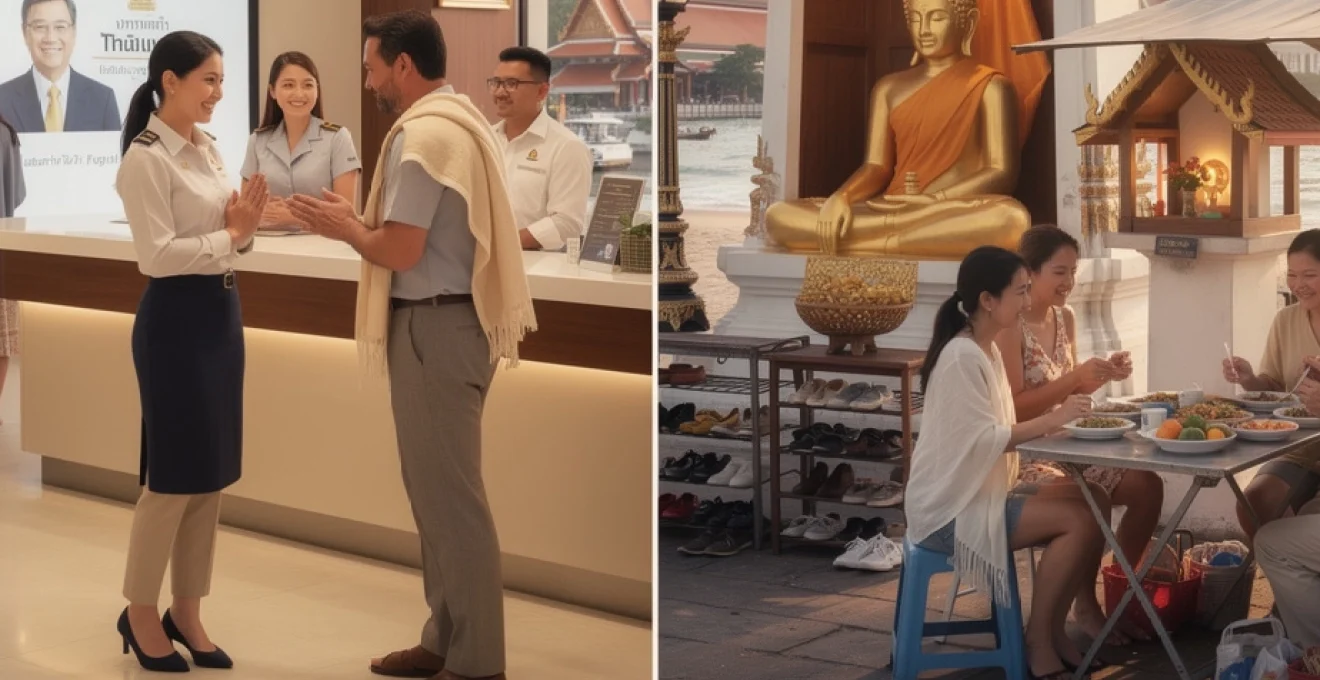
Thailand’s magnetic appeal extends far beyond its turquoise waters and golden temples. The Kingdom’s true essence lies in its deeply rooted cultural traditions, where respect, hierarchy, and spiritual reverence shape every social interaction. As tourism continues to flourish—with visitor numbers reaching pre-pandemic levels and Thailand consistently ranking among Asia’s most welcoming destinations—understanding local customs has never been more critical. The difference between a surface-level holiday and an authentic cultural experience often hinges on your awareness of Thai etiquette. From the graceful wai greeting to the unspoken rules governing temple conduct, these customs aren’t merely quaint traditions; they’re the social fabric that binds Thai society together and defines interactions across generations.
Wai greeting protocol: hand positioning and hierarchical gestures in thai social interactions
The wai stands as Thailand’s most recognisable cultural gesture, yet its execution involves considerably more nuance than many visitors realise. This prayer-like greeting communicates respect, gratitude, and acknowledgement through subtle variations in hand placement and bow depth. The gesture’s elegance masks a complex system of social signalling that Thais learn from childhood, where age, social status, and context determine the appropriate response. Understanding when and how to perform a wai transforms you from an obvious tourist into someone who genuinely respects Thai cultural values.
Executing the proper wai: hand placement relative to age and social status
Hand positioning in a wai directly correlates with the recipient’s social standing. When greeting someone of higher status or significantly older, your hands should rise to nose level, with fingertips reaching towards your eyebrows whilst maintaining a deeper bow. For peers or those slightly older, chest-level positioning with a modest head bow suffices. The highest form of wai, reserved for royalty and sacred Buddha images, places hands at forehead level with a pronounced bow. Your thumbs should rest near your chest, fingers pointing upward and pressed together, with elbows positioned naturally at your sides rather than protruding awkwardly. The gesture should flow smoothly, held for a moment before releasing, accompanied by a gentle smile that conveys warmth alongside respect.
Responding to wai gestures from monks, elders, and service staff
Reciprocating a wai requires cultural awareness rather than automatic mirroring. When Buddhist monks offer a wai, laypeople typically do not return the gesture with equal formality; instead, a slight bow or respectful nod acknowledges their spiritual status. Elderly Thais deserve a returned wai that matches or slightly exceeds their gesture’s formality, reflecting the culture’s veneration of age and wisdom. However, service staff—including hotel receptionists, restaurant servers, and shop attendants—present a different scenario. Whilst they may wai you as professional courtesy, returning an equally formal wai can create social awkwardness. A warm smile, slight nod, or casual wai at chest level appropriately acknowledges their greeting without overstepping hierarchical boundaries that Thais naturally understand but foreigners often misjudge.
Situations where wai etiquette does not apply in contemporary bangkok
Modern Bangkok’s cosmopolitan environment has created contexts where traditional wai protocol relaxes considerably. In international business settings, particularly within multinational corporations and foreign-owned establishments, handshakes have become standard practice. Contemporary shopping malls, Western-style coffee chains, and expat-frequented venues often see staff offering simple verbal greetings rather than formal wais. Younger Thais educated abroad or working in global industries may initiate handshakes, especially with Western visitors, signalling their comfort with international customs. Street vendors, tuk-tuk drivers, and market sellers typically don’t expect wais during transactions; a friendly smile and verbal greeting suit these informal commercial exchanges perfectly. However, this relaxation applies primarily to Bangkok’s central districts and tourist areas—venture into residential neighbourhoods, provincial towns, or traditional communities, and conventional wai etiquette remains firmly expected.
Common wai mistakes made by western tourists at wat pho and grand palace
Popular temple sites witness countless well-intentioned but culturally confused wai attempts daily. The most frequent error involves tourists wai-ing indiscriminately—greeting security guards, ticket sellers,
ticket clerks, and even younger staff with an overly high hand position more suited to monks or elders. This over-formality, while meant as polite, can appear awkward or insincere to Thai onlookers. Another common misstep is offering a wai while wearing sunglasses or chewing gum, both of which undermine the gesture’s respectful intent. At major sites like Wat Pho and the Grand Palace, some visitors also wai Buddha statues as if they were people, rather than offering a quiet bow with hands held in a prayer position without exaggerated movements. When in doubt, observe how local visitors greet one another and follow their lead; subtlety and sincerity are valued far more than dramatic gestures.
Royal family reverence: navigating lèse-majesté laws and public conduct
Respect for the Thai royal family is both a cultural expectation and a legal requirement. The monarchy occupies a central place in national identity, and criticism or mockery is taken extremely seriously. Thailand’s lèse-majesté laws are among the strictest in the world, applying to Thai citizens and foreigners alike. For travelers, this means that cultural etiquette in Thailand includes not only polite behaviour in public spaces, but also caution in conversations, social media posts, and even how you handle Thai currency. Understanding these boundaries ensures you remain respectful while avoiding legal trouble during your visit.
Standing protocol during royal anthem at cinema theatres and public venues
One of the most visible expressions of royal reverence occurs in cinema theatres across Thailand. Before most film screenings, a short video montage of the King is played, accompanied by the royal anthem. Everyone in the auditorium is expected to stand quietly until the anthem ends, regardless of personal views. Remaining seated, talking, or using your phone during this time is considered deeply disrespectful and can lead to confrontation or intervention by staff.
Similar expectations sometimes apply at large public events, sports matches, and official ceremonies where the royal anthem or national anthem is played. If you are unsure what to do, simply follow the crowd—when others stand, you stand. Think of it as the Thai equivalent of standing for a national anthem in your own country, but with added cultural and legal significance. This small act of respect signals that you understand and honour Thailand’s core social values.
Appropriate behaviour near royal portraits in hotels and government buildings
Portraits of the King and members of the royal family appear in hotels, banks, government offices, schools, and even small family businesses. These images are not mere decoration; they are objects of respect. Avoid leaning on, blocking, or posing playfully in front of royal portraits, especially with humorous gestures or exaggerated expressions. Sitting on furniture beneath royal images with your feet propped up towards the portrait is also highly inappropriate.
When walking past large displays—such as those you may see near Sanam Luang or in official compounds—maintain a respectful distance and moderate your voice. If locals are lighting candles or laying flowers near royal monuments, treat the space as you would a memorial site in your own country. As a visitor, you are not expected to participate in every ritual, but you are expected not to trivialise or interrupt them.
Social media restrictions: what visitors cannot post about thai monarchy
In the era of constant connectivity, many travelers underestimate how their online behaviour is viewed within Thailand. Lèse-majesté laws extend to digital content, including social media posts, comments, memes, and shared articles. Posting or sharing anything that could be interpreted as insulting, mocking, or defaming the monarchy can, in theory, lead to investigation—even if the post was made outside Thailand but is accessible within its borders. While enforcement varies, cases involving inflammatory content have resulted in arrest and prosecution.
As a rule of thumb, avoid discussing the royal family online while you are in the country, particularly in critical or joking terms. Do not repost satirical content, even if it seems commonplace in your home media environment. If you photograph royal parades, portraits, or commemorative events, share them with neutral or respectful captions. Just as you would not insult a host in their own home, remembering this digital etiquette in Thailand is a vital part of traveling responsibly.
Respectful conduct at royal sites including sanam luang and dusit palace
Royal sites such as the Grand Palace complex, the Dusit Palace area, and the ceremonial grounds of Sanam Luang require a higher standard of decorum than ordinary tourist attractions. Dress modestly, similar to temple etiquette: shoulders and knees covered, no see-through clothing, and closed shoes or neat sandals rather than beach flip-flops. Loud jokes, music, or horseplay on palace grounds are out of place and can upset both staff and local visitors who see these spaces as national symbols.
When guided tours explain historical events or royal roles, listen respectfully and avoid making flippant comparisons to foreign political figures. Drone flying, climbing on railings, or sitting on monuments for photographs is strictly prohibited and may lead to confiscation of equipment or fines. Treat these royal zones as you might treat a combination of a presidential residence, a war memorial, and a sacred historic site—because in Thai cultural context, they are all three at once.
Buddhist temple etiquette: dress codes and behavioural standards at sacred sites
With more than 40,000 temples across the country, visiting at least a few wats is almost unavoidable during any trip to Thailand. Yet temples are not open-air museums; they are living places of worship woven into daily community life. Following proper Buddhist temple etiquette in Thailand helps you avoid causing offence and allows you to appreciate the spiritual atmosphere more fully. From clothing requirements to foot positioning and photography rules, a few simple habits can transform your visit from accidental intrusion into respectful participation.
Clothing requirements for wat arun, wat phra kaew, and provincial temples
At major temples like Wat Phra Kaew (the Temple of the Emerald Buddha) and Wat Arun, dress codes are enforced at the entrance. Both men and women must cover shoulders and knees; sleeveless tops, low-cut shirts, crop tops, and shorts above the knee are not permitted. Transparent fabrics and tight athletic wear are also discouraged. If you arrive underdressed, you may be required to rent or purchase a sarong or shawl from vendors outside, which can add unplanned costs and delay your visit.
Provincial temples tend to be more relaxed, but the same principles of modesty apply. A lightweight long-sleeved shirt and breathable trousers or a long skirt usually meet expectations while still keeping you cool in the tropical climate. Think of temple dress as similar to what you might wear to a modest family gathering or religious service at home. By planning your outfit for temple days in advance, you avoid awkward last-minute changes and show clear respect for Thai Buddhist culture.
Physical conduct rules: foot positioning and sitting postures in temple halls
Once inside a temple hall (ubosot or viharn), your feet become an important part of etiquette. Because feet are considered the lowest and least sacred part of the body, pointing them towards Buddha images, monks, or other worshippers is seen as highly disrespectful. When sitting on the floor, avoid stretching your legs out in front of you. Instead, sit on your heels, tuck your legs to one side, or sit cross-legged while making sure your toes angle away from the altar.
Need to move through a crowded hall? Take care not to step over people who are seated or praying; walk around them wherever possible, even if it means a slightly longer route. Keep your body lower than prominent Buddha images and monks when you pass by, and move calmly rather than rushing. These postures might feel unfamiliar at first, but they are central to temple etiquette in Thailand and help preserve the calm, meditative environment locals come to enjoy.
Interacting with monks: gender-specific restrictions and donation protocols
Monks hold a revered position in Thai society, and interactions with them are governed by clear rules. For male visitors, speaking politely, keeping a respectful distance, and sitting slightly lower than a monk is appropriate. For female visitors, the key guideline is to avoid physical contact. Women should not touch monks or hand items directly to them; instead, place offerings on a tray or surface for the monk to pick up, or pass them via a male intermediary if available.
When making donations—common at temples in Bangkok, Chiang Mai, and smaller towns—you’ll often find metal boxes labeled for maintenance, education, or merit-making. Place your offering gently into the box rather than throwing or dropping it. If monks are chanting or receiving alms, avoid interrupting to ask for photos or conversation. Think of monks as both religious professionals and people seeking spiritual focus; interacting with them respectfully is one of the most important aspects of Buddhist etiquette in Thailand.
Photography permissions at buddha images and during meditation sessions
Photography rules vary from temple to temple, so look for signage or ask staff before taking out your camera. In many outdoor areas, photos of stupas, murals, and Buddha statues are allowed, provided you avoid climbing on structures or blocking pathways. Inside ordination halls, restrictions are often stricter: flash photography may be banned to protect artwork, and some temples prohibit photos during active ceremonies altogether. Using a tripod or posing extensively for social media-style shoots can be frowned upon, particularly in smaller provincial temples where locals are praying.
During meditation sessions or chanting, treat the space as you would a yoga class or quiet retreat. Set your phone to silent, avoid walking directly in front of participants, and never lean over someone meditating to get a better angle for a photo. If you are invited to join a session, sit quietly and follow simple instructions. Respectful, low-key photography is usually fine, but once it starts to distract from worship, you have crossed a line in Thai cultural etiquette.
Shoe removal customs in temple compounds and private thai homes
Shoe etiquette in Thailand is a visible sign of respect. At temples, you will usually remove your shoes before entering the main hall, marked by rows of footwear or a sign near the door. Socks are acceptable, but bare feet are also common; just ensure they are clean. Some areas within a temple compound, such as cloisters or museum rooms, may also require shoe removal, so follow local cues. Walking into a sacred area with shoes on is one of the most obvious breaches of etiquette foreign visitors make.
The same principle applies to private homes and many traditional guesthouses or massage parlours. If you see a cluster of shoes at the entrance, slip yours off and place them neatly with the rest. Consider wearing slip-on sandals on days when you expect to visit multiple temples or local homes. This simple act communicates that you understand Thai customs and are willing to adapt your behaviour accordingly.
Head and feet symbolism: understanding body hierarchy in thai cultural context
To fully grasp cultural etiquette in Thailand, it’s helpful to understand the symbolic hierarchy of the body. In Thai thought, the head represents the highest, most sacred part of a person—associated with spirit and dignity—while the feet are the lowest, linked with dirt and the physical world. Many dos and don’ts in Thailand stem from this concept, shaping how people sit, move, and even interact in crowded markets and public transport. Once you internalise this symbolic map, behaviours that might seem overly sensitive at first quickly start to make sense.
Prohibitions against touching thai people’s heads including children
In some Western cultures, patting a child’s head is seen as affectionate. In Thailand, it can feel intrusive or disrespectful, even when aimed at young children. Because the head is considered sacred, touching it without permission implies a lack of respect for the person’s spiritual integrity. This applies to adults and children alike, though locals may be more forgiving of foreigners who clearly don’t know the custom.
If you develop a warm rapport with a Thai family or guide, you might see adults gently touching their own children’s heads, but that familiarity doesn’t automatically extend to you. When you want to show friendliness, use your smile, body language, or a light touch on the arm rather than reaching for someone’s head. By avoiding head contact altogether, you stay safely within accepted Thai etiquette and avoid causing unintended offence.
Foot etiquette: avoiding pointing feet towards buddha images and people
Just as the head should not be handled casually, the feet should not be pointed at people, religious images, or important objects. Sitting on a bus or BTS Skytrain with your legs stretched so that your feet are directed at another passenger can be perceived as rude, even if nothing is said. In homes and temples, pointing your feet at elders, family altars, or Buddha statues is considered especially impolite.
Need a simple rule of thumb? Imagine your feet carry not just physical dirt but symbolic disrespect; you wouldn’t “aim” that at someone you respect. When sitting, try to keep your feet flat on the floor or tucked to one side, and avoid resting them on tables, chairs, or other elevated surfaces. This adjustment may feel minor to you, but it signals a major understanding of Thai cultural norms.
Stepping over objects and people in markets and traditional settings
In busy markets and village homes, you may sometimes need to navigate around people sitting on mats, low tables, or baskets on the ground. Stepping over someone—especially their legs or body—is viewed as disrespectful, linking again to the idea of the feet as low and unclean. The same goes for sacred objects such as monk’s robes, offerings, or religious texts placed temporarily on the floor. Even in cramped spaces, it’s better to ask people to shift slightly than to climb over them.
If you accidentally brush someone with your foot in a crowd, a quick apologetic gesture and a soft “khor thot” (sorry) can help smooth things over. Think of Thai public spaces like a shared living room: you wouldn’t step over your grandmother on the sofa, so you shouldn’t do it in a Chiang Mai market either. Learning to move with this kind of spatial awareness is a subtle but powerful sign of cultural respect.
Dining customs and table manners in thai restaurants and street food culture
Food is central to social life in Thailand, and the way you eat says as much about your cultural awareness as the dishes you choose. Whether you’re sampling noodles at a street stall in Bangkok or sharing a family-style feast in Isaan, understanding Thai dining customs helps you blend in and avoid awkward moments. Table manners in Thailand emphasise sharing, politeness, and a relaxed, communal approach—quite different from the individualised, course-by-course style common in many Western countries.
Fork and spoon technique: traditional thai eating utensil usage
In most Thai meals, the primary utensils are a spoon and fork, not chopsticks. The spoon is held in the dominant hand and used for eating, while the fork in the other hand is used to gently push food onto the spoon. Eating directly off the fork is uncommon in traditional settings and can look slightly clumsy to locals. Knives rarely appear at the table, as dishes are usually served in bite-sized pieces.
Chopsticks are mainly reserved for Chinese-influenced noodle soups and some street food dishes. When they are provided, avoid sticking them upright into a bowl of rice, as this resembles funeral offerings and is considered bad luck. Instead, lay them neatly across the bowl or on the provided rest. Adopting these small dining etiquette habits in Thailand signals that you’re not just tasting the cuisine, but also respecting the culture it comes from.
Sharing protocols for family-style meals at som tam stalls and local eateries
Meals in Thailand are commonly shared, particularly at som tam (papaya salad) stalls, rice shops, and family restaurants. Rather than ordering separate main courses for each person, groups typically choose several dishes to place in the centre of the table. Everyone then serves themselves small portions onto their own plate, usually with a base of rice. As a guest, wait for your host or the most senior person at the table to invite everyone to start eating.
It’s polite to offer food to others before taking more for yourself, especially prized pieces of fish or meat. Taking the very last bite from a shared dish without checking if anyone else wants it can be seen as greedy, unless you’re specifically told to finish it. Think of a Thai table as a cooperative, not a competition; the goal is collective enjoyment, not individual entitlement. This approach to dining is one of the most enjoyable aspects of Thai etiquette once you get used to it.
Respectful behaviour towards food and leaving offerings for spirits
Food in Thailand often carries spiritual as well as practical significance. You’ll notice small spirit houses in front of homes, businesses, and even hotels, decorated with offerings of rice, fruit, sweets, and drinks. These are gifts to protective spirits, and removing, tasting, or playing with them is extremely disrespectful. Treat spirit houses as you would a shrine or grave marker—photograph from a discreet distance and never disturb the offerings.
At the table, avoid wasting large amounts of food when possible, especially rice, which holds special cultural importance. Dropping food on the floor and ignoring it, or making jokes about “bad” or “weird” Thai dishes, can come across as insulting to hosts who are proud of their cuisine. If a dish is not to your taste, take only a small portion and leave the rest for others. Respect for food is woven deeply into daily etiquette in Thailand, connecting hospitality, religion, and gratitude.
Social conduct standards in public spaces across thailand’s tourism regions
Beyond temples and dining tables, everyday social conduct in Thailand is guided by an emphasis on harmony, modesty, and emotional restraint. Whether you’re exploring night markets in Chiang Mai, beaches in Krabi, or the nightlife of Bangkok, the same core principles apply. Thailand’s reputation as the “Land of Smiles” is not just a tourism slogan; it reflects a cultural preference for keeping interactions pleasant and avoiding open conflict. As a visitor, aligning your behaviour with these norms helps you move smoothly through different regions without misunderstandings.
Public displays of affection restrictions in chiang mai, phuket, and bangkok
Attitudes towards public displays of affection (PDA) vary slightly by region, but modesty remains the general rule. In cosmopolitan Bangkok or tourist-heavy Phuket, you may see couples holding hands or giving quick hugs, especially in nightlife districts. However, extended kissing, cuddling on public transport, or overtly intimate behaviour can still provoke disapproving looks. In more conservative Chiang Mai, particularly around temples and older neighbourhoods, expectations are even stricter.
Think of acceptable PDA in Thailand as being closer to what you might see in a family-friendly public space rather than a nightclub at home. Save romantic gestures for private settings, hotel rooms, or discrete corners, not temple grounds or busy skytrain platforms. Following this guideline shows you understand that, despite Thailand’s modern, tourism-oriented image, social norms around intimacy in public remain relatively traditional.
Appropriate beachwear guidelines for pattaya, krabi, and koh samui coastal areas
On the beaches of Pattaya, Krabi, or Koh Samui, swimwear is of course acceptable, but context matters. Bikinis, trunks, and board shorts are fine on the sand and around resort pools, yet walking through town, visiting shops, or eating in restaurants while shirtless or in just a bikini top is considered disrespectful. Locals may tolerate it in heavily touristed areas, but that tolerance shouldn’t be mistaken for approval.
As a general rule, cover up with at least a T-shirt and shorts or a casual dress when you leave the beach or pool area. Topless sunbathing is illegal and can lead to fines or confrontation, particularly in more conservative parts of the country. Picture the beach as a designated “swimwear zone”; once you step beyond it into streets, temples, or markets, modest clothing becomes part of basic cultural etiquette in Thailand.
Voice modulation and emotional restraint in conflict situations
Thai social norms place a high value on keeping one’s “jai yen”—a cool heart. Raising your voice, gesturing aggressively, or displaying visible anger in public is seen as a loss of self-control and “losing face,” both for you and the person you’re addressing. Even in stressful situations, such as a taxi dispute or booking error, staying calm and speaking softly will usually get you much further than shouting. Staff in hotels, shops, and transport services are far more likely to help if you maintain a polite tone.
Imagine conflict resolution in Thailand as similar to navigating a crowded boat: sudden movements rock everyone, while steady, measured actions keep things balanced. If you feel your frustration rising, take a breath, lower your voice, and, if necessary, step aside to compose yourself. By managing your emotions publicly, you respect not just the individual you’re dealing with, but also the broader Thai cultural preference for harmony.
Modesty standards in rural areas of isaan and northern thailand villages
Urban centres like Bangkok and Phuket may feel relatively relaxed, but rural areas in Isaan and Northern Thailand maintain more traditional expectations, particularly around dress and behaviour. In village settings, women wearing very short shorts, strapless tops, or low-cut clothing may unintentionally attract negative attention. Men going shirtless away from fields or work sites can also be viewed as inappropriate. When visiting friends’ families, homestays, or local festivals, opt for modest, comfortable clothing that covers shoulders and thighs.
Social interactions in rural communities also tend to be more reserved. Loud, boisterous behaviour, heavy drinking in public, or open criticism of local customs can quickly damage trust. Instead, follow the lead of your hosts: speak gently, accept offers of food or drink graciously, and show interest in village life without turning it into a spectacle. By adjusting to these regional nuances in Thai social etiquette, you not only avoid offence but also open doors to deeper, more authentic connections with local people.