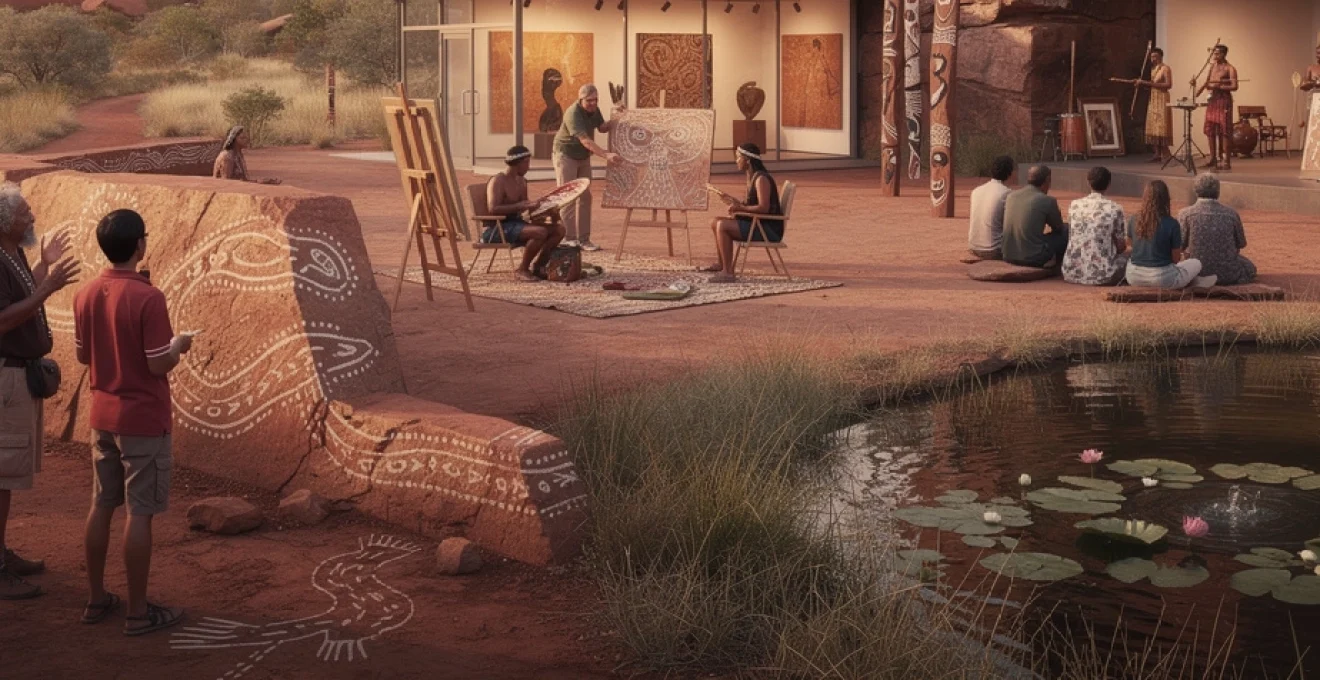
The Northern Territory stands as Australia’s most profound repository of Indigenous heritage, where over 60,000 years of continuous Aboriginal culture unfolds across spectacular landscapes. From the red heart of Central Australia to the tropical Top End, this remarkable region offers visitors unparalleled opportunities to engage with the world’s oldest living culture. The Territory’s Indigenous communities, representing numerous distinct tribal groups and language families, continue to practice ancient traditions while adapting to contemporary life. Each sacred site, rock art gallery, and cultural centre tells stories that predate written history, offering modern visitors a chance to witness the remarkable continuity of human connection to country that defines Aboriginal Australia.
Traditional dreamtime stories and sacred site significance at Uluru-Kata tjuta national park
Uluru-Kata Tjuta National Park represents one of Australia’s most significant cultural landscapes, where the Anangu people have maintained their spiritual connection to country for countless generations. The monolithic presence of Uluru and the distinctive domes of Kata Tjuta serve as more than geological wonders; they are living libraries of creation stories known as Tjukurpa, which form the foundation of Anangu law, culture, and identity. These narratives explain the formation of the landscape, establish social protocols, and provide guidance for living harmoniously with the natural environment.
The park’s cultural centre provides visitors with essential context for understanding the profound spiritual significance of this World Heritage landscape. Through carefully curated displays featuring traditional tools, ceremonial objects, and contemporary Aboriginal art, visitors gain insight into the complex relationship between the Anangu people and their ancestral country. The centre emphasises the importance of approaching this sacred landscape with respect and understanding, highlighting how tourism can support cultural preservation while fostering cross-cultural appreciation.
Anangu cultural protocols for visiting kata tjuta rock formations
Visiting Kata Tjuta requires adherence to strict cultural protocols established by the Anangu Traditional Owners. These guidelines reflect deep spiritual beliefs about gender-specific sacred sites and areas where ceremonial knowledge is restricted to particular community members. The Valley of the Winds walk, while accessible to all visitors, passes through country that holds special significance for men’s law, requiring respectful behaviour and adherence to designated pathways.
Photography restrictions apply to certain areas of Kata Tjuta, particularly those associated with sacred stories or ceremonial practices. Visitors are encouraged to observe these protocols not as limitations but as opportunities to engage more mindfully with the landscape. The Anangu concept of kulintjaku – listening and learning – becomes essential when exploring these formations, allowing visitors to appreciate the layers of meaning embedded in every rock face and walking track.
Pulkanya dreaming tracks and ancestral navigation systems
The concept of Pulkanya encompasses the ancestral tracks that crisscross the Uluru-Kata Tjuta landscape, creating an intricate navigation system that extends far beyond park boundaries. These dreaming tracks, known more broadly as songlines, represent the journeys of ancestral beings during the creation period, establishing pathways that Aboriginal people have followed for millennia. Each track carries specific songs, stories, and ceremonial obligations that connect distant communities across vast distances.
Understanding Pulkanya requires appreciating how Aboriginal people conceptualise country as a living map of relationships, responsibilities, and resources. The tracks visible to visitors represent only a fraction of the complex network that extends across Central Australia, linking water sources, food gathering areas, and sacred sites. This ancient GPS system demonstrates the sophisticated geographical knowledge that enabled Aboriginal people to thrive in challenging desert environments for tens of thousands of years.
Tjukurpa law interpretation through rock art at mutitjulu waterhole
The rock art galleries surrounding Mutitjulu Waterhole provide fascinating insights into how Tjukurpa law is encoded in visual form. These paintings, some dating back thousands of years, serve as educational tools for passing down cultural knowledge, legal principles, and social obligations to successive generations. The imagery combines naturalistic depictions of animals and people with symbolic representations that carry deeper ceremonial meanings.
Interpreting these artworks requires understanding the multilayered nature of Aboriginal visual communication. While some elements are accessible to all community members and visitors, others contain restricted knowledge reserved for initiated individuals. The ongoing maintenance and retouching of these paintings by Traditional
Owners ensures that knowledge remains alive and relevant, rather than frozen in the past. For visitors, guided walks to Mutitjulu Waterhole with Anangu guides provide a rare opportunity to see how law, story, and landscape interweave. You are not simply looking at “ancient art”; you are learning how a living legal and ethical system is carried on through images, much like a visual constitution written on stone.
Kuniya and liru creation stories along uluru base walk circuit
One of the most frequently shared Dreaming narratives around Uluru is the story of Kuniya, the python woman, and Liru, the venomous snake man. As you follow sections of the Uluru Base Walk, Anangu guides point out features in the rock that correspond to key moments in this dramatic story of conflict, retribution, and balance being restored. These physical markings in the stone are read as evidence of ancestral actions, reinforcing the idea that Uluru is a living archive rather than a static monument.
The Kuniya and Liru story is not just a myth; it encodes moral teachings about responsibility, restraint, and the consequences of violence. By hearing this narrative while standing in the very places it describes, visitors gain a deeper appreciation of how Aboriginal culture in the Northern Territory fuses ethics, landscape, and memory. You are encouraged to walk slowly, listen carefully, and imagine the country as Anangu people do – as a text that can be read, sung, and interpreted through Tjukurpa law. This immersive experience transforms a simple hike into a profound cultural encounter.
Contemporary aboriginal art movements and cultural centres in darwin and alice springs
While sacred sites like Uluru and Kata Tjuta highlight the ancient roots of Aboriginal culture, the urban centres of Darwin and Alice Springs showcase its contemporary expression. Here, galleries, art centres, and cultural institutions present powerful works that bridge ceremonial knowledge and modern technique. For travellers interested in Aboriginal art in the Northern Territory, these cities offer some of the best opportunities to purchase ethically sourced artworks, meet artists, and understand the stories behind each piece.
Contemporary Aboriginal art movements in the Territory are not separated from tradition; rather, they evolve from it. Dot painting, ochre work, sculpture, and printmaking all draw on long-established visual languages while responding to present-day realities. As you explore these cultural hubs, you quickly see that Aboriginal culture is not a relic of the past but a dynamic force shaping Australia’s creative landscape today. This blend of continuity and innovation makes the Northern Territory a global centre for First Nations art.
Papunya tula artists cooperative and western desert dot painting techniques
The Papunya Tula Artists cooperative, founded in the early 1970s, played a pivotal role in bringing Western Desert art to international attention. Based around communities west of Alice Springs, the cooperative is owned and directed by Aboriginal artists, ensuring that cultural and economic benefits stay with the Traditional Owners. Their distinctive dot painting techniques, now recognised worldwide, evolved from sand drawings and ceremonial designs traditionally used to teach Dreaming stories on country.
When you view Papunya Tula works in Alice Springs galleries, you are seeing more than attractive abstract patterns. Each canvas encodes complex narratives about waterholes, travelling ancestors, and sacred sites across the Western Desert. The dots can represent footprints, stars, or desert seeds, while concentric circles and radiating lines map out meeting places and songlines. Ethical galleries will explain which aspects of a painting’s story can be shared and which details remain restricted, helping you respect cultural boundaries while deepening your appreciation of this sophisticated visual tradition.
Museum and art gallery of the northern territory indigenous collections
The Museum and Art Gallery of the Northern Territory (MAGNT) in Darwin is an essential stop for anyone wanting a structured overview of Aboriginal art and culture in the Top End. Its Indigenous collections include bark paintings from Arnhem Land, carved hollow log coffins, fibre works, and contemporary canvases from across the region. Curated exhibitions highlight both the diversity of Aboriginal cultures and the shared principles that connect them, such as respect for country and kinship obligations.
MAGNT also plays a key role in conserving and researching Aboriginal cultural heritage, working in partnership with communities to document provenance and cultural context. As you move through the galleries, interpretive panels and multimedia displays help you decode symbols and styles that might otherwise seem opaque. This institutional framework supports more informed cultural tourism in the Northern Territory, equipping you with context before you head out to remote communities, art centres, or rock art sites.
Tiwi islands art centre traditional ochre painting and pukumani poles
A short flight north of Darwin, the Tiwi Islands offer a distinct cultural experience with their own visual language and ceremonial traditions. Local art centres in communities such as Wurrumiyanga (Bathurst Island) and Milikapiti (Melville Island) are renowned for bold ochre paintings, intricate fabric designs, and the striking carved and painted Pukumani poles. These poles are associated with mortuary ceremonies, where art, song, and dance come together to honour the deceased and guide their spirit on its journey.
Visitors on Tiwi Islands cultural tours can witness how traditional ochres are collected, ground, and mixed, then applied to bark, canvas, or carved ironwood. You may see geometric patterns, stylised figures, and clan designs that express identity and connection to country. Buying directly from Tiwi art centres ensures that your contribution supports community-led enterprises and cultural continuity. You also gain the rare chance to talk with artists about how they balance ceremonial obligations with the demands of the contemporary art market.
Arafura cultural precinct aboriginal performance venues
Darwin’s emerging Arafura cultural precinct brings together performance spaces, galleries, and public art to highlight the creative work of Aboriginal and Torres Strait Islander artists. While plans and facilities can change over time, the vision is consistent: to create a waterfront hub where dance, music, theatre, and multimedia storytelling can be shared with both local audiences and international visitors. For travellers, this kind of precinct offers a way to experience Aboriginal culture at night, complementing daytime visits to museums and galleries.
Live performance adds another layer to your understanding of Aboriginal culture in the Northern Territory. Songlines can be sung, stories danced, and historical experiences dramatised in ways that reach beyond what can be shown on a gallery wall. When you attend a performance by an Indigenous-led company, you are participating in a living exchange rather than passively consuming culture. This kind of engagement supports artists’ livelihoods and reinforces the idea that traditional knowledge systems are fully compatible with contemporary creative practice.
Bush telegraph communication systems and traditional ecological knowledge
Long before satellite phones and mobile coverage reached the outback, Aboriginal communities across the Northern Territory used sophisticated “bush telegraph” systems to share information. These networks relied on a combination of smoke signals, message sticks, songlines, and word-of-mouth relays carried by travellers moving between waterholes and camps. In remote areas, news about ceremonies, births, deaths, or environmental changes could move surprisingly quickly, demonstrating how social and ecological knowledge were woven together.
This bush telegraph was underpinned by deep traditional ecological knowledge (TEK). People understood seasonal indicators, animal behaviours, and plant cycles in great detail, allowing them to predict weather patterns or resource availability. Imagine TEK as a constantly updated field guide stored in memory and story rather than on paper; every person was both a reader and a contributor. Today, land and sea ranger programs in the Northern Territory draw on this knowledge to manage fire, protect threatened species, and monitor coastal ecosystems, combining Indigenous science with Western research methods.
Kakadu national park rock art galleries and archaeological significance
Kakadu National Park, jointly managed by Traditional Owners and Parks Australia, is another cornerstone of Aboriginal culture in the Northern Territory. The park’s rock art galleries and archaeological sites provide evidence of continuous human occupation stretching back more than 65,000 years. For visitors, exploring these galleries is like walking through a layered time capsule, where ancient depictions of ancestral beings sit alongside images of early European contact, firearms, and sailing ships.
The cultural and scientific value of Kakadu lies in this extraordinary time depth. Archaeologists have uncovered stone tools, grindstones, and hearths in rock shelters that predate the last Ice Age, showing how people adapted to major climate shifts over tens of millennia. At the same time, Bininj and Mungguy Traditional Owners emphasise that these sites are not just historical records but active cultural places. Guided tours with Aboriginal rangers help you navigate both the scientific narratives and the spiritual obligations that shape how these galleries are cared for today.
Ubirr rock art complex x-ray style painting analysis
The Ubirr rock art complex in northern Kakadu is famous for its stunning “X-ray style” paintings, where animals and fish are depicted with internal organs, skeletons, and muscle structure visible. This technique demonstrates a close observation of anatomy and behaviour, reflecting the importance of these species in local diets and ceremonies. When you stand in front of an X-ray barramundi or magpie goose, you are seeing both an artistic achievement and a kind of visual field guide to the floodplain ecosystem.
Art historians and archaeologists analyse these works to trace changes in hunting technology, species abundance, and even climate over thousands of years. For example, some X-ray paintings show now-rare or locally extinct animals, hinting at past environmental conditions. At the same time, Bininj guides may explain that certain images relate to specific Dreaming stories or clan responsibilities. This dual lens – scientific analysis and cultural interpretation – helps visitors understand why Kakadu’s rock art is recognised as a World Heritage treasure for both its cultural and natural significance.
Nourlangie rock shelter burrungkuy cultural heritage interpretation
Burrungkuy (Nourlangie) is another key rock art area in Kakadu, where towering sandstone outcrops house shelters that have been used for countless generations. Here you can see images of Namarrkon, the Lightning Man, whose presence is felt during the tropical build-up when storms roll across the sky. These paintings are not merely decorative; they anchor powerful stories about the cycles of wet and dry seasons, the dangers of certain places, and the obligations associated with sacred sites.
Interpretive walks at Burrungkuy guide you through this cultural landscape, explaining how different rock shelters were used for camping, ceremonies, or teaching. Information boards and ranger talks help you distinguish between older and more recent art, showing how styles and subjects evolved over time. You might notice contact-era images of rifles or ships beside much older ancestral figures, a visual reminder that Aboriginal culture has responded to external pressures while maintaining its core values and connections to country.
Gunbim walk archaeological dating methodologies
Across Kakadu, including areas accessible via walks like Gunbim, archaeologists use a range of dating methods to understand the age of rock art and occupation deposits. Radiocarbon dating of charcoal from ancient hearths, optically stimulated luminescence (OSL) dating of sediments, and analysis of mineral accretions over paintings all contribute to building a chronological framework. These techniques are akin to reading the layers of a very old book, where each page records a different chapter of human-environment interaction.
However, scientific dating is always carried out in consultation with Traditional Owners, who hold their own timelines and understandings of place based on oral histories and songlines. Rather than competing with these narratives, archaeology can complement them, providing additional tools for heritage management and climate research. When you walk through Kakadu as an informed visitor, you can appreciate that every rock shelter is both a scientific archive and a cultural ancestor, deserving of careful behaviour and respect.
Anbangbang billabong seasonal calendar systems
Anbangbang Billabong, near Burrungkuy, is an ideal place to learn about Aboriginal seasonal calendar systems in the Top End. Unlike the European four-season model, Bininj and Mungguy people recognise up to six distinct seasons, each defined by subtle environmental cues such as the flowering of certain plants or the arrival of particular birds. For example, the appearance of dragonflies may signal that it is time to fish for barramundi, while the first humid storms mark the start of burning practices that reduce fuel loads and promote new growth.
Walking around the billabong with an Aboriginal guide helps you see the landscape as a living clock, where every species and weather change is a hand marking time. This approach to seasonal knowledge is highly practical – it tells people when to hunt, when to move camp, and when to avoid dangerous conditions – yet it is also deeply spiritual, woven into songs and ceremonies. By tuning into these local calendars, visitors gain a clearer sense of how sustainable living in the Northern Territory depends on understanding and respecting country’s rhythms.
Language preservation initiatives and linguistic diversity across northern territory communities
The Northern Territory is one of the most linguistically diverse regions in Australia, with dozens of Aboriginal languages still spoken, many of them unique to specific stretches of country. Languages such as Arrernte, Pitjantjatjara, Yolŋu Matha, Tiwi, and Kunwinjku encode detailed knowledge of plants, animals, kinship relationships, and Dreaming stories. Losing a language is therefore much more than losing words; it is like losing an entire library of ecological science, law, and philosophy.
To counter this risk, communities and organisations are leading language preservation initiatives that range from bilingual education programs to digital archives and language apps. In some Central Australian schools, for example, children learn in both English and their first language, strengthening cultural identity while building literacy. Elders record stories, songs, and place names so that younger generations – and sometimes visitors – can hear correct pronunciations and meanings. When you travel through the Northern Territory, taking the time to learn basic greetings or place names in the local language is a simple but powerful gesture of respect.
Cultural tourism certification programs and indigenous-led experience authenticity
As interest in Aboriginal cultural experiences grows, so does the need to ensure that tourism is respectful, ethical, and beneficial to Traditional Owners. Cultural tourism certification programs in Australia aim to recognise operators who meet high standards for authenticity, community partnership, and cultural safety. These frameworks encourage businesses to employ local guides, share profits fairly, and present stories with proper permissions and attribution, rather than commodifying sacred knowledge.
For visitors, choosing Indigenous-led tours and certified experiences is one of the most effective ways to support Aboriginal culture in the Northern Territory. How can you make informed choices? Look for tours that clearly identify Traditional Owner involvement, explain what elements of culture can be shared, and encourage questions within respectful boundaries. When you walk on country with an Aboriginal guide, you are not only gaining deeper insight into Dreamtime stories, rock art, and seasonal knowledge; you are also contributing to the ongoing vitality of the world’s oldest living cultures.