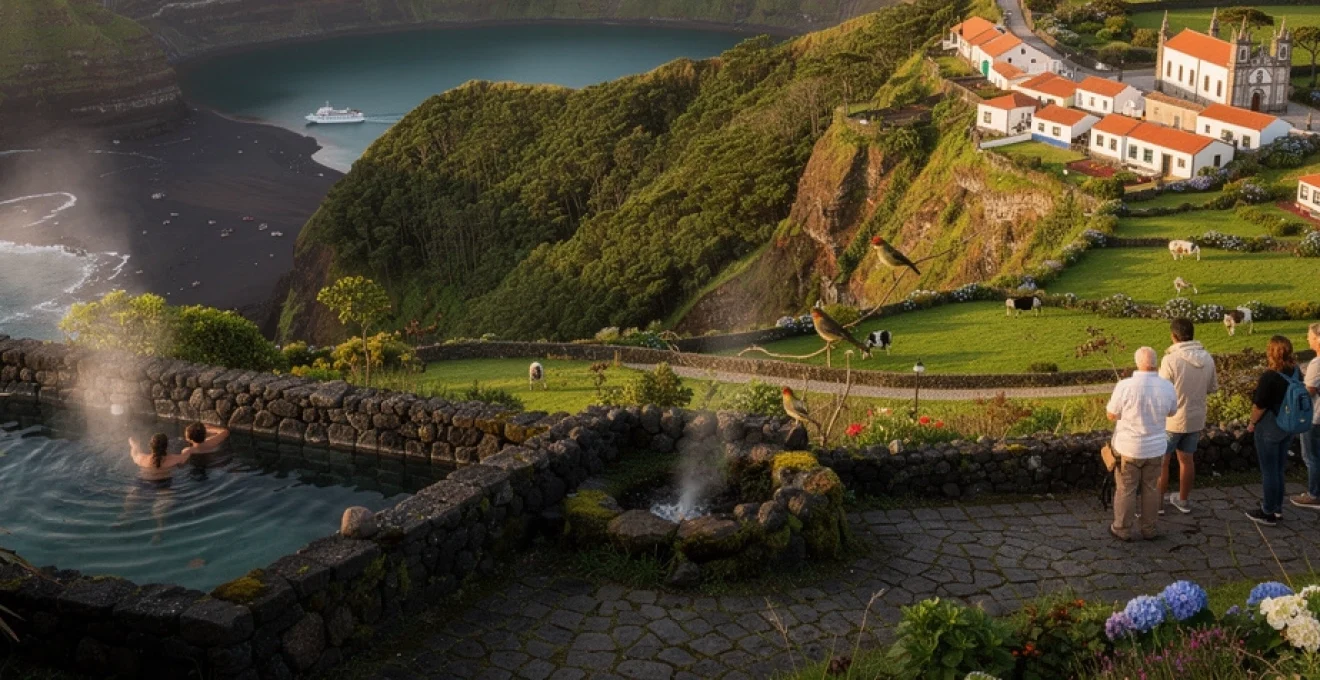
Portugal’s Azores archipelago stands as one of Europe’s most remarkable destinations, a collection of nine volcanic islands scattered across the vast Atlantic Ocean. Located approximately 870 miles west of mainland Portugal, these emerald jewels have captured the imagination of travellers seeking pristine landscapes, authentic culture, and extraordinary natural phenomena. The archipelago’s unique position on the Mid-Atlantic Ridge has created a geological wonderland where active volcanoes, thermal springs, and crystal-clear crater lakes coexist in perfect harmony. From the bustling streets of Ponta Delgada to the remote wilderness of Corvo, each island offers distinct experiences shaped by volcanic forces and centuries of Portuguese heritage. The recent accessibility improvements have opened these Atlantic treasures to discerning visitors, yet the Azores maintain their unspoiled character that makes them increasingly precious in our modern world.
Geological formation and volcanic landscape architecture of the azores archipelago
The Azores archipelago represents one of the most dynamic geological environments in the Atlantic, where three major tectonic plates converge to create a landscape of extraordinary complexity. This volcanic archipelago emerged from the depths of the Atlantic Ocean through millions of years of intense geological activity, positioning itself as a living laboratory for understanding oceanic volcanism and plate tectonics.
Mid-atlantic ridge tectonic activity and hotspot volcanism
The archipelago sits at the unique intersection of the Eurasian, African, and North American tectonic plates, creating the Azores Triple Junction. This geological phenomenon generates continuous volcanic activity through hotspot volcanism, where magma plumes rise from deep within the Earth’s mantle. The western islands of Flores and Corvo rest on the North American plate, while the central and eastern groups lie on the Eurasian and African plates respectively.
Scientists have identified over 1,750 volcanic cones across the nine islands, with 26 major volcanoes classified as potentially active. The geological youth of these formations becomes evident when examining the landscape—sharp volcanic ridges, pristine crater formations, and mineral-rich soils that support the islands’ renowned agricultural productivity. Recent seismic monitoring reveals that the archipelago experiences approximately 2,000 micro-earthquakes annually, most imperceptible to residents but crucial indicators of ongoing geological processes.
Caldeira das sete cidades double crater system on são miguel island
The Sete Cidades caldera on São Miguel represents one of the most spectacular volcanic formations in the Atlantic. This massive crater, measuring approximately 5 kilometres in diameter, contains two interconnected lakes—Lagoa Azul and Lagoa Verde—whose distinct colours create one of Portugal’s most photographed natural phenomena. The caldera formed during a catastrophic volcanic eruption approximately 22,000 years ago, creating the dramatic circular depression visible today.
The colour differential between the lakes results from varying depths and light refraction rather than different mineral compositions, though local folklore attributes the phenomenon to the tears of a princess and shepherd whose love was forbidden. The surrounding rim offers multiple viewpoints, with Vista do Rei providing the most comprehensive panorama of this geological marvel. The caldera floor supports a thriving ecosystem where endemic flora species have adapted to the unique microclimate created by the crater walls.
Pico mountain stratovolcano: portugal’s highest peak at 2,351 metres
Mount Pico dominates the landscape of Pico Island as Portugal’s highest mountain and one of the Atlantic’s most prominent volcanic peaks. This stratovolcano rises directly from sea level to its impressive summit elevation, creating one of the steepest mountain profiles in the world. The volcanic cone continues underwater for another 6,000 metres, making the complete structure among Earth’s tallest mountains when measured from its oceanic base.
The mountain’s geological composition reveals multiple eruption phases spanning thousands of years, with the most recent significant activity occurring in 1718. Climbing enthusiasts face a challenging ascent through four distinct ecological zones, from coastal scrubland to alpine desert conditions near the summit. The peak area features numerous fumaroles—volcanic vents releasing steam and gases—evidence of the ongoing thermal activity within the mountain’s core. Weather conditions change rapidly due to the mountain’s elevation, with summit temperatures often 15-20 degrees Celsius lower than sea level.
Given these conditions, experienced hikers typically begin the climb in the early morning, carrying layered clothing, waterproof gear, and GPS-enabled devices registered with the local mountain association. Guided climbs are recommended, particularly outside the main summer season, as local guides understand the volcano’s fast-changing weather patterns and can help you make the most of sunrise or sunset views over the central group of islands.
Furnas valley geothermal springs and sulphurous thermal pools
On the eastern side of São Miguel, Furnas Valley showcases the Azores’ geothermal activity in its most accessible form. The valley sits atop a complex volcanic system with more than 30 hot springs, fumaroles, and mud pools distributed between the village and Furnas Lake. Visitors immediately notice the distinctive smell of sulphur and see columns of steam rising from the ground, a visual reminder that the magma chamber beneath remains very much alive.
The geothermal field along the shores of Furnas Lake is particularly famous for its use in traditional cooking. Local restaurants bury large metal pots of cozido das Furnas—a rich stew of meats and vegetables—into the hot volcanic soil, where they slowly cook for six to seven hours using nothing but geothermal heat. Walking among the steaming vents, you can watch staff unearth the pots with long iron rods, a striking example of how Azoreans have integrated volcanic energy into daily life for centuries.
Within the village itself, several thermal bathing facilities utilise naturally heated, mineral-rich waters. Temperatures in these pools often range between 35°C and 40°C, ideal for relaxing muscles after a day of hiking São Miguel’s crater lakes. Because geothermal areas are fragile and potentially dangerous, marked paths and viewing platforms guide visitors safely around the fumaroles, and it is important to follow all signage to avoid thin crusts and scalding water.
Faial island’s capelinhos volcano: 1957-1958 eruption impact
Capelinhos Volcano, on the western tip of Faial Island, represents one of the most significant volcanic events in modern Azorean history. Between 1957 and 1958, a submarine eruption just offshore gradually built a new landmass as ash and lava accumulated above the ocean surface. Over 13 months, the eruption buried farmland and houses, forcing the evacuation of hundreds of residents and dramatically altering Faial’s coastline.
The eruption’s legacy is visible today in the stark, lunar-like landscape that contrasts with the island’s otherwise green pastures. Much of the newly formed land has since eroded back into the sea, but the barren ash slopes and collapsed cones remain, creating an open-air classroom for anyone interested in volcanic processes. The nearby Capelinhos Interpretation Centre, built discreetly beneath the ground, offers interactive exhibits, archival footage, and geological models explaining how the eruption unfolded and how the island has slowly stabilised.
For travellers, a walk among the ash fields and up to the old lighthouse—half-buried in volcanic material—can feel like stepping onto another planet. Strong winds and loose gravel make sturdy footwear essential, and visibility can vary with sea fog rolling in from the Atlantic. Yet this desolate beauty underscores a central reality of the Azores: the same forces that created this Atlantic paradise continue to reshape it, sometimes within a human lifetime.
Endemic biodiversity and macaronesian ecological systems
Beyond its dramatic geology, the Azores archipelago forms part of the Macaronesian biogeographical region, alongside Madeira, the Canary Islands, and Cape Verde. This classification reflects a shared heritage of oceanic islands with high endemism, where species have evolved in isolation over millions of years. Although early deforestation and agriculture reduced native forest cover, ambitious conservation programmes over the last three decades have helped restore key habitats and protect rare species.
For nature-focused travellers, exploring these ecosystems offers a chance to see plants and animals found nowhere else on Earth. From mist-shrouded laurel forests to offshore seamounts that attract migrating whales, the Azores function like a living mosaic of micro-habitats. Understanding this ecological richness can also deepen our appreciation of why sustainable tourism and careful trail usage are so important across the islands.
Azores bullfinch conservation on são miguel’s laurisilva forests
One of Europe’s rarest birds, the Azores bullfinch (Pyrrhula murina), survives only in a small area of eastern São Miguel. This critically endangered species depends on remnants of native laurisilva (laurel forest), a humid, evergreen woodland once widespread across the Azores. For much of the 20th century, habitat loss and invasive plants pushed the bullfinch to the brink of extinction, with estimates in the 1990s suggesting fewer than 400 individuals remained.
Conservationists responded with intensive habitat restoration in the Serra da Tronqueira and Pico da Vara region. Projects focused on removing invasive species such as ginger lily and Japanese cedar, replanting native shrubs and trees, and managing grazing pressure. As a result, recent surveys indicate a gradual recovery of the bullfinch population, with numbers now believed to exceed 1,000 individuals, though the species remains highly vulnerable.
Today, guided birdwatching tours along designated trails provide responsible ways to encounter this elusive finch. Because the laurisilva environment is extremely sensitive, visitors are encouraged to stay on marked paths, minimise noise, and avoid visiting during severe weather when erosion risks increase. In this way, you can enjoy world-class birding in the Azores while supporting the long-term survival of its most iconic endemic species.
Terra nostra botanical garden: rare species preservation programme
Terra Nostra Park in Furnas, São Miguel, is widely regarded as one of the finest botanical gardens in the Atlantic. Established in the 18th century as a private estate, it has evolved into a 12-hectare sanctuary housing thousands of plant species from temperate and subtropical regions. Meandering paths lead through collections of camellias, cycads, ferns, and endemic Azorean flora, all set around a large, ochre-coloured thermal pool fed by geothermal springs.
In recent decades, the garden has expanded its role from ornamental display to active conservation. Collaborating with regional universities and environmental agencies, Terra Nostra participates in seed banking, propagation of threatened island species, and trials to understand how Azorean plants respond to shifting climate patterns. For travellers, this means you are not simply strolling through a picturesque park; you are walking through a living laboratory dedicated to preserving Atlantic island biodiversity.
Practical considerations include advance reservations during peak season and respect for plant collections—many beds contain fragile or slow-growing specimens. Swimming in the thermal pool is a highlight for many visitors, but the mineral-rich waters can stain light-coloured swimwear, so bringing darker clothing is advisable. Combining a visit to Terra Nostra with nearby geothermal fields creates an ideal day trip focused on both the botanical and volcanic heritage of São Miguel.
Marine protected areas and sperm whale migration corridors
Surrounded by deep ocean trenches and underwater seamounts, the Azores archipelago occupies a strategic position along major marine migration routes. The islands’ nutrient-rich waters form critical habitat for at least 28 species of whales and dolphins, including sperm whales (Physeter macrocephalus) that reside here year-round. Historically, these animals were hunted from shore-based whaling stations; today, the same vantage points are used for sustainable whale-watching operations.
To safeguard these marine ecosystems, the regional government has established several Marine Protected Areas (MPAs), such as the Princesa Alice Bank and Formigas Islets. These zones restrict certain fishing practices and regulate maritime traffic to reduce disturbance to cetaceans, seabirds, and sensitive coral communities. For example, whale-watching vessels must follow strict codes of conduct, including minimum approach distances, time limits with each group of animals, and caps on the number of boats present at any one sighting.
If you join a whale-watching tour from islands like Pico, Faial, or São Miguel, you are likely to see not only sperm whales but also common dolphins, bottlenose dolphins, and, in certain seasons, migrating baleen whales such as blue or fin whales. Choosing operators that emphasise research collaboration and environmental education ensures your excursion contributes to ongoing monitoring efforts rather than merely viewing wildlife as a spectacle.
Endemic flora: azorean heather and picconia azorica distribution
On land, the Azores’ vegetation reflects a mix of ancient native species and more recent introductions from Europe, Africa, and the Americas. Among the most characteristic native plants are Azorean heathers, particularly Erica azorica, which form dense, wind-sculpted shrubs on high-altitude ridges and crater rims. Their twisted trunks and compact foliage testify to centuries of adaptation to salt-laden winds and frequent mist.
Another emblematic tree is Picconia azorica, sometimes called the Azorean olive, once abundant in lowland laurel forests and now confined to protected pockets on islands such as São Miguel, Terceira, and Pico. Extensive clearing for agriculture, combined with competition from invasive species, has dramatically reduced its range. Current restoration projects aim to reintroduce Picconia into suitable habitats, both to bolster biodiversity and to recreate the structural complexity of original forests.
As you hike along marked trails, you may notice interpretive panels highlighting these and other endemic species. Paying attention to these signs turns a simple walk into a deeper exploration of island evolution—like reading chapters of a natural history book written in leaves and bark. Respecting guidelines against collecting plants or seeds helps ensure that these rare species remain part of the Azorean landscape for generations to come.
Island-specific tourism infrastructure and accessibility networks
Because the Azores are scattered across hundreds of kilometres of Atlantic Ocean, efficient transport and thoughtfully scaled infrastructure are essential for sustainable tourism. Over the past decade, investments in regional airports, ports, and road networks have made inter-island travel more reliable while still preserving the archipelago’s remote character. Rather than mega-resorts, you will find small guesthouses, eco-lodges, and family-owned hotels integrated into existing villages.
Planning an Azores itinerary therefore often involves balancing flight schedules, ferry routes, and seasonal variations in service. While this may seem complex at first glance, the reward is a style of travel that feels slower and more intentional. You are encouraged to linger on each island, explore local trails, and connect with resident communities rather than rushing from sight to sight.
João paulo ii airport terceira: trans-atlantic aviation hub
Terceira Island plays a pivotal role in the Azores’ air connectivity, thanks to Lajes/João Paulo II Airport near Angra do Heroísmo and Praia da Vitória. Historically used as a strategic military base during World War II and the Cold War, Lajes has long served as a refuelling point for trans-Atlantic flights. Today, its dual-use infrastructure supports both military and civilian operations, with regular connections to mainland Portugal and seasonal flights from North America and other European destinations.
For travellers, Terceira can function as an alternative gateway to the archipelago, particularly when seeking multi-island itineraries that combine cultural heritage with outdoor activities. The runway’s length and facilities allow it to accommodate larger aircraft than some of the smaller island airports, improving reliability during periods of adverse weather. However, like all Atlantic airports, operations remain sensitive to fog and crosswinds, so building some flexibility into your schedule is wise.
Once on Terceira, visitors benefit from a well-maintained road network connecting the airport to Angra do Heroísmo, a UNESCO-listed city, and to rural areas dotted with volcanic cones and coastal viewpoints. Renting a car is the most practical way to explore, though local taxis and organised tours provide alternatives for those who prefer not to drive.
Inter-island ferry services via atlânticoline maritime network
Complementing air travel, the Atlânticoline ferry network links many of the Azores’ islands, particularly within the central group. Modern catamarans operate regular routes between Faial (Horta), Pico (Madalena and São Roque), and São Jorge (Velas), with seasonal extensions to Terceira and Graciosa. Crossing times can be as short as 30 minutes between Faial and Pico, making day trips and multi-island stays both feasible and enjoyable.
Because the Atlantic can produce sudden swells and strong winds, ferry schedules are occasionally adjusted or cancelled for safety reasons. Booking tickets in advance—especially in July and August—helps secure your preferred departure times, but it is also important to monitor updates close to travel dates. Motion sickness tablets and warm layers are useful additions to your packing list, as sea conditions may change several times during a single crossing.
For many visitors, travelling by ferry is not just a means of transport but an experience in itself. Standing on deck, you can watch Pico’s volcanic cone rise from the sea, spot dolphins surfing the bow wave, and appreciate how isolated each island once was before modern infrastructure shrank the distances between them.
São miguel’s thermal resort infrastructure at furnas lake
São Miguel, as the largest and most populated island, offers the most developed tourism infrastructure in the Azores, and Furnas Lake stands out as a focal point for thermal wellness experiences. Around the lake and in the nearby village, a cluster of hotels, guesthouses, and spa facilities harness geothermal resources through carefully managed boreholes and natural springs. This has transformed Furnas into a year-round destination for health-focused travellers.
Thermal complexes such as those near Furnas Lake typically feature a mix of outdoor pools, jacuzzis, and wellness treatments utilising mineral-rich mud and waters. Temperature controls and continuous monitoring ensure that pools remain comfortable and safe, while filtration systems help maintain high water quality despite the naturally high iron content that gives the water its characteristic colour. Many resorts also incorporate native vegetation into their landscaping, blending built structures with the surrounding volcanic scenery.
To make the most of these facilities, it is advisable to reserve time slots during high season and to follow on-site guidelines regarding bathing duration, particularly if you have cardiovascular conditions. Combining a morning hike along the lake’s perimeter trail with an afternoon soak offers one of the most rewarding ways to engage with São Miguel’s volcanic landscape.
Flores island unesco biosphere reserve eco-tourism facilities
At the western edge of the Azores, Flores Island has been designated a UNESCO Biosphere Reserve since 2009, recognising both its exceptional natural beauty and its community-led conservation efforts. The island’s rugged cliffs, numerous waterfalls, and crater lakes required a sensitive approach to tourism development, favouring small-scale accommodations and low-impact activities over mass infrastructure. As a result, Flores feels particularly untouched, even during the busier summer months.
Eco-lodges, restored stone cottages, and family-run guesthouses form the backbone of the island’s hospitality sector. Many properties implement rainwater harvesting, solar power, and local sourcing of food to reduce environmental footprints. Waymarked hiking trails—such as those connecting the central lakes to coastal villages like Fajã Grande—are regularly maintained but intentionally limited in number to prevent overuse of fragile habitats.
Visitors are encouraged to adopt a “leave no trace” ethic, carrying out all waste, avoiding shortcuts on trails, and respecting seasonal restrictions on access to nesting areas for seabirds. In exchange, you gain access to some of the most dramatic scenery in the Azores, where misty plateaus, basalt cliffs, and ocean views combine in a landscape that feels far removed from everyday life.
Traditional azorean gastronomy and agricultural heritage systems
Azorean cuisine reflects the archipelago’s volcanic soils, oceanic location, and centuries of agricultural adaptation. Rich pastures produce exceptionally tender beef and high-quality dairy products, while surrounding waters yield tuna, limpets, barnacles, and a variety of deep-sea fish. Many traditional dishes arose from the need to preserve food for long Atlantic crossings, resulting in hearty stews, cured meats, and robust cheeses that still feature on local menus today.
On São Miguel, pineapple plantations grown in greenhouses, tea fields at Gorreana and Porto Formoso, and sweet potatoes from fertile lowlands illustrate how farmers have harnessed microclimates created by varying elevations and volcanic slopes. Pico and Terceira are renowned for their wines and fortified spirits, produced from vines cultivated in stone-walled plots that protect them from wind and salt spray. This unique viticultural landscape on Pico is recognised as a UNESCO World Heritage Site.
Signature dishes include cozido das Furnas, cooked in geothermal vents; alcatra, a slow-braised beef stew from Terceira baked in clay pots; grilled lapas (limpets) with garlic and lemon; and fresh tuna steaks seared quickly over charcoal. On São Jorge, the island’s namesake cheese—semi-hard, tangy, and aromatic—pairs perfectly with local bread and homemade jams. When you dine in the Azores, you are not simply tasting food; you are experiencing the outcome of centuries of experimentation with volcanic terrain and Atlantic weather.
Atlantic maritime climate patterns and seasonal weather dynamics
The Azores enjoy a mild, maritime climate shaped by the surrounding Atlantic and the influence of the Azores High, a semi-permanent high-pressure system. Average temperatures typically range from 14°C in winter to 24°C in summer, with relatively small variations between day and night. High humidity and frequent cloud cover help keep landscapes lush year-round, turning the islands into a patchwork of green fields, forests, and flower-lined roads.
Rainfall is distributed across all seasons but tends to peak between November and February, especially at higher elevations. Summer months are generally drier and more stable, though brief showers and rapid shifts between sun and mist are common—locals often joke that you can experience four seasons in a single day. This variability benefits hikers and photographers, as changing light and cloud formations can dramatically transform views of crater lakes and coastal cliffs within minutes.
For travel planning, late spring (May and June) and early autumn (September) often offer the best balance of pleasant temperatures, manageable visitor numbers, and relatively calm seas for inter-island crossings. Regardless of season, packing layers, a waterproof jacket, and sturdy footwear is essential. By embracing the archipelago’s dynamic weather rather than resisting it, you gain a deeper appreciation of how wind, rain, and sun continually sculpt the Azores’ volcanic landscapes.
Cultural heritage sites and portuguese colonial architecture legacy
Beneath the wild scenery of the Azores lies a rich cultural layer shaped by five centuries of Portuguese settlement, Atlantic trade, and religious tradition. Whitewashed churches, basalt-framed houses, and cobbled squares reveal how colonists adapted mainland architectural styles to a volcanic context. The black-and-white pavements of Ponta Delgada and other towns echo the designs of Lisbon, yet the use of local stone and compact urban layouts reflect island-specific needs.
Angra do Heroísmo on Terceira stands as the clearest example of this heritage, recognised as a UNESCO World Heritage Site for its well-preserved Renaissance street plan and historic fortifications. During the Age of Discovery, Angra served as a crucial stopover for fleets returning from the Americas and India, which is why it boasts grand merchant houses, monasteries, and defensive forts oriented towards the harbour. Walking through its grid of streets, you can trace the evolution from maritime stronghold to modern administrative centre.
Elsewhere in the archipelago, smaller towns such as Horta on Faial, Velas on São Jorge, and Lajes on Pico preserve their own interpretations of Portuguese colonial architecture. Maritime murals in Horta’s marina testify to its role as a crossroads for trans-Atlantic sailors, while tiny chapels with brightly painted interiors dot rural landscapes, offering spiritual anchors for farming communities. Traditional festivals, often tied to religious calendars and the sea, animate these spaces with processions, music, and local cuisine.
By combining visits to natural landmarks with time in historic centres, you gain a fuller understanding of the Azores as both a geological and cultural crossroads. The same Atlantic that brought magma to the surface also carried explorers, traders, and ideas, leaving behind an architectural legacy that continues to evolve as the islands move cautiously into a new era of sustainable tourism.