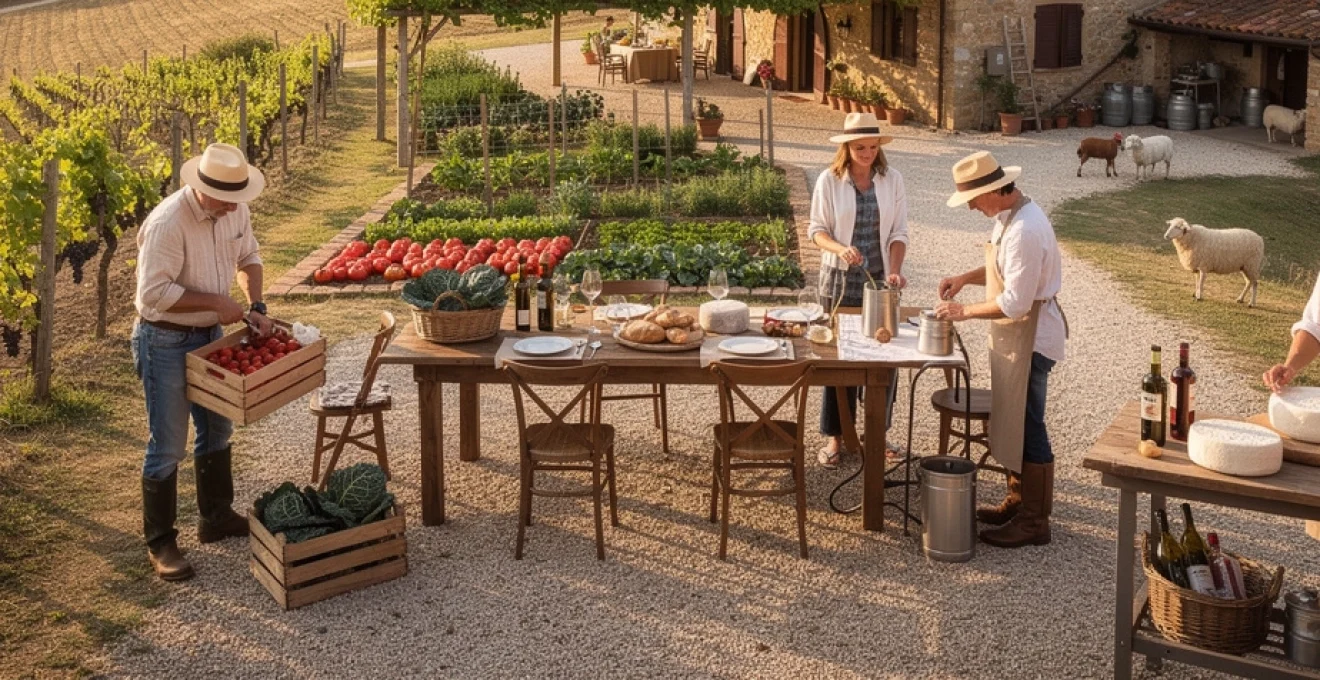
The rolling hills of Tuscany have long captivated travellers seeking more than superficial tourism—those yearning for genuine connection with Italy’s agricultural heritage and rural traditions. Beyond the Renaissance art and medieval towers lies a landscape shaped by generations of farming families, where ancient olive groves cascade down sun-drenched slopes and vineyard-covered valleys produce some of the world’s finest wines. This agricultural heartland offers visitors an opportunity to step away from crowded tourist circuits and immerse themselves in the authentic rhythms of Italian countryside living, where seasonal harvests dictate daily routines and meals emerge directly from the surrounding land.
Farm stays in Tuscany represent far more than accommodation—they provide portals into a way of life increasingly rare in our fast-paced modern world. Whether you’re pressing olives into golden oil, hand-rolling pasta with a farmer’s wife, or simply watching the evening light transform the Chianti hills into shimmering gold, these experiences connect you to traditions that have endured for centuries. The question isn’t whether to visit Tuscany, but rather how to experience it most authentically, in a manner that honours both the land and the people who cultivate it.
Understanding agriturismo regulations and authentic farm stay classifications in tuscany
Navigating the world of Tuscan farm stays requires understanding a regulatory framework that protects both visitors and the agricultural integrity of these working estates. The term “agriturismo” isn’t simply marketing language—it’s a legally defined designation with specific requirements that distinguish authentic farm operations from countryside hotels masquerading as rural experiences.
Italian agriturismo legislation: requirements for working farm operations
Italian law, specifically Regional Law 30/2003 in Tuscany, established clear parameters for what constitutes a legitimate agriturismo. These regulations mandate that any property claiming agriturismo status must derive the majority of its income—at least 51%—from agricultural activities rather than tourism. This fundamental requirement ensures that these establishments remain working farms first and guest accommodations second, preserving the authentic agricultural character that makes them special.
The legislation further specifies that farm products served to guests must predominantly come from the estate itself or from neighbouring farms within the same region. This requirement creates the foundation for genuine farm-to-table experiences, where the olive oil drizzled over your morning bruschetta was pressed from fruit harvested mere metres from your room, and the wine accompanying dinner fermented in the cellar beneath the dining hall. Properties must also limit their accommodation capacity—typically to a maximum of thirty guests—preventing the transformation of intimate farm experiences into impersonal hotel operations.
Denominazione comunale di origine (DCO) certified agriturismi standards
Beyond basic agriturismo requirements, some Tuscan farm stays carry additional certifications that signal exceptional quality and authenticity. The Denominazione Comunale di Origine (DCO) certification represents a municipal-level quality guarantee, verifying that products originate from specific territories and adhere to traditional production methods. When you encounter a DCO-certified agriturismo, you’re assured that the estate maintains rigorous standards for both agricultural practices and guest experiences.
These certified properties undergo regular inspections verifying everything from soil management techniques to animal welfare standards. They must demonstrate commitment to preserving local agricultural traditions, whether that involves maintaining heritage grape varieties, employing traditional cheese-aging methods, or cultivating heirloom vegetable species. For discerning travellers, DCO certification serves as a reliable indicator that you’ve found an establishment genuinely invested in authentic rural traditions rather than tourist theatre.
Differentiating between commercial hotels and registered poderi farm estates
The Tuscan countryside contains numerous accommodation options, but not all rural properties qualify as authentic agriturismi. Understanding these distinctions helps you select experiences aligned with your expectations. A podere—the traditional Tuscan term for a farm estate—typically encompasses agricultural land, production facilities, and residential structures historically occupied by farming families. When converted to guest accommodation while maintaining active agricultural operations, these become legitimate agriturismi.
Conversely, many beautifully restored countryside villas operate as boutique hotels or rental properties without any agricultural component. These establishments may offer stunning views and comfortable accommodation but lack the working-
agricultural backbone that defines true Tuscan farm stays. They might brand themselves as “country resorts” or “rural retreats,” but without cultivated fields, vineyards, olive groves, or livestock, they fall outside the agriturismo classification.
When choosing between these options, consider what you want from your time in the Tuscan countryside. If your priority is spa treatments, infinity pools, and designer interiors, a countryside hotel or villa may be the better fit. If, however, you want to wake to the sound of tractors in the fields, smell must from the cellar during harvest, or watch sheep being driven in at dusk, look specifically for registered poderi or azienda agricola properties listed as agriturismi in regional registers. Checking whether the estate sells its own labelled products—olive oil, wine, honey, flour—can be another useful shortcut to identifying a genuine farm stay.
Organic certification standards: ICEA and CCPB accredited tuscan farms
Many travellers seeking an authentic farm stay in Tuscany are equally interested in sustainable, environmentally conscious agriculture. In Italy, organic certification is rigorously controlled, and two of the most widely recognised certifying bodies you’ll encounter on Tuscan farms are ICEA (Istituto per la Certificazione Etica e Ambientale) and CCPB (Consorzio per il Controllo dei Prodotti Biologici). These organisations audit farms annually to verify that cultivation practices comply with EU organic regulations, from soil management to pest control.
On a practical level, staying on an ICEA- or CCPB-certified organic agriturismo means the vegetables in your ribollita were grown without synthetic pesticides, the grapes in your Chianti were cultivated with natural fertilisers, and any animal products you consume come from livestock raised according to strict welfare standards. Certification also extends beyond fields and barns: it can include energy use, waste management, and even cleaning products used in guest rooms. If organic living and low-impact travel matter to you, incorporating these labels into your search criteria will help you identify agriturismi aligned with your values.
Prime tuscan regions for immersive farm stay experiences
Once you understand what defines an authentic agriturismo, the next step is choosing where in Tuscany to stay. The region stretches from Apennine mountains to Tyrrhenian coast, and each area offers distinct landscapes, agricultural traditions, and farm stay experiences. Do you picture yourself among iconic cypress-lined roads, or are you more intrigued by wild coastal marshes and cattle ranches? Your answer will guide which Tuscan territory best matches your ideal countryside escape.
Val d’orcia UNESCO heritage zone: podere estates in pienza and montalcino
The Val d’Orcia, a UNESCO World Heritage landscape south of Siena, is perhaps the most photographed countryside in Italy. Here, soft clay hills, isolated farmhouses, and sinuous lines of cypress trees form a tableau that feels almost theatrical. Traditional poderi in this area typically combine cereal fields, olive groves, and vines, with many estates producing Brunello di Montalcino, Rosso di Montalcino, and Vino Nobile di Montepulciano alongside olive oil and grains.
Choosing a farm stay near Pienza, Montalcino, or San Quirico d’Orcia gives you front-row access to these landscapes as they change through the seasons—from emerald green in spring to wheat-gold in early summer and burnt sienna after harvest. Many agriturismi here are centuries-old stone farmhouses renovated with respect for original architecture: think terracotta floors, wooden beams, and internal courtyards protected from the wind. Beyond postcard views, you’ll also find strong culinary traditions centred on pecorino cheese from Pienza, hearty soups, game meats, and robust red wines that pair perfectly with cool evenings on the terrace.
Chianti classico wine territory: farm stays between greve and castellina
Between Florence and Siena lies the Chianti Classico zone, a mosaic of vineyards, oak forests, and medieval hilltop villages. For many visitors, this area epitomises the idea of a Tuscan vineyard stay. Agriturismi between Greve, Radda, Castellina, and Gaiole often form part of working aziende agricole that have produced wine and olive oil for generations. Here, you can witness the full cycle of Sangiovese grapes, from pruning in winter to harvest in late September and fermentation in historic stone cellars.
Staying on a Chianti wine estate allows you to explore the countryside on foot or by bike between small villages, visit family-run wineries, and join tastings where winemakers explain differences between vineyard parcels and vintages. Many Chianti agriturismi also offer cooking classes focused on cucina contadina—peasant-style dishes that historically sustained local farming families. If you’re drawn to the idea of sipping a glass of Chianti Classico while overlooking the very rows that produced it, this territory is a natural choice for your Tuscan farm stay.
Maremma coastal plains: working cattle ranches and olive groves near grosseto
For a wilder, less manicured version of the Tuscan countryside, head southwest to the Maremma near Grosseto. Once a malarial marshland, this area was reclaimed in the twentieth century and now supports extensive cattle ranches, organic farms, and vast olive groves. Here you might stay on an agriturismo where butteri—Tuscan cowboys—still work Maremma cattle, or on an estate that alternates cereal crops with sunflower fields and pasture.
Farm stays in the Maremma often combine rural life with easy access to the Tyrrhenian Sea, natural parks, and Etruscan archaeological sites. You could spend the morning helping with olive harvest or observing cheese-making, then drive 20–30 minutes to swim along the Parco dell’Uccellina coast in the afternoon. Compared with central Tuscany, this area sees fewer international visitors, so experiences can feel more intimate and less structured. If you’re looking for an agriturismo that combines agriculture, nature reserves, and coastal escapes, the Maremma offers a compelling mix.
Mugello valley agricultural heartland: traditional farmhouses north of florence
North of Florence, the Mugello valley presents a greener, cooler version of Tuscan rural life. This fertile basin, framed by the Apennines, has long supplied Florence with grain, milk, meat, and vegetables. Agriturismi here tend to focus less on wine and more on mixed farming: dairy cattle, sheep, cereal crops, potatoes, chestnuts, and extensive vegetable gardens. Architecture feels sturdier and more alpine-influenced, with stone farmhouses designed to withstand colder winters.
Choosing a farm stay in Mugello suits travellers who want to combine countryside relaxation with day trips to Florence, which is typically under an hour away by car. You might spend one day exploring Renaissance art, then return to help collect eggs or join a rustic cooking class focused on polenta, stews, and hearty baked dishes. Because the Mugello sits at higher altitude, temperatures remain more comfortable in July and August than in lowland areas—an important consideration if you’re planning a summer agriturismo holiday in Tuscany.
Lucchesia hills: chestnut flour mills and mountain agriturismi near lucca
The hills north and east of Lucca—often referred to as the Lucchesia and Garfagnana—offer yet another facet of Tuscan farm life, shaped by chestnut forests, terraced olive groves, and small mountain villages. For centuries, chestnuts were a staple food here, ground into flour at water-powered mills to make breads, cakes, and pasta. Several agriturismi in this area maintain or collaborate with traditional mills, allowing guests to see chestnut flour production firsthand and taste recipes you’ll rarely encounter elsewhere in Italy.
A farm stay near Lucca also gives you easy access to the walled Renaissance city for day trips, while providing a tranquil retreat in the hills at night. Many estates combine small-scale viticulture and olive cultivation with orchards, chestnut groves, and woodland. Hiking trails often start directly from the property, leading to Romanesque churches, ancient bridges, and panoramic viewpoints. If your vision of a Tuscan farm stay includes stone hamlets, chestnut pancakes (necci), and cool mountain air, the Lucchesia hills are well worth considering.
Hands-on agricultural activities and seasonal farm work programmes
One of the defining features of a true farm stay in Tuscany is the opportunity to engage directly with agricultural life. Rather than watching from a distance, many agriturismi invite guests to join daily routines and seasonal tasks in a structured, safe way. These activities aren’t staged performances; they follow the real agricultural calendar, which means your experience in March will differ entirely from one in October. This is where the concept of “living Tuscany, not just visiting it” becomes most tangible.
Vendemmia grape harvesting: september wine production participation
If you’ve ever imagined snipping bunches of ripe grapes with morning mist still hanging over the vines, the vendemmia—grape harvest—is your moment. In most of Tuscany, harvest runs from mid-September to early October, depending on altitude, grape variety, and weather conditions. Many vineyard agriturismi offer structured participation days or half-days, where guests can help collect grapes under supervision, learn how to handle bunches without bruising the fruit, and follow the first steps of fermentation in the cellar.
For safety and quality reasons, you won’t be turned loose on premium vineyard parcels unsupervised, but you may be invited to work alongside regular staff in designated rows. Afterwards, some estates host simple harvest lunches: long tables set up outdoors with seasonal dishes, new oil, and of course, estate wine. It’s hard to find a more direct connection between landscape and glass than tasting last year’s vintage while helping to harvest the grapes that will become the next. If grape picking sounds physically demanding, you can often opt instead to join guided cellar tours focused on fermentation, barrel ageing, and blending.
Frantoio olive oil pressing: november cold-press extraction workshops
From late October into November, olive groves across Tuscany come alive with another essential harvest. Extra-virgin olive oil is as central to Tuscan farm life as wine, and the annual trip to the frantoio (olive mill) is almost a ritual. Some agriturismi operate their own small press, while others collaborate with local mills, organising visits and hands-on workshops for guests. You may start in the grove, learning how to hand-pick or comb olives from branches, before following crates of fruit to the mill.
At the frantoio, you’ll see how olives are cleaned, crushed, kneaded, and finally separated into oil and water using modern centrifuges. Workshops often include tastings that teach you to distinguish fresh, high-quality oil—peppery, bitter, intensely green—from older or industrial versions. Think of this as a crash course in reading olive oil the way you might read wine: colour, aroma, mouthfeel, and finish all tell a story. Many guests leave with a new appreciation for that green-gold drizzle over bruschetta and a determination never again to underestimate the complexity of a good Tuscan extra virgin.
Pecorino cheese making: traditional caseificio techniques with raw sheep’s milk
Cheese-making remains one of the most fascinating and tactile farm experiences in Tuscany, particularly in regions like the Val d’Orcia and Maremma where sheep farming is prevalent. Small caseifici (cheese dairies) attached to agriturismi often run workshops showing how local pecorino evolves from warm, raw sheep’s milk into firm wheels aged in caves or cellars. Under the guidance of an artisan cheesemaker, you might observe or help with milk heating, rennet addition, curd cutting, moulding, and salting.
Because full maturation takes weeks or months, you won’t see the entire process from start to finish during a single stay, but many workshops include tastings of cheeses at different ages. This allows you to compare fresh, soft pecorino used in salads with semi-aged and fully aged versions best suited for grating or pairing with honey and jams. For families, watching curds separate and transform into something tangible can be especially engaging—like a chemistry lesson you can eat. If hygiene rules restrict direct handling, you’ll still be able to stand close enough to observe every stage in detail.
Vegetable garden cultivation: heirloom tomato and cavolo nero harvesting
Not every farm activity involves machinery, cellars, or processing rooms. Many agriturismi maintain extensive orto (vegetable gardens), where guests are welcome to help with planting, weeding, or harvesting, depending on the season. In late spring and summer, this might mean picking sun-warmed heirloom tomatoes, zucchini flowers, and basil destined for that evening’s dinner. In autumn and winter, you could help harvest cavolo nero (Tuscan black kale), leeks, and root vegetables for soups and stews.
Joining the work in the orto is often where children feel most at ease, as tasks can be adapted to small hands and shorter attention spans. It’s also an excellent way for adults to reconnect with the origins of everyday ingredients. Have you ever tasted a tomato minutes after it left the vine, or pulled your own carrots from rich Tuscan soil? These simple, tactile experiences often linger longer in memory than more elaborate activities, and they embody the slow-travel philosophy that underpins the best farm stays in Tuscany.
Traditional tuscan farmhouse architecture and rural property types
Part of the charm of agriturismi in Tuscany lies in the buildings themselves. Traditional farmhouses were designed not for aesthetics but for function: to house families, animals, tools, and harvests under one roof or within a compact cluster. Over centuries, these practical structures evolved into a distinct architectural language—one that modern restorations often preserve while quietly integrating contemporary comforts like underfloor heating and Wi‑Fi.
Classic Tuscan farmhouses are typically constructed in local stone or brick, with thick walls that buffer summer heat and winter cold. Roofs are covered in terracotta tiles, and interiors feature exposed wooden beams, vaulted ceilings, and simple, durable finishes. Many properties include separate outbuildings—former stables, granaries, or tobacco drying houses—now converted into guest apartments. When you stay in such a place, you’re not just occupying a room; you’re inhabiting a building that once stored hay, sheltered oxen, or housed seasonal workers.
You’ll also encounter different rural property types depending on region. In central Tuscany, the casa colonica (farmhouse) usually sits amid its own fields, while in Chianti and Val d’Orcia larger poderi may form small clusters of buildings that functioned almost like mini-hamlets. In the Maremma, some estates grew around fattorie (farm complexes) that coordinated work over large tracts of land. When evaluating farm stays, pay attention to how restorations have handled these original layouts. The most sensitive projects retain shared courtyards, ovens, and loggias, creating natural spaces for guests to meet and for property owners to share stories about the building’s past.
Farm-to-table dining: authentic cucina contadina and zero-kilometre cuisine
One of the greatest pleasures of a farm stay in Tuscany is eating food that has travelled mere metres, not miles, to reach your plate. Many agriturismi embody the concept of cucina contadina—peasant cooking—where dishes are simple, seasonal, and rooted in what the farm actually produces. Rather than elaborate restaurant-style plating, you’ll more likely encounter robust soups, slow-cooked meats, grilled vegetables, and generous use of olive oil and herbs. This is “zero‑kilometre” cuisine in practice: wheat from the farm milled nearby becomes bread, tomatoes from the garden become sauce, and eggs collected at dawn enrich fresh pasta by midday.
Typical menus reflect both regional specialities and the micro‑traditions of each valley. In the Chianti hills, you might start with crostini topped with chicken liver pâté and end with cantucci biscuits dipped in Vin Santo dessert wine produced on the estate. In the Val d’Orcia, dinners often highlight pecorino cheese, wild boar ragù, and soups like pici all’aglione (thick hand-rolled pasta with garlic and tomato sauce). Many agriturismi offer optional communal dinners a few times per week, creating opportunities to share long tables with other guests and enjoy the sort of unhurried, conversational meals that Italians themselves treasure.
Interested in learning how to recreate these flavours at home? Numerous farm stays run informal cooking classes where you can knead dough for pici, assemble seasonal vegetable tarts, or practice folding tortelli filled with local ricotta and herbs. Think of these workshops as an extension of dinner rather than a separate attraction: you’re not just following recipes, but understanding why certain ingredients, techniques, and combinations evolved in rural Tuscany. When you later cook these dishes in your own kitchen, they’ll carry memories of the specific farmhouse table, valley, and season in which you first tasted them.
Booking strategies and seasonal pricing for tuscan agriturismi accommodation
Because agriturismi follow the rhythm of the agricultural year, availability, pricing, and even the type of experiences offered can vary significantly by season. Understanding these patterns helps you choose the right time to visit and secure the farm stay that best matches your priorities and budget. It’s a bit like planning a harvest: the more you understand cycles and timing, the richer your eventual yield.
High season in most of Tuscany runs from late May through September, with July and August the busiest—and most expensive—months. During this period, many agriturismi prefer week‑long Saturday‑to‑Saturday bookings, especially those with self‑catering apartments and pools. If your dates are fixed, aim to book 4–6 months in advance for peak periods, particularly in iconic areas such as Chianti and Val d’Orcia. Shoulder seasons—April to early May and October to early November—offer a sweet spot of lower prices, fewer crowds, and rich agricultural activity, including the grape and olive harvests.
Winter, from late November through March, brings the lowest rates and quietest atmosphere, though some properties close entirely or reduce services. In this period, focus on agriturismi that emphasise indoor comforts: fireplaces, hearty meals, and perhaps cooking classes, rather than pools and outdoor activities. Whatever the season, remember that many smaller, family‑run farms still manage bookings directly and may not appear on every global platform. Don’t hesitate to email or call; personalised communication can clarify what’s included in rates (breakfast, dinner options, activities) and sometimes uncover flexible discounts for longer stays or midweek arrivals.
When comparing prices, look beyond nightly rates to the overall value of the experience. Does the agriturismo include breakfast made from estate products? Are farm tours, tastings, or use of bikes complimentary or charged separately? Is there a minimum stay in high season, and what is the cancellation policy if your plans change? By weighing these elements carefully and aligning them with your expectations—whether that’s daily farm involvement, easy day trips to cities, or pure relaxation—you’ll be well placed to choose a Tuscan farm stay that delivers both authenticity and excellent value for your countryside holiday.