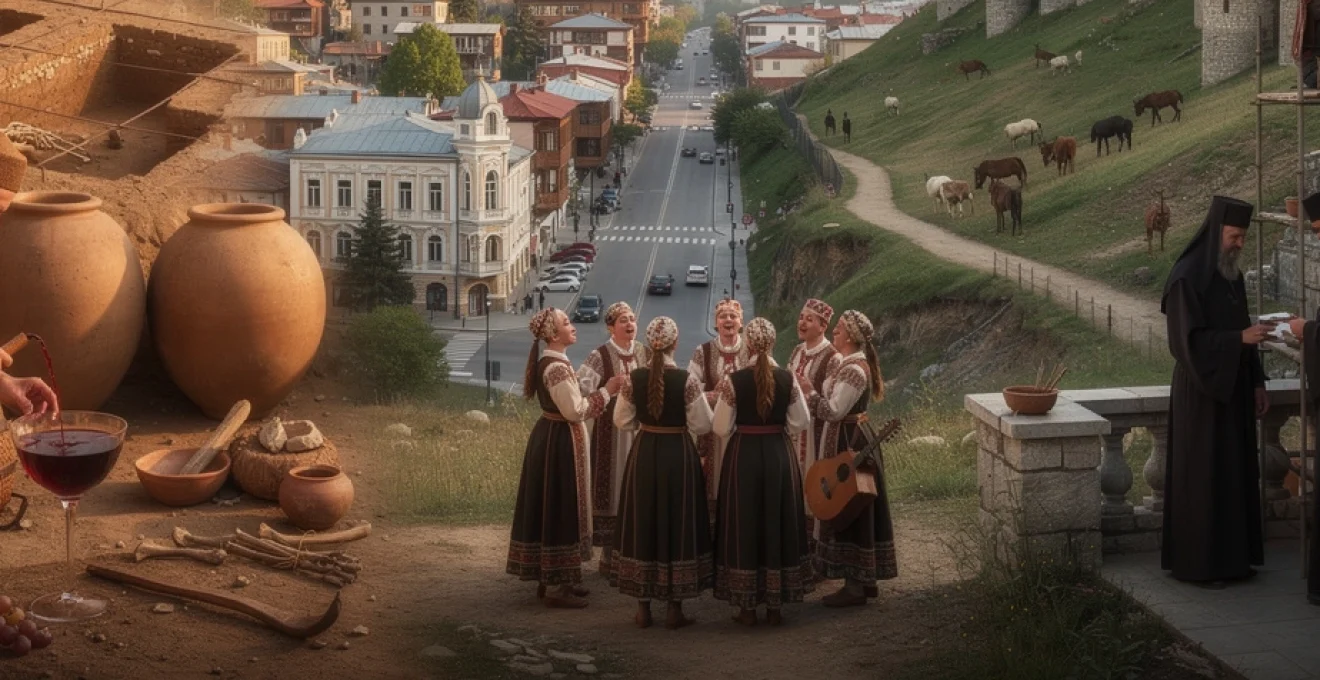
Nestled between Europe and Asia at the crossroads of ancient civilisations, Georgia emerges as one of Europe’s most underappreciated cultural treasures. This Caucasus nation harbours archaeological wonders spanning nearly two million years, from the world’s earliest human settlements outside Africa to medieval cave cities carved into cliffsides. Beyond its dramatic mountain landscapes and legendary hospitality, Georgia preserves cultural traditions that predate Christianity whilst simultaneously embracing contemporary artistic renaissance. The country’s unique position has fostered a remarkable synthesis of influences—Persian, Byzantine, Ottoman, and Soviet—creating a distinctive cultural identity that remains largely undiscovered by mainstream European tourism.
Ancient colchis legacy: archaeological evidence of europe’s earliest wine civilisation
The ancient kingdom of Colchis, immortalised in Greek mythology as the destination of Jason’s quest for the Golden Fleece, represents far more than legendary tales. Archaeological evidence reveals Georgia as the birthplace of European viticulture, with wine production techniques dating back 8,000 years. This extraordinary longevity positions Georgian wine culture as humanity’s oldest continuous viticultural tradition, predating Mediterranean wine civilisations by millennia.
Kvevri winemaking tradition: UNESCO-Protected 8,000-year fermentation technology
The kvevri method represents perhaps the most sophisticated ancient fermentation technology ever developed. These egg-shaped clay vessels, buried underground and sealed with beeswax, create optimal conditions for natural wine fermentation without additives or artificial temperature control. UNESCO’s recognition of this technique as Intangible Cultural Heritage acknowledges its scientific sophistication and cultural significance.
Modern archaeological excavations have uncovered kvevri fragments throughout Georgia, with carbon dating confirming continuous use since 6000 BCE. The technique involves fermenting grape juice with stems, seeds, and skins for extended periods, producing complex, amber-coloured wines with distinctive tannin structures. Contemporary Georgian winemakers continue this tradition, with over 500 indigenous grape varieties preserved through centuries of selective cultivation.
Uplistsikhe cave city: Pre-Christian Rock-Hewn urban planning marvel
Uplistsikhe, literally meaning “Lord’s Fortress,” demonstrates sophisticated urban planning principles from the Early Bronze Age. This ancient cave city, carved directly into volcanic rock formations, housed up to 20,000 inhabitants during its zenith. The complex features sophisticated drainage systems, storage facilities, and ceremonial spaces that reveal advanced engineering knowledge.
The site’s architectural evolution spans over 3,000 years, with structures adapted for changing religious and political circumstances. Pre-Christian temples dedicated to the sun goddess Mithras coexist with early Christian basilicas, illustrating Georgia’s gradual religious transformation. The complex’s strategic location along the Silk Road facilitated cultural exchange between European and Asian civilisations, making it a crucial archaeological window into ancient trade networks.
Dmanisi hominid site: 1.8 Million-Year-Old european human settlement
The Dmanisi archaeological site revolutionised understanding of early human migration patterns. Discovered hominin fossils, dated to 1.8 million years ago, represent the earliest evidence of human presence in Europe. These findings suggest that human ancestors left Africa much earlier than previously theorised, establishing Georgia as humanity’s European gateway.
The site has yielded remarkably complete skeletal remains, including skulls that demonstrate diverse morphological characteristics within early human populations. Associated stone tools indicate sophisticated technological knowledge, whilst animal remains suggest complex hunting strategies. This archaeological evidence positions Georgia as a crucial location for understanding human evolutionary development outside Africa.
Golden fleece mythology: historical connections to svaneti gold mining techniques
The legendary Golden Fleece finds historical basis in Svaneti region’s ancient gold mining practices. Traditional miners used sheepskins to trap gold particles from mountain streams, creating literal “golden fleeces” that inspired Greek mythological narratives. Archaeological evidence confirms extensive gold mining operations in the Caucasus Mountains dating to the 3rd millennium BCE.
Svanetian communities developed sophisticated hydraulic mining techniques, diverting mountain streams to expose gold-bearing gravels. These methods, preserved in oral traditions and archaeological remains, demonstrate remarkable engineering ingenuity adapted to harsh
high-altitude conditions. When we look beyond the myth, the Golden Fleece becomes a powerful metaphor for how Georgian culture has long transformed raw natural resources into refined, almost mystical value—much like its wine, music, and spiritual traditions.
Tbilisi’s architectural synthesis: Byzantine-Persian-Soviet urban development patterns
Nowhere is Georgia’s layered history more visible than in Tbilisi, a city where architectural styles overlap like palimpsests. Founded in the 5th century, the capital has absorbed Byzantine ecclesiastical forms, Persian courtyard typologies, Russian imperial boulevards, and Soviet micro-districts, all capped by daring 21st-century interventions. Walking through Tbilisi today, you encounter an urban laboratory that quietly records 1,500 years of continuous adaptation at the crossroads of empires.
Narikala fortress complex: 4th century defensive architecture evolution
Dominating Tbilisi’s skyline, Narikala Fortress represents the city’s earliest architectural core. Originally established as a Sassanian Persian citadel in the 4th century, the complex was continuously expanded by Arab emirs, Georgian kings, and later Russian garrisons. Each construction phase left distinct masonry techniques and defensive patterns, turning Narikala into a living textbook of Caucasian military architecture.
From the fortress walls, you can trace how topography shaped Tbilisi’s urban development. The steep cliffs dropping to the Mtkvari River offered natural protection, while staggered ramparts and watchtowers controlled access along the valley. Today, visitors can follow restored paths and read stone inscriptions that document reconstruction after earthquakes and sieges—reminders that Tbilisi has been destroyed and rebuilt multiple times, yet never abandoned.
Art nouveau rustaveli avenue: lezhava and benois european design integration
If Narikala reflects Tbilisi’s ancient strategic role, Rustaveli Avenue illustrates its late 19th-century European ambitions. Under the Russian Empire, urban planners and architects such as Paul Stern and local designers like Lezhava integrated Art Nouveau and Neo-Renaissance facades along what became the city’s main cultural axis. The result is a boulevard that would not feel out of place in Vienna or Budapest, yet retains distinctly Georgian ornamentation.
The Rustaveli Theatre, former Nobility Assembly, and National Museum all demonstrate how imported European design languages were adapted to local light, climate, and materials. Undulating balconies, floral ironwork, and stained glass coexist with traditional brickwork and arched porticos. For architecture enthusiasts exploring Georgia, walking Rustaveli Avenue offers a concise lesson in how a small Caucasian capital positioned itself within broader European modernity without losing its own identity.
Brutalist soviet housing estates: micro-district planning in temqa and gldani
Beyond the historic centre, Tbilisi’s Soviet-era districts reveal a very different but equally instructive urban layer. Planned in the 1960s–1980s, micro-rayon neighbourhoods such as Temqa, Gldani, and Vazisubani were designed according to standardised Soviet principles: prefabricated concrete blocks, internal courtyards, schools and clinics within walking distance, and clearly defined green spaces. On paper, they embodied a social utopia of accessible housing and collective life.
In practice, these estates have evolved in uniquely Georgian ways. Informal extensions, enclosed balconies, rooftop gardens, and small family-run shops have softened the stark brutalist silhouettes, illustrating how residents adapted rigid central planning to lived cultural habits. For anyone interested in post-Soviet urbanism, Gldani and Temqa show how micro-district planning has aged, where it still functions, and where Tbilisi now faces challenges of infrastructure renewal and public space design.
Old town balconies: traditional wooden oriel construction methods
Perhaps the most photographed symbol of Tbilisi is the wooden balcony—often painted in turquoise, green, or ochre—projecting over steep streets and river cliffs. These oriel structures, which spread from the 17th century onwards, combine Persian courtyard logics with local timber craft. Built on intricate wooden brackets and latticework, they allowed families to expand living space while maximising light and ventilation in a dense, hilly city.
Traditional balconies used locally sourced pine and oak joined without nails, relying on mortise-and-tenon joints that could flex during earthquakes. Decorative carving patterns often encoded regional or family symbolism, transforming structural elements into storytelling surfaces. Conservation projects in the Old Town now face a delicate balance: how do you reinforce these fragile structures for modern safety without erasing their handmade irregularities, which are precisely what make Tbilisi’s skyline so distinct?
Caucasus mountain cultural enclaves: isolated ethnolinguistic communities
Leaving the capital, Georgia’s most striking cultural diversity appears in its mountain regions. The Greater and Lesser Caucasus ranges have long functioned as both barriers and sanctuaries, allowing small communities to maintain unique languages, rituals, and settlement patterns. For travellers, exploring these enclaves is less about ticking off sights and more about encountering living traditions that have survived precisely because of their geographic isolation.
Svaneti tower houses: medieval defensive settlement architecture in mestia
In Upper Svaneti, particularly around Mestia and Ushguli, the landscape is punctuated by stone towers known as koshki. Rising up to five storeys high, these structures formed combined residential and defensive complexes, with families and livestock sheltering on lower levels and upper floors used for observation and refuge. Most surviving towers date from the 9th to 13th centuries, when blood feuds and external raids made defence a daily concern rather than an abstract military issue.
UNESCO recognised Upper Svaneti as a World Heritage Site partly because this tower-house system remains unusually intact. Many families still live next to or within these medieval structures, maintaining a tangible link between contemporary life and feudal-era spatial organisation. When you stand inside a Svan tower, with smoke-blackened ceilings and narrow arrow slits admitting thin bands of light, you experience architecture not as a museum piece but as an active participant in community resilience.
Tusheti seasonal migration: omalo village transhumance agricultural systems
Further east, Tusheti exemplifies how highland communities engineered their year around vertical movement. Villages such as Omalo and Dartlo sit at over 1,900 metres and are essentially seasonal capitals. For centuries, families followed a transhumance system: spending summers in mountain pastures with sheep and cattle, then descending to lower Kakheti villages before snow closed the only access road. This annual migration pattern structured everything from architecture to social rituals.
Stone houses in Tusheti are compact and thick-walled, built to withstand fierce winds and dramatic temperature shifts. Adjacent defensive towers and animal enclosures reflect a way of life where herding, trade, and security were inseparable. Although the number of permanent residents has decreased, many Tushetian families still return every summer, maintaining ancestral grazing routes and ritual calendars. For visitors, timing a trip between June and September allows you to witness this living agricultural system rather than just its abandoned infrastructure.
Khevsureti chain mail traditions: medieval warrior culture preservation
Khevsureti, wedged between Kazbegi and Tusheti, has long captivated historians and travellers with accounts of its warrior culture. Well into the 20th century, Khevsur communities maintained chain mail, swords, and shields as part of ceremonial dress, leading some early observers to liken them to “medieval knights” living in the modern era. While such romanticised descriptions oversimplify reality, they do reflect genuine continuity in martial symbolism and craft traditions.
Fragments of original chain armour, now conserved in the Georgian National Museum, reveal sophisticated metalworking techniques and regional design motifs. In villages like Shatili and Mutso, terraced stone complexes served both as family homes and fortified redoubts, blurring boundaries between domestic and defensive space. Contemporary cultural initiatives now work with local youth to document songs, dances, and oral histories that encode this warrior heritage—demonstrating that for Khevsurs, identity is carried as much in performance as in physical artefacts.
Adjara subtropical microclimate: black sea coastal cultural adaptation
On Georgia’s south-western flank, Adjara presents a different kind of mountain culture shaped by a subtropical Black Sea climate. Here, heavy rainfall and mild winters support lush tea plantations, citrus orchards, and dense chestnut forests. Villages climb steep hillsides above Batumi, their wooden houses lifted on stilts to protect against humidity and pests—a striking contrast to the stone dwellings of the northern highlands.
Adjara’s location on historic trade routes and its centuries under Ottoman influence have also produced a distinctive religious and culinary profile. Many Adjarans are Muslim, and wooden mosques with painted interiors dot riverside settlements, incorporating both Islamic geometry and local floral motifs. Dishes such as Adjaruli khachapuri—the famous boat-shaped cheese bread with egg and butter—reflect a high-calorie mountain diet adapted to a year-round growing season. As you move from Batumi’s palm-lined promenade into the surrounding valleys, you can literally taste how geography has shaped culture.
Georgian polyphonic music: UNESCO intangible heritage vocal techniques
Even before you grasp individual words, Georgian music makes a visceral impression. The country’s polyphonic singing tradition, recognised by UNESCO as Intangible Cultural Heritage, weaves three or more independent vocal lines into harmonies that can sound both ancient and startlingly modern. Unlike Western choral music built around a single melody with supporting chords, Georgian polyphony distributes melodic responsibility across voices—more like a conversation than a solo with accompaniment.
Regional styles vary dramatically. In Kakheti, you hear long, sustained drone notes underpinning a soaring lead, producing an almost meditative effect. Gurian songs, by contrast, feature rapid modulations, yodel-like krimanchuli passages, and complex dissonances that resolve at the last possible moment, a bit like a jazz ensemble improvising within strict rules. How have these intricate techniques survived in small villages for centuries without written scores? The answer lies in strong oral transmission and the social role of singing at feasts, harvests, and religious celebrations.
For visitors, the most direct way to experience Georgian polyphony is at a traditional supra, or feast, where toasts by the tamada (toastmaster) alternate with spontaneous song. Increasingly, music schools and urban ensembles are also teaching these vocal techniques in structured workshops, making it possible for you to try singing a drone or middle part yourself. Think of it as stepping into a living archive: by adding your voice, however briefly, you participate in an 800-year-old soundscape that has outlived kingdoms, borders, and political systems.
Monastery architecture: medieval stone masonry and fresco conservation
Georgia’s landscape is studded with monasteries that serve as both spiritual centres and architectural case studies. From the 6th century onwards, monastic builders refined a distinctive cross-in-square church type, often crowned by a conical dome that seems to grow organically from surrounding cliffs and forests. Sites such as Gelati near Kutaisi and Jvari above Mtskheta illustrate how medieval architects balanced structural innovation with symbolic geometry, using precisely cut limestone and tuff blocks that still align perfectly after 900 years.
The interior of these churches reveals another layer of craftsmanship: fresco cycles that cover walls and vaults with vivid depictions of saints, rulers, and biblical scenes. Many date from the 12th–14th centuries, Georgia’s political and cultural “Golden Age.” However, earthquakes, humidity, and earlier inappropriate restoration attempts have posed serious challenges to their preservation. Modern conservation teams now combine traditional materials—such as lime-based mortars—with non-invasive diagnostics, infrared imaging, and microclimate monitoring to stabilise pigments without erasing the patina of age.
If you are interested in medieval architecture, visiting several monasteries across regions quickly shows how local conditions shaped design. Mountain sites like Shio-Mgvime are partially carved into rock, blending cave chapels with built structures. In contrast, Alaverdi in Kakheti rises as a monumental freestanding cathedral-castle amid vineyards, its defensive walls reflecting centuries of frontier conflict. Practical tip: when touring monasteries, modest dress (covered shoulders and knees) is expected, and in active convents you may be asked to wear a provided headscarf or skirt—another example of how contemporary religious practice coexists with heritage tourism.
Contemporary cultural renaissance: post-soviet artistic identity formation
Since regaining independence in 1991, Georgia has undergone a profound cultural reorientation. The collapse of Soviet ideological frameworks—followed by economic hardship and political upheaval—initially created a vacuum. Yet over the past 15–20 years, that space has become fertile ground for a new wave of artists, filmmakers, musicians, and designers who are reinterpreting Georgian identity for the 21st century. Rather than rejecting tradition or copying Western models, many work in a hybrid mode, sampling medieval chants, folk costumes, and Soviet-era typography alongside digital media and global subcultures.
Tbilisi’s contemporary art institutions, such as the Georgian Museum of Fine Arts and smaller independent galleries in the Vera and Chughureti districts, showcase work that often grapples with questions of memory, power, and belonging. The city’s underground electronic music scene—anchored by clubs like Bassiani and Khidi—has gained international attention not only for its sound but for its role as a platform for LGBTQ+ rights, labour activism, and youth political engagement. In this sense, dance floors have become as significant as galleries or theatres for articulating what a modern European, yet distinctly Georgian, society might look like.
Outside the capital, creative initiatives are revitalising regional heritage in equally compelling ways. In Guria and Racha, young winemakers are reviving near-extinct grape varieties using traditional kvevri methods but branding and exporting them to niche markets abroad. Textile collectives in Tusheti and Khevsureti are reworking historic patterns into contemporary fashion, ensuring that traditional weaving and embroidery techniques remain economically viable. For travellers, engaging with this renaissance can be as simple as choosing a family-run guesthouse that collaborates with local artists, attending a small film festival, or visiting a community art space in Kutaisi instead of sticking only to major museums.
As you explore Georgia’s archaeological sites, monasteries, mountain villages, and urban neighbourhoods, you are not just stepping into a static past. You are witnessing an ongoing negotiation between memory and modernity—a country actively deciding which layers of its rich cultural archive to preserve, which to question, and which to remix into something entirely new.