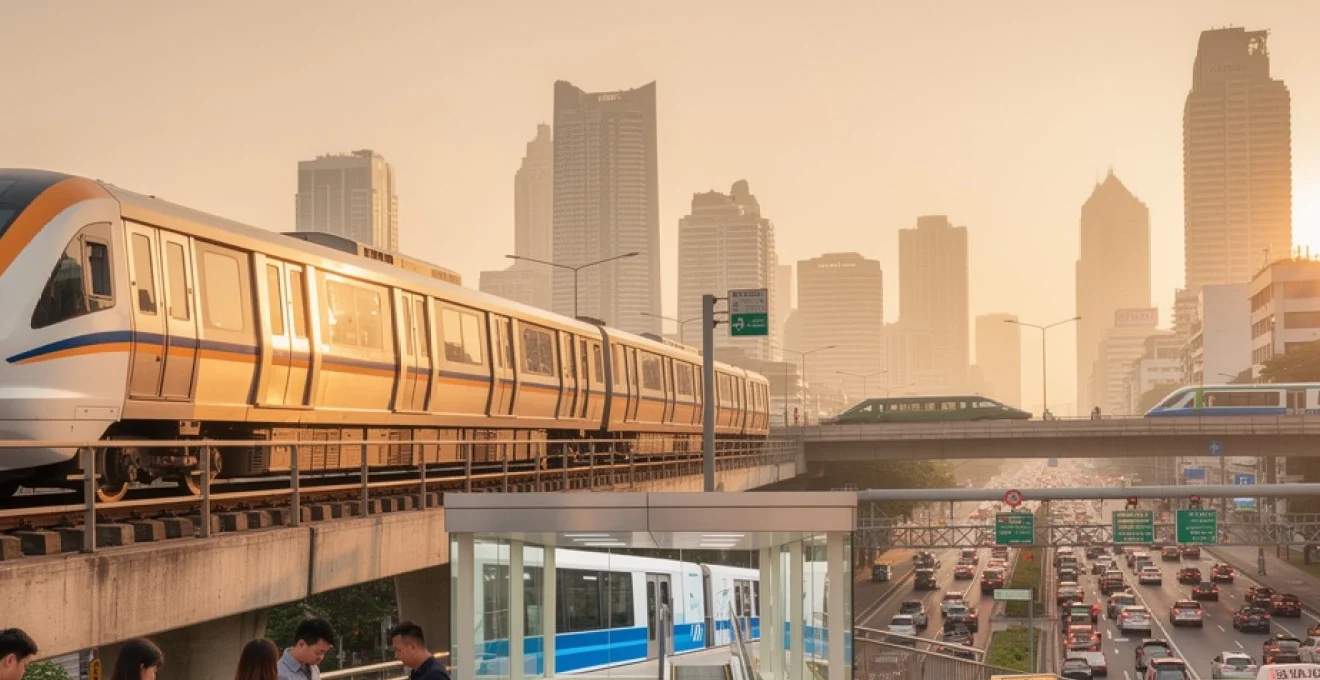
Bangkok’s transportation landscape presents a fascinating paradox: a city renowned for its notorious traffic congestion also boasts one of Southeast Asia’s most sophisticated urban rail networks. With over 10 million residents navigating the metropolitan area daily, understanding the capital’s transit options isn’t merely convenient—it’s essential for maximising your time in this dynamic city. The interplay between the elevated BTS Skytrain, the underground MRT metro system, and the ubiquitous metered taxis creates a complex yet remarkably functional transport ecosystem that continues to evolve year after year.
Whether you’re commuting from Suvarnabhumi Airport to your hotel in Sukhumvit, exploring the historic temples of Rattanakosin, or navigating the business districts around Sathorn Road, each transport mode offers distinct advantages. The elevated perspectives from BTS carriages provide remarkable city views, whilst the MRT’s underground tunnels offer respite from Bangkok’s humidity and a fascinating glimpse into modern Thai engineering. Meanwhile, taxis remain the flexible option for routes not covered by rail infrastructure, though they come with the unpredictability of Bangkok’s legendary traffic jams during peak hours.
BTS skytrain network: route coverage and operational specifications
The Bangkok Mass Transit System, universally known as the BTS Skytrain, revolutionised urban mobility when it commenced operations in 1999. This elevated rapid transit system now comprises three operational lines serving 53 stations across approximately 67 kilometres of track. The distinctive green carriages glide above Bangkok’s congested streets, providing passengers with an efficient alternative to ground-level traffic whilst offering panoramic views of the city’s architectural diversity—from gleaming glass towers to traditional shophouses squeezed between modern developments.
The system operates from approximately 06:00 to midnight daily, with extended hours until 01:00 on weekends. During peak hours (07:00-09:00 and 17:00-19:00), trains arrive every three to five minutes, whilst off-peak frequencies extend to seven minutes. This punctuality stands in stark contrast to the unpredictability of surface transport, making the BTS particularly valuable for time-sensitive journeys. The air-conditioned carriages maintain comfortable temperatures despite Bangkok’s tropical climate, though you’ll find them considerably more crowded during rush hours when office workers and students fill every available space.
Sukhumvit line: on nut to mo chit station connectivity
The Sukhumvit Line, identified by its light green colour coding, represents the BTS network’s busiest artery, stretching from Khu Khot in the north to Kheha in the southeast. This 37-kilometre route traverses some of Bangkok’s most economically vibrant districts, connecting residential areas, commercial centres, and entertainment zones. Key interchange stations include Siam (where it meets the Silom Line), Asok (connecting to MRT Sukhumvit), and Mo Chit (linking to MRT Chatuchak Park and the Northern Bus Terminal).
Stations along this line serve remarkably diverse purposes. Phrom Phong and Thong Lo cater to expatriate communities and upscale dining establishments, whilst On Nut provides access to more affordable accommodation and local markets. The extension beyond Bearing Station has opened up previously car-dependent eastern suburbs, demonstrating how rail infrastructure can reshape urban development patterns. Commuters travelling from On Nut to central Siam can expect journey times of approximately 25 minutes, a fraction of what the same trip requires by road during peak periods.
Silom line: national stadium to bang wa terminal integration
The Silom Line, distinguished by its dark green branding, runs 14 kilometres from National Stadium through Bangkok’s financial heartland to Bang Wa on the Thonburi side of the Chao Phraya River. This route serves the concentrated business districts around Sala Daeng and Chong Nonsi, where multinational corporations occupy towering office blocks. The line’s strategic importance becomes evident during weekday mornings when thousands of suited professionals stream through turnstiles at stations like Sala Daeng, which connects to MRT Silom via an underground pedestrian link.
Beyond the central business district, the line continues across
the river to serve residential districts and park-and-ride facilities, making it a practical option if you are staying west of the Chao Phraya. For visitors, key stops include Saphan Taksin, which links directly to the Chao Phraya Express Boat services, and Wongwian Yai, a traditional neighbourhood with local markets and street food. If your Bangkok itinerary combines temple sightseeing with business meetings, you will almost certainly find yourself switching between the Sukhumvit and Silom Lines at Siam, or transferring to the MRT at Sala Daeng/Silom to reach older parts of the city. In day-to-day use, you can think of the Silom Line as the “business spine” of the BTS system, whilst Sukhumvit functions more as its residential and shopping backbone.
Gold line extension: krung thonburi to iconsiam shuttle service
The BTS Gold Line is a short but strategically significant people-mover that operates between Krung Thonburi and Khlong San, with most travellers using it as a shuttle to Iconsiam, one of Bangkok’s largest luxury malls. Technically classified as an automated guideway transit system rather than a full metro line, the Gold Line covers just under two kilometres, but it closes an important “last mile” gap between the Silom Line and riverside attractions. Services typically operate at intervals of around five minutes, and the journey itself takes less than five minutes end to end.
From a practical standpoint, the Gold Line is invaluable if you are staying along the Silom Line and want easy access to Iconsiam’s shopping, dining and riverfront promenade without relying on taxis or riverboats. You simply ride the BTS to Krung Thonburi Station and follow clearly marked signs to the Gold Line platform via an elevated walkway. Although short, this connection helps you avoid confusing street-level transfers, busy intersections and exposure to the elements, which can make a big difference during Bangkok’s rainy season or in peak afternoon heat. For many visitors, the Gold Line will be your most efficient way of combining BTS travel with riverside sightseeing and shopping.
Rabbit card fare structure and contactless payment systems
The BTS fare system uses a distance-based model, with single journeys typically ranging from approximately 17 to 47 THB depending on how many stations you travel. For casual users, you can purchase single-journey tickets from vending machines using coins or notes, selecting your destination station on a touchscreen map. However, if you intend to use the BTS several times per day, it quickly becomes more convenient to obtain a Rabbit Card, the BTS stored-value card that allows you to tap in and out at gates without queueing for tickets each time. This card can also be used for small purchases at selected retailers and convenience stores, making it a flexible tool for everyday commuting in Bangkok.
Rabbit Cards require a small deposit and minimum top-up—usually in multiples of 100 THB—with balances displayed each time you exit a station. Whilst many vending machines and ticket counters still prefer cash, an increasing number now accept Thai bank cards with contactless capability. Foreign visitors sometimes assume they can simply tap their phone or international credit card at BTS gates as in cities like London or Singapore, but this is not yet widely supported. Think of the Rabbit Card as your “key” to the elevated network: once you have it loaded, transfers between the Sukhumvit, Silom and Gold Lines become frictionless, and you can focus on route planning rather than ticket logistics.
MRT underground and above-ground metro systems
Parallel to the BTS Skytrain, Bangkok’s Mass Rapid Transit (MRT) system forms the second major pillar of the city’s rail-based transportation. Launched in 2004, the MRT currently consists of the Blue and Purple Lines, supplemented by new monorail systems such as the Yellow Line that functionally integrate with the network. Unlike the elevated BTS, much of the MRT runs underground through central districts, emerging above ground as lines move into suburban areas. For travellers comparing BTS vs MRT in Bangkok, it is useful to think of the MRT as the system that links modern commercial areas with the historic core, particularly around Rattanakosin and the Thonburi riverbank.
Operational hours for the MRT broadly mirror those of the BTS, with services starting around 06:00 and running until midnight. Trains generally arrive every five minutes during peak periods and every seven to eight minutes off-peak, providing a reliable backbone for both commuters and tourists. Stations are fully air-conditioned, with escalators, lifts, and clear bilingual signage in Thai and English, which significantly reduces the stress of navigating an unfamiliar city. For many visitors, the MRT becomes the preferred option during hotter months, as moving between underground stations and air-conditioned malls keeps time spent in Bangkok’s heat and humidity to a minimum.
Blue line circular route: tha phra to bang sue grand station
The MRT Blue Line is the system’s primary route and effectively forms a loop, linking Tha Phra in Thonburi with Bang Sue Grand Station in northern Bangkok via core districts like Sukhumvit, Silom, and the Old City. Key interchange stations include Tao Poon (connecting to the Purple Line), Sukhumvit (connected by walkway to BTS Asok), Silom (linked to BTS Sala Daeng), and Sanam Chai, which serves as a gateway to major cultural attractions such as the Grand Palace and Wat Pho. By bridging the gap between Bangkok’s modern business hubs and its historic heart, the Blue Line is often the most efficient way to reach temples, museums and riverside landmarks without battling traffic.
For example, if you are staying near Asok and want to visit the Grand Palace, you can transfer from the BTS Sukhumvit Line to the MRT Blue Line at Asok/Sukhumvit and continue to Sanam Chai in around 25–30 minutes door-to-door. This journey by taxi during rush hour can easily exceed an hour, not to mention the added unpredictability of surface congestion. The Blue Line also passes through Chinatown at Wat Mangkon Station, where the atmospheric station design pays homage to the area’s heritage with red pillars and lantern motifs. As extensions continue to open, the Blue Line will increasingly function as Bangkok’s equivalent of an “inner ring” metro, making it the backbone of any comprehensive public transport strategy in the city.
Purple line commuter service: tao poon to khlong bang phai
The MRT Purple Line runs from Tao Poon northwards to Khlong Bang Phai, serving rapidly growing residential and industrial zones in Nonthaburi province. Primarily designed as a commuter route rather than a tourist line, it is nonetheless useful if your accommodation or business meetings take you outside central Bangkok. Trains are spacious and generally less crowded outside peak hours, with many passengers using the line to access park-and-ride facilities before transferring to the Blue Line at Tao Poon. If you are exploring beyond the usual tourist districts, the Purple Line can significantly reduce travel time compared with taxis or buses.
From a traveller’s perspective, the main value of the Purple Line lies in its connection with Bang Sue Grand Station, Thailand’s largest rail hub and a gateway for long-distance trains across the country. As intercity services increasingly shift operations from older Hua Lamphong Station to Bang Sue, understanding how to link the Blue and Purple Lines becomes more important. Would you rather spend 90 minutes in unpredictable traffic or 40 minutes on predictable rail services when catching a train to Chiang Mai or Ubon Ratchathani? In many cases, routing via Tao Poon and the Purple Line offers both time savings and a more comfortable journey.
Yellow line monorail: lat phrao to samrong connectivity
The Yellow Line is a relatively new monorail system operating from Lat Phrao in northern Bangkok to Samrong in the southeast, creating a valuable east–west orbital connection. Although not branded as BTS or MRT in the strict sense, it integrates functionally with the broader transit network by linking with the MRT Blue Line at Lat Phrao and the BTS Sukhumvit Line near Samrong. For residents of eastern Bangkok, the Yellow Line reduces the need to travel into central interchange hubs like Asok or Siam just to change lines, thereby easing pressure on crowded transfer stations.
For visitors, the Yellow Line becomes particularly useful if you are staying in suburbs along Srinakarin or Thepharak Roads, or if you want to access shopping complexes and residential neighbourhoods that were previously taxi-dependent. Think of the Yellow Line as Bangkok’s “bypass road” in rail form: instead of driving around the ring roads in heavy traffic, you can glide above the streets, switching between lines without entering the densest central corridors. As the city’s monorail network expands, these orbital connections will make it far easier to live, work and travel in Bangkok without owning a car or relying heavily on taxis.
MRT token dispensers and stored-value card options
Unlike the BTS, where the Rabbit Card dominates, the MRT offers a slightly different approach to fare payment. Casual users will typically acquire single-journey tokens from ticket machines, which calculate fares based on destination and issue a small plastic coin encoded with journey data. You tap this token on the gate to enter and insert it into the slot when exiting at your destination station. Fares on the MRT are broadly comparable to the BTS, usually ranging from around 17 to 42 THB depending on distance, and remain very affordable compared with taxi or rideshare prices over the same route.
For frequent travellers, the MRT provides stored-value cards and long-term passes, including options for adults, students and seniors. One particularly convenient feature for international visitors is the ability to use contactless EMV bank cards (Visa or Mastercard) directly at MRT gates, though mobile wallets like Apple Pay or Google Pay are not always supported. This means that, in many cases, you can avoid queuing for tokens and instead tap your physical bank card in and out, much like systems found in London or Singapore. While Bangkok still lacks a fully unified multi-modal card that works seamlessly across BTS, MRT, Airport Rail Link and bus services, becoming familiar with MRT token dispensers and stored-value cards will dramatically simplify your daily movements.
Metered taxi services: pricing models and operational standards
Despite Bangkok’s expanding rail network, metered taxis remain an integral part of the city’s transport system, particularly for late-night journeys, luggage-heavy trips, or routes beyond the reach of BTS and MRT lines. Brightly coloured in shades of pink, green-yellow and blue, these taxis operate under a regulated fare structure set by the Department of Land Transport. Vehicles are required to display a working meter, driver identification and licence details, and most modern cabs are equipped with air conditioning and seat belts, though rear belts may occasionally be tucked away.
In practice, however, service standards can vary. Some drivers may decline short journeys, especially in heavy traffic or near shift-change times, while others might propose a fixed fare instead of using the meter, particularly in tourist-heavy areas. As a rule of thumb, always insist on the meter being turned on when you enter the taxi; if the driver refuses, it is usually quicker and less stressful to step out and hail another cab. Think of Bangkok taxis as a flexible back-up option rather than your default mode of transport: ideal when used strategically, but less efficient than rail systems for predictable, repeatable journeys.
Flag-down rates and per-kilometre charge breakdown
As of the latest regulations, Bangkok taxi fares begin with a flag-down rate of approximately 35 THB for the first kilometre, after which the tariff increases incrementally based on distance and speed. For most inner-city journeys under 10 kilometres, you can expect to pay between 80 and 150 THB, depending on traffic conditions and route choice. Fares rise more steeply during gridlock because time spent idling or moving slowly is charged at a per-minute rate, meaning that a short distance can still result in a relatively high fare if congestion is severe. This is one of the key reasons rail remains more predictable for time-sensitive appointments.
Understanding this fare structure can help you quickly sanity-check the meter during your ride. If a five-kilometre trip in light traffic is showing 250 THB on the meter, you are likely being overcharged or the driver has taken an excessively indirect route. You do not need to memorise the full tariff table, but having a rough idea that central journeys rarely exceed 200 THB (without tolls) gives you leverage in the unlikely event of a dispute. Many travellers also keep a rideshare app open to estimate what a similar ride would cost, using it as a benchmark to judge whether a taxi fare is reasonable.
Expressway toll surcharges and airport link transfers
When travelling longer distances, particularly to and from Bangkok’s airports, taxi rides may include additional fees beyond the standard meter fare. If your driver uses an expressway or toll road, the toll charges are typically paid by you at the booth or added to the final fare, depending on local practice. These tolls are usually modest—often between 25 and 80 THB per section—but they can significantly reduce travel time by bypassing congested surface streets. It is entirely acceptable to ask your driver in advance whether they plan to use the expressway and what the approximate tolls will be.
From Suvarnabhumi Airport, an official public taxi stand operates on the lower arrivals level, where you receive a queue ticket from an automated machine before being assigned a driver. In addition to the metered fare and any tolls, airport taxis may include a small surcharge (typically around 50 THB) as an official service fee. For Don Mueang Airport, similar arrangements apply, though traffic conditions can be more variable. Combining taxis with the Airport Rail Link or MRT—such as taking the Airport Rail Link to Phaya Thai, then a short taxi ride—often yields a balance of cost, comfort and reliability, especially when Bangkok’s roads are heavily congested.
Bolt and grab ride-hailing platform comparison
Alongside traditional metered taxis, ride-hailing platforms such as Grab and Bolt have become central to getting around Bangkok efficiently. These services allow you to request a car via smartphone, see an upfront fare estimate, and follow your route in real time, significantly reducing the risk of misunderstandings or disputes over pricing. Grab is the more established player in Thailand, offering a wide range of options including standard cars, premium vehicles, and motorbike taxis, while Bolt has built a reputation for slightly lower prices on comparable routes. Both platforms typically undercut hotel limousine services and provide English-language interfaces, which are valuable advantages for visitors.
When deciding between Grab, Bolt and traditional taxis, much depends on your priorities. Do you value an exact price quote and cashless payment via card or digital wallet? In that case, ride-hailing may be your best option, particularly late at night or in suburban areas where street taxis are less frequent. Conversely, if you are standing outside a BTS station in central Bangkok, it might be faster to flag down a taxi than to wait five to ten minutes for an app-based driver. Regardless of platform, it is wise to check your route on a map app like Google Maps to ensure the driver is taking a sensible path—this is less about distrust and more about navigating a city whose one-way systems and flyovers can confuse even locals.
Route optimisation: suvarnabhumi airport to central bangkok districts
Arriving at Suvarnabhumi Airport, you are immediately faced with a strategic decision: should you take a taxi, use the Airport Rail Link, or combine rail and road to reach your accommodation? The optimal route depends on your destination, time of arrival, budget and how much luggage you are carrying. The Airport Rail Link (ARL) runs from Suvarnabhumi to Phaya Thai Station in around 30 minutes, with intermediate stops connecting to the MRT at Makkasan (via Phetchaburi) and to several suburban areas. Trains generally operate from 06:00 to midnight, with frequencies of 10–15 minutes, making the ARL a fast and cost-effective backbone for airport transfers.
For travellers heading to Sukhumvit or Silom, a popular strategy is to ride the ARL to Phaya Thai and transfer to the BTS Sukhumvit Line, continuing to stations such as Nana, Asok or Phrom Phong. This journey typically costs under 100 THB in total and avoids most surface traffic, though it does require handling your luggage through a couple of station transfers. If you are travelling as a family with several large suitcases or arriving very late at night, a direct taxi from the airport may be more comfortable despite being more expensive, with fares usually in the 300–500 THB range plus tolls and the airport surcharge. Think of it as choosing between a “rail first, then short taxi” hybrid model and a “door-to-door taxi” model, each with its own trade-offs.
For destinations along Ratchada, Rama 9 and the new business district around the Thailand Cultural Centre, you might instead take the ARL to Makkasan and connect to the MRT Blue Line via Phetchaburi Station. This route places you underground and out of the heat for most of your journey, with only a short walk between ARL and MRT platforms. Travellers bound for riverside hotels near Sathorn or the Chao Phraya may opt to combine ARL with the BTS Silom Line, alighting at Saphan Taksin and then continuing by shuttle boat or taxi. In all cases, checking live traffic conditions and rail timetables on your phone as soon as you land will help you make an informed decision rather than defaulting to the first option you see.
Cost-efficiency analysis: daily commuting versus tourist multi-day passes
Assessing the cost-efficiency of Bangkok transport options requires you to consider not only individual fares, but also how often you expect to travel each day and which modes you will use. For most short-term visitors, standard pay-as-you-go fares on BTS and MRT lines remain excellent value, particularly when compared with taxi prices in peak traffic. Daily spending on rail rarely exceeds 150–250 THB even for intensive sightseeing, which is often still less than a single long taxi ride during rush hour. However, if you plan to make more than six or seven trips per day, certain passes and stored-value options may offer incremental savings and significant convenience.
The BTS has historically offered one-day unlimited-ride passes, along with longer-duration packages aimed more at residents than tourists. These can be attractive if you are doing a “transport-heavy” day that involves jumping between malls, markets and cultural sights along the BTS network. The MRT, by contrast, focuses primarily on stored-value cards and concessions for specific user groups, with fewer tourist-specific multi-day products. Because Bangkok does not yet have a truly integrated city pass that covers BTS, MRT, Airport Rail Link and buses under a single fare cap, the economic case for multi-day passes is weaker than in cities like Tokyo or Hong Kong.
So how should you decide? One simple approach is to estimate your likely number of rail journeys based on your itinerary, multiply by the average fare (roughly 30–40 THB per trip), and compare this with the cost of any available day pass. If the difference is marginal, prioritise flexibility and simply use stored-value cards or contactless bank cards, which prevent you from “overbuying” travel you do not use. For longer stays—say, a month in Bangkok as a digital nomad—investing time in learning the nuances of Rabbit Card top-ups, MRT stored-value discounts and occasional promotional passes can yield greater cumulative savings. Much like choosing between prepaid and postpaid mobile plans, the best option depends on your usage pattern rather than a one-size-fits-all rule.
Peak hour traffic patterns: asoke intersection and sathorn road congestion zones
No discussion of getting around Bangkok would be complete without addressing the city’s notorious peak-hour traffic patterns. Two of the most congested zones are the Asoke intersection—where Sukhumvit Road crosses Asok Montri Road under the BTS and above the MRT—and Sathorn Road, which runs through one of Bangkok’s primary business districts. During weekday mornings (07:00–09:00) and evenings (17:00–19:30), these corridors can slow to a crawl, with taxis and buses often moving only a few metres between traffic light cycles. For commuters relying solely on road transport, journey times can easily double or even triple compared with off-peak conditions.
From a route-planning perspective, this is where BTS and MRT systems demonstrate their greatest advantage over taxis. At Asoke, for example, the BTS Sukhumvit Line and MRT Blue Line intersect, allowing you to bypass gridlocked streets entirely by descending underground or ascending to the skytrain platforms. Similarly, Sathorn’s Sala Daeng BTS and Lumphini/MRT stations provide vital escape valves from surface congestion, making rail the logical choice for travel during peak periods. Would you rather sit in a stationary taxi watching the meter climb, or glide above or below the chaos, arriving at your destination in a predictable timeframe?
Of course, rail systems are not immune to peak-hour pressure. Trains on the Sukhumvit and Silom Lines can become crowded to the point of discomfort during the busiest times, particularly around Siam, Asok and Sala Daeng, and you may occasionally need to wait for a second or third train before finding space to board. That said, even at their most crowded, BTS and MRT services maintain reliable frequencies and punctuality, whereas surface traffic can be rendered completely unpredictable by accidents, demonstrations or sudden downpours. The most effective strategy is to combine modes intelligently: use BTS and MRT for core segments through known congestion zones, then switch to taxis or ride-hailing for shorter “last mile” hops in quieter neighbourhoods.
In practical terms, this might mean taking the BTS to Asok, walking 5–10 minutes to your hotel rather than enduring 25 minutes in a taxi for the same distance, or riding the MRT to Lumphini before finishing your journey by short cab ride into Sathorn’s backstreets. By understanding where and when Bangkok’s congestion is worst, you can design routes that treat traffic like a river: sometimes you flow with it, sometimes you dive under it, and sometimes you rise above it entirely. Over a multi-day stay, these strategic choices can save not only hours of time but also a significant amount of money, making your experience of Bangkok’s complex transport ecosystem far more enjoyable.