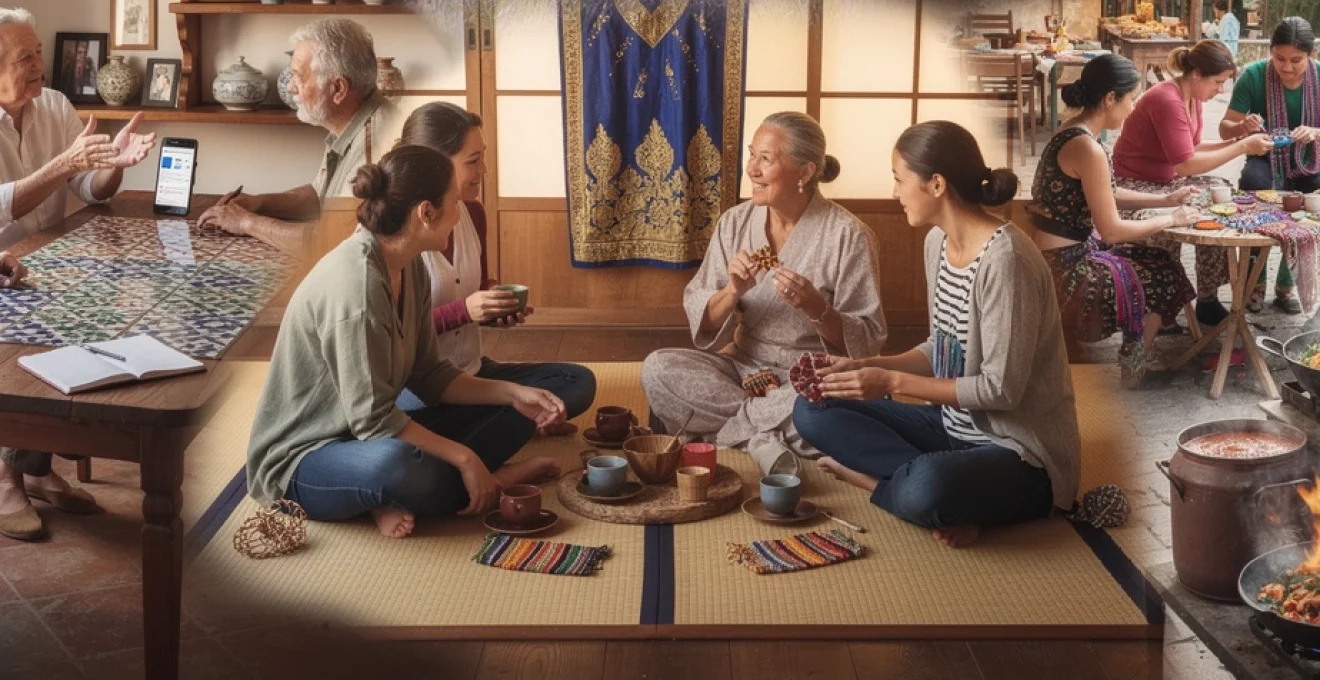
Travel has evolved far beyond the superficial collection of passport stamps and obligatory photographs in front of famous landmarks. Today’s discerning travellers seek something profoundly different: authentic engagement with the places they visit. Cultural immersion represents a paradigm shift in how we approach travel, transforming tourists into participants who actively engage with local communities, traditions, and ways of life. This deeper form of travel doesn’t merely scratch the surface; it penetrates the very essence of a destination, offering insights that no guided tour or luxury hotel could ever provide. The transformation that occurs through genuine cultural immersion extends far beyond the journey itself, reshaping perspectives, challenging assumptions, and fostering a global consciousness that resonates long after returning home.
The distinction between conventional tourism and immersive travel experiences becomes immediately apparent in the quality and depth of memories created. Rather than collecting generic experiences that blur together over time, immersive travellers accumulate rich, textured encounters that remain vivid for decades. This approach requires vulnerability, curiosity, and a willingness to step outside established comfort zones, but the rewards justify every moment of uncertainty.
Linguistic integration through homestays and language exchange programmes
Language acquisition represents one of the most powerful catalysts for cultural transformation during travel. When you commit to linguistic integration, you’re not simply learning vocabulary and grammar structures; you’re accessing an entirely different way of perceiving and interpreting the world. Each language carries within it the accumulated wisdom, humour, and worldview of millions of speakers across generations, making language learning an anthropological expedition as much as an educational endeavour.
The distinction between classroom language learning and immersive acquisition becomes starkly apparent within days of arriving in a foreign environment. Traditional education methods often prioritise grammatical precision over communicative competence, whereas immersion forces immediate practical application. This accelerated learning environment activates multiple cognitive pathways simultaneously, engaging visual, auditory, and contextual memory systems in ways that conventional study cannot replicate.
Conversational fluency development in japanese ryokans and spanish casas particulares
Traditional accommodation options like Japanese ryokans and Spanish casas particulares offer unparalleled opportunities for linguistic development within authentic cultural contexts. In a ryokan, the formal ritual of evening meals and morning preparations provides structured yet natural opportunities to practise Japanese honorific language, seasonal expressions, and the subtle art of indirect communication that characterises Japanese social interaction. The proprietors of these establishments often possess both patience and cultural pride that makes them exceptional informal language instructors.
Similarly, staying in a casa particular in Cuba or Spain immerses you in the rhythms of daily Spanish conversation, from breakfast table discussions about local politics to evening conversations about family traditions. The domestic environment provides context-rich scenarios where language learning occurs organically, supported by visual cues, repeated daily routines, and the genuine desire for mutual understanding that characterises host-guest relationships in these settings.
Polyglot immersion techniques: shadowing and Code-Switching in multilingual communities
Advanced language learners employ sophisticated techniques like shadowing—the practice of simultaneously repeating what native speakers say—to accelerate pronunciation accuracy and internalise natural speech patterns. In multilingual environments such as Switzerland, Singapore, or Montreal, you encounter the fascinating phenomenon of code-switching, where speakers fluidly transition between languages within single conversations. Observing and eventually participating in this linguistic dance develops cognitive flexibility and cultural adaptability that extends far beyond language competency.
Multilingual communities also demonstrate how language choices reflect identity, context, and social relationships. A Singaporean might use English in professional settings, Mandarin with certain family members, and Hokkien with older relatives, each language activating different aspects of their identity. Witnessing these linguistic negotiations provides profound insights into how language and culture intertwine to shape human experience.
Digital language learning apps versus In-Situ vernacular acquisition
The proliferation of language learning applications has democratised access to foreign language instruction, but these digital tools serve fundamentally different purposes than immersive learning. Apps like Duolingo or Babbel excel at building vocabulary foundations and introducing grammatical concepts through gamified, bite-sized lessons. However, they cannot replicate the emotional resonance of successfully ordering your first meal in Italian or the satisfaction of making a local laugh with well
-timed local joke. These lived experiences create emotional anchors that make vocabulary and expressions far more memorable than any digital flashcard set. Rather than replacing immersion, apps are most powerful when used as preparatory or supplementary tools—helping you arrive with basic structures so that once in-country, every café interaction, bus journey, and market negotiation becomes an organic language lesson.
In-situ vernacular acquisition also exposes you to slang, idioms, and regional turns of phrase that rarely appear in formal curricula. You begin to understand when a phrase is playful rather than literal, or when a polite formula softens a direct request. Over time, you internalise not only how to say something, but when—and whether—it is culturally appropriate to say it at all. This pragmatic layer of language use, learned through real interactions, is what ultimately transforms you from a textbook learner into a confident, culturally attuned communicator.
Regional dialect exposure in rural tuscany and provençal villages
One of the most overlooked benefits of cultural immersion is exposure to regional dialects and micro-variations within a language. In rural Tuscany, for instance, you’ll quickly notice that the Italian spoken in Florence differs subtly from that in hilltop villages where older residents still use local vocabulary and archaic verb forms. Staying with a farming family during the olive harvest or wine season allows you to hear these nuances daily, and locals are often delighted to explain colourful expressions that never make it into standard language courses.
Similarly, in Provençal villages in the south of France, you may encounter a melodic blend of French and Occitan influences. Market vendors might slip into Provençal terms of endearment, or older neighbours may sprinkle conversations with regional proverbs that reveal deep connections to land, seasons, and community. By listening closely and asking curious questions, you not only expand your linguistic repertoire, you also gain insight into how language preserves local identity in the face of globalisation.
Participatory cultural practices: festivals, ceremonies, and traditional craftsmanship
While language opens doors, participatory cultural practices invite you fully across the threshold. Festivals, ceremonies, and artisanal traditions offer immersive travel experiences that go far beyond observation; they allow you to contribute, however modestly, to the living culture of a place. Rather than treating these events as spectacles to be consumed, approaching them as opportunities for respectful participation fundamentally transforms how you understand a destination.
Engaging with traditional craftsmanship or joining in local celebrations also creates multi-sensory memories—textures under your fingers, rhythms in your body, scents and sounds that no photograph can capture. This kind of embodied knowledge anchors abstract concepts like “heritage” or “ritual” in direct personal experience. You begin to appreciate that for local communities, these practices are not performances for tourists but vital expressions of history, spirituality, and collective identity.
Hands-on apprenticeships in moroccan zellige tilework and balinese batik production
Short-term apprenticeships with artisans provide a rare window into the patience, skill, and cultural meaning encoded in traditional crafts. In Morocco, participating in a zellige tilework workshop in Fez or Marrakech reveals how geometry, religion, and aesthetics intersect. As you learn to chip individual tiles and piece them into intricate patterns, you begin to appreciate why these mosaics are considered both decorative art and spiritual practice, reflecting Islamic principles of infinite repetition and unity.
In Bali, batik production offers a similarly immersive journey into material culture. Sitting alongside local artisans, you’ll practice using a canting (wax pen) to draw motifs that often carry symbolic meaning—waves, flowers, or mythical creatures tied to local beliefs. The slow, meditative process of waxing, dyeing, and drying fabrics contrasts sharply with fast-fashion consumption. It invites you to reconsider your relationship with clothing, labour, and time, and to recognise how cultural immersion can reshape even everyday choices back home.
Ceremonial participation at pushkar camel fair and kyoto’s gion matsuri
Major festivals like India’s Pushkar Camel Fair or Kyoto’s Gion Matsuri illustrate how cultural immersion transforms mass events into intimate learning experiences. At Pushkar, you might initially be drawn by the spectacle of thousands of camels and traders, yet homestays with Rajasthani families can reveal the fair’s religious significance, economic stakes, and social dynamics. Sharing chai at dawn with herders, you witness negotiations, rituals, and informal networks that rarely appear in tour brochures.
During Gion Matsuri in Kyoto, staying in a traditional neighbourhood allows you to see months of preparation for the festival’s elaborate floats. You might help locals fold omamori charms, learn the history of your host family’s involvement, or observe how Shinto and Buddhist elements coexist in the rituals. Instead of simply photographing the parade, you understand the festival as a living thread connecting past and present, reinforcing community bonds in the heart of a modern city.
Indigenous knowledge transfer: maasai beadwork and navajo weaving workshops
Indigenous-led workshops can be among the most powerful forms of cultural immersion, especially when they prioritise knowledge transfer on the community’s own terms. Learning Maasai beadwork in Kenya or Tanzania, for example, offers more than a decorative skill. Each colour and pattern carries social and spiritual meaning, communicating age, status, and life events. As you thread beads under the guidance of Maasai women, conversations often touch on land rights, climate change, and the pressures of tourism—complex issues grounded in personal stories.
In the American Southwest, Navajo weaving workshops similarly reveal a rich tapestry of cosmology, resilience, and artistic innovation. You might sit in a family compound, carding wool and listening to elders explain how designs relate to stories of emergence and balance. This kind of immersive travel demands humility: rather than treating indigenous culture as exotic, you recognise it as a sophisticated knowledge system that has sustained communities for centuries.
Sacred ritual observation protocols in varanasi ghats and bhutanese monastery festivals
Some of the most moving cultural immersion experiences occur around sacred rituals—but they also require the highest level of respect. On the ghats of Varanasi, dawn and dusk aarti ceremonies honour the Ganges with fire, music, and chant. While travellers are welcome to observe, responsible participation involves understanding where to stand, when photography is inappropriate, and how to avoid disrupting mourners or pilgrims for whom the river is not a backdrop but a living deity.
In Bhutan, monastery festivals (tshechu) feature masked dances that reenact Buddhist teachings and local legends. As an outsider, it can be tempting to treat these events as colourful performances, yet monks and villagers experience them as profound acts of devotion and community protection. Learning basic observation protocols—dressing modestly, keeping a respectful distance, refraining from intrusive flash photography—ensures your presence enhances rather than detracts from the ritual atmosphere. In both settings, cultural immersion becomes as much about ethical sensitivity as about access.
Culinary anthropology: market-to-table experiences and regional gastronomy
Food may be the most accessible gateway to cultural immersion, yet “culinary anthropology” invites you to go far beyond restaurant reviews. By tracing dishes from market to table, you uncover stories of migration, trade routes, class hierarchies, and religious norms. A bowl of noodles in Bangkok or a tagine in Marrakech is never just a meal; it’s a living archive of history and geography, shaped by centuries of adaptation.
Approaching travel through the lens of regional gastronomy also encourages more sustainable and responsible choices. When you understand the effort behind rice cultivation in the Mekong Delta or the seasonal cycles of olive harvesting in Crete, you tend to value ingredients more and waste less. You start to ask deeper questions: Who grew this? Under what conditions? How has this recipe changed over generations? In doing so, your travel experience becomes an ongoing conversation between palate, place, and people.
Participatory cooking classes in chiang mai street food culture and oaxacan mole traditions
Participatory cooking classes transform you from a passive consumer into an active co-creator of local cuisine. In Chiang Mai, many street food-focused classes begin with a guided tour of fresh markets, where instructors explain regional herbs, curry pastes, and the social role of night bazaars. Back in the kitchen, you might learn to pound som tam (papaya salad) or stir-fry pad krapow, gaining insight into the balance of sweet, sour, salty, and spicy that defines northern Thai food culture.
In Oaxaca, mole traditions offer a deeper dive into ritual and celebration. Preparing a complex mole negro can involve grinding upwards of 20 ingredients, from chillies and nuts to chocolate and plantains. As you toast and blend each component, you hear how mole is tied to weddings, saints’ days, and family milestones. This hands-on immersion makes it clear that recipes are not just instructions; they’re repositories of memory and identity, passed lovingly from one generation to the next.
Foraging expeditions with local guides in scandinavian forests and mediterranean coastlines
Foraging with local guides introduces a powerful dimension of ecological awareness to cultural immersion travel. In Scandinavian forests, for example, you might learn the principles of allemansrätten (everyman’s right), which allows public access to nature while emphasising responsibility. Guided walks to collect berries, mushrooms, or wild herbs reveal how Nordic cultures integrate seasonal foraging into daily life, from traditional jams to contemporary New Nordic cuisine.
Along Mediterranean coastlines in places like Croatia or southern Italy, foraging often focuses on wild greens, sea urchins, or coastal herbs such as wild fennel and thyme. Local fishers and grandmothers may show you how these ingredients have sustained communities during lean times, long before they became fashionable on upscale tasting menus. By literally getting your hands dirty, you develop a visceral understanding of how landscapes shape diets—and why environmental protection is inseparable from culinary heritage.
Food sourcing ethnography at marrakech’s jemaa el-fnaa and bangkok’s chatuchak market
Markets like Marrakech’s Jemaa el-Fnaa and Bangkok’s Chatuchak offer outstanding opportunities for “food sourcing ethnography”—observing how ingredients move from producer to plate. In Jemaa el-Fnaa, spice sellers, orange juice vendors, and grill masters coexist in a sensory overload that at first may feel chaotic. Yet with a local guide or patient self-observation, patterns emerge: how vendors compete and cooperate, how pricing fluctuates through the day, how storytelling and theatrics help build trust and reputation.
Chatuchak Market in Bangkok, one of the largest weekend markets in the world, reveals a different set of dynamics. Here, street food stalls sit alongside plant nurseries, clothing stands, and pet sections, illustrating how urban Thais integrate food into a broader ecosystem of consumption and leisure. Paying attention to who shops where, what they buy, and how they interact offers insights into class, generation, and regional identity that few museum exhibits can match.
Agricultural tourism: olive harvesting in crete and rice cultivation in vietnamese mekong delta
Agricultural tourism, or “agritourism,” allows travellers to participate directly in the cycles that sustain local food systems. In Crete, joining an olive harvest for a few days means early mornings in terraced groves, rhythmic work alongside families, and communal meals that showcase fresh oil in its simplest forms. As you feel the weight of full crates and witness the pressing process, extra virgin olive oil shifts from a supermarket commodity to the embodied labour of a specific landscape.
In Vietnam’s Mekong Delta, rice cultivation experiences offer a similarly eye-opening immersion. You might transplant seedlings in flooded paddies, help with harvesting, or learn how rice by-products feed animals and fertilise fields. Understanding the meticulous care and vulnerability to weather extremes that rice farmers face can change how you view every bowl of rice you eat. In both regions, agritourism experiences underscore how cultural immersion is inseparable from economic realities and environmental constraints.
Socio-economic integration through community-based tourism models
Truly transformative travel does more than enrich the visitor; it also supports host communities in sustainable, equitable ways. Community-based tourism (CBT) models place local people at the centre of decision-making, ensuring that cultural immersion experiences are designed and led by those who live there. This shift from top-down tour operations to grassroots initiatives helps redistribute tourism revenue, protect cultural heritage, and reduce the negative impacts of mass tourism.
For travellers, socio-economic integration means recognising themselves as participants in local economies rather than detached observers. Where you sleep, eat, and shop becomes an ethical choice, with direct consequences for livelihoods and landscapes. By choosing CBT initiatives, you align your desire for authentic engagement with a framework that prioritises long-term community wellbeing over short-term profit.
Voluntourism frameworks in peruvian andean communities and kenyan conservation projects
Voluntourism—combining travel with volunteering—can either be a force for good or a source of harm, depending on how it’s structured. In Peruvian Andean communities, responsible programmes focus on skills transfer, infrastructure support, or language exchange under local leadership, rather than short-term, unskilled interventions. For example, assisting with sustainable farming projects or after-school language clubs can be beneficial when communities set the agenda and visitors receive proper training and orientation.
In Kenyan conservation projects, ethical voluntourism often prioritises data collection, habitat restoration, or community education over direct wildlife interaction. Participating in bird counts, invasive species removal, or local outreach programmes can contribute to long-term environmental goals without creating dependency or disrupting animal behaviour. Before committing, it’s crucial to ask hard questions: Who designed this project? How are local people involved? What happens when volunteers leave? This critical lens ensures that your desire to help aligns with responsible, community-based tourism principles.
Cooperative living arrangements: kibbutz experiences and eco-village participation
Cooperative living arrangements such as Israeli kibbutzim or global eco-villages offer immersive case studies in alternative socio-economic models. Staying on a kibbutz, you may participate in communal meals, agricultural work, or educational activities that highlight the history of collective farming, socialist ideals, and their evolution in a modern market economy. Conversations with long-term residents can illuminate tensions between tradition and adaptation, ideology and practicality.
Eco-villages, found from Europe to Latin America, experiment with low-impact living, shared governance, and localised economies. As a short-term participant, you might engage in permaculture projects, renewable energy maintenance, or consensus-based meetings. These experiences show, in real time, what it looks like to build community around environmental and social values. Immersing yourself in such environments can prompt you to reconsider assumptions about ownership, work, and consumption once you return home.
Microfinance engagement with guatemalan textile cooperatives and indian self-help groups
Microfinance initiatives linked to tourism provide another powerful avenue for socio-economic integration. In Guatemala, many women’s textile cooperatives combine weaving demonstrations with opportunities to learn about small loans, savings schemes, and collective bargaining. By purchasing directly from cooperatives or attending workshops, you support both cultural preservation and economic empowerment, witnessing how additional income translates into school fees, healthcare, and improved housing.
In India, self-help groups (SHGs) often bring together women from marginalised communities to pool savings and access microcredit. Some CBT programmes invite travellers to attend SHG meetings, observe decision-making processes, and understand the challenges of entrepreneurship in rural contexts. These encounters can be humbling, revealing both the power and limitations of microfinance as a tool for development. When approached with respect and curiosity, they also transform “poverty” from an abstract issue into a set of complex, human stories.
Ethnographic observation methodologies for deep cultural understanding
Many of the most rewarding cultural immersion experiences borrow tools from ethnography—the qualitative research method used by anthropologists to study societies from the inside. While you are not in the field as an academic researcher, adopting simple observation and note-taking techniques can deepen your understanding of daily life in profound ways. Rather than rushing from attraction to attraction, you learn to pause, watch, and reflect.
This shift in mindset turns everyday spaces—buses, barbershops, corner cafés—into rich learning environments. You begin to notice patterns: who speaks first in a group conversation, how conflict is resolved, how children are disciplined or praised. These micro-observations, recorded thoughtfully, help you move beyond surface impressions and stereotypes toward nuanced, context-sensitive interpretations of what you see.
Participant observation techniques in fijian kava ceremonies and turkish hammam rituals
Participant observation, a cornerstone of ethnographic method, involves engaging in activities while also watching how they unfold. In Fijian kava ceremonies, for instance, you might sit in a circle with villagers, drink the mildly narcotic beverage made from kava root, and pay attention to turn-taking, speech levels, and ritualised clapping. Who prepares the kava? Who speaks the most? How are guests introduced? These details reveal underlying hierarchies, gender roles, and norms of hospitality.
In a Turkish hammam, you may participate in the bathing ritual while reflecting on how privacy, modesty, and care are negotiated in a communal setting. Observing the interactions between staff and clients, the division of spaces by gender, and the unhurried pace of washing can challenge your assumptions about body, time, and self-care. By consciously toggling between “doing” and “noticing,” you transform a relaxing spa visit into a window onto broader cultural logics.
Cross-cultural communication competency development through non-verbal cues
Verbal language is only part of the communication puzzle; non-verbal cues often carry equal or greater weight, especially in high-context cultures. During immersive travel, paying close attention to eye contact, gesture, posture, and physical distance can dramatically improve your cross-cultural communication competency. For example, in some East Asian contexts, prolonged eye contact might be seen as confrontational, whereas in many Western countries it signals confidence and honesty.
Learning to read these signals is a bit like tuning into a previously inaudible radio frequency. You start to notice when a smile masks discomfort, when a pause invites you to speak, or when a slight step back indicates you’re standing too close. Over time, you adjust your own non-verbal behaviour, becoming more adept at building rapport across cultural boundaries. This heightened sensitivity not only reduces misunderstandings; it also fosters a deeper sense of mutual respect.
Anthropological field notes: documenting daily life in cuban neighbourhoods and senegalese villages
Keeping field notes—a practice borrowed from anthropology—is a powerful way to process and consolidate your cultural immersion experiences. In Cuban neighbourhoods, you might record observations about how people use public spaces: who gathers on stoops in the evening, how music weaves through alleyways, how neighbours share food or news. Writing down snippets of dialogue, sensory details, and your own emotional reactions helps you move beyond the tourist snapshot to a more layered, reflective account.
In Senegalese villages, field notes could capture everything from morning greetings and call-to-prayer routines to the organisation of compound life and the scheduling of communal work. By reviewing your notes over time, patterns emerge that you might have missed in the moment. You’ll also notice where your own cultural assumptions coloured your interpretations, allowing for course corrections and deeper learning. In this way, a simple notebook becomes both mirror and map, guiding your evolution as a more perceptive, self-aware traveller.
Psychological and neurological impacts of extended cultural exposure
Extended cultural exposure doesn’t just change your photo album; it reshapes your mind. Psychologists and neuroscientists have increasingly documented how immersive travel can enhance cognitive flexibility, emotional intelligence, and even structural aspects of the brain. Living abroad for as little as several months has been linked to improved problem-solving abilities and greater creativity, particularly when individuals actively engage with local cultures rather than remaining in expatriate bubbles.
These changes arise because immersion constantly challenges your default settings. Everyday tasks—buying groceries, navigating bureaucracy, making friends—require you to adapt, interpret ambiguous cues, and tolerate uncertainty. Over time, this ongoing “mental cross-training” strengthens neural networks involved in attention, memory, and executive function. In other words, cultural immersion is not only an enriching life experience; it is also a potent form of brain training.
Cognitive flexibility enhancement through cross-cultural problem-solving scenarios
Cognitive flexibility—the ability to switch between different modes of thinking and adapt to new rules—is a key predictor of creativity and resilience. Immersive travel provides a constant stream of cross-cultural problem-solving scenarios: deciphering an unfamiliar transit system, renegotiating expectations around punctuality, or resolving misunderstandings born from differing communication styles. Each time you successfully navigate such a challenge, you strengthen your capacity to see multiple perspectives and generate alternative solutions.
Studies have found that people with significant multicultural experience often perform better on tasks requiring “out-of-the-box” thinking. Why? Because they’ve practised viewing situations through different cultural lenses. If you’ve learned to interpret both German directness and Thai indirectness as valid, context-specific norms, you’re more likely to approach complex problems back home with similar nuance and openness.
Identity transformation and bicultural identity integration frameworks
On a psychological level, deep cultural immersion often triggers shifts in identity. You may begin to see yourself not solely as a citizen of your home country, but as someone who inhabits multiple cultural worlds. Researchers refer to this as bicultural or multicultural identity integration—the degree to which you perceive your different cultural affiliations as compatible and harmonious rather than conflicting.
Spending extended time in another culture can prompt you to question inherited assumptions about success, family, time, or spirituality. Some travellers experience an initial phase of disorientation, followed by a gradual weaving together of old and new values into a more flexible, expansive sense of self. This doesn’t mean abandoning your roots; rather, it involves adding more “rooms” to the house of your identity, making space for diverse influences and viewpoints.
Neuroplasticity activation in adult language learners during immersive travel
Neuroplasticity—the brain’s ability to reorganise itself by forming new neural connections—does not disappear in adulthood, and language learning during immersive travel is a powerful way to activate it. Functional MRI studies have shown structural changes in regions associated with language processing and memory among adults who acquire a second language intensively, especially when they use it daily in real-world contexts.
When you negotiate rent in Portuguese, haggle in Arabic, or share jokes in Japanese, your brain is doing far more than storing vocabulary. It’s building and strengthening networks that support attention, auditory discrimination, and working memory. This neural workout has spillover benefits: bilingual and multilingual individuals often show delayed onset of age-related cognitive decline and improved performance on multitasking tasks. In this sense, your decision to immerse yourself linguistically while travelling is both a cultural investment and a long-term health strategy.
Empathy development metrics: pre and post-immersion psychological assessments
One of the most celebrated outcomes of cultural immersion is increased empathy—the ability to understand and share the feelings of others. Psychological assessments conducted before and after study-abroad programmes or long-term volunteering experiences often show measurable gains in perspective-taking and empathic concern. Participants report greater comfort with ambiguity, reduced ethnocentrism, and a stronger sense of global citizenship.
From a measurement standpoint, tools like the Intercultural Development Inventory (IDI) or empathy scales track shifts from monocultural mindsets (“my culture is the default”) toward more ethnorelative orientations (“different cultures are equally complex and valid”). While no metric can fully capture the richness of lived experience, these studies support what many travellers intuitively feel: that stepping into someone else’s world—even briefly—can fundamentally change how you relate to people everywhere. As you return home, this expanded empathy becomes one of the most valuable souvenirs of your journey, informing your choices, relationships, and sense of responsibility in an interconnected world.