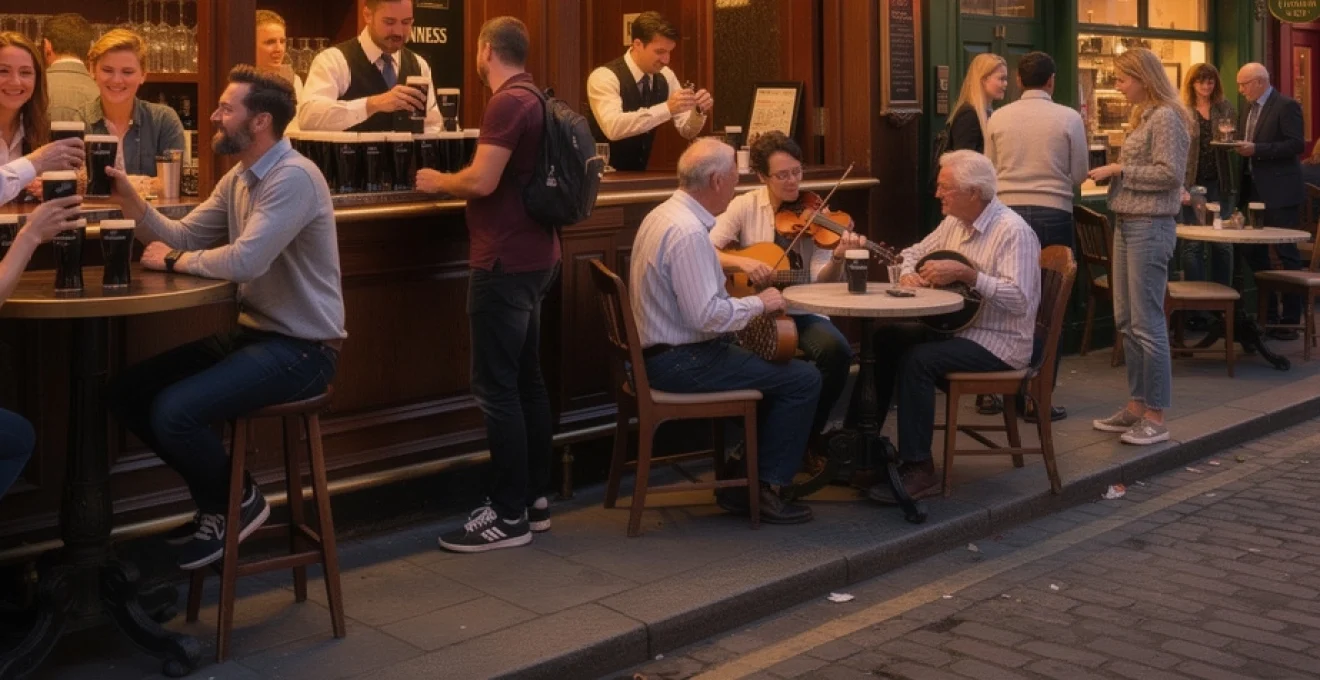
Dublin’s pub culture represents far more than a collection of drinking establishments—it constitutes the social infrastructure of the city itself. For over a millennium, public houses have functioned as democratic spaces where Dubliners from every background gather to share stories, debate politics, celebrate victories, and commiserate over losses. The ritual of stepping into a local pub transcends the simple act of ordering a drink; it represents participation in a uniquely Irish form of community building that has survived economic downturns, emigration waves, social upheaval, and even prohibition attempts. Understanding how these establishments shape daily life in Ireland’s capital requires examining their architectural evolution, the unwritten codes governing social interaction within them, and their role as custodians of cultural traditions that might otherwise have vanished. The pub remains the great equalizer in Dublin society—a space where taxi drivers debate literature with university professors, where traditional musicians preserve centuries-old melodies, and where the art of conversation continues to thrive despite the digital age’s relentless advance.
Historical evolution of dublin’s public house architecture and social spaces
Dublin’s pub architecture tells the story of the city’s transformation from a colonial outpost to a modern European capital. The earliest drinking establishments emerged from medieval alehouses and taverns, simple structures where travelers could secure food, lodging, and locally brewed ale. By the 18th century, spirit grocers dominated the landscape—establishments that combined retail groceries with alcohol sales, reflecting the practical needs of working-class neighborhoods. These hybrid spaces allowed customers to purchase household essentials while socializing over a dram, creating a commercial-social nexus that defined community interaction for generations. The layout was utilitarian: barrels lined the walls, goods hung from rafters, and conversation happened wherever space permitted.
Victorian-era gin palace design elements in temple bar district
The Victorian era brought unprecedented prosperity and architectural ambition to Dublin’s pub landscape. Inspired by London’s gin palaces, publicans invested heavily in ornate interiors designed to attract and impress customers. Establishments like The Palace Bar and The Long Hall incorporated etched glass panels, elaborate mahogany woodwork, brass fixtures, and decorative tile work that transformed functional drinking spaces into temples of hospitality. These design elements served multiple purposes beyond aesthetics—the mirrors expanded visual space in cramped buildings, while the ornate surroundings elevated the social status of patrons who might live in tenement housing. The Temple Bar district preserves several exemplary Victorian pubs where gas lamp-style lighting, pressed tin ceilings, and original bar fixtures transport visitors to an era when craftsmanship defined commercial spaces.
Authenticity preservation at the brazen head and the long hall
Dublin’s oldest pubs function as living museums where authenticity isn’t reconstructed but continuously maintained. The Brazen Head, established in 1198, occupies a site that predates Dublin’s Norman fortifications, while The Long Hall’s Victorian interior remains virtually unchanged since 1881. Preservation efforts at these establishments extend beyond physical structures to encompass operational practices—traditional cash registers, handwritten tabs, and even the sequence of preparing certain drinks follow patterns established generations ago. These pubs resist modernization not from stubbornness but from recognition that their value lies precisely in their unchanged character. The worn grooves in bar counters, smoke-stained ceilings that predate smoking bans, and photographs documenting decades of regular patrons create tangible connections to Dublin’s past that no amount of themed decoration can replicate.
Snug culture and compartmentalised drinking environments
The snug—a small, semi-private compartment within a pub—represents one of Irish drinking culture’s most distinctive architectural features. Originally designed to accommodate women and clergy who wished to drink without public observation, snugs evolved into spaces for confidential business discussions, romantic encounters, and small group conversations. Their partitioned design created multiple social zones within a single establishment, allowing diverse clientele to coexist comfortably. The architectural philosophy behind snugs reflects a sophisticated understanding of human social needs: people desire both community connection and private intimacy, often simultaneously. Modern Dublin pubs that retain functional snugs recognize their continued relevance—in an era of open-plan everything, these intimate spaces offer sanctuary from the surveillance culture that dominates contemporary life.
Transition from spirit
grocers to modern gastropub formats reflects wider economic and social shifts in Dublin. As licensing laws changed and supermarkets absorbed much of the retail trade in the late 20th century, many spirit grocers either closed or reinvented themselves as full-service pubs. Counters once divided between dry goods and casks of porter were opened up, kitchens were added, and seating replaced storage areas. This transition laid the groundwork for the contemporary Dublin gastropub, where seasonal menus, craft beers, and curated whiskey lists now sit alongside the traditional pint of Guinness.
Today’s gastropubs continue to function as community anchors but with expanded roles: they host weekend brunches, tasting menus, and even co-working mornings, reflecting how Dubliners blend work and leisure. Rather than erasing history, the best examples retain visible traces of their spirit-grocer past—original shopfronts, old signage, and repurposed shelving—offering layered spaces where old and new Ireland coexist. For visitors trying to understand how Irish pub culture shapes social life in Dublin, these hybrid venues reveal that adaptation, not nostalgia alone, keeps the public house at the centre of city life.
Rituals and social protocols within traditional dublin pubs
The social choreography inside a Dublin pub is governed less by written rules than by shared understandings passed down over generations. From how you order at the bar to where you stand, there is a subtle etiquette that helps strangers become temporary communities. These rituals are not designed to exclude newcomers; rather, they streamline interaction so people can focus on what matters most: conversation, music, and connection. Learning these unwritten codes is like learning the grammar of a language—you can get by without it, but fluency unlocks a deeper level of experience.
Round-buying etiquette and reciprocal drinking norms
At the heart of social life in many Dublin pubs is the practice of buying drinks in rounds. Instead of each person paying for their own pint, one member of the group orders and pays for everyone, and others take turns doing the same. This system transforms a simple transaction into a ritual of reciprocity, reinforcing trust and equality within the group. Declining to participate, or disappearing when it’s your turn, can be read as a breach of social obligation, even if nobody says so directly.
For visitors, joining a round can feel daunting at first—what if you choose the wrong moment, or misjudge the cost? A practical rule of thumb is simple: if someone explicitly includes you in their round, you should plan to buy at least one round back for those same people before the evening ends. Think of it as contributing to a shared tab of goodwill rather than settling an exact ledger. In this way, round-buying functions as social glue in Dublin’s pub culture, quietly shaping who feels part of the group and how long the night’s craic continues.
The pub session: traditional irish music at o’donoghue’s and cobblestone
Traditional music sessions—often simply called “sessions”—form another core ritual that shapes social life in Dublin pubs. At venues like O’Donoghue’s on Merrion Row and The Cobblestone in Smithfield, musicians gather not as hired performers on a stage, but as participants in a communal practice. Fiddles, flutes, tin whistles, and bodhráns cluster around a central table, with tunes circulating much like stories in conversation. There is usually no setlist; instead, a lead musician will begin a reel or jig, and others will join in if they know it.
For audiences, understanding session etiquette is crucial. You are welcome to listen, clap, and even quietly sing along to familiar choruses, but interrupting mid-tune or shouting requests breaks the spell of the shared moment. If you are a musician yourself, you don’t simply walk up and start playing; you wait for a break, make eye contact, and often ask permission to join. In these settings, the pub becomes a living archive of Irish cultural heritage, where the boundaries between performer and listener blur, and where a Tuesday night in Dublin can feel as rich as a concert hall performance—only with better conversation between sets.
Counter culture and barside conversation dynamics
While tables and snug booths offer comfort, the true engine of many Dublin pubs remains the bar counter itself. Standing or perching at the bar places you in direct contact with both staff and fellow patrons, creating a fluid space for conversation that you rarely find in table-service venues. Topics range from the predictable—weather, sport, and politics—to the deeply personal, often within the span of a single pint. The bartender acts as informal moderator, archivist, and sometimes confessor, remembering regulars’ preferred drinks and small details of their lives.
This “counter culture” thrives on gentle eavesdropping and open invitations to join in. You might arrive alone and find yourself pulled into a debate about the latest election results, or into a nostalgic discussion about how the neighbourhood has changed. Unlike more transactional drinking cultures, where customers come and go with minimal interaction, Dublin barside dynamics encourage you to linger. In many ways, the counter functions like a communal desk in a shared office of everyday life—only here, the work being done is the ongoing maintenance of social bonds.
Literary pub crawl routes and cultural tourism integration
Dublin’s literary heritage has long intertwined with its pub culture, and today that relationship is formalised in literary pub crawls that weave together storytelling, performance, and guided drinking. Routes often include classic stops such as Davy Byrne’s (immortalised in James Joyce’s Ulysses), Toner’s, Neary’s, and The Palace Bar, where journalists, poets, and playwrights once held court. Professional actors and guides recite passages from Joyce, Yeats, Beckett, and Brendan Behan, transforming a night out into a walking seminar on Irish literature and social history.
These tours illustrate how pub culture shapes not only local social life but also Dublin’s global brand. Visitors come seeking “authentic Irish pub culture,” and the literary pub crawl offers a curated but still grounded way to encounter it. At their best, these experiences avoid turning pubs into mere backdrops; they highlight how writers used public houses as creative laboratories, listening posts, and informal offices. For Dubliners, the presence of tourists on such routes is a reminder that their everyday haunts double as cultural institutions—spaces where ordering a stout can also mean stepping into a living anthology.
Guinness as cultural cornerstone and social lubricant
It is almost impossible to discuss how Irish pub culture shapes social life in Dublin without addressing the black-and-white icon that dominates many counters: Guinness. While Dublin’s drinking landscape now includes craft beer, cocktails, and zero-alcohol options, Guinness remains both symbol and substance—a drink that signals belonging, tradition, and local pride. In many neighbourhoods, the quality of a pub’s Guinness is still a shorthand for its overall standard, influencing everything from customer loyalty to word-of-mouth reputation.
The two-part pour ritual and settling time significance
The ritual surrounding a pint of Guinness is as important as the stout itself. The two-part pour—first filling the glass to about three-quarters at a 45-degree angle, then letting it settle before topping it off—has become a carefully observed performance. Bar staff in Dublin are judged on their mastery of this sequence, which typically takes around 90 to 120 seconds. Why all the fuss? On a technical level, the pause allows nitrogen bubbles to settle, forming the dense, creamy head that defines a proper pint. On a social level, the wait creates anticipation and signals respect for the drink and the customer.
Watching your pint “settle” also gives you a moment to settle into the pub’s rhythm—perhaps exchanging a first comment with the person beside you or taking in the room’s details. Many Dubliners will happily walk past several bars for what they consider a reliably well-poured pint, suggesting that this small ritual has outsized influence on social patterns. In a way, the two-part pour functions like a short, shared meditation before conversation begins, reminding everyone that some things cannot be rushed.
James’s gate brewery legacy in shaping dublin identity
Since Arthur Guinness signed his famous 9,000-year lease at St James’s Gate in 1759, the brewery has shaped Dublin’s physical and cultural landscape. For decades, the Guinness brewery was one of the city’s largest employers, and entire neighbourhoods around The Liberties grew in its shadow. The smell of roasting barley became part of the city’s sensory identity, while Guinness-branded barges, trains, and trucks wove its image into everyday life. Today, the Guinness Storehouse is among Ireland’s most visited attractions, drawing over a million visitors a year in pre-pandemic times and reinforcing Dublin’s association with the stout worldwide.
This legacy extends into the social fabric of Dublin’s pubs. Many older locals still recall family members who “worked in the Brewery,” and their stories infuse conversations over pints today. For visitors, touring James’s Gate and then tasting a pint in a nearby pub creates a narrative arc—from production to consumption—that deepens their sense of place. The brewery’s presence has also driven innovation: collaborations with pubs on seasonal stouts, festivals, and training programmes for bar staff all contribute to a shared standard of quality that keeps Guinness central to Dublin pub culture.
Pint quality assessment and public house reputation management
Among Dubliners, conversations about the “best pint of Guinness in Dublin” can be as passionate as any sports rivalry. Pint quality assessment goes far beyond personal taste; it involves a semi-formal checklist that regulars apply almost unconsciously. Is the temperature correct—cold but not icy? Does the head sit just above the rim, with tight, even bubbles and no large gaps? Does the first sip leave a clean “mustache” of foam and a clear ring on the glass as you drink?
Pub owners are acutely aware that their reputation often hinges on these details. They invest in line-cleaning schedules, glassware maintenance, and staff training to ensure consistency. A single bad experience, magnified on social media or review sites, can quickly undermine years of goodwill. Conversely, being known for a “flawless pint” can draw both locals and tourists across the city. In practical terms, this means that Guinness is more than a drink; it is a quality-control system that shapes how pubs operate and how customers choose where to spend their evenings.
Community anchoring functions of neighbourhood locals
Beyond the headline-grabbing pubs of Temple Bar and the city centre, Dublin’s social life is quietly sustained by hundreds of “locals”—neighbourhood pubs where staff know customers by name and by story. These establishments function as informal community centres, especially in areas where other civic spaces are scarce. Birthdays, wakes, football victories, and fundraising quizzes all find their venue here. During difficult times, such as the 2008 financial crisis or the Covid-19 lockdowns, many locals became organising hubs for mutual aid, delivering meals to vulnerable residents or coordinating support for struggling families.
Even as Irish drinking habits change—with younger Dubliners consuming less alcohol overall and showing greater interest in coffee, food, and zero-alcohol options—the role of the local as a social anchor remains. Many pubs now open earlier to serve coffee and breakfast, host book clubs or language exchanges midweek, and provide free Wi‑Fi for remote workers. In doing so, they adapt to new patterns while preserving their core function: offering a reliable, familiar place where you can walk in alone and still feel you belong. For urban planners and sociologists, these neighbourhood pubs are case studies in how “third places” sustain mental health and social cohesion in a fast-changing city.
Gender dynamics and inclusivity shifts in contemporary pub culture
Historically, Dublin pubs—like many public spaces—were dominated by men, with women often relegated to the snug or to special “lounge” areas. Over the past few decades, that landscape has changed dramatically. Today, mixed-gender groups are the norm in most city pubs, and women not only frequent bars but also own, manage, and staff them in growing numbers. This shift has influenced everything from interior design to entertainment choices, with more emphasis on comfortable seating, food offerings, and inclusive music programming rather than solely sport on big screens.
At the same time, questions of inclusivity now extend beyond gender. Many Dublin pubs actively position themselves as LGBTQ+ friendly, host Pride events, or provide safe spaces for minority communities who may not feel welcome elsewhere. The increasing availability of low- and no-alcohol options, from alcohol-free Guinness to craft sodas and mocktails, also broadens who can participate in pub culture. Someone who is sober, pregnant, or simply taking a break from drinking can still join colleagues or friends at the pub without feeling out of place. In this sense, the evolution of gender dynamics has paved the way for a wider conversation: who gets to feel at home in Dublin’s public houses, and what must change to ensure that welcome is truly universal?
Economic impact of pub density on dublin’s hospitality ecosystem
Dublin has one of the highest pub densities in Europe, and this concentration exerts a powerful influence on the city’s wider hospitality economy. Pubs generate direct employment—from bartenders and chefs to cleaners and security staff—and support local suppliers of food, drink, music, and maintenance services. According to industry estimates, the broader Irish pub sector supports tens of thousands of jobs nationwide, with Dublin accounting for a significant share thanks to its tourism draw and large resident population. In many central districts, the evening economy is effectively organised around the ebb and flow of pub patrons.
This density also creates network effects that benefit hotels, restaurants, and cultural attractions. Tourists often choose accommodation based on proximity to “good pubs,” and theatre-goers plan pre- and post-show drinks around trusted venues. Pub trails, food-and-pint pairings, and combined tickets with attractions like the Guinness Storehouse or whiskey distilleries encourage visitors to extend their stays and increase their spending. However, the same concentration presents challenges: rising commercial rents, noise complaints, and competition from global chains can threaten independent publicans, particularly in central areas.
In response, many Dublin pubs are diversifying their offerings—hosting daytime markets, ticketed events, tastings, and collaborations with local producers—to create multiple revenue streams beyond pints alone. Some work with city authorities on responsible drinking campaigns and late-night transport solutions, recognising that long-term sustainability depends on balancing economic vibrancy with residents’ quality of life. As Dublin continues to grow, the density and diversity of its pubs will remain a key indicator of the health of its hospitality ecosystem—and of how successfully the city can protect its social heart while embracing change.