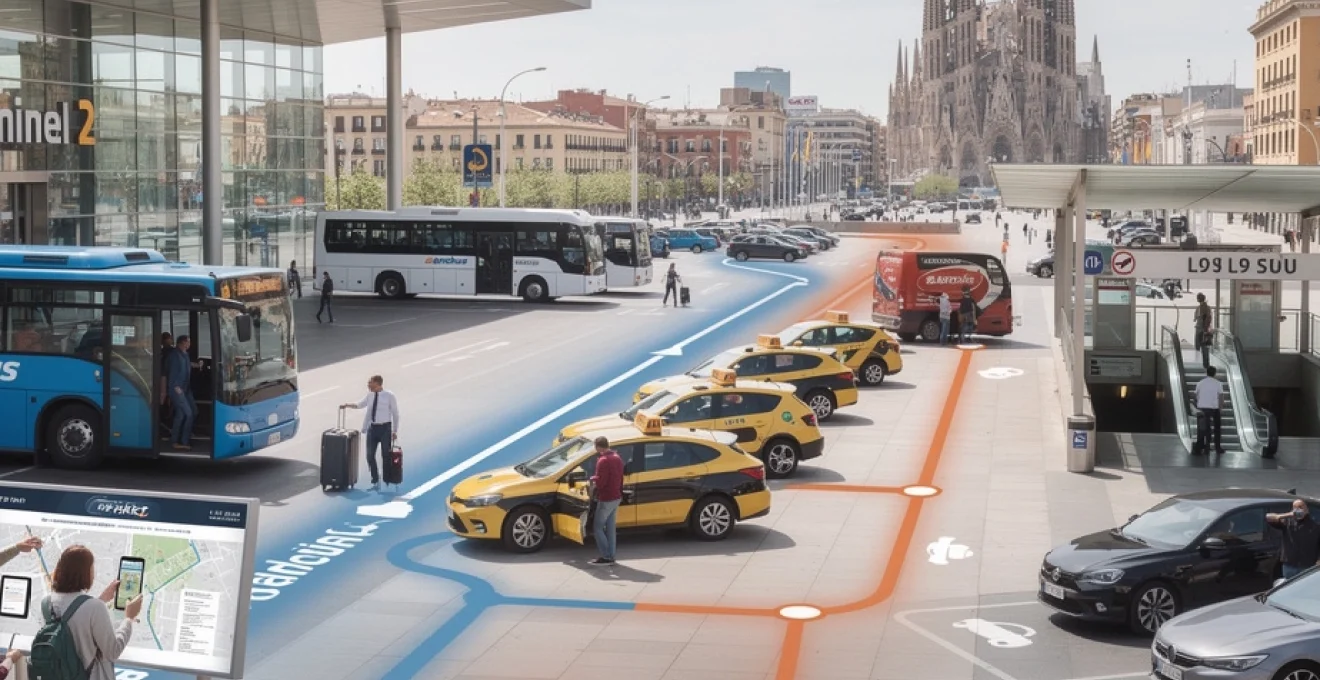
Barcelona’s Josep Tarradellas Barcelona-El Prat Airport serves as the primary gateway for millions of visitors annually, positioning itself just 13 kilometres southwest of the bustling city centre. The airport’s strategic location and comprehensive transport infrastructure make it one of Europe’s most accessible aviation hubs, offering travellers multiple efficient pathways to reach their urban destinations. Whether you’re arriving for business meetings in the Gothic Quarter, leisure exploration of Park Güell, or connections to broader Catalonia, understanding your transport options can significantly impact both your travel budget and overall Barcelona experience.
The airport’s dual-terminal configuration, encompassing Terminal 1 and Terminal 2, integrates seamlessly with Barcelona’s extensive public transport network, while also accommodating private transfer services and traditional taxi operations. Modern travellers benefit from digital ticketing systems, real-time passenger information displays, and coordinated scheduling across multiple transport modalities. This comprehensive connectivity ensures that regardless of your arrival terminal, time constraints, or budget considerations, you’ll find suitable options for reaching Barcelona’s city centre efficiently and comfortably.
Barcelona el prat airport terminal layout and ground transportation hub analysis
Josep Tarradellas Barcelona-El Prat Airport’s architectural design prioritises passenger flow efficiency and multimodal transport integration. The airport’s comprehensive layout facilitates seamless connections between air travel and ground transportation, with strategically positioned access points that minimise walking distances and transfer times. Terminal 1, opened in 2009, represents a modern aviation facility designed with sustainability principles and passenger convenience at its core, while Terminal 2 comprises three interconnected buildings (T2A, T2B, and T2C) that have evolved to accommodate growing passenger volumes and diverse airline operations.
Terminal 1 ground transport connections and departure points
Terminal 1’s ground level houses the primary transport departure points, with clear signage directing passengers to various transport options. The Aerobus A1 stop is located on the lower level, accessible via escalators from the arrivals hall. Metro Line 9 Sud provides direct access through the Aeroport T1 station, positioned adjacent to the terminal building with lift access for passengers with mobility requirements or heavy luggage. Taxi ranks are immediately visible upon exiting the arrivals area, with designated areas for standard vehicles and accessible taxis.
Terminal 2 public transport integration and access routes
Terminal 2’s configuration offers the most comprehensive transport options, including the RENFE Cercanías train station located approximately 300 metres from the terminal buildings. The Aerobus A2 service operates from designated stops outside each of the three terminal buildings, while Metro Line 9 Sud serves the complex through the Aeroport T2 station. Bus Line 46 and night bus services N16, N17, and N18 provide additional public transport alternatives, with stops clearly marked throughout the terminal complex.
Baggage claim area exit strategies for efficient city centre access
Efficient navigation from baggage claim areas to ground transport requires understanding each terminal’s layout and optimal exit routes. Terminal 1’s linear design channels passengers naturally toward the central ground transport hub, while Terminal 2’s multi-building structure offers multiple exit points that can reduce congestion during peak periods. Passengers should follow colour-coded signage systems that distinguish between different transport options, with digital displays providing real-time information about service frequencies and any operational disruptions.
Inter-terminal shuttle service coordination for onward journey planning
The complimentary inter-terminal shuttle service operates 24 hours daily, connecting Terminal 1 and Terminal 2 at frequent intervals. This service proves particularly valuable for passengers who need to access specific transport options only available from certain terminals, such as the RENFE train service exclusively departing from Terminal 2. Journey time between terminals averages 10-12 minutes, including stops, and the service accommodates passengers with luggage and mobility equipment through low-floor vehicles and dedicated storage areas.
Aerobus express service route optimisation and ticketing systems
The Aerobus express service represents Barcelona’s flagship airport-to-city transport solution, designed specifically for air travellers requiring fast, direct connections to central Barcelona locations. This premium bus service operates with dedicated vehicles featuring
spacious luggage racks, free Wi‑Fi and clear onboard information screens. For many visitors, the Aerobus is the most straightforward way to travel from Barcelona Airport to the city centre, thanks to its limited stops, extended operating hours and simple flat fare structure. Services run every few minutes throughout most of the day, minimising waiting times and providing a reliable backbone for airport-to-city transfers even during peak travel seasons.
A1 line terminal 1 to plaça catalunya direct service analysis
The Aerobus A1 line connects Terminal 1 directly with Plaça Catalunya, stopping at key hubs such as Plaça Espanya, Gran Via–Urgell and Plaça Universitat. Typical journey time is around 30–35 minutes, depending on traffic conditions along the Gran Via corridor. For most travellers staying in or near the Eixample, Gothic Quarter, Raval or Passeig de Gràcia, this route provides a near “point-to-point” connection that keeps walking distances short once you arrive in the city centre.
Tickets for the A1 service are priced as a premium compared with standard city buses but remain competitively priced against taxis and private transfers, especially for solo travellers or couples. A one-way Aerobus ticket is generally in the €7–€8 range, with discounted round-trip tickets available that remain valid for an extended period (often up to 15 days). Children under four usually travel free, making the Aerobus cost-effective for families who want a fast yet budget-aware airport transfer to Barcelona city centre.
A2 line terminal 2 route via plaça espanya and gran via corridor
The Aerobus A2 line mirrors the A1’s route almost exactly but originates at Terminal 2, serving passengers arriving into T2A, T2B and T2C. Stops are located immediately outside the arrivals areas, with clear blue Aerobus branding visible from the terminal exits. Journey times and fares on the A2 are identical to the A1, giving Terminal 2 passengers the same fast link to Plaça Espanya, Gran Via–Urgell, Plaça Universitat and Plaça Catalunya.
One important operational detail is that only the route number (A1 or A2) distinguishes the buses on the return journey from Plaça Catalunya to the airport. When travelling back to Barcelona Airport, passengers must ensure they board the correct line corresponding to their departure terminal. Mis-boarding can result in unnecessary delays and an extra terminal transfer, so checking the front display panels and platform signs at Plaça Catalunya is essential, particularly during busy periods when buses arrive in quick succession.
Digital ticketing integration through TMB app and contactless payment methods
While the Aerobus is operated as a dedicated airport service rather than a standard TMB city bus, it integrates smoothly with Barcelona’s broader digital ticketing and payment ecosystem. Travellers can purchase Aerobus tickets from vending machines at the airport, directly from onboard staff (cash or card) or in advance via official online platforms. Buying online before you fly is often the most efficient approach, as it reduces queuing time and ensures you have your airport-to-city transfer sorted the moment you land.
Contactless card payments and mobile wallets such as Apple Pay and Google Pay are widely accepted on ticket machines and at many sales points, allowing you to avoid withdrawing cash on arrival. Although Aerobus tickets are not valid with standard T‑Casual or integrated T‑fare cards, digital confirmation emails and QR codes make validation simple: you either scan your code at the platform or present it to staff when boarding. For tech‑savvy travellers, managing transfers this way feels similar to using a boarding pass on your phone—streamlined, paperless and quick.
Peak hour frequency scheduling and Real-Time passenger information systems
During peak hours—typically early morning flight waves and late afternoon to evening periods—the Aerobus schedule is reinforced with higher-frequency departures. Buses can run as frequently as every 5 minutes from both terminals, significantly reducing platform crowding and ensuring that even large arrival cohorts disperse quickly into the city. Off-peak frequencies remain robust, usually every 10 minutes, which means you rarely need to consult a timetable in advance.
Real-time passenger information displays at Aerobus stops provide countdowns to the next departures, route numbers and any disruption alerts. Onboard audio announcements and LED screens list upcoming stops, helping you prepare to disembark even if you are unfamiliar with the city’s layout. This blend of high frequency and real-time data makes the Aerobus particularly attractive if you value predictability—much like choosing an express train over a slower local service when time is at a premium.
Barcelona metro L9 sud extension integration with airport terminals
Barcelona’s Metro Line 9 Sud (L9S) integrates both airport terminals directly into the wider urban rail network, providing a consistent and weatherproof alternative to surface transport. The line connects Aeroport T1 and Aeroport T2 with key interchange stations such as Torrassa and Collblanc, from which you can transfer to central lines like L1 (red) and L5 (blue). Although L9S does not run straight to Plaça Catalunya or the historical centre, its high level of integration and frequent services make it a strategic option for travellers staying outside the immediate downtown core.
For visitors familiar with urban metro systems, L9S offers a predictable, timetable-light mode of travel: trains typically run every few minutes during the day and early evening. The line is fully accessible, air-conditioned and equipped with clear route maps, making it user-friendly even for first-time visitors. If your accommodation is near stations such as Sagrada Família, Diagonal, or Glòries, using the metro can be as direct as the Aerobus, with the added advantage of being protected from road congestion.
Aeroport T1 and aeroport T2 station platform access and lift systems
Both Aeroport T1 and Aeroport T2 stations are physically integrated into the terminal buildings, with clearly marked signs leading from the arrivals areas to the metro entrances. In Terminal 1, you descend from the arrivals hall via escalators or lifts to reach the ticket halls and platforms, while in Terminal 2 the station is accessible by covered walkways and elevators from the central concourse. Wayfinding is intuitive, with the familiar orange L9S colour coding appearing on walls, floors and overhead signage.
The stations have been designed with travellers in mind, offering wide gates for suitcases, step-free access and multiple lifts down to platform level. This means that even with heavy luggage or pushchairs, you can navigate the metro without facing long staircases or awkward gaps. Platform edge doors and modern safety systems further enhance the experience, and real-time displays show train destinations and waiting times so that you can quickly verify you are heading in the right direction towards the city centre.
Zone 1 fare structure and T-Casual Multi-Journey card validation process
Barcelona Airport stations are located within Zone 1 of the integrated fare system, but travel to and from the airport requires a special airport ticket if you pay per journey. As of recent fare structures, a single airport metro ticket costs significantly more than a standard inner-city ride, reflecting the dedicated infrastructure serving the terminals. However, integrated travel cards such as the Hola Barcelona Travel Card typically include airport transfers at no extra cost, offering unlimited metro, bus and tram rides for 48, 72, 96 or 120 hours.
For regular city journeys, many residents and longer-stay visitors use the T‑Casual multi-journey card, which allows ten rides on metro, bus and certain train lines within specified zones. Although the standard T‑Casual does not cover the metro airport surcharge, it remains highly advantageous once you are in the city. Validation is straightforward: you insert or tap your card at the turnstile, and the system deducts one journey, allowing up to 75 minutes of transfers within the same zone without extra charges. For you as a visitor, thinking of the T‑Casual as a “10-pack of rides” can make budgeting much simpler.
Passeig de gràcia and sagrada família interchange connectivity analysis
While L9S itself does not stop at central landmarks such as Passeig de Gràcia or Sagrada Família, it is engineered to connect efficiently with lines that do. A common strategy is to change at Collblanc (for L5) or Torrassa (for L1) and continue towards the heart of Barcelona. For example, from Collblanc on L5 you can travel directly to Sagrada Família, Diagonal or Verdaguer, placing you within walking distance of many major sights and hotels. From Torrassa on L1, direct services run to Plaça Catalunya and Arc de Triomf, bridging the last leg between airport and city centre.
In practice, this means your metro journey from the airport often involves one simple interchange rather than a complex multi-line route. Digital maps in stations and on trains clearly show these interchanges, and many travellers compare the process to changing lines in other European cities like Paris or London. If you are carrying very heavy luggage, you may find one change less convenient than a direct bus; however, for most visitors the trade-off in cost savings and immunity to traffic delays makes the metro a strong contender for airport-to-city centre travel.
Late night service limitations and alternative transport coordination
Barcelona’s metro system operates with reduced hours compared to some 24-hour networks, which is an important factor if your flight arrives late at night or departs very early. On weekdays, last trains on L9S typically run around midnight, with extended hours on weekends and public holidays. If you land after the final departure, you will need to switch to surface transport options such as the Aerobus, night buses N16, N17 or N18, or licensed taxis for your journey into Barcelona.
To avoid last-minute surprises, it’s wise to check the metro timetable a few days before your trip, especially if you already know your flight’s scheduled arrival time. Think of your planning as a simple decision tree: if the metro is running, it is often the most predictable, low-cost option; if not, coordinating with night bus schedules or booking a private transfer in advance becomes your backup plan. Many travellers choose to combine options—for instance, using the metro on arrival and a pre-booked taxi or shuttle for a very early return flight when public transport is less frequent.
Licensed taxi services and Ride-Hailing platform operational framework
Licensed taxis play a central role in Barcelona airport transfers, especially for travellers seeking door-to-door service with minimal effort. Official taxis are easily identifiable by their black-and-yellow livery and are regulated by the Metropolitan Taxi Institute, which sets fare structures, surcharges and service standards. Taxi ranks are located directly outside both Terminal 1 and Terminal 2, with clearly managed queues and staff on hand during busy periods to assist with loading and directing passengers.
Fares from Barcelona Airport to the city centre typically range between €30 and €40, depending on traffic conditions, terminal of departure and exact drop-off location. A minimum fare applies to all journeys originating at the airport, which includes standard surcharges such as airport access fees and luggage supplements. Night-time and weekend journeys cost slightly more due to higher tariff bands, but for groups of three or four passengers the per-person cost can be comparable to, or even lower than, that of the Aerobus or metro. Payment can usually be made by card or cash, and receipts are available on request for expense claims.
Ride-hailing platforms such as Free Now, Uber and Cabify also operate at Barcelona Airport, but local regulations require that they work with licensed taxi fleets or authorised private hire vehicles. In practice, this means that when you request a ride through these apps, you are matched either with a conventional taxi or a VTC-licensed car rather than an unregulated driver. The advantage for you is twofold: you benefit from upfront fare estimates and cashless payment, while still enjoying the legal protections and standards associated with licensed services.
For travellers who value predictability, booking a taxi or private hire car via app just before leaving the baggage claim area can be particularly convenient. You see the driver’s details, vehicle registration and estimated arrival time, helping you avoid queuing at the taxi rank during peak arrival waves. However, surge pricing or limited availability may occasionally occur at very busy times, so it is prudent to maintain a fallback option such as the Aerobus or metro in case app-based services are temporarily constrained.
Private transfer solutions and car rental terminal integration
Private airport transfers offer a tailored solution for travellers who prioritise comfort, fixed pricing and personalised meet-and-greet service. These pre-booked services range from standard sedans to luxury vehicles and minibuses capable of carrying larger groups or families with multiple suitcases. Your driver typically waits for you in the arrivals hall holding a name sign, monitors your flight for delays and escorts you directly to the vehicle, eliminating the need to queue or navigate ticket machines after a long journey.
Pricing for private Barcelona airport transfers is usually set per vehicle rather than per passenger, making them surprisingly competitive for groups of four or more. A standard private transfer to central Barcelona commonly starts around €40–€45 for a car, with larger vans costing more but spreading the fare across more travellers. Another advantage is transparency: the total cost is agreed when you book, so there are no surprises due to traffic jams, late-night surcharges or meter variations. Cancellations up to 24 hours before pick-up are often free, which gives you flexibility if your travel plans change.
Car rental is another option integrated directly into both terminals, suitable for visitors planning to explore beyond Barcelona city centre—such as the Costa Brava, Montserrat or the wine regions of Penedès and Priorat. Major international and Spanish rental agencies maintain desks in the arrivals halls, and vehicles are usually parked a short walk from the terminal in dedicated structures. While renting a car to drive into central Barcelona is rarely necessary—given the city’s extensive public transport and parking restrictions—it can be an efficient strategy if you intend to leave the city soon after arrival.
When weighing private transfers against car rental, consider your itinerary and driving confidence. If your main objective is to reach a hotel in Eixample and you do not plan to drive again for several days, a private transfer or taxi will almost certainly be simpler and more economical than renting a vehicle and paying for urban parking. Conversely, if your trip centres on visiting several towns along the coast or rural Catalonia, collecting a rental car at the airport might function as your combined transfer and touring solution, much like using a rental car as both shuttle and sightseeing tool on a road trip.
Cost-benefit analysis across transport modalities for different travel scenarios
Choosing the best way to get from Barcelona Airport to the city centre depends on several factors: budget, group size, luggage volume, arrival time and your comfort with public transport. No single option is universally superior; instead, each mode of transport aligns with specific needs and expectations. Thinking of your choice as a balance between cost, time and convenience can help you decide quickly, even after a long flight.
For solo travellers and couples prioritising affordability, local buses (such as Line 46 by day or N16–N18 at night) and the RENFE airport train from Terminal 2 are usually the cheapest options, often costing just a few euros per person. The Aerobus and metro L9S represent a middle ground, combining reasonable fares with speed, frequent services and clear routes into central Barcelona. They are ideal if you are comfortable handling your own luggage and walking a short distance from the final stop to your accommodation.
Families and small groups carrying several suitcases often find that licensed taxis or pre-booked private transfers offer the best value when cost is divided per person. Door-to-door service removes the stress of navigating with tired children or bulky luggage, and the small premium over public transport can feel minimal when shared across three or four travellers. For larger groups of six to twelve people, private minibuses or shared transfer services can become the most financially attractive choice, as one vehicle can replace multiple Aerobus or metro tickets.
Arrival time is another crucial variable. If you land during normal daytime or early evening hours, you have the full spectrum of Aerobus, metro, train, bus and taxi options available. Late-night arrivals narrow the field, making night buses, taxis and private transfers more prominent. In these cases, pre-booking can be invaluable, ensuring that you are not left comparing limited options at 2 a.m. when you would rather be heading straight to your hotel.
Ultimately, the “best” airport transfer to Barcelona city centre is the one that aligns with your travel style. If you prefer structure and speed, the Aerobus or metro will likely serve you well; if comfort and simplicity matter more, taxis and private transfers become compelling. By understanding how each mode operates—and by considering your own priorities in advance—you can turn what might have been a stressful transition into a smooth, even enjoyable, first encounter with Barcelona.