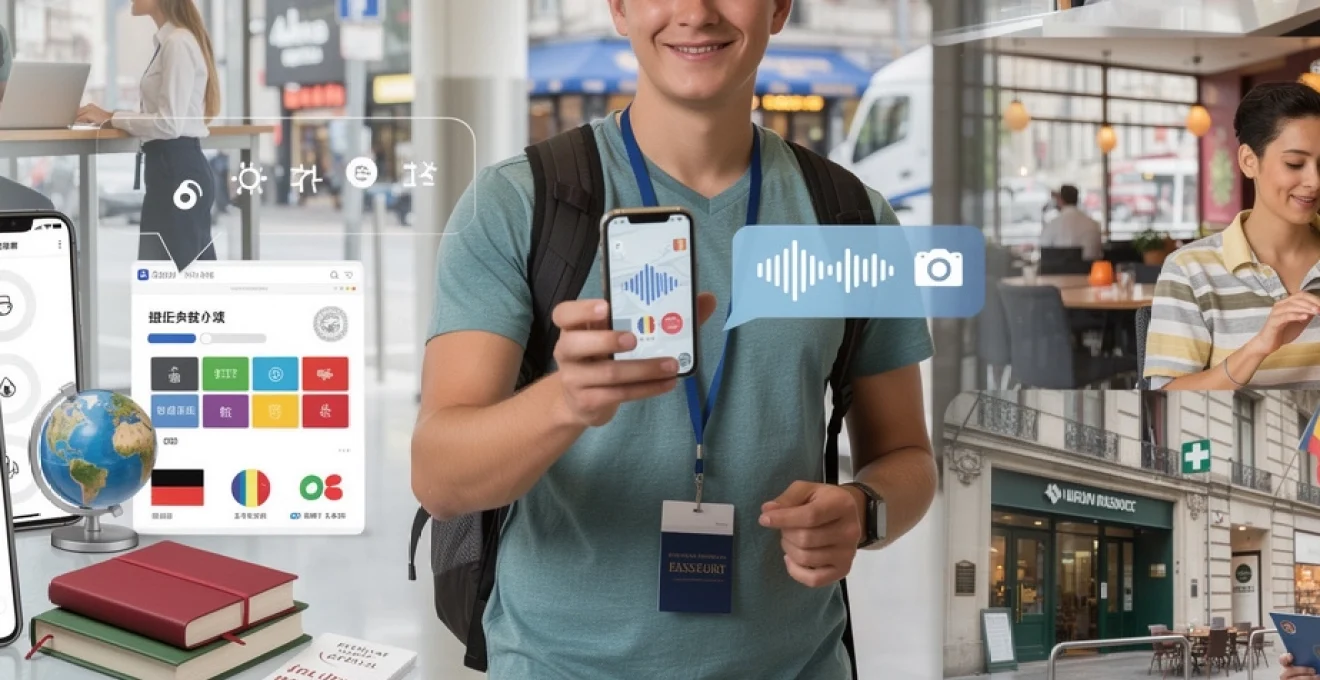
Language barriers represent one of the most significant challenges faced by international travellers, yet they needn’t become insurmountable obstacles to meaningful cultural experiences. Modern technology, combined with strategic preparation and cultural awareness, has revolutionised how we navigate linguistic differences during our journeys. The ability to communicate effectively across language divides often determines whether a trip becomes a series of frustrating misunderstandings or transformative encounters that broaden our understanding of the world.
Contemporary research indicates that language anxiety affects approximately one-third of American travellers, with younger generations experiencing higher levels of communication apprehension than their older counterparts. However, this concern often stems from misconceptions about the necessity for fluency rather than the reality of successful travel communication. Effective travel communication relies more on preparation, adaptability, and cultural sensitivity than perfect linguistic proficiency.
Pre-departure linguistic preparation strategies for international travel
Successful navigation of language barriers begins weeks before departure, requiring systematic preparation that encompasses both technological and traditional learning approaches. The foundation of effective travel communication rests upon understanding that modest linguistic preparation can yield disproportionately positive results when combined with cultural awareness and technological support.
Research demonstrates that travellers who invest even minimal time in pre-departure language preparation report significantly higher satisfaction levels and more meaningful cultural interactions. This preparation need not involve intensive language courses; rather, strategic learning focused on travel-specific scenarios proves most beneficial for short-term international trips.
Google translate offline mode configuration and regional dialect downloads
Google Translate’s offline functionality represents a crucial tool for travellers venturing into areas with limited internet connectivity. The application supports offline text translation for 59 languages, providing essential communication capabilities even in remote locations. Prior to departure, download language packages for your destination country, including any regional variants that might prove relevant.
Configuration requires accessing the application settings and selecting “Offline translation” to download specific language pairs. Consider downloading multiple regional variants where applicable, as dialectical differences can significantly impact translation accuracy. For instance, Spanish language packages for Mexico differ substantially from those optimised for Argentina or Spain, affecting both colloquialisms and formal expressions.
Duolingo travel course completion for Destination-Specific phrases
Duolingo’s travel-focused courses offer structured approaches to learning essential phrases and vocabulary for international trips. These courses emphasise practical scenarios such as airport navigation, hotel interactions, and restaurant ordering, providing contextual learning that proves immediately applicable upon arrival.
The platform’s gamification elements encourage consistent daily practice, making language learning an engaging pre-departure activity rather than a burdensome obligation. Completing travel courses typically requires 15-20 minutes daily for two to four weeks, depending on linguistic complexity and personal learning pace. The investment yields functional vocabulary for common travel scenarios whilst building confidence in pronunciation and basic grammar structures.
Cultural context research using hofstede’s dimensional framework
Understanding cultural dimensions beyond language significantly enhances communication effectiveness during international travel. Hofstede’s framework examines power distance, individualism versus collectivism, uncertainty avoidance, and other cultural parameters that influence communication styles and social expectations.
This research proves particularly valuable for business travellers or those engaging in extended cultural exchanges. For example, understanding that Japanese culture emphasises indirect communication and hierarchical respect helps frame interactions appropriately, whilst recognising Brazilian culture’s emphasis on personal relationships informs appropriate conversational approaches. Cultural intelligence often compensates for linguistic limitations, creating positive interactions despite language barriers.
Embassy language resource documentation and phrasebook compilation
Embassy websites frequently provide country-specific language resources tailored for visitors, including essential phrases, cultural etiquette guidelines, and emergency communication protocols. These official resources offer reliability and cultural accuracy often missing from generic language learning applications.
Compiling a personalised phrasebook combining embassy resources with destination-specific needs creates a valuable backup communication tool. Include medical terminology relevant to any health conditions, dietary restrictions in local language, and emergency contact information. Physical phrasebooks remain valuable when digital devices fail or require charging, particularly during extended outdoor activities or in remote locations.
Digital translation technology implementation during transit
The integration of artificial intelligence and machine learning has transformed digital translation technology, creating tools that approach human-level accuracy for common
situations such as airport transfers, border crossings, and hotel check-ins. When used intelligently, these tools can dramatically reduce stress, streamline logistics, and give you the confidence to explore independently rather than relying solely on bilingual guides or tour groups.
Microsoft translator real-time conversation mode for airport navigation
Microsoft Translator offers a robust real-time conversation mode that can be particularly useful in airports, train stations, and other transit hubs. After downloading the app and any relevant offline language packs, you can initiate a bilingual conversation session and share a QR code with staff or fellow travellers, allowing everyone to speak in their own language while the app displays translations on-screen.
In practice, this becomes invaluable when clarifying gate changes, baggage issues, or security procedures. For instance, if you are dealing with a missed connection in a regional airport where English proficiency is limited, you can speak your question into the app, show the translation, and then hand the device to the staff member to respond in their own language. Compared with shouting slowly in English, this approach preserves politeness, clarity, and your travel schedule.
Itranslate voice recognition systems for hotel check-ins
Hotel check-in is one of the most common points where language barriers while traveling become obvious, especially in smaller guesthouses or family-run properties. iTranslate’s voice recognition and text-to-speech features are well suited to these interactions, as they handle everyday hospitality vocabulary with relatively high accuracy. You can prepare key phrases in advance, such as queries about late checkout, Wi‑Fi access, or breakfast times, and save them as favourites for quick access at the reception desk.
When using a voice translator at check-in, maintain eye contact with the staff and treat the device as a tool, not a barrier. Speak clearly but naturally, pause between sentences, and verify that they have understood by repeating key details such as room rate or dates of stay. Think of the technology as a digital phrasebook that speeds up the exchange rather than a magic solution that removes the need for patience and courtesy.
Waygo visual translation camera for restaurant menu deciphering
For many travellers, restaurant menus and food stalls are where language barriers feel most intimidating. Waygo and similar visual translation apps allow you to point your phone’s camera at printed text and see an instant translation overlaid on the screen. Although Waygo focuses on East Asian scripts (Chinese, Japanese, Korean), the underlying approach—visual translation—has now been adopted by a range of apps and is particularly effective for decoding menus, street signs, and ticket machines.
One advantage of visual translation is that you can compare multiple options on a menu without asking the server to explain each dish in detail. This is especially useful when you have dietary restrictions or allergies and need to identify ingredients like nuts, shellfish, or gluten. As accuracy is not perfect, we recommend combining camera translation with a short list of “critical phrases” about your diet in the local language and, where possible, confirming important details verbally.
Sayhi translate bidirectional communication for transport bookings
Transport bookings—taxis, private transfers, regional buses—often require precise communication of locations, times, and prices. SayHi Translate excels in this context thanks to its simple bidirectional interface, allowing you and the driver or ticket agent to take turns speaking while the app displays and voices the translation. You can choose a formal or informal tone in some languages, which helps align your speech with local norms.
Before negotiating fares or confirming a route, enter or dictate critical information such as your hotel name, flight time, or bus departure point into the app and save it. This allows you to show the relevant phrase even if mobile data drops. If you are booking a return trip, use SayHi to confirm timing (“You will pick us up at 7:30 a.m. here tomorrow?”) and ask the other person to repeat it back; this double confirmation, supported by the app, reduces the risk of costly misunderstandings.
Non-verbal communication protocols in cross-cultural environments
Digital tools are powerful, but they do not replace the human ability to communicate without words. Non-verbal communication—gestures, facial expressions, posture, and personal space—often carries more meaning than vocabulary when navigating language barriers while traveling. Misreading these signals can create friction, while using them thoughtfully can build trust surprisingly fast.
Begin by observing before acting. Notice how locals greet each other, how close they stand in conversation, and how expressive they are with their hands. In some cultures, like Italy or Brazil, animated gestures and frequent eye contact are normal; in others, such as Japan or Finland, a more reserved posture and limited eye contact signal respect rather than coldness. Approaching non-verbal communication like learning a local “operating system” can help you avoid missteps.
Basic protocols apply almost everywhere. A relaxed, open posture, a genuine smile, and a slight nod convey goodwill in most cultures. When you do not share a language, you can use simple actions—pointing to a map, miming eating or sleeping, counting on your fingers—to supplement spoken attempts. However, be cautious with specific gestures such as the thumbs-up, “OK” sign, or V-sign, which are positive in some countries and offensive in others. A quick pre-trip search for “hand gestures to avoid in [country]” is a small effort that can prevent awkward moments.
Non-verbal communication is also a valuable tool for de-escalating tension. If a misunderstanding occurs, lowering your voice, adopting a non-threatening stance (hands visible, shoulders relaxed), and using apologetic expressions can calm the situation even when you lack the precise words. Think of your body language as the “tone of voice” of your entire interaction; just as you choose polite language, you can choose reassuring gestures that invite cooperation rather than conflict.
Emergency communication frameworks for critical situations
While everyday miscommunications are often amusing or mildly inconvenient, emergencies in a foreign language can be genuinely frightening. Establishing clear emergency communication frameworks before departure ensures that you can seek help quickly, even if your translation apps fail or connectivity is limited. In crisis situations, redundancy—multiple tools and methods—is essential.
International emergency number programming and ICE contact configuration
One of the simplest yet most overlooked steps is programming emergency numbers into your phone. In much of the world, 112 or 911 will connect you to emergency services, but this is not universal. Before you travel, look up the local equivalents for police, ambulance, and fire, and store them with clear labels. Many modern smartphones allow you to add emergency contacts and medical details that can be accessed from the lock screen.
Configure one or more ICE (In Case of Emergency) contacts with international dialing codes and indicate their relationship to you (e.g., “ICE – Partner,” “ICE – Parent”). If your device offers an emergency SOS function, familiarise yourself with how it works and test it briefly. Having these systems in place is like wearing a seatbelt: most of the time you will not need them, but when you do, they are indispensable.
Medical translation cards for healthcare facility interactions
For medical situations, relying solely on live translation apps can be risky, especially in noisy environments or when you are distressed. Medical translation cards—printed documents that list essential health information in both your language and the local language—provide a reliable, low-tech backup. These can include chronic conditions, allergies, medications, blood type, and any implants or devices you carry.
You can create your own cards by drafting short, clear sentences and having them professionally translated, or by using templates provided by health organisations and insurance companies. Laminate the card or keep a few copies in different bags so that one is always accessible. Presenting a concise card that states “I am allergic to penicillin” or “I have Type 1 diabetes and use insulin” in the local language can save valuable time and reduce the chance of dangerous errors in treatment.
Embassy contact protocols for consular assistance requests
In more serious incidents—lost passports, arrests, major accidents—your embassy or consulate becomes a key communication ally. Before your trip, note down the address, phone number, and emergency after-hours contact for your country’s mission in each destination. Many foreign affairs departments also offer traveller registration services; enrolling your itinerary can speed up assistance in crises.
If you need help, contact the embassy as soon as it is safe to do so. When language barriers prevent direct communication with local authorities, consular staff can help arrange interpreters, provide letters in the local language, or speak directly with officials on your behalf. Think of the embassy as your escalation channel: while translation apps and phrasebooks work for routine issues, consular services exist for situations where legal or safety stakes are high and professional support is required.
Regional language barrier mitigation techniques by destination
Language barriers do not present the same challenges everywhere. Navigating a metro system written in Cyrillic requires different skills than bargaining in an Arabic souk or ordering street food in Bangkok. By tailoring your preparation to specific regions, you can reduce friction and feel more at ease even in linguistically complex environments.
Mandarin script recognition systems for mainland china navigation
Mainland China presents a unique combination of tonal spoken Mandarin and logographic Chinese characters, which can intimidate even experienced travellers. Fortunately, script recognition systems built into apps like Google Lens, Pleco, and other OCR (optical character recognition) tools allow you to photograph characters on signs, timetables, or maps and see an approximate translation. For city navigation, this is often more practical than attempting to memorise characters in advance.
A useful strategy is to store screenshots of key place names (your hotel, nearest metro station, major landmarks) in Chinese characters on your phone. You can then show these images to taxi drivers or station staff without needing to pronounce them perfectly. When possible, learn a few core phrases such as “I want to go here” alongside pointing gestures; combining visual aids with minimal spoken Mandarin goes a long way in avoiding wrong turns or missed stops.
Arabic phrase integration for middle eastern market negotiations
In many Middle Eastern and North African destinations, some English or French is spoken, but basic Arabic phrases dramatically improve interactions, particularly in markets and small shops. Market negotiations are as much about relationship-building as price, and using even a few words in Arabic signals respect and interest. Simple greetings such as “as-salāmu ʿalaykum” (peace be upon you) and “shukran” (thank you) help establish a warm tone before you discuss costs.
Because numbers and bargaining terms are central to shopping, learning to recognise prices in Arabic numerals and a handful of negotiation phrases (for example, “How much is this?” and “That is too expensive”) can make the process smoother. Think of these expressions as social tools rather than just transactional vocabulary; you are not only trying to get a fair price but also to share a cultural ritual in which humour, patience, and politeness are valued.
Cyrillic alphabet familiarisation for eastern european transport systems
Travelling through countries that use the Cyrillic alphabet—such as Russia, Serbia, Bulgaria, or parts of Ukraine—can feel like facing a secret code. The good news is that learning to decode basic Cyrillic is far easier than mastering a new language. Many letters correspond closely to Latin equivalents, and with a short practice session you can begin to sound out station names, street signs, and bus destinations.
Approach Cyrillic like learning to read a new font rather than an entirely new language. Start with a short reference chart and practise with metro maps or screenshots of signage before your trip. Once you can recognise the names of key stops, navigating local transport systems becomes significantly less stressful. Even if your pronunciation is imperfect, being able to match written names on your ticket to those on platform displays is a major advantage when dealing with language barriers while traveling in Eastern Europe.
Thai tonal language basics for bangkok street food ordering
Thai is a tonal language, meaning that pitch affects meaning, which can be daunting for short-term visitors. Fortunately, you do not need to master the tonal system to order safely and confidently from Bangkok’s legendary street food stalls. Focus on a short list of menu-related words—chicken, pork, vegetarian, spicy, not spicy—and rehearse them with the help of audio-based apps or local guides.
When in doubt, combine your basic Thai phrases with visual cues. Point to ingredients, use fingers to indicate quantity, and have key dietary phrases written down in Thai script if you have allergies or religious restrictions. Street vendors are accustomed to serving international visitors, and a mix of simple Thai, smiles, and gestures often works better than perfect grammar. Think of your Thai vocabulary as seasoning: even a small amount enhances the overall flavour of your interactions.
Post-travel language skills development and cultural intelligence enhancement
The end of a trip does not have to be the end of your engagement with the language and culture you encountered. In fact, post-travel reflection and continued learning can transform short-term coping strategies into long-term skills. By reviewing what worked, what felt difficult, and which misunderstandings arose, you can refine your approach for future journeys and gradually lower your anxiety about language barriers while traveling.
One effective habit is to keep a short list of “phrases I wish I had known” during your trip. After returning home, you can look up accurate translations, add pronunciation guides, and store them in a digital note or flashcard app. Over time, this personalised phrasebook becomes a highly relevant resource tailored to your travel style, far more useful than generic vocabulary lists.
Beyond vocabulary, consider your broader cultural intelligence—the ability to adapt to different communication styles and social norms. Did you notice differences in how people expressed disagreement, hospitality, or humour? Reflecting on these patterns, perhaps through journaling or discussing with fellow travellers, helps you internalise lessons that go far beyond words. The more cultures you experience with openness and curiosity, the easier it becomes to read subtle cues and respond appropriately, even when you do not speak the language.
Finally, if a particular destination or language resonated with you, treat that spark of interest as an invitation. Enrol in an online course, join a language exchange, or consume media—films, podcasts, books—from that region. Instead of viewing language barriers as walls, you begin to see them as doors that can be opened gradually with each new word and insight. Over time, your travel communication toolkit will evolve from basic survival strategies into a rich, flexible skill set that enhances every journey you take.