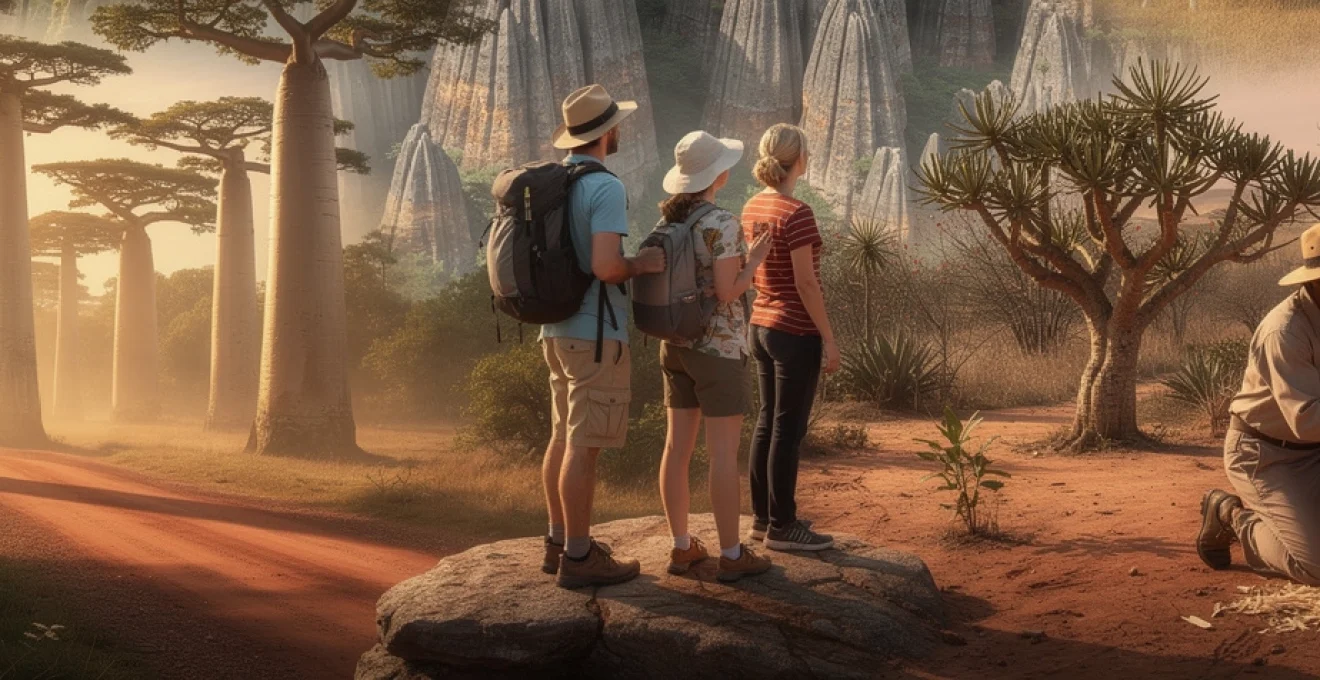
Madagascar stands as one of Earth’s most extraordinary destinations, a vast island nation that broke away from the African continent approximately 165 million years ago. This geological separation created an isolated laboratory of evolution, resulting in biodiversity levels that astound scientists and travellers alike. With over 200,000 endemic species and landscapes ranging from pristine rainforests to otherworldly limestone formations, Madagascar offers experiences impossible to replicate anywhere else on the planet. The island’s unique position in the Indian Ocean, combined with its diverse topography and rich cultural heritage, creates a destination that challenges conventional tourism whilst rewarding those who venture beyond typical holiday destinations.
The island’s significance extends far beyond its natural wonders. Madagascar’s cultural tapestry weaves together Austronesian and African influences, creating traditions and practices found nowhere else in the world. From ancient burial ceremonies to innovative conservation initiatives, the island demonstrates how human communities can thrive alongside extraordinary biodiversity. For travellers seeking authentic experiences and meaningful connections with both nature and culture, Madagascar presents opportunities that transform understanding of what sustainable tourism can achieve.
Endemic biodiversity and conservation ecosystems of madagascar
Madagascar’s isolation has produced one of the world’s most remarkable concentrations of endemic species. Scientists estimate that over 90% of the island’s wildlife exists nowhere else on Earth, making it a living museum of evolutionary processes. This extraordinary endemism results from millions of years of isolated evolution, creating ecosystems that function as natural laboratories for understanding biodiversity conservation.
Andasibe-mantadia national park: indri lemur habitat preservation
The haunting calls of indri lemurs echo through the misty rainforests of Andasibe-Mantadia National Park, creating an auditory experience that connects visitors directly to Madagascar’s most iconic species. These largest of Madagascar’s lemurs communicate through songs that can travel up to three kilometres through the dense forest canopy. The park’s elevation ranges from 800 to 1,200 metres, creating microclimates that support over 100 orchid species and numerous endemic birds including the Madagascar serpent eagle and ground roller species.
Conservation efforts within Andasibe-Mantadia demonstrate innovative approaches to habitat protection. Local communities participate directly in forest monitoring programmes, creating sustainable income streams whilst protecting critical lemur habitats. The park’s buffer zones allow controlled harvesting of medicinal plants and sustainable forestry practices, proving that conservation and community development can coexist successfully.
Tsingy de bemaraha geological formations and species endemism
The razor-sharp limestone pinnacles of Tsingy de Bemaraha create landscapes that appear almost alien in their otherworldly beauty. These formations, known locally as tsingy meaning “the place where one cannot walk barefoot,” harbour extraordinary levels of endemism within their isolated canyons and caverns. The unique geology creates distinct microhabitats that support species found nowhere else, including several lemur species and numerous endemic succulent plants.
Recent scientific expeditions continue to discover new species within the Tsingy’s inaccessible reaches. The isolated nature of individual limestone towers creates evolutionary islands within islands, leading to rapid speciation and unique adaptations. Visitors can witness this evolutionary laboratory firsthand through carefully managed climbing routes that provide access whilst minimising environmental impact.
Spiny forests of ifaty: octopus tree and pachypodium conservation
The spiny forests of southwestern Madagascar represent one of the world’s most unusual ecosystems, dominated by bizarre succulent trees that seem designed by imagination rather than evolution. The iconic octopus tree (Alluaudia procera) and various Pachypodium species create forests that resemble giant sculptures more than traditional woodlands. These adaptations to extreme aridity demonstrate nature’s incredible capacity for innovation in challenging environments.
Conservation challenges in the spiny forests centre on preventing charcoal production and overgrazing by zebu cattle. Community-based conservation programmes work with local populations to develop alternative income sources, including sustainable tourism and traditional crafts. The region’s endemic baobab species, including Adansonia za and Adansonia fony, serve as flagship species for broader ecosystem protection efforts.
Masoala peninsula
This vast peninsula on Madagascar’s northeast coast forms one of the last great blocks of lowland primary rainforest in the Indian Ocean. The Masoala Peninsula connects forest, river, and marine ecosystems in a continuous corridor that still functions much as it did thousands of years ago. Here you can find critically endangered lemur species, including the red-ruffed lemur, alongside rare birds such as the helmet vanga and a remarkable diversity of amphibians and reptiles. Offshore, the adjacent marine park protects coral reefs, sea grass beds, and mangroves that serve as nurseries for reef fish and feeding grounds for migrating whales.
Conservation in the Masoala Peninsula centres on maintaining this forest–sea continuum. Community-based patrols, sustainable fishing zones, and regulated forest use aim to reduce pressure from logging and slash-and-burn agriculture. For travellers, guided rainforest walks, sea kayaking, and responsible whale-watching tours provide low-impact ways to experience this biodiversity hotspot. Visiting with an operator committed to conservation ensures that tourism revenues support local livelihoods and reinforce forest protection rather than undermine it.
Amber mountain national park microclimate species distribution
Rising abruptly from the surrounding dry plains of northern Madagascar, Amber Mountain National Park creates its own climate system. Moist air from the Indian Ocean condenses over the massif, generating frequent mist and rain that sustain lush montane rainforest. Within a relatively compact area, altitudes range from roughly 850 to 1,475 metres, producing a mosaic of microclimates where species distribution changes noticeably with elevation, aspect, and humidity. This compressed environmental gradient allows you to witness, in a single day’s hike, shifts in vegetation that would normally require crossing an entire country.
The park shelters an impressive array of endemic species, from leaf-tailed geckos and colourful chameleons to rare frogs and several lemur species, including crowned and Sanford’s brown lemurs. Botanists are particularly drawn to Amber Mountain’s ferns, orchids, and tree diversity, many of which remain poorly studied. Clearly marked trails and local guides help visitors explore crater lakes, waterfalls, and panoramic viewpoints while minimising disturbance to sensitive habitats. Understanding how microclimates shape species distribution here offers valuable insights for climate-change adaptation and conservation planning across Madagascar.
Malagasy cultural heritage and anthropological significance
Beyond its famed wildlife, Madagascar is a living archive of human history and cultural fusion. Archaeological and linguistic evidence suggests that the island was settled by seafarers from Southeast Asia more than 1,500 years ago, later joined by migrants from East Africa and the Middle East. This layered history produced a rich tapestry of beliefs, rituals, and social structures that still guide daily life across the island. Exploring Malagasy cultural heritage gives travellers a deeper understanding of how communities have adapted to, and shaped, Madagascar’s diverse environments over centuries.
Famadihana ancestral exhumation ceremonies in central highlands
In the central highlands, one of the most striking expressions of Malagasy spirituality is Famadihana, often translated as the “turning of the bones.” During this ancestral exhumation ceremony, families reopen tombs, carefully rewrap the remains of their forebears in fresh shrouds, and celebrate with music, dance, and feasting. Rather than focusing on mourning, Famadihana emphasises joy, reunion, and the strengthening of ties between the living and the dead. Ancestors are regarded as active members of the family who continue to influence health, prosperity, and social harmony.
For anthropologists, Famadihana illustrates how Malagasy cosmology blends Austronesian notions of ancestor veneration with African ritual forms and local beliefs known as fady (taboos). Travellers who are respectfully invited to witness a ceremony should follow the guidance of local hosts regarding dress codes, photography, and behaviour. Participating as an observer offers a powerful reminder that cultural heritage in Madagascar is not confined to museums; it is a dynamic, lived practice that shapes community identity and social cohesion.
Bara and antandroy zebu cattle pastoral traditions
In the semi-arid south, the Bara and Antandroy peoples have developed pastoral traditions built around the zebu cattle that dominate Madagascar’s rural landscapes. For these groups, zebu are more than livestock; they represent wealth, social status, and spiritual connection. Complex rituals govern cattle ownership, bridewealth payments, and sacrifice during ceremonies marking major life events. The horns of sacrificed zebu often adorn family tombs, signifying respect for both ancestors and the animals that sustained the community.
These pastoral systems are finely tuned to harsh, variable climates, relying on seasonal movements, shared grazing agreements, and deep ecological knowledge. However, climate change, land fragmentation, and shifting economic pressures are reshaping traditional practices. When you travel through Bara or Antandroy regions, engaging local guides offers insight into how herders are adapting—experimenting with crop diversification, community grazing rules, and, in some areas, ecotourism partnerships. Understanding zebu culture helps explain why cattle are central to Madagascar’s rural economy and why conservation projects must consider pastoral livelihoods.
Zafimaniry woodcarving techniques and UNESCO recognition
High in the eastern highlands, the Zafimaniry people have safeguarded a distinctive woodcarving tradition that earned UNESCO recognition as Intangible Cultural Heritage of Humanity. Zafimaniry architecture and household objects are decorated with intricate geometric patterns, each motif carrying symbolic meaning related to family, fertility, and connection to the forest. Houses, granaries, and even everyday tools become canvases for this elaborate visual language, turning entire villages into living galleries of vernacular art.
Historically, Zafimaniry livelihood depended on shifting agriculture and sustainable use of surrounding forests. As deforestation accelerated, their woodcarving skills became both a cultural anchor and an economic lifeline. Today, visitors who travel with responsible tour operators can meet artisans, observe traditional carving methods, and purchase certified pieces that support local families. By valuing Zafimaniry craftsmanship, travellers help preserve not only a unique artistic style but also the knowledge systems and forest stewardship practices embedded within it.
Malagasy language austronesian-bantu linguistic fusion
The Malagasy language provides one of the clearest windows into the island’s mixed heritage. Linguists classify Malagasy as an Austronesian language closely related to those spoken in Borneo and across island Southeast Asia, yet it incorporates substantial Bantu, Arabic, and French influences. This fusion is evident in vocabulary, phonetics, and regional dialects, which reflect centuries of maritime trade, migration, and colonial contact. For example, words for rice cultivation, seafaring, and kinship often have Austronesian roots, while terms linked to cattle herding and certain social structures show African origins.
For travellers, learning a few Malagasy phrases—such as misaotra (thank you) or veloma (goodbye)—goes a long way in building rapport and showing respect. The coexistence of Malagasy and French in many urban areas illustrates how language continues to evolve as a tool of identity, education, and economic opportunity. From an anthropological perspective, Madagascar’s linguistic landscape is akin to a palimpsest, where older cultural layers remain visible beneath more recent influences, reminding us that cultures, like ecosystems, are always in flux.
Geological phenomena and landscape formations
Madagascar’s geological story is as compelling as its biodiversity and culture. Having broken away from Africa and then from the Indian subcontinent, the island has followed its own tectonic path for tens of millions of years. This isolation allowed erosion, volcanism, and sedimentation to sculpt some of the most distinctive landscapes on Earth. Travellers encounter everything from towering sandstone massifs and eroded plateaus to lava fields and coral-limestone formations, each revealing a chapter of the island’s deep-time history.
Avenue of the baobabs adansonia grandidieri grove conservation
Near Morondava on the west coast, the Avenue of the Baobabs presents one of Madagascar’s most emblematic vistas. Dozens of Adansonia grandidieri trees—some more than 800 years old—line a dusty track, their massive trunks and sparse crowns silhouetted against the sky at sunrise and sunset. These “upside-down trees” are the remnants of a once-extensive dry forest, now mostly cleared for agriculture. While the scene appears timeless, the remaining baobabs face threats from soil erosion, land-use change, and shifting rainfall patterns.
Conservation efforts around the Avenue focus on stabilising soils, replanting native vegetation, and involving local communities in managing visitor flows. Simple measures, such as staying on designated paths and avoiding climbing the trees, help reduce damage to baobab root systems. Many conservationists now encourage travellers to visit lesser-known baobab groves deeper inland, where the experience may be more authentic and the tourism footprint lighter. By viewing the Avenue as both a scenic highlight and a conservation case study, we better appreciate what is at stake for Madagascar’s dry forests.
Isalo sandstone massif erosion patterns and canyon systems
In the southwest, Isalo National Park showcases the power of wind and water to sculpt ancient sandstone into dramatic forms. Over millions of years, erosion has carved deep canyons, natural arches, and towering cliffs from sedimentary layers deposited when this region lay under shallow seas. The result is a landscape of golden plateaus and shadowed ravines where seasonal rivers feed hidden oases and natural rock pools. For geologists, Isalo provides a textbook example of how differential erosion creates complex relief from relatively uniform rock strata.
Hiking through Isalo’s canyon systems, you can trace erosion patterns in the shapes of overhanging cliffs, smooth potholes, and V-shaped gullies. The interplay between rock and water also influences local ecology, concentrating moisture-loving plants and wildlife around permanent pools while drought-tolerant species colonise exposed ridges. Park authorities have established marked circuits with local guides to help visitors explore safely, avoid fragile slopes, and respect sacred sites used by nearby communities for burials. Isalo demonstrates that geology, ecology, and culture are deeply intertwined.
Ankarafantsika laterite soil formation and mineral composition
Further north, Ankarafantsika National Park is characterised by striking red and ochre landscapes shaped by laterite soils. These iron- and aluminium-rich layers form when prolonged weathering leaches away more soluble minerals, leaving behind concentrated oxides that harden into a crust. In some areas, erosion has sculpted these deposits into colourful gullies and badlands, exposing the geological processes that transformed ancient rocks into nutrient-poor but visually dramatic terrain. For soil scientists, Ankarafantsika offers valuable insights into tropical weathering, land degradation, and restoration potential.
Despite the apparent harshness of lateritic soils, Ankarafantsika supports dry deciduous forests that host endemic birds, lemurs, and reptiles adapted to seasonal extremes. Understanding the mineral composition and physical properties of these soils is crucial for designing sustainable agriculture and reforestation projects in surrounding communities. Visitors can observe how vegetation changes along topographic gradients, from exposed laterite plateaus to more fertile valley bottoms. This geologically informed perspective helps explain why some areas of Madagascar are especially vulnerable to erosion and why careful land management is essential.
Nosy be volcanic island formation and ylang-ylang cultivation
Off Madagascar’s northwest coast, Nosy Be and its satellite islets tell a different geological story shaped by volcanic activity. The island’s rolling hills, crater lakes, and basaltic outcrops are remnants of ancient eruptions that created fertile soils rich in minerals. Over time, these conditions proved ideal for cultivating cash crops such as coffee, cocoa, sugarcane, and especially ylang-ylang. The fragrant flowers of this tropical tree are distilled into an essential oil prized by perfumers worldwide, making Nosy Be one of the global centres of ylang-ylang production.
The patchwork of volcanic hills and plantations demonstrates how geology underpins local economies and cultural landscapes. When you walk through ylang-ylang groves at dusk, the air thick with floral scent, you experience a direct link between deep-time processes and contemporary livelihoods. Responsible tours often include visits to small distilleries where you can see how flowers are transformed into essential oil using traditional techniques. Understanding Nosy Be’s volcanic origin also enhances appreciation for its coral-fringed bays and marine life, which have developed in the sheltered waters around this ancient island arc.
Marine ecosystems and coastal conservation zones
Madagascar’s marine environments are as remarkable as its terrestrial ecosystems, forming part of the Western Indian Ocean’s vast coral triangle. With more than 4,800 kilometres of coastline and numerous offshore islands, the country supports extensive coral reefs, mangrove forests, and seagrass meadows. These habitats provide nursery grounds for fish, feeding areas for marine turtles and dugongs, and migratory routes for humpback and whale sharks. Yet, like many coastal regions worldwide, they face mounting pressures from overfishing, unregulated tourism, and climate-driven coral bleaching.
In response, a growing network of marine protected areas and locally managed marine zones has emerged along Madagascar’s shores. Coastal communities, often working with NGOs and researchers, establish no-take zones, seasonal closures, and gear restrictions to allow fish populations and coral reefs to recover. For travellers, choosing operators who respect these regulations and employ local guides is one of the most effective ways to support marine conservation. Whether you are diving in Nosy Tanikely, kayaking through mangroves near Kivalo, or joining whale-watching trips off Île Sainte-Marie, your choices help determine whether these fragile ecosystems will thrive for future generations.
Adventure tourism infrastructure and ecotourism development
Madagascar’s reputation as an adventure destination stems from its rugged landscapes and relatively low levels of mass tourism. Trekking, canyoning, caving, birdwatching, and multi-day 4×4 expeditions all find natural homes here, from the karst pinnacles of Tsingy de Bemaraha to the remote trails of the Makay massif. However, the country’s limited infrastructure and challenging road conditions mean that adventure tourism requires careful planning and realistic expectations. Journeys that look short on a map can take many hours, especially during the rainy season when routes become muddy or impassable.
Over the past two decades, a new generation of ecolodges, community-run guesthouses, and specialised tour operators has emerged to meet demand for sustainable adventure travel. Many partner directly with local associations—such as women’s cooperatives in Ankarana or eco-guides in Kivalo—to create itineraries that distribute economic benefits and incentivise conservation. As a traveller, you can support this model by prioritising small-scale, locally owned accommodations and experiences that limit group size and environmental impact. Asking how your trip contributes to community projects or protected-area management is a simple yet powerful way to align your adventure with positive change.
Vanilla production and agricultural biodiversity systems
Madagascar is the world’s leading producer of natural vanilla, supplying around 60–70 percent of the global market in most years. Grown primarily in the humid northeast around Sava, vanilla cultivation is a labour-intensive process that depends on shaded agroforestry systems. Vines of Vanilla planifolia climb support trees in mixed gardens that may also include cloves, coffee, fruit trees, and food crops. Because vanilla flowers must be hand-pollinated within a few hours of opening, each bean represents dozens of careful human interventions across an 18–24 month cycle of flowering, curing, and drying.
These traditional vanilla agroforests function as important reservoirs of agricultural biodiversity, providing habitat for birds, insects, and understory plants while buffering farmers against price volatility and climate risks. However, surges in global vanilla prices can lead to forest clearing, theft, and social tension, illustrating the double-edged nature of high-value cash crops. When visiting vanilla-growing regions, choosing certified or traceable products and buying directly from reputable cooperatives helps ensure fair compensation and sustainable practices. In this way, vanilla becomes more than a flavouring; it becomes a lens through which we understand how global demand, local livelihoods, and biodiversity conservation intersect in Madagascar.