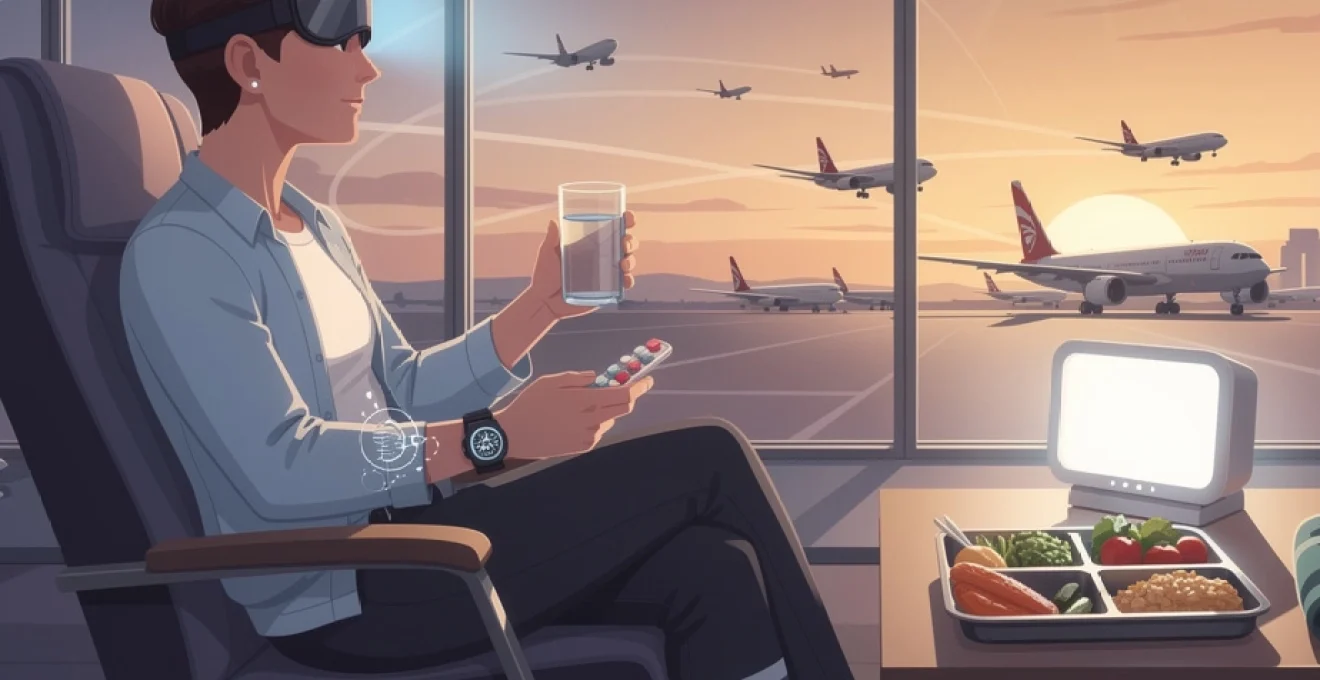
Crossing multiple time zones disrupts your body’s natural circadian rhythm, leading to the familiar symptoms of jet lag that affect millions of international travellers annually. Modern research reveals that jet lag isn’t simply about feeling tired—it’s a complex physiological response involving your internal biological clock, hormone production, and cellular processes. Understanding the science behind these disruptions enables you to implement targeted strategies that significantly reduce recovery time and improve your travel experience. Advanced techniques combining light therapy, chronotherapy, and environmental manipulation can transform how your body adapts to new time zones, making international travel more enjoyable and productive.
Circadian rhythm manipulation through strategic light exposure therapy
Light exposure therapy represents the most powerful tool for resetting your circadian rhythm before, during, and after international flights. Your body’s master clock, located in the suprachiasmatic nucleus of your brain, responds directly to light signals, making strategic phototherapy essential for minimising jet lag symptoms. Research demonstrates that properly timed light exposure can shift your circadian rhythm by up to 90 minutes per day, dramatically reducing the adjustment period typically required for long-haul travel.
The timing of light exposure determines whether you advance or delay your biological clock. Morning light exposure advances your circadian rhythm, making you feel sleepy earlier in the evening, while evening light exposure delays your rhythm, keeping you alert later at night. This fundamental principle forms the basis for all effective light therapy protocols used in combating jet lag.
Phototherapy protocols for eastward flight adjustments
Eastward travel requires advancing your circadian rhythm, which proves more challenging than westward adjustments due to the natural human tendency towards a slightly longer than 24-hour cycle. Beginning three days before departure, expose yourself to bright light immediately upon waking, preferably within 30 minutes of getting out of bed. A light intensity of 2,500-10,000 lux for 30-60 minutes provides optimal results, with higher intensities requiring shorter exposure periods.
Combine morning light therapy with strict evening light avoidance after 8 PM in your home time zone. Use blackout curtains, blue light filtering glasses, and dim lighting to signal your brain that bedtime approaches earlier than usual. This dual approach—morning light plus evening darkness—accelerates the eastward circadian shift necessary for European, Asian, or Middle Eastern destinations.
Blue light filtering techniques during westward travel
Westward travel benefits from strategic blue light filtering rather than complete light avoidance. Blue light wavelengths between 460-480 nanometres exert the strongest influence on circadian rhythms, making selective filtering more effective than total darkness when travelling west. Amber-tinted glasses worn for 2-3 hours before your desired bedtime in the destination time zone help delay your circadian rhythm appropriately.
During the flight, continue wearing blue light filtering glasses during evening hours in your destination time zone while maintaining normal exposure to cabin lighting during daytime hours. This approach allows your circadian clock to gradually adjust without the abrupt shifts that cause severe jet lag symptoms upon arrival.
Melatonin suppression strategies using natural sunlight
Natural sunlight provides the most effective method for suppressing inappropriate melatonin production and resetting your biological clock. Upon arrival at your destination, prioritise outdoor activities during morning hours, aiming for at least 30 minutes of direct sunlight exposure without sunglasses. Even on cloudy days, outdoor light intensity ranges from 1,000-10,000 lux, significantly higher than indoor lighting which typically measures only 100-500 lux.
Combine sunlight exposure with physical activity to enhance circadian resetting effects. A morning walk, outdoor breakfast, or sightseeing activities provide dual benefits of light therapy and movement, both crucial for rapid adjustment to new time zones. The combination proves particularly effective for travellers crossing 6-9 time zones, where traditional adjustment methods often fall short.
Light box therapy implementation for Trans-Pacific routes
Trans-Pacific flights crossing 12+ time zones require intensive light therapy intervention due to the extreme circadian disruption involved. Portable light therapy devices delivering 10,000 lux enable precise timing control regardless of weather
conditions or limited daylight at your destination. Begin using the light box two to three days before your Trans-Pacific flight, aligning exposure with the morning hours of your destination time zone rather than your current location. Continue these sessions for the first three to five days after arrival, ideally at the same local time each morning. Consistency is more important than session length, but most travellers benefit from 20–40 minutes of 10,000-lux exposure at a distance of 30–60 cm.
For overnight flights to destinations such as Tokyo, Sydney, or Auckland, avoid bright light (including your light box) during what will be your new local evening and night. Think of the light box as a “circadian steering wheel”: used at the right time, it helps you turn your internal clock smoothly; used at the wrong time, it can send you further off course. Always cross-check your planned sessions with your arrival time and time zone difference to avoid inadvertently delaying your body clock when you need to advance it.
Chronotherapy applications for long-haul flight recovery
Chronotherapy focuses on timing sleep, wake, and supplement schedules to manipulate your internal clock with precision. For international jet lag, this means using exogenous melatonin, carefully timed sleep phases, and adjunct nutrients to shorten adjustment time. While you cannot eliminate circadian misalignment completely on long-haul routes, you can often cut recovery from a week or more down to just a few days.
Before implementing any chronotherapy protocol, remember that melatonin and other sleep-support supplements can interact with existing medications or health conditions. Always consult your healthcare provider, particularly if you have cardiovascular disease, mood disorders, epilepsy, or are pregnant. Once cleared, you can follow structured schedules tailored to common long-distance routes to improve both sleep quality and daytime alertness after arrival.
Exogenous melatonin dosing schedules for London-Sydney routes
London–Sydney is one of the most disruptive itineraries for jet lag, often involving 9–11 hours of time difference and one or more layovers. To reduce jet lag on this ultra-long route, start adjusting your sleep-wake cycle two to three days before departure. Gradually shift your bedtime 60–90 minutes earlier each night if you are flying eastward to Sydney, using low-dose melatonin (0.5–1 mg) taken 4–5 hours before your current usual bedtime to gently advance your circadian rhythm.
On the travel day and during layovers, align melatonin use with your destination bedtime rather than your departure time. Once in Sydney, continue with 0.5–3 mg of melatonin 60–90 minutes before your intended sleep time for three to five nights, then taper off. Higher doses do not necessarily work better; in fact, lower doses often produce fewer next-day side effects and mimic natural melatonin peaks more closely, helping your body adopt the Sydney time zone more quickly.
Sleep phase advancement protocols for european business travel
For eastbound business trips from North America to Europe, time is often limited and performance expectations are high. A structured sleep phase advancement protocol can help you arrive more alert for morning meetings. Three to four days before departure, move your bedtime and wake time 30–45 minutes earlier each day. Combine this with bright morning light exposure and reduced light in the late evening to reinforce the new schedule.
On the overnight flight, treat the first half of the flight as your new “late evening” and the second half as the start of your “night.” Eat a light meal shortly after take-off, then minimise screens and cabin light, using an eye mask and earplugs to obtain 3–5 hours of consolidated sleep. When you land in Europe in the morning, prioritise natural light, moderate caffeine, and movement, while avoiding daytime naps longer than 20 minutes. This approach allows many travellers to function reasonably well even on day one of a tight business itinerary.
Controlled release melatonin timing for Trans-Atlantic flights
Controlled release (or extended release) melatonin can be particularly useful on Trans-Atlantic flights where nighttime at your destination coincides with much of your flight time. Unlike immediate release melatonin, which peaks quickly and then declines, controlled release formulas maintain steadier levels for several hours, more closely matching a natural night. For most adults flying overnight to Europe, taking 1–2 mg of controlled release melatonin shortly after boarding, once the cabin lights dim, can support more sustained inflight sleep.
Upon arrival, avoid additional melatonin until your new local bedtime, at which point a lower dose of immediate release (0.5–1 mg) 60 minutes before sleep may help you fall asleep on schedule. Taking controlled release melatonin again during the day, or too close to morning, can confuse your circadian system and prolong jet lag. Think of controlled release as a tool for consolidating one main “night” period per 24 hours, both during the flight and on your first few nights abroad.
Combination therapy using melatonin and magnesium glycinate
Many travellers find that combining melatonin with magnesium glycinate enhances sleep quality without heavy sedation. Magnesium glycinate supports relaxation and reduces muscle tension, which is particularly valuable when you are trying to sleep in a cramped cabin seat. A common protocol involves taking 100–200 mg of magnesium glycinate with your evening meal at the destination, followed by 0.5–2 mg of melatonin 60–90 minutes before your target bedtime.
This combination does not “force” sleep the way some prescription hypnotics do, but instead creates favourable conditions for your circadian clock to reset. For those concerned about grogginess, starting with the lowest doses and trialling the combination at home before travel is wise. As always, if you have kidney disease, are on medications that affect magnesium levels, or use other sedatives, medical supervision is essential before adding magnesium or melatonin to your jet lag toolkit.
Pre-flight sleep architecture optimisation techniques
Your sleep architecture—the structure and sequence of light, deep, and REM sleep—plays a major role in how resilient you are to jet lag. Entering a long-haul flight already sleep-deprived dramatically worsens circadian misalignment, much like starting a marathon dehydrated. Ideally, you should aim for three consecutive nights of high-quality sleep (7–9 hours for most adults) before departure, even if that requires protecting your schedule more carefully than usual.
To optimise pre-flight sleep architecture, standardise your bedtime and wake time, avoid heavy meals and alcohol within three hours of sleep, and limit caffeine after midday. A wind-down routine—dim lighting, no work emails, and a consistent pre-sleep ritual—helps your brain transition more efficiently into restorative deep sleep. If you plan to shift your sleep window ahead of an eastbound flight or delay it for westbound travel, do so gradually over several nights; abrupt changes compress certain sleep stages and leave you feeling “jet lagged” even before you board.
In-flight circadian entrainment methodologies
The hours spent in the air are not dead time; they are a critical window for circadian entrainment when you are trying to avoid jet lag on international trips. By aligning your behaviour with the destination time zone rather than your departure time, you send early signals to your body clock about when to expect sleep, meals, and activity. This includes how you hydrate, when and what you eat, how you manage sleep periods, and even how you regulate your body temperature in the cabin environment.
Many travellers default to the airline’s schedule, but service times are often optimised for logistics rather than circadian health. Instead, set your watch or phone to the destination time as soon as you board, and make decisions about napping, meal timing, and light exposure based on that clock. This proactive strategy can feel counterintuitive at first, yet it is one of the most effective ways to shorten recovery after landing.
Cabin pressure adaptation through hydration protocols
Modern aircraft cabins are typically pressurised to the equivalent of 6,000–8,000 feet above sea level, which promotes fluid loss and mild hypoxia. Dehydration exacerbates many jet lag symptoms—headache, fatigue, and impaired concentration—and can subtly worsen sleep quality. To adapt more smoothly, begin hydrating the day before your flight and continue sipping water regularly in the air, aiming for roughly 200–250 ml every hour you are awake.
At the same time, limit or avoid alcohol and high-caffeine beverages, especially in the second half of the flight, as both act as diuretics and disturb sleep architecture. You might ask: doesn’t this mean more trips to the restroom? Yes, but that extra movement also helps circulation and reduces stiffness. Adding electrolytes in low-sugar formulations to one or two bottles of water on ultra-long routes can further support fluid balance without causing blood sugar swings that interfere with your circadian rhythm.
Strategic meal timing based on destination time zones
Feeding schedules are another powerful, often overlooked, cue for your internal clock. Digestive rhythms are tightly linked to circadian timing, and eating at “biological midnight” can worsen both gastrointestinal discomfort and jet lag. As far as possible, align your in-flight meals with approximate breakfast, lunch, and dinner times at your destination. If the airline serves a heavy meal at what will be 2 a.m. local time, consider opting for something light or skipping it.
Choosing lighter, protein-rich meals with moderate complex carbohydrates and minimal sugar helps stabilise energy levels and prevents post-meal crashes. On overnight flights, a modest meal early in the journey followed by a prolonged fasting window that ends with a “breakfast” near destination morning can help anchor your new daily rhythm. Think of your digestive system as a second clock: when you feed it at the right times, it tells the rest of your body where in the 24-hour cycle you are.
Controlled sleep cycles during emirates A380 ultra-long range flights
Ultra-long range flights such as Emirates A380 routes from Dubai to Los Angeles, Auckland, or Houston offer enough time to run structured sleep cycles in flight. Rather than dozing intermittently, plan one or two deliberate sleep blocks that match night-time at your destination. For example, on a 16-hour flight where local night at your arrival city spans hours 4–12 of the journey, you might target a main sleep block from hour 5 to 10, corresponding to a 5-hour “core night.”
Create a sleep-conducive micro-environment: change into comfortable clothing, use an eye mask and noise-cancelling headphones, and set your seat to the most reclined position available. Limit screen exposure for at least 30 minutes before your planned sleep block, substituting reading or calm audio instead. After your core sleep, stay awake, hydrate, and move periodically, resisting the urge for unplanned naps; this controlled approach helps your brain accept a clear division between “night” and “day,” even at 38,000 feet.
Temperature regulation using compression garments
Cabin temperatures are often slightly cooler than most bedrooms, and the combination of reduced movement and thin clothing can lead to subtle drops in core temperature. While a mild fall in core temperature helps initiate sleep, feeling cold or experiencing poor circulation can fragment sleep and increase discomfort. Compression garments—such as knee-high compression socks or light compression leggings—not only support venous return and reduce swelling but also help maintain a more stable thermal environment around your limbs.
Pair compression wear with breathable layers that you can adjust as the cabin temperature fluctuates. If you tend to overheat, choose moisture-wicking fabrics and avoid heavy synthetic materials that trap heat. By keeping your body within a comfortable temperature range, you support deeper, more continuous sleep cycles and reduce the likelihood of waking up groggy and “foggy” when the cabin lights come on for landing.
Post-arrival recovery acceleration using environmental cues
The first 48 hours after landing are crucial for accelerating recovery from jet lag. Environmental cues—light, temperature, social interaction, and physical activity—are the levers you can pull to tell your body, “This is when we are awake and when we sleep now.” As soon as you arrive, sync your behaviour with local time, even if your internal clock feels several hours behind or ahead. This often means pushing through mild fatigue during local daytime and resisting long daytime naps.
Natural light should be your primary tool: get outside within the first couple of hours after arrival and spend at least 30–60 minutes walking or sitting in daylight. Keep your meals aligned with local breakfast, lunch, and dinner, even if that means eating a lighter portion at first. In the evening, dim your environment, avoid bright screens 60–90 minutes before bed, and keep your room cool and quiet. Short “power naps” of 15–20 minutes, if absolutely necessary, can help you function, but longer naps tend to reinforce your old time zone and delay adaptation.
Technology-assisted jet lag mitigation through wearable devices
Modern wearables and apps add a new layer of precision to jet lag management by tracking sleep stages, heart rate variability, and activity patterns. Devices such as advanced smartwatches, sleep-tracking rings, and dedicated jet lag apps can suggest tailored sleep and light exposure schedules based on your exact itinerary. Instead of guessing when to sleep or seek light, you can follow a data-driven plan that adjusts in real time if flights are delayed or routes change.
Many wearables also monitor how restorative your sleep actually is, rather than simply how long you were in bed. By reviewing metrics like deep sleep duration, resting heart rate, and readiness scores, you can decide whether to push through another busy day or scale back and prioritise rest. Used wisely, this technology becomes a feedback loop: you implement light, sleep, and hydration strategies, observe how your body responds, and fine-tune your approach on subsequent trips. Over time, you build a personalised jet lag playbook that makes even complex multi-time-zone journeys far more manageable.