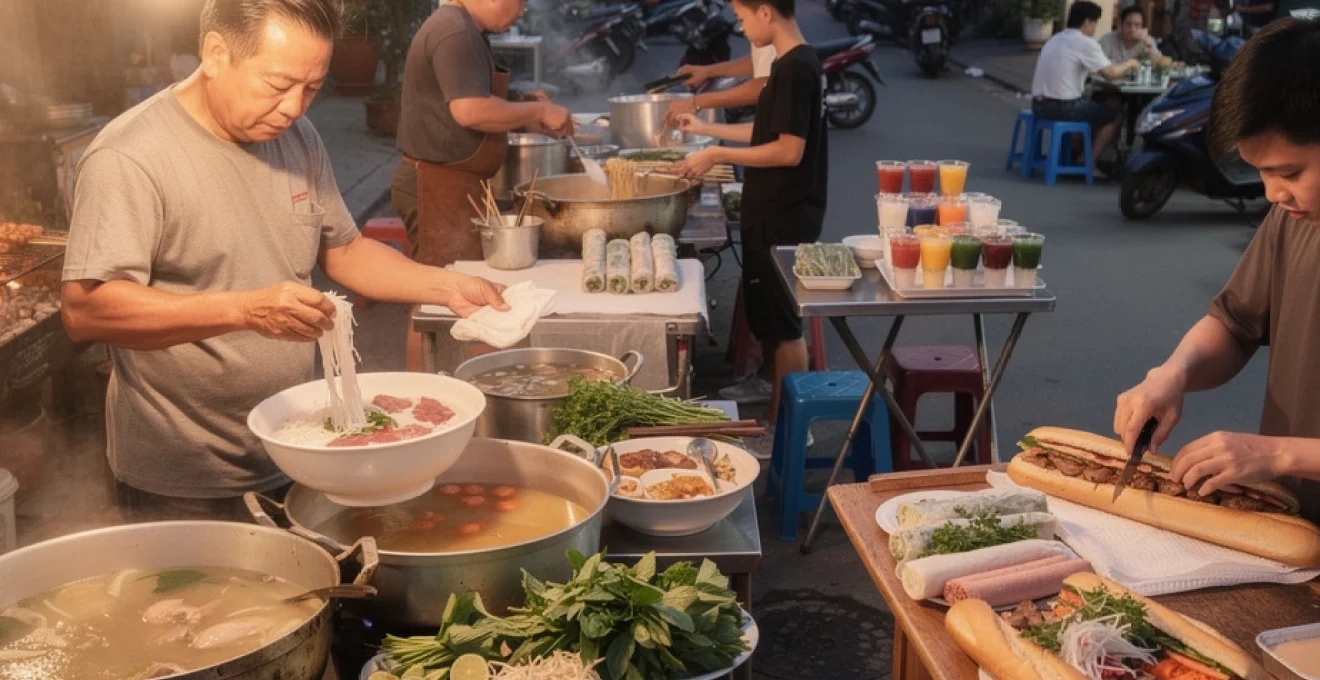
Hanoi’s bustling streets pulse with the rhythm of sizzling woks, bubbling broths, and the gentle hum of countless vendors preparing Vietnam’s most beloved dishes. The capital city serves as the epicentre of northern Vietnamese cuisine, where centuries-old recipes are perfected daily on sidewalk stalls and family-run establishments. From the iconic phở that originated in these very streets to the complex layers of bánh mì that showcase French colonial influences, Hanoi’s street food scene represents one of Asia’s most authentic and accessible culinary experiences.
The art of street food preparation in Hanoi extends far beyond simple cooking techniques. Each dish tells a story of cultural fusion, seasonal ingredients, and time-honoured traditions passed down through generations. Whether you’re navigating the narrow alleys of the Old Quarter or exploring the vibrant night markets, understanding the intricacies of preparation methods, sourcing practices, and regional variations will transform your culinary journey from mere consumption to genuine cultural immersion.
Phở variations and traditional preparation methods in hanoi’s street kitchens
The soul of Hanoi’s street food culture resides in its phở establishments, where master chefs begin their daily rituals before dawn to create the perfect bowl of Vietnam’s national dish. Traditional phở preparation demands unwavering dedication to technique, with bone broths simmering for up to 24 hours to achieve the complex depth of flavour that distinguishes authentic Hanoi phở from its regional counterparts. The clear, aromatic broth serves as the foundation upon which layers of rice noodles, herbs, and proteins create a harmonious symphony of taste and texture.
Authentic Hanoi phở differs significantly from southern variations through its restrained use of herbs and vegetables. Northern phở purists maintain that excessive garnishes mask the delicate balance of the broth, preferring minimal accompaniments that allow the beef or chicken essence to shine through. This philosophical approach to simplicity reflects broader northern Vietnamese culinary principles, where subtlety and refinement take precedence over bold, complex flavour profiles.
Phở bò tái at phở gia truyền bát đàn: raw beef technique
The technique of serving raw beef slices in phở bò tái demonstrates the mastery required in traditional Vietnamese cooking. At establishments like Phở Gia Truyền Bát Đàn, paper-thin beef slices are arranged precisely over steaming rice noodles, where the near-boiling broth instantly cooks the meat to perfect tenderness. This method requires exceptional knife skills and understanding of beef anatomy, as different cuts require varying thickness to achieve optimal texture when subjected to the broth’s heat.
The timing of service becomes crucial in phở bò tái preparation. Bowls must reach customers within moments of assembly to ensure the beef cooks properly without becoming tough or overcooked. Master phở cooks develop an intuitive sense of broth temperature, adjusting heat levels throughout service to maintain the precise temperature needed for consistent results.
Phở gà specialties at phở gà vui: Free-Range chicken broth preparation
Chicken phở requires entirely different preparation protocols compared to beef versions, with free-range chickens forming the foundation of superior broth development. At renowned establishments like Phở Gà Vui, whole chickens are simmered gently for hours, with temperature control becoming critical to prevent the delicate chicken proteins from breaking down into cloudiness. The resulting golden broth showcases pure chicken essence without the robust intensity of beef-based versions.
Traditional chicken phở preparation involves multiple cooking stages, beginning with an initial blanching to remove impurities, followed by the primary simmering phase where aromatics like ginger, onion, and star anise infuse their essences into the developing broth. The chicken meat, once tender, is carefully removed and shredded by hand to maintain optimal texture for service.
Morning service rituals at phở thìn bờ hồ: 4AM bone broth protocols
The dedication required for authentic phở preparation becomes
most evident at Phở Thìn Bờ Hồ, where the lights switch on around 4AM and the first stockpots are already at a gentle roll. Bones are roasted or blanched depending on the day’s batch, then layered with charred onion, ginger, and a closely guarded mix of spices. The broth is never allowed to reach a violent boil; instead, it is kept at a steady simmer to extract collagen and flavour without emulsifying excess fat, which would cloud the liquid and dull its aroma.
These dawn rituals are run with near-military precision. One cook monitors only the stockpots, skimming impurities every few minutes, while another handles seasoning adjustments as the broth reduces over the course of the morning rush. By 6AM, a queue of locals snakes down the pavement, each bowl built to order with noodles blanched seconds before serving and a ladle of broth drawn from the surface—not the bottom—to maintain clarity and depth of flavour throughout service.
Regional garnishing techniques: herb selection and presentation standards
Garnishing a bowl of phở in Hanoi is treated as a discipline in itself. Unlike in southern Vietnam, where plates of herbs can resemble miniature salads, Hanoi phở stalls select just a few key elements—typically scallions, cilantro, and occasionally sawtooth coriander. These herbs are rinsed several times, spun dry, and cut to precise lengths so that they sit neatly on the surface of the broth without overwhelming the bowl.
Presentation standards have evolved over decades of street-side practice. You will often notice a distinct layering: chopped scallion stems are added first to release sweetness into the broth, followed by a sprinkling of fragrant leaves for aroma. Lime wedges and fresh chilli are provided on the side rather than dumped into the bowl, allowing you to customise seasoning without disrupting the chef’s intended balance. This restrained approach ensures that when you taste phở on Hanoi’s streets, you are experiencing the broth first and the herbs second, rather than the other way around.
Bánh mì street vendors: artisanal assembly techniques across districts
If phở is Hanoi’s morning ritual, bánh mì is its all-day companion—fast, handheld, and endlessly adaptable. Street vendors across Hoàn Kiếm, Ba Đình, and Tây Hồ districts have developed meticulous assembly techniques to keep up with demand while preserving texture and flavour. A well-made bánh mì relies on three pillars: a crisp yet airy baguette, balanced proteins, and thoughtfully layered condiments and pickles.
Watching a skilled vendor at work is like observing a tiny, efficient production line. Baguettes are reheated just long enough to restore their crunch, pâté is spread in one swift motion to avoid tearing the crumb, and proteins are layered so that every bite delivers a mix of savoury, tangy, and herbal notes. The best Hanoi bánh mì stalls are obsessive about consistency, ensuring that whether you visit at 8AM or 10PM, the sandwich structure and flavour profile remain the same.
French baguette sourcing at bánh mì 25 hàng cá: daily bakery partnerships
At popular Old Quarter spots like Bánh Mì 25 on Hàng Cá, the quality of the baguette begins long before the first sandwich is assembled. Rather than baking in-house, many of Hanoi’s best vendors partner with specialist bakeries that deliver multiple times per day. This practice ensures a constant supply of loaves with shatteringly crisp crusts and soft, elastic interiors—essential for street food that must be eaten quickly yet hold up to generous fillings.
Deliveries are timed to match peak customer flows. You will often see fresh crates arriving mid-morning and early evening, when office workers and travellers converge on the Old Quarter. Staff sort the baguettes by texture, reserving the lightest, most evenly browned loaves for sandwiches with wetter fillings such as grilled pork or omelette. Slightly denser loaves are used for simpler combinations, reducing the risk of sogginess and keeping the eating experience clean even when you are perched on a small plastic stool by the roadside.
Protein layering methods: chả lụa and jambon integration protocols
The hallmark of a classic northern-style bánh mì is its layered cold cuts, most notably chả lụa (Vietnamese pork sausage) and jambon. Vendors have developed specific “integration protocols” to keep these proteins balanced and visually appealing. Typically, pâté goes down first as a moisture barrier, followed by thin slices of jambon pressed directly into the spread so they adhere to the bread and do not slide out when bitten.
Next comes chả lụa, often cut thicker to provide a satisfying, springy bite that contrasts with the softness of the jambon. Some vendors alternate slices of the two meats along the length of the baguette, ensuring even distribution. Others stack them in distinct layers, then compress the sandwich lightly before wrapping, allowing flavours to meld during the short walk from stall to sidewalk seat. This careful sequencing prevents any single ingredient from dominating and guarantees that each mouthful delivers the full “bánh mì experience.”
Pickled vegetable fermentation: traditional đồ chua preparation at bánh mì phượng
Although Bánh Mì Phượng is more closely associated with Hội An, many Hanoi vendors study and adapt its fermentation techniques for đồ chua—the pickled carrot and daikon that cut through the richness of meat and pâté. Traditional preparation starts with meticulous knife work: vegetables are julienned into uniform batons to ensure even fermentation and a pleasant crunch. They are then lightly salted to draw out moisture before being rinsed and submerged in a brine of sugar, vinegar, and water.
The fermentation window is surprisingly short. For street food use, đồ chua is typically “young,” pickled for 12–24 hours to maintain brightness and texture rather than full sourness. Vendors monitoring large batches taste frequently, adjusting sugar or vinegar levels to account for seasonal changes in vegetable sweetness. In Hanoi’s humid climate, storage containers are kept off the ground and shaded from direct sun, preventing over-fermentation during busy service hours. The result is a garnish that acts like the citrus in a well-made cocktail—subtle but essential to balance the sandwich.
Pâté application standards: liver mousse consistency and spread techniques
Pâté is the flavour anchor of many Hanoi bánh mì, and its texture can make or break the sandwich. Street vendors favour a mousse-like consistency that is firm enough to hold shape at room temperature yet soft enough to spread in a single pass. Many buy from long-term suppliers who specialise in pork liver pâté enriched with butter, aromatics, and sometimes a hint of cognac or local rice wine for depth.
Application technique is all about efficiency and preservation of the bread’s structure. The baguette is slit but not fully opened, then a wide, flat spatula is used to coat both interior sides in a thin, even layer. Too much pressure can collapse the crumb; too little leaves dry patches where fillings will not adhere. During peak hours, you might notice a dedicated “pâté specialist” on the team whose sole task is to maintain speed and uniformity. This seemingly small detail explains why different Hanoi bánh mì stalls can vary so dramatically in perceived quality, even when using similar ingredients.
Night market specialities: authentic grilling and fermentation processes
As daylight fades, Hanoi’s night markets come alive with smoke, sizzling skewers, and the unmistakable aroma of fermented sauces. While daytime street food focuses on soups and sandwiches, evening vendors lean into grilled meats, fermented dips, and shareable snacks. The cooking methods here are more theatrical—open flames, visible marinades, and skewers turned by hand—but behind the spectacle lies a precise understanding of temperature control and fermentation.
Night markets like Chợ Đồng Xuân and the weekend pedestrian zone around Hoàn Kiếm Lake offer an ideal setting to observe these techniques up close. You will see vendors managing multiple charcoal grills at once, each dedicated to a different protein or marination style to prevent flavour cross-contamination. Fermented condiments are kept in covered jars to protect them from dust yet remain within arm’s reach, ready to be brushed onto meats at just the right moment for caramelisation.
Nem nướng preparation at chợ đồng xuân: pork skewer marination cycles
Nem nướng, or grilled pork skewers, are among the most popular night-time street foods in Hanoi’s markets. At Chợ Đồng Xuân, vendors operate on strict marination cycles to keep meat both safe and flavourful. Ground pork is mixed with finely minced garlic, shallots, fish sauce, sugar, and sometimes honey or condensed milk to promote browning. This mixture is then rested for a minimum of two hours to allow proteins to bind and seasonings to penetrate deeply.
Skewers are formed shortly before grilling to maintain a bouncy, juicy texture. During busy evenings, you might observe batches in different stages—some just mixed and resting in refrigerated containers, others skewered and lined up near the grill, and a final batch cooking over glowing coals. This staggered system prevents over-marination, which can lead to mushy texture and overly salty flavours. When served, nem nướng is often paired with fresh herbs, pickles, and rice paper, allowing you to create your own rolls directly at the table.
Bún chả grilling techniques at dac kim restaurant: charcoal temperature control
Bún chả showcases Hanoi’s mastery of charcoal grilling, and few places illustrate this better than Đắc Kim in the Old Quarter. Here, temperature control is treated almost like an art form. Pork belly slices and minced patties are placed over embers that have burned down to a consistent glow, rather than active flames, to prevent flare-ups that would char the exterior before the interior is cooked.
Grill masters adjust heat not by turning knobs but by physically rearranging the coals and altering distance from the grill grates. They watch for visual cues—the sheen of rendered fat, the colour of caramelisation, the slight springiness when pressed with tongs. Between batches, grates are scraped clean to remove burnt residue that could impart bitterness. The finished meat is then plunged into a warm bowl of diluted fish sauce with green papaya and carrot, a step that not only seasons the pork but also locks in moisture before it reaches your table.
Fresh spring roll assembly: rice paper hydration methods at weekend markets
Fresh spring rolls, or gỏi cuốn, require a delicate balance of speed and precision, especially in Hanoi’s weekend markets where orders can stack up quickly. The most crucial step is hydrating the rice paper. Vendors avoid fully soaking the sheets; instead, they drag each wrapper across a shallow bowl of warm water in one swift motion, allowing residual moisture to soften it gradually as fillings are added.
Assembly follows a specific order designed to prevent tearing. Leafy greens go down first to cushion the fragile rice paper, followed by noodles, herbs, and finally proteins or fried elements that might otherwise puncture the wrapper. Rolls are tightened from the centre outward, with experienced vendors using just enough pressure to compact the ingredients without causing breakage. For takeaway orders, each roll is wrapped separately or spaced out in the box to prevent sticking, ensuring that what you unwrap at your hotel still resembles the neat cylinder you saw built at the stall.
Traditional soup culture: bún riêu and regional crab-based broths
Beyond phở, Hanoi’s soup culture extends into a rich world of crab-based broths, with bún riêu standing out as a local favourite. This dish combines rice vermicelli with a tangy tomato broth and delicate “crab cakes” made from pounded freshwater crab, egg, and sometimes minced pork. The result is lighter than beef phở yet deeply savoury, with a natural sweetness from crab and tomato that feels especially refreshing in Hanoi’s humid climate.
Preparation starts with extracting crab essence, a labour-intensive process that involves rinsing live freshwater crabs, pounding them into a paste, and then carefully straining to separate shells from liquid. The strained crab water is heated gently until proteins coagulate, forming soft, custard-like curds that are later added back to the soup. Tomatoes are sautéed in annatto oil for colour before being simmered with the crab stock, creating the signature reddish hue. Regional variations might include tofu, congealed pig’s blood, or snails, but in Hanoi, the focus tends to remain on clean, bright crab flavour with restrained garnishing—shredded herbs, a few leaves of perilla, and a squeeze of lime.
Street-side dessert vendors: chè varieties and coconut milk integration
No exploration of Hanoi street food is complete without a stop at a chè stall. These dessert vendors offer an ever-changing selection of sweet soups, jellies, and puddings that showcase beans, fruits, and sticky rice. While combinations can look complex, most bowls follow a simple logic: a base of starch or jelly for texture, a sweet component like mung beans or jackfruit, and a final pour of coconut milk or syrup to tie everything together.
Coconut milk integration is the key to balance. Vendors simmer coconut cream with pandan leaves and a touch of salt, creating a fragrant, slightly savoury counterpoint to the sweetness of beans and syrups. Rather than mixing everything in advance, they assemble bowls to order, layering ingredients before adding coconut milk last so that you can control how much you stir. In the hotter months, shaved or crushed ice is piled on top, turning chè into a refreshing alternative to ice cream. Hygiene-conscious travellers may appreciate that many modern stalls now use stainless steel containers and ladles, and prepare coconut milk in small batches to avoid separation and off-flavours over the course of the evening.
Geographic distribution of hanoi’s premier street food corridors
Understanding where to find the best street food in Hanoi can transform how you plan your days in the city. Rather than being confined to a single “food street,” Hanoi’s culinary landscape is organised into corridors and pockets, each specialising in certain dishes. The Old Quarter, with its maze-like alleys, remains the most accessible starting point, concentrating famous spots for phở, bánh mì, bún chả, and egg coffee within walking distance of Hoàn Kiếm Lake.
West of the Old Quarter, areas around Lý Quốc Sư, Hàng Điếu, and Cửa Đông are known for breakfast soups and congee, making them ideal for early-morning food walks. Further south, the French Quarter offers slightly more spacious, sit-down versions of classic street dishes, often favoured by office workers and families. In the evenings, night markets around Chợ Đồng Xuân and the pedestrianised weekend streets near Hoàn Kiếm transform into hubs for grilled skewers, chè, and fresh spring rolls, ideal if you prefer to sample many small dishes in one outing.
Venturing beyond the city centre, districts like Tây Hồ and Trúc Bạch have emerged as modern street food corridors, blending traditional stalls with contemporary cafés and vegetarian or vegan options. Here you will find experimental takes on classics—salt coffee, plant-based bún chả, or updated chè combinations—served alongside traditional vendors who have operated for decades. By mapping your meals around these corridors, you not only maximise your time and budget, but also gain a deeper sense of how Hanoi’s street food culture adapts and thrives in every corner of the city.