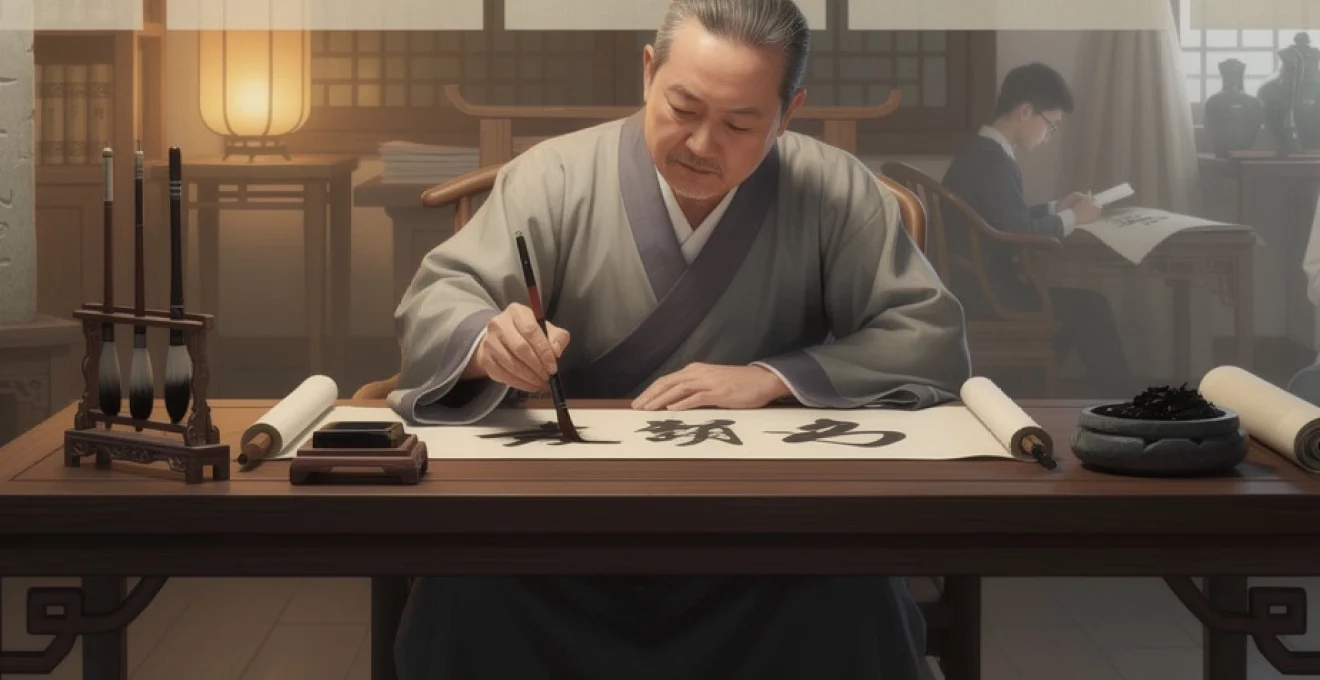
# L’Art de la Calligraphie Chinoise : Héritage Culturel et Expression Philosophique
Chinese calligraphy stands as one of humanity’s most sophisticated visual art forms, representing far more than decorative writing. For over three millennia, this profound artistic practice has shaped China’s intellectual landscape, serving as the primary vehicle for philosophical expression, cultural transmission, and aesthetic refinement. Unlike alphabetic writing systems, Chinese characters embody both linguistic meaning and visual artistry simultaneously, transforming every written word into a potential masterpiece. The brush becomes an extension of the calligrapher’s spirit, capturing not merely information but the writer’s character, education, and inner cultivation. This unique fusion of utility and beauty has elevated calligraphy to a position unmatched by any other writing tradition, making it inseparable from Chinese civilization itself.
Shufa: the ancient art of brushwork and ink mastery
The term shufa (書法), literally meaning “the method of writing,” encompasses the comprehensive discipline of Chinese calligraphy. This ancient practice emerged from a culture deeply devoted to the power of the written word, where emperors engraved their pronouncements on mountainsides and stone steles to assert authority across generations. From its earliest manifestations, Chinese writing transcended mere communication—it became a vehicle for cosmic energy, moral exemplification, and aesthetic contemplation. The physical act of wielding the brush connects the calligrapher to natural forces, with each stroke embodying the dynamic interplay between control and spontaneity, structure and freedom.
Four treasures of the study: brush, ink, paper, and inkstone
The fundamental tools of calligraphy, reverently known as the “Four Treasures of the Study” (wenfang sibao), represent far more than mere implements. The writing brush, with its flexible hair tip, allows for an extraordinary range of expression—from hair-thin lines to bold, expansive strokes. Unlike rigid instruments such as styluses or modern pens, the brush responds to the slightest variation in pressure, angle, and speed, making it an authentic extension of the calligrapher’s arm and, indeed, entire body. The ink, traditionally formed into solid sticks or cakes, requires grinding on a stone surface with water, allowing the artist to control consistency and darkness. This preparatory ritual itself serves as meditation, focusing the mind before the actual writing begins.
The inkstone, often crafted from fine stone and treasured across generations, provides the surface for grinding and mixing. Meanwhile, the paper—particularly high-quality xuan paper (rice paper)—possesses unique absorbent properties that capture the ink’s gradations, revealing every nuance of brush technique. Together, these four treasures create a system of remarkable subtlety, where the calligrapher orchestrates multiple variables simultaneously: ink density, brush moisture, stroke speed, and pressure application. The seeming simplicity of these tools belies the profound complexity of effects they enable, allowing masters to create works where dragons leap, dewdrops glisten, and thunderstorms rage—all within the confines of written characters.
The evolution from oracle bone script to modern kaishu
Chinese calligraphy’s historical development spans more than 3,000 years, beginning with pictograms and ideographs incised onto oracle bones and cast into ritual bronze vessels during the Shang Dynasty (1600-1046 BCE). These early characters, used primarily for divination and ceremonial purposes, established the fundamental principle that each word possesses its own unique visual symbol—a characteristic that distinguishes Chinese from phonetic writing systems. As the written language standardized, it evolved into seal script (zhuanshu), which remained the preferred form for official seals and formal inscriptions.
The Han Dynasty (206 BCE-220 CE) witnessed revolutionary developments with the emergence of clerical script (lishu), used by government clerks, and the widespread adoption of the flexible hair brush. This technological advancement proved transformative, as the brush’s supple tip could produce effects—such as the distinctive wavelike diagonal strokes—impossible to achieve through incision or casting. The brush liberated calligraphy from mechanical reproduction, introducing organic fluidity and individual expression. Subsequent centuries saw the
emergence of increasingly cursive forms, such as running script (xingshu) and cursive script (caoshu), which allowed characters to be abbreviated and linked in a single, flowing motion. As these expressive styles interacted with the more rectilinear clerical hand, they gradually gave rise to standard script (kaishu), in which each stroke is clearly articulated yet full of kinetic energy. By the time of the Tang and Song dynasties, kaishu had become the benchmark for legible writing, while other scripts were cultivated for artistic and ceremonial purposes. This historical evolution from oracle bone inscriptions to modern kaishu reveals how calligraphy has continuously adapted to social needs while preserving its deep spiritual and aesthetic core.
Qi yun sheng dong: achieving spiritual resonance through stroke technique
In Chinese aesthetics, the concept of qi yun sheng dong (氣韻生動)—often translated as “spiritual resonance and life movement”—lies at the heart of both painting and calligraphy. A written character is not judged solely by accuracy of form; it is evaluated by whether it seems to breathe, to vibrate with inner vitality. To achieve this, the calligrapher must coordinate breath, posture, and intention so that each stroke manifests a continuous flow of qi, or vital energy. Like a dancer who has internalized choreography, the calligrapher moves with disciplined spontaneity, allowing the wrist and arm to transmit invisible inner rhythm into visible lines.
Classical treatises describe good calligraphy as “full of bone and sinew,” praising works that balance strength with suppleness. Firm, well-defined strokes are said to possess “bone,” reflecting moral uprightness and structural clarity, while lighter, more textured strokes provide “flesh,” suggesting emotional nuance and softness. Too much flesh without bone produces a weak, decadent appearance; too much bone without flesh feels dry and lifeless. When you practice calligraphy with attention to breath—exhaling as you complete a stroke, pausing briefly before the next—you begin to understand how technical stroke order and spiritual resonance are inseparable. The goal is not mechanical perfection but a living script that reveals both disciplined training and a responsive, present mind.
The role of xuan paper in ink absorption and character formation
Among the Four Treasures, xuan paper holds a particularly subtle importance in Chinese calligraphy. Produced for over a thousand years in the region of Xuancheng in Anhui province, this paper is prized for its fine fibers, high absorbency, and remarkable durability. Unlike many Western papers designed to resist ink spread, xuan paper welcomes the ink, allowing it to diffuse slightly and create soft edges, rich tonal gradations, and the famous “flying white” effect where the brush moves so swiftly that areas of paper show through the stroke. The interaction between brush, ink, and paper is thus a delicate negotiation, much like a conversation where each party must listen as well as speak.
Calligraphers select different types of xuan—raw, semi-sized, or fully sized—depending on the desired effect. Raw paper absorbs quickly, rewarding confident, decisive strokes but punishing hesitation; sized paper slows absorption, allowing more corrections and layered effects. For students of Chinese calligraphy, learning how much water to load into the brush relative to the absorbency of the paper is a crucial technical skill. It is also a metaphor for balance in life: too much force or too much ink and the character bleeds outward; too little, and it appears dry and constrained. By observing how the ink blooms and settles, we gain insight into the material intelligence that underpins the entire tradition.
The five major script styles: zhuanshu to caoshu
Over centuries of cultural development, Chinese calligraphy crystallized into five major script styles, each with its own historical role and aesthetic character. Together, they map the journey of Chinese civilization from ritual bronzes to everyday handwriting, from rigid formality to free-flowing expression. Understanding these scripts not only enriches your appreciation of calligraphic art but also helps you see how different visual forms embody shifting values—political centralization, bureaucratic efficiency, personal expression, and philosophical introspection. While all five scripts remain in use today, each invites a distinct mental state and technical approach from the calligrapher.
Seal script (zhuanshu): ancient ceremonial writing of the qin dynasty
Seal script (zhuanshu) represents one of the oldest standardized forms of Chinese writing, reaching maturity during the Qin dynasty (221–206 BCE). Its characters are elongated and symmetrical, composed of even, rounded lines that resemble carved designs rather than quickly written marks. Because it developed from the inscriptions on bronze vessels and stone, zhuanshu preserves a sense of solemnity and ritual gravity. Even today, it is most commonly seen on official seals, name chops, and monumental inscriptions where authority and permanence are emphasized.
From a technical standpoint, writing seal script challenges the calligrapher to slow down and think in terms of carving rather than casual writing. Strokes are typically of uniform thickness, with minimal visible modulation of pressure, creating a sculptural effect on the page. For learners, practicing zhuanshu can deepen understanding of the structural origins of Chinese characters, since many traditional radicals and components appear in their more pictographic form. It is as if one were examining the skeleton of the script family: austere, archaic, yet unexpectedly elegant.
Clerical script (lishu): the han dynasty administrative standard
Clerical script (lishu) emerged during the late Warring States and reached full development in the Han dynasty as an efficient writing style for administration and record-keeping. Its horizontal strokes broaden and flatten, often ending in a distinctive “silkworm head and wild goose tail” shape: a slight thickening at the beginning of the stroke and a gentle flick at the end. This gives lishu a strong horizontal emphasis and a sense of deliberate, methodical movement, reflecting its role in the expanding imperial bureaucracy.
Visually, lishu marks a turning point between the rounded, seal-like forms of early scripts and the more squared, balanced forms of later standard script. Practicing lishu trains the calligrapher to pay attention to contrast between thick and thin, as well as to the rhythm of long horizontals and compact verticals. Many modern calligraphy teachers recommend beginners spend time with clerical script because it builds a solid foundation in stroke order and proportion while encouraging a stable, grounded posture. You can think of lishu as the architectural blueprint from which later, more expressive “interiors” are developed.
Regular script (kaishu): wang xizhi’s influence on contemporary practice
Regular script (kaishu) is today’s most widely used form of Chinese writing, having become the standard for printed texts, signage, and formal handwritten documents by the Tang dynasty. Each stroke in kaishu follows a well-established order and trajectory, with clear beginnings, steady middles, and controlled endings. The result is a script that is highly legible yet capable of great subtlety; small changes in angle, pressure, and spacing can dramatically alter the character’s personality. For anyone learning Chinese characters, mastering regular script is essential, as it provides the visual template from which other, more cursive styles are derived.
Although Wang Xizhi (303–361 CE) is historically more associated with running script, his innovations and aesthetic principles deeply influenced the development of kaishu. Later masters, such as Ouyang Xun and Yan Zhenqing, synthesized Wang’s emphasis on inner rhythm with the structural clarity demanded by official writing, producing models that are still studied in modern classrooms. When you copy canonical kaishu works, you are not merely learning to “write neatly”; you are entering into a millennium-spanning dialogue with scholars, monks, and statesmen who all used the same basic stroke grammar to express their minds.
Running script (xingshu): balancing speed and legibility in fluid motion
Running script (xingshu) occupies the middle ground between the formality of regular script and the abandon of cursive. Developed as a practical solution for writing more quickly without sacrificing too much legibility, xingshu permits slight abbreviations of stroke forms and occasional linking between characters. The brush moves with greater continuity, and the white spaces between strokes begin to echo the rhythm of the written line, much like musical phrasing connects individual notes into a melody. For many calligraphers, running script offers the ideal balance between control and expressiveness.
From the reader’s perspective, good xingshu feels as though the characters are walking or flowing in conversation across the page. This makes it particularly well-suited for personal letters, essays, and informal inscriptions where you wish to convey both clarity and warmth. When practicing running script, you quickly discover how much your mental state affects the coherence of the line: impatience leads to tangled strokes, while relaxed attention results in graceful transitions. In this way, xingshu becomes a daily exercise in harmonizing speed with mindfulness—an invaluable habit in our own fast-paced era.
Cursive script (caoshu): zhang xu’s wild cursive and artistic expression
Cursive script (caoshu) represents the most liberated and expressive of the five major styles, prioritizing speed, rhythm, and emotional intensity over strict legibility. Characters may be drastically abbreviated, strokes merged, and entire phrases executed in a single, continuous motion. For the untrained eye, a piece of wild cursive can look less like writing and more like abstract art, yet connoisseurs read these works as vividly as one might hear a virtuoso performance of music. The Tang dynasty master Zhang Xu, famous for his “wild cursive,” reportedly wrote in states of ecstatic inspiration, his hair loosened and garments disheveled, using his whole body to guide the brush.
Although such tales may sound exaggerated, they underscore a key truth: caoshu demands years of disciplined training before such freedom can be responsibly exercised. The calligrapher must internalize character structure so completely that even the most extreme abbreviation retains an invisible architecture. For contemporary viewers, cursive script offers a powerful reminder that Chinese calligraphy is not an archaic craft but a living art of gesture, comparable to modern abstract expressionism. If you ever wondered how handwriting could convey joy, anger, or melancholy without illustration, a scroll of Zhang Xu’s wild cursive provides a compelling answer.
Calligraphy as philosophical expression in confucian and daoist thought
Beyond its visual variety, Chinese calligraphy has long served as a medium for expressing the deepest currents of Confucian, Daoist, and later Buddhist philosophy. Because the written character embodies both meaning and form, the way a text is written becomes part of its message. A Confucian maxim penned in disciplined regular script communicates moral rectitude; a Daoist verse brushed in flowing cursive suggests spontaneity and alignment with nature. In this sense, calligraphy functions like spoken tone in conversation: it colors the words with attitude and worldview, revealing how the writer inhabits their own teachings.
The confucian ideal: character cultivation through daily practice
Confucianism places great emphasis on xiushen—the cultivation of one’s moral character through consistent self-discipline. For centuries, calligraphy was regarded as a central tool in this process, especially among scholar-officials. Copying classical texts such as the Analects or the “Thousand-Character Classic” in meticulous script was not only a method of literacy but an act of ethical training. The patience required to repeat characters thousands of times mirrored the patience needed to refine one’s behavior in family, government, and society. As the saying goes, “The writing reveals the person” (zi ru qi ren).
From this perspective, poor or careless handwriting was seen as a sign of inner disorder, while balanced, composed characters indicated integrity and restraint. Many Confucian educators still encourage students to practice calligraphy as a way to develop concentration and respect for tradition. If you have ever used handwriting practice to memorize vocabulary or calm your thoughts, you have touched on the same principle: the hand trains the mind, and the mind guides the hand. In Chinese culture, calligraphy is thus both a mirror and a workshop for the moral self.
Daoist principles of wu wei in spontaneous brushwork
While Confucianism stresses discipline and propriety, Daoism celebrates naturalness, spontaneity, and non-coercive action—wu wei (無為). Paradoxically, these ideas also find a perfect home in calligraphy. A master calligrapher prepares diligently yet, in the moment of writing, releases conscious striving, allowing the brush to move “of itself” in response to the situation. This is analogous to the Daoist butcher in the classic Zhuangzi text, who carves an ox effortlessly by following the natural structure of its bones rather than forcing his knife. In calligraphy, the “bones” are the invisible rules of stroke order and character composition, while the “knife” is the brush guided by effortless attention.
When we speak of a work of calligraphy as feeling “unforced” or “as if written in one breath,” we are really observing wu wei in action. The ideal is not careless scribbling but action so attuned that it appears simple and inevitable. For modern practitioners, this Daoist aspect of calligraphy offers a powerful antidote to perfectionism. Instead of obsessing over each flaw, we learn to accept the slight variations and “happy accidents” that make a piece feel alive—much like accepting the imperfections that give our own lives character.
Zen buddhism’s influence on song dynasty calligraphic aesthetics
By the Song dynasty, Chan (Zen) Buddhism had also left a deep imprint on Chinese calligraphy, especially among monk-artists who used brushwork as a form of meditation and teaching. Zen emphasizes direct experience over doctrinal explanation, and calligraphic practice became a way to embody this immediacy. A single character such as “emptiness” (kong) or “Buddha” (fo) might be written in a bold, seemingly impulsive stroke that captured the calligrapher’s state of mind at a particular instant. These works, often accompanied by short poems or koan-like phrases, were hung in meditation halls as visual koans, inviting contemplation beyond words.
Zen-influenced calligraphy tends to value simplicity, asymmetry, and the expressive use of blank space. The uninked areas of the paper are not mere background but active participants in the composition, akin to silence within music. This aesthetic later traveled to Japan, where it developed into shodō, or “the way of writing,” and continues to influence East Asian ink arts today. When you stand before a Zen calligraphic piece, you are not just reading a text; you are encountering the residue of a moment of awakened awareness, preserved in ink.
Master calligraphers: wang xizhi, yan zhenqing, and su shi
The history of Chinese calligraphy is punctuated by figures whose work redefined what brush and ink could express. Among the many celebrated masters, three names recur most frequently in discussions of the art’s highest achievements: Wang Xizhi, Yan Zhenqing, and Su Shi. Each lived in a different era and social context, yet all three used calligraphy to forge a powerful synthesis of personal temperament, technical mastery, and philosophical reflection. Studying their lives and works offers a practical roadmap for anyone seeking to understand why calligraphy occupies such an exalted position in Chinese culture.
Wang Xizhi of the Eastern Jin dynasty is often called the “Sage of Calligraphy.” His “Preface to the Orchid Pavilion Gathering” (Lanting Xu) is perhaps the single most famous work in the tradition, praised for its flowing running script that seems to capture the convivial yet reflective atmosphere of a poetry gathering among friends. No original copy survives, but countless rubbings and reproductions have shaped the training of generations. Yan Zhenqing of the Tang dynasty, by contrast, is renowned for his upright, vigorous kaishu, often interpreted as the visual manifestation of his loyal, unyielding character in times of political turmoil. His “Yan style” remains a standard model for students seeking strength and structural clarity.
Su Shi (Su Dongpo), the polymath poet, statesman, and calligrapher of the Song dynasty, introduced a more relaxed, conversational approach to brushwork. His calligraphy, frequently executed in running script, appears effortless and unpretentious, echoing his literary style and philosophical openness. Su’s works remind us that calligraphy is not only about virtuosity but also about authenticity; his slightly irregular characters and varied spacing convey a living, thinking mind rather than a desire to impress. By examining these masters side by side, we see how calligraphy can embody loyalty and courage (Yan), refined sociability (Wang), or humorous resilience in adversity (Su)—a spectrum of human qualities inscribed in line and space.
Calligraphic literacy in imperial examination systems
For more than a thousand years, success in the imperial examination system was the primary pathway to social mobility in China, and calligraphy played a decisive role in this process. Examiners faced mountains of essays and policy responses written by aspiring scholar-officials, and they often formed first impressions based on the candidates’ handwriting. A clear, balanced script signaled not only education but also self-discipline and respect for tradition, while careless or crude writing could doom an otherwise insightful essay. In extreme cases, historical records suggest that outstanding calligraphy alone could catch an examiner’s eye, tipping the scales in a candidate’s favor.
Because of this, families invested heavily in calligraphic education for their sons, viewing it as both a cultural refinement and a practical necessity. Young students copied model books (tie) of famous masters daily, sometimes for years, before they were allowed to write their own exam compositions in freehand. This practice turned calligraphic literacy into a kind of cultural capital: those who wielded the brush gracefully gained access to government positions, influence, and honor. Even outside the examination hall, individuals proficient in calligraphy were sought after to draft letters, contracts, and religious or commemorative inscriptions, further intertwining handwriting with social status.
From a contemporary standpoint, the imperial linkage between calligraphy and meritocratic advancement helps explain why the art form has never been relegated to mere decoration in China. It was historically a life-changing skill, one that could alter the fate of entire families. When we view classical calligraphic works in museums today, we are not just looking at abstract art; we are seeing the visible residue of ambition, anxiety, hope, and diligence invested by countless exam candidates. This historical memory still shapes how many Chinese parents and educators regard neat, well-formed handwriting as a reflection of a child’s character and future potential.
Contemporary preservation: calligraphy in digital age china
In an era dominated by keyboards, touchscreens, and voice input, one might assume that traditional calligraphy would fade into obscurity. Yet in contemporary China, the opposite trend is visible: calligraphy continues to enjoy robust popularity as both a cultural heritage and a modern lifestyle practice. Government initiatives have reinforced its importance, with calligraphy included in school curricula and promoted as part of broader campaigns to strengthen “cultural confidence.” At the same time, grassroots enthusiasm has surged, with community centers, universities, and private studios offering classes to children and adults alike. For many urban professionals, an evening of brush practice provides a welcome counterbalance to screen-heavy workdays.
Digital technology, rather than simply displacing calligraphy, has also opened new avenues for its preservation and innovation. High-resolution scans and online archives make classical masterpieces accessible to anyone with an internet connection, while tablet-based calligraphy apps allow beginners to simulate brush movement before investing in traditional tools. Designers integrate calligraphic aesthetics into logos, packaging, and advertising to evoke authenticity and cultural depth, demonstrating that the visual language of brush and ink still resonates powerfully with modern consumers. Tourist destinations across China feature calligraphy demonstrations and short workshops, turning the act of writing into a form of experiential cultural tourism.
Of course, the digital age presents challenges as well. As everyday handwriting declines, fewer people can read complex cursive scripts, and some educators worry that typing will erode the fine motor skills associated with brush and pen. Yet this tension has also sparked renewed reflection on why calligraphy matters. For many practitioners, it is no longer just a utilitarian skill but a deliberate choice to slow down, to cultivate mindfulness, and to connect with a tradition spanning millennia. Whether practiced on rice paper in a quiet studio or explored through digital interfaces, Chinese calligraphy continues to function as a bridge—linking past and present, body and mind, individual creativity and shared cultural memory.