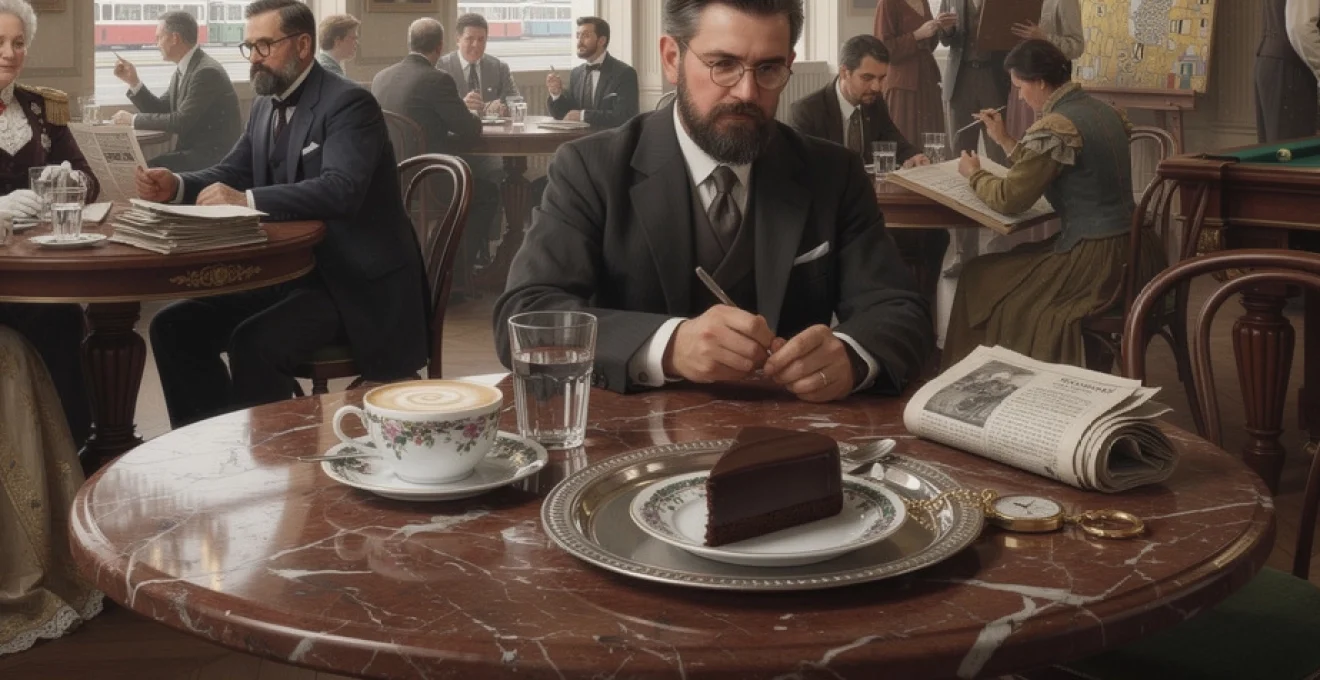
Vienna’s coffee culture represents far more than a simple beverage preference – it embodies centuries of social transformation, intellectual discourse, and cultural evolution that shaped modern European society. From the legendary origins following the 1683 Turkish siege to its recognition as UNESCO Intangible Cultural Heritage, Viennese Kaffeehauskultur has served as the backbone of the city’s social infrastructure. The coffeehouses became crucibles where aristocrats mingled with artists, where revolutionary ideas percolated alongside perfectly brewed Melange, and where the very fabric of Austro-Hungarian society was woven through countless conversations over marble-topped tables. This unique cultural phenomenon transformed Vienna into Europe’s intellectual capital, fostering movements that would influence psychology, literature, and politics across the continent. Understanding Vienna’s coffee culture means examining the intricate relationships between social class, urban development, and cultural innovation that defined an empire and continue to shape the city today.
Habsburg imperial coffee house establishments and aristocratic patronage systems
The Habsburg monarchy’s relationship with coffee culture established the foundation for Vienna’s sophisticated social hierarchy within coffeehouse settings. Emperor Franz Joseph I himself became a patron of several establishments, legitimising coffeehouse culture as an acceptable aristocratic pursuit. The imperial court’s endorsement transformed these venues from simple beverage providers into sophisticated social institutions where nobility could engage in discrete political discourse while maintaining the appearance of leisure.
The patronage system that emerged around Habsburg coffee houses created distinct social strata, with certain establishments catering exclusively to aristocratic clientele while others served the growing bourgeoisie. This stratification reflected broader imperial social structures, where access to particular coffeehouses indicated one’s position within the complex hierarchy of Austro-Hungarian society. The most prestigious establishments required imperial recommendation letters or aristocratic sponsorship for regular patronage, creating an exclusive network of politically connected individuals.
Café central’s role in intellectual discourse and political networking
Established in 1876, Café Central became the epicentre of Vienna’s intellectual and political networking, attracting figures who would shape European history. The coffeehouse’s distinctive Neo-Renaissance architecture and spacious halls provided the perfect setting for clandestine political meetings disguised as casual social gatherings. Revolutionary thinkers like Leon Trotsky and Josip Broz Tito frequented Central, using its international atmosphere to coordinate activities across the sprawling Habsburg territories.
The establishment’s unique seating arrangements – featuring intimate alcoves alongside grand communal areas – facilitated both private conspiracies and public intellectual debates. Writers and journalists gathered around specific tables that became known as “editorial offices,” where entire newspaper articles were conceived and debated before publication. This convergence of media, politics, and intellectual discourse at Central created an informal but powerful information network that influenced imperial policy decisions.
Griensteidl coffeehouse literary salon culture under franz joseph I
The Griensteidl Coffeehouse emerged as Vienna’s premier literary salon during the height of Franz Joseph’s reign, attracting the era’s most celebrated writers and poets. This establishment pioneered the concept of structured literary evenings, where authors would present new works to carefully curated audiences of fellow writers, critics, and aristocratic patrons. The coffeehouse’s proprietor, Heinrich Griensteidl, established reading schedules and discussion protocols that influenced literary culture throughout the German-speaking world.
Under imperial patronage, Griensteidl developed sophisticated systems for nurturing emerging talent whilst maintaining established literary hierarchies. Seasoned authors served as mentors to younger writers, creating generational bridges that ensured literary continuity. The establishment’s influence extended beyond Vienna, with provincial writers travelling great distances to participate in Griensteidl’s literary circles, effectively centralising Austro-Hungarian literary culture within this single coffeehouse.
Demel’s royal warrant and Court-Sanctioned social stratification
Demel’s confectionery and coffeehouse received its imperial and royal warrant in 1874, establishing it as the official supplier to the Habsburg court and creating Vienna’s most exclusive coffee culture venue. This royal endorsement meant that Demel’s became the
epicentre of court-approved indulgence, where access itself signalled proximity to imperial favour. The clientele at Demel’s consisted largely of aristocrats, senior civil servants, and wealthy industrialists whose presence reinforced the court-sanctioned social stratification that defined late Habsburg society. The simple act of taking coffee and cake at Demel’s became a performance of status, with seating arrangements, pastry choices, and even the time of day carefully coded within Vienna’s social etiquette.
Demel’s royal warrant also helped formalise a culture of service rituals that distinguished upper-class coffee consumption from more modest habits elsewhere in the city. Uniformed staff addressed frequent patrons by title, remembered preferred combinations of Sachertorte, Melange, and liqueurs, and managed informal waiting lists for favoured window seats overlooking the Kohlmarkt. In this sense, Demel’s functioned as a semi-public extension of the Hofburg palace, a place where imperial elites could be both visible and carefully separated from the broader urban population who frequented less exalted coffee houses.
Café sacher’s diplomatic functions in Austro-Hungarian foreign relations
Café Sacher, integrated into the iconic Hotel Sacher opposite the State Opera, played a distinctive role as a diplomatic salon in the final decades of the Habsburg Empire. Foreign envoys, visiting monarchs, and high-ranking military officers frequently met there for discreet conversations over coffee and the legendary Original Sacher-Torte. The hotel’s private salons allowed diplomats to conduct informal negotiations away from the rigid protocols of the Ballhausplatz, while still remaining within walking distance of key ministries and the imperial court.
The coffeehouse itself provided a neutral yet unmistakably prestigious backdrop for what historians sometimes call “soft protocol” encounters. Seating foreign guests at Sacher rather than in a ministry meeting room signalled a willingness to engage in confidential dialogue without committing to formal agreements. Over time, certain tables acquired reputations as unofficial embassies, where Balkan statesmen, Italian politicians, and Russian envoys could test political ideas as casually as they discussed the texture of whipped cream. In this way, Viennese coffee culture subtly underpinned Austro-Hungarian foreign relations, turning caffeinated hospitality into a tool of imperial diplomacy.
Viennese kaffeehauskultur as urban social infrastructure development
Beyond aristocratic circles, coffeehouses functioned as a critical layer of Vienna’s urban social infrastructure, shaping how people moved, met, and exchanged information in the rapidly growing capital. As the city expanded in the nineteenth century, new cafés opened along major traffic arteries, tram lines, and commercial boulevards, effectively mapping social life onto the built environment. Coffeehouses became semi-public living rooms where residents could warm themselves in winter, read newspapers, meet business contacts, or simply observe the theatre of city life through large plate-glass windows.
This integration of coffee culture into everyday routines helped Vienna manage the social pressures of industrialisation and urbanisation. Where other European cities relied on clubs restricted by class, or on pubs dominated by alcohol, Vienna offered a more inclusive, sober, and conversation-oriented alternative. The result was a network of spaces that connected diverse social groups, enabled upward mobility for the educated middle classes, and anchored new neighbourhoods with recognisable, welcoming institutions. When we speak about Vienna’s high quality of life today, we are also speaking about the legacy of this coffeehouse-based social infrastructure.
Ringstrasse era coffee house architecture and spatial social dynamics
The construction of the Ringstrasse in the mid-nineteenth century created a grand stage for displaying imperial power, bourgeois wealth, and architectural ambition – and coffeehouses were central actors on this stage. Cafés like Landtmann, Schwarzenberg, and Museum were deliberately positioned along this monumental boulevard, their façades echoing the neo-Renaissance and neo-Baroque styles of nearby theatres, museums, and ministries. Inside, high ceilings, chandeliers, and long sightlines encouraged a sense of openness, while alcoves and corners provided more intimate spaces for confidential conversations.
These spatial arrangements shaped social dynamics in subtle but important ways. Central tables near the entrance or windows were associated with visibility and prestige, often occupied by lawyers, professors, and journalists keen to be seen. Peripheral corners and secluded booths, by contrast, attracted artists, radicals, and couples engaged in more private exchanges. In effect, the architecture of Ringstrasse coffeehouses orchestrated a choreography of social interaction, allowing Vienna’s emerging middle classes to perform respectability while still carving out niches for dissent, creativity, and experimentation.
Newspaper reading rooms and information dissemination networks
One of the defining features of Viennese coffee culture was the extensive provision of newspapers and journals, mounted on wooden frames and available to patrons for the price of a single cup of coffee. From the early eighteenth century onwards, coffeehouses became informal information hubs, aggregating local and international news, financial reports, satirical weeklies, and specialist literary magazines. By the late nineteenth century, a well-stocked café might offer dozens of titles in multiple languages, turning it into a de facto news agency for its regulars.
This system created what we might describe today as an analogue version of a social media feed. Patrons passed newspapers from table to table, commented aloud on editorials, and relayed rumours they had heard at another café earlier in the day. Journalists cultivated coffeehouse contacts as sources, while politicians monitored public reactions in real time. For students and lower-middle-class readers who could not afford subscriptions, the coffeehouse reading room offered crucial access to information and ideas. In this way, Vienna’s coffeehouses dramatically reduced the barriers to participation in political and cultural discourse, helping to democratise knowledge long before universal internet access.
Billiard halls and gaming parlours as male social consolidation spaces
While many coffeehouses welcomed mixed-gender clientele by the late nineteenth century, their billiard rooms and gaming parlours often remained predominantly male spaces. In these smoky back rooms, middle-class men formed networks that were as important for career advancement as for leisure. Civil servants, officers, and businessmen played cards or billiards late into the night, sealing business deals, recommending candidates for promotions, or orchestrating party politics away from public scrutiny.
These gaming spaces functioned as informal training grounds in the social skills expected of Habsburg gentlemen: measured risk-taking, strategic thinking, and controlled displays of emotion. At the same time, they reinforced gender norms by excluding most women from the consequential conversations that accompanied the clink of billiard balls and the shuffle of cards. When we examine Vienna’s coffee culture as urban social infrastructure, then, we also have to recognise how it both opened and limited opportunities, consolidating male power while gradually – and unevenly – extending access to women and other marginalised groups.
Melange service rituals and Class-Based consumer behaviour patterns
The ritual of ordering, serving, and consuming a Wiener Melange offers a revealing window into the class-based behaviour patterns that structured coffeehouse life. For the upper bourgeoisie, the Melange was often ordered in combination with a specific pastry, at a habitual time of day, and sometimes at a habitual table. The arrival of the silver tray, with its precisely placed cup, saucer, spoon, sugar, and obligatory glass of water, was part of a choreography of distinction that signalled refinement, self-control, and familiarity with unwritten rules.
By contrast, working clerks or students might stretch a single Melange over several hours, carefully rationing each sip while taking full advantage of the newspapers and warm interior. Some ordered the cheaper Verlängerter or a simple Schwarzer, subtly marking their economic position. Yet even these small purchases granted access to the same space as wealthier patrons, blurring rigid class boundaries through shared rituals. In contemporary sociological terms, we could say that coffee service in Vienna converted economic capital into cultural and social capital, allowing individuals to perform and negotiate their place in the city’s hierarchy with every cup they ordered.
Psychoanalytic movement origins in viennese coffee house discourse
The origins of psychoanalysis are often located in Sigmund Freud’s consulting room on Berggasse, but the ideas that shaped the new discipline circulated widely through Vienna’s coffeehouses. Freud himself was a regular at cafés such as Landtmann, where he met colleagues, read foreign journals, and followed political developments. Over Schwarzer Kaffee and cigars, physicians, philosophers, and writers debated questions of consciousness, sexuality, and neurosis that would later crystallise into psychoanalytic theory. The coffeehouse offered a more relaxed, exploratory environment than hospital corridors or university lecture halls, encouraging speculative leaps and interdisciplinary dialogue.
Many early psychoanalysts, including Alfred Adler and later disciples and critics of Freud, also used coffeehouses as neutral ground where professional hierarchies could be temporarily suspended. Here, a young doctor could challenge established authorities without the intimidating formality of academic conferences. If we think of the psychoanalytic movement as a network of conversations rather than a single genius’s revelation, then Viennese coffee culture appears as its communication infrastructure. The constant flow of coffee, conversation, and imported books created the mental atmosphere in which theories of the unconscious could take root, cross-pollinate with literature and philosophy, and eventually spread far beyond the confines of the Habsburg capital.
Fin de siècle artistic movements and coffee house intellectual networks
The fin de siècle period in Vienna witnessed an extraordinary concentration of artistic and intellectual innovation, and coffeehouses were the connective tissue linking these movements. Painters, architects, composers, and critics met regularly in specific cafés that functioned as unofficial headquarters for new aesthetic programmes. Conversations about colour theory, ornament, and psychological symbolism unfolded alongside heated debates on politics, gender roles, and the future of the monarchy. As in a modern co-working space, creative professionals used the coffeehouse as an office, studio, and showroom all at once.
These networks were not purely local. International visitors brought news of Parisian Impressionism, British Arts and Crafts design, and Russian literature, while Viennese artists exported their own innovations through exhibitions and publications discussed and planned at café tables. The result was a dense mesh of relationships that helped propel movements like the Vienna Secession, modernist architecture, and expressionist literature onto the European stage. Without the daily, informal contact that coffeehouses facilitated, it is hard to imagine how so many pioneering figures could have synchronised their efforts so effectively.
Gustav klimt and vienna secession movement café gatherings
Gustav Klimt and his fellow Secessionists used several coffeehouses, notably Café Museum and Café Sperl, as meeting points to coordinate their challenge to the conservative Künstlerhaus. Over cups of Einspänner and glasses of wine, they discussed exhibition strategies, manifesto texts, and the practicalities of maintaining their breakaway association. The café environment, with its mixture of regulars and curious onlookers, allowed them to test the public reception of their ideas in real time. After all, what better way to gauge bourgeois taste than to overhear comments about their latest posters or building designs at the next table?
These gatherings also fostered interdisciplinary collaboration. Architects like Josef Hoffmann and Otto Wagner, designers from the Wiener Werkstätte, and writers sympathetic to Secessionist ideals all frequented the same cafés, trading sketches, pamphlets, and contacts. The coffeehouse functioned as both salon and project office, where aesthetic theories moved rapidly from conversation to concrete commissions. When we admire Klimt’s golden portraits or the Secession building today, we are also witnessing the material outcome of countless caffeinated meetings in smoky Viennese interiors.
Stefan zweig’s literary circle at café museum social interactions
Café Museum, often described as the “Café of the Artists,” served as a key hub for writers of the early twentieth century, including Stefan Zweig. Known for its relatively austere interior compared to more opulent establishments, it attracted authors who valued intense conversation over mere display. Zweig and his contemporaries met there to exchange manuscripts, critique each other’s work, and debate the role of literature in a rapidly changing society. The café’s atmosphere of concentrated sociability – quiet enough to think, lively enough to inspire – suited Zweig’s cosmopolitan sensibilities.
Social interactions at Café Museum also shaped the themes of Zweig’s writing. Observing the anxieties, pretensions, and small dramas playing out around him, he developed a keen sense of the psychological undercurrents beneath polite Viennese manners. In this way, the coffeehouse became both his social laboratory and his character archive. For readers today, recognising the importance of these spaces helps us understand why Zweig later described the Viennese coffeehouse as an “institution of a special kind,” central to the formation of a European intellectual identity that fascism would tragically threaten.
Arthur schnitzler’s psychological realism development through coffee house debates
Arthur Schnitzler, a physician-turned-writer, honed his distinctive psychological realism in part through conversations held in Vienna’s coffeehouses. Regularly engaging with doctors, actors, and critics, he absorbed current debates on hysteria, sexuality, and moral hypocrisy that circulated between clinics, theatres, and cafés. These discussions, often sparked by newspaper reports or new scientific publications left on reading tables, informed the nuanced interior monologues and fragmented dialogues that characterise his plays and novellas.
In coffeehouse debates, Schnitzler could test daring viewpoints on topics such as adultery, double standards, and anti-Semitism, gauging where scandal ended and genuine curiosity began. The café thus functioned as an informal ethics committee for his literary experiments. When we consider how boldly his works dissected Viennese society, it becomes clear that the protective anonymity and intellectual openness of the coffeehouse were crucial. They provided the social oxygen necessary for a writer to probe the unconscious motives of a culture that prided itself on surface elegance and restraint.
Post-war reconstruction and coffee house cultural preservation efforts
The devastation of the Second World War and the subsequent Allied occupation left many of Vienna’s historic coffeehouses damaged, closed, or struggling for survival. Yet even in these difficult years, locals recognised that preserving Kaffeehauskultur was essential to restoring the city’s identity. Reconstruction efforts often prioritised the repair of iconic cafés, not only for their economic potential but also for their symbolic value as spaces of continuity amidst political rupture. Original furnishings were restored or carefully replicated, and surviving staff members helped re-establish traditional service rituals.
At the same time, coffeehouses had to adapt to new social realities. Television, suburbanisation, and changing work patterns all threatened the leisurely rhythms that had once defined café life. In response, owners experimented with live music, extended food menus, and, from the 1950s onwards, the integration of espresso machines alongside classic filter coffee. The founding of the Klub der Wiener Kaffeehausbesitzer in 1956 marked a decisive step in organising collective preservation and promotion. Through training programmes, cultural events, and advocacy, the club helped ensure that Viennese coffeehouses remained living institutions rather than static museum pieces, capable of welcoming new generations without losing their historical soul.
Contemporary UNESCO intangible cultural heritage recognition and tourism impact
In 2011, UNESCO inscribed Viennese coffeehouse culture on its national inventory of Intangible Cultural Heritage, formally acknowledging what locals had long understood: that these cafés embody a way of life as much as a set of recipes or architectural features. This recognition emphasised the social practices associated with coffeehouses – lingering over a single drink, reading newspapers, engaging in conversation – as crucial to Vienna’s cultural ecosystem. It also placed a responsibility on the city and café owners to safeguard this heritage in the face of globalisation and commercial pressures.
The impact on tourism has been significant. Visitors increasingly arrive in Vienna with a specific desire to experience “authentic” coffeehouse culture, not just to taste a Melange but to sit for an hour beneath chandeliers, watching time slow down. This interest has provided vital revenue for historic cafés, helping fund restoration projects and staff training. Yet it also presents challenges: how can coffeehouses accommodate higher visitor numbers without turning into theme parks? Many have responded by maintaining clear distinctions between quick-service areas and traditional seating, preserving the expectation that you can still order one coffee and stay as long as you like.
For travellers and residents alike, understanding the role of coffee culture in Vienna’s social history adds depth to every café visit. When you choose a table, unfold a newspaper, or wait for your glass of water to arrive on its silver tray, you are participating in a living tradition that has shaped emperors and exiles, artists and analysts. In a world that often celebrates speed and productivity, Viennese Kaffeehauskultur quietly insists on something different: that conversation, contemplation, and community are worth savouring – one cup at a time.