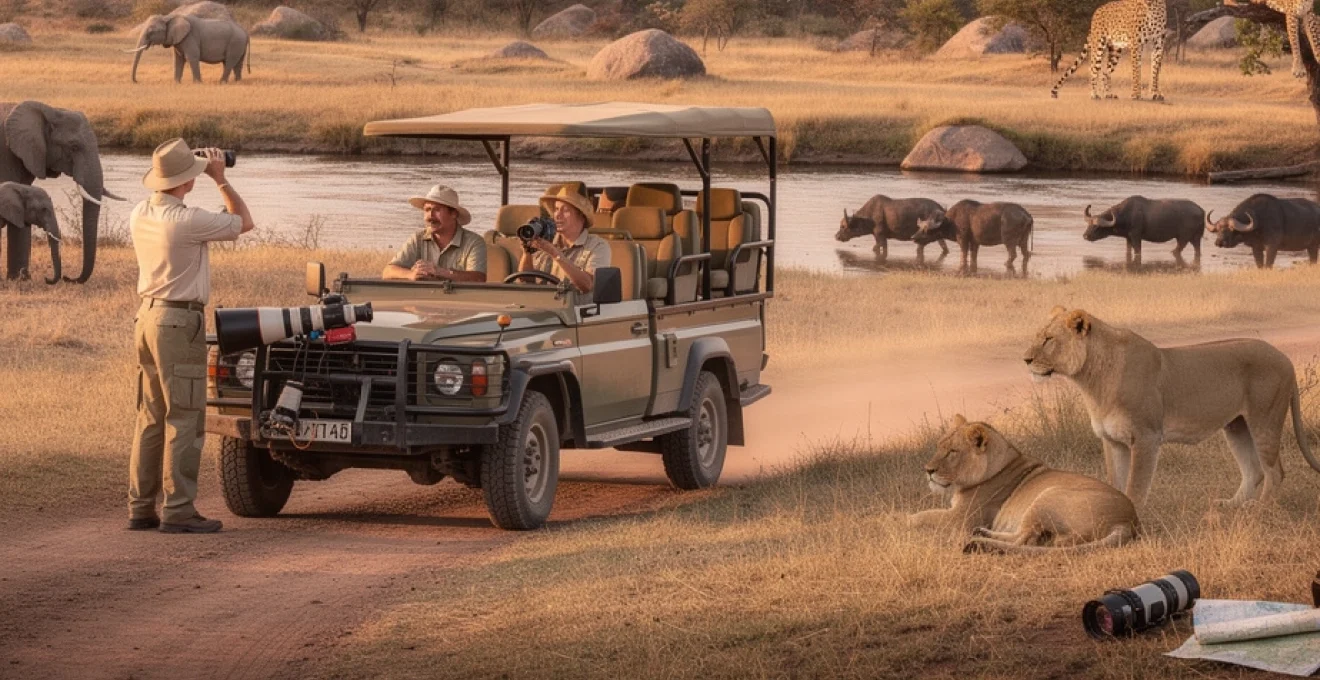
Kruger National Park stands as Africa’s most iconic safari destination, spanning nearly 20,000 square kilometres of pristine wilderness along South Africa’s eastern border with Mozambique. This legendary conservation area offers unparalleled wildlife viewing opportunities, from the celebrated Big Five to over 500 bird species and 147 mammal varieties. The park’s diverse ecosystems, ranging from dense riverine forests to open savannahs, create a tapestry of habitats that support one of the world’s most concentrated wildlife populations.
What sets Kruger apart from other African safari destinations is its remarkable accessibility combined with authentic wilderness experiences. Whether you’re seeking luxury lodge accommodations or budget-friendly self-drive adventures, the park caters to every safari preference and budget level. The question isn’t whether you’ll encounter extraordinary wildlife, but rather how many species you’ll tick off your wildlife checklist during your visit.
Planning your kruger national park safari: gate selection and accommodation strategies
Strategic planning forms the foundation of any successful Kruger safari experience. Your choice of entry point, accommodation, and timing can dramatically influence the quality and diversity of your wildlife encounters. Understanding the park’s layout and seasonal patterns allows you to maximise your chances of witnessing the extraordinary behaviours and interactions that make Kruger legendary amongst safari enthusiasts worldwide.
Paul kruger gate vs phabeni gate: access routes and wildlife density analysis
Paul Kruger Gate serves as the primary southern entrance, providing direct access to some of the park’s most wildlife-rich areas. The H4-1 road from this gate leads through diverse habitats including the productive grasslands around Skukuza, where large herbivore concentrations attract numerous predators. This route consistently delivers exceptional game viewing opportunities, particularly during the dry season when animals congregate around permanent water sources.
Phabeni Gate, located near Hazyview, offers access to the central regions via the H1-2 road network. This entrance provides excellent connectivity to Satara Rest Camp and the renowned predator territories of the central plains. The road infrastructure from Phabeni allows for efficient exploration of multiple habitat zones within a single game drive, making it ideal for visitors with limited time who want comprehensive wildlife exposure.
Private concessions: sabi sands and timbavati reserve luxury safari options
Private concessions within the greater Kruger ecosystem offer unparalleled luxury and exclusivity whilst maintaining the authentic African wilderness experience. Sabi Sands Game Reserve, sharing an unfenced 50-kilometre boundary with Kruger, provides some of Africa’s most reliable Big Five viewing opportunities. The reserve’s traversing rights system allows guides to follow animals across vast territories, significantly increasing your chances of witnessing predator hunts and other rare behaviours.
Timbavati Private Nature Reserve presents a different but equally compelling safari experience, with its diverse geological formations creating varied microhabitats. The reserve’s commitment to conservation research means visitors often gain insights into ongoing wildlife studies, adding an educational dimension to luxury safari experiences. Both concessions offer off-road driving capabilities, allowing guides to position vehicles optimally for wildlife photography and close-range observations.
Rest camp selection: skukuza, Berg-en-Dal, and satara strategic positioning
Skukuza Rest Camp’s position along the Sabie River makes it Kruger’s premier wildlife viewing base. The camp’s proximity to year-round water sources ensures consistent animal activity, whilst its extensive road network provides access to diverse habitat types within short driving distances. The camp’s research facilities and interpretive centres offer valuable insights into ongoing conservation efforts and animal behaviour studies.
Berg-en-Dal Rest Camp occupies a unique position in Kruger’s southwestern region, surrounded by granite koppies that create distinctive microhabitats. This area supports healthy populations of both black and white rhinoceros, making it exceptional for rhino viewing. The camp’s elevated position provides spectacular sunset views whilst its modern facilities cater to visitors seeking comfortable accommodations without compromising authentic bush experiences.
Satara Rest Camp sits strategically in the heart of Kruger’s central plains, renowned for exceptional predator densities. The surrounding grasslands support massive herbivore populations, which in turn attract lions, leopards, cheetahs, and wild dogs. The camp
itself is surrounded by an intricate network of gravel and tarred roads that intersect prime hunting territories, making it particularly rewarding for travellers focused on predator interactions. Because of its central position, Satara also serves as an excellent base for multi-day itineraries that explore both northern and southern sectors, allowing you to experience Kruger’s remarkable habitat diversity within a single stay.
Seasonal migration patterns: optimal timing for great kruger park experience
Seasonality plays a decisive role in shaping your overall Kruger National Park safari experience. During the dry winter months from June to September, sparse vegetation and shrinking water sources funnel animals towards rivers and artificial waterholes, dramatically increasing wildlife densities in specific areas. This period is widely regarded as the best time for first-time visitors seeking classic Big Five sightings and high visibility across the open bush.
By contrast, the summer rainy season from November to March transforms the landscape into a lush green paradise, with spectacular birding, newborn animals, and dramatic afternoon cloud formations. While dense foliage can make wildlife spotting more challenging, it also creates opportunities to witness fascinating behaviours such as territorial disputes and courtship displays. Transitional months like April–May and late September–October offer a balanced compromise: fewer crowds, pleasant temperatures, and dynamic wildlife movements as animals adjust to changing resource availability.
Understanding these seasonal migration patterns helps you align your expectations with reality. If your priority is photography of large herds and predators, lean towards late winter when animals concentrate near perennial rivers like the Sabie, Olifants, and Letaba. If you are more interested in biodiversity, birdwatching, and dramatic skies, a green-season Kruger safari delivers an equally rewarding, though very different, experience.
Big five tracking techniques and prime wildlife viewing locations
Effective Big Five tracking in Kruger National Park relies on a combination of ecological knowledge, careful observation, and strategic route planning. Each of the Big Five species occupies distinct habitat niches and follows predictable patterns driven by food, water, and territorial behaviour. By understanding these patterns, you can dramatically improve your chances of high-quality sightings, whether you are on a guided safari or self-driving through the park.
Professional guides read the bush like a book, interpreting spoor, alarm calls, and subtle shifts in animal behaviour to locate elusive predators. As a visitor, you can adopt simplified versions of these techniques by learning to identify tracks on roadside dust, listening for impala snorts or monkey alarm calls, and paying attention to vulture activity overhead. Combining this observational approach with knowledge of Kruger’s key wildlife corridors and hotspots turns a simple game drive into a more immersive tracking experience.
Southern kruger rhino tracking: malelane to crocodile bridge corridor
The southern Kruger region between Malelane Gate and Crocodile Bridge is one of the most important strongholds for both white and, to a lesser extent, black rhinoceros. This corridor features a mosaic of thornveld, riverine thickets, and open grazing areas, providing ideal rhino habitat. Roads such as the S25 along the Crocodile River and the S114 north of Malelane offer regular rhino encounters, particularly during early morning and late afternoon when temperatures are moderate.
Rhino tracking here often begins with scanning open clearings and riverbanks for characteristic grey silhouettes and listening for oxpecker calls, which frequently accompany these massive herbivores. Fresh spoor in the dust, including large three-toed tracks and dung middens, indicate active territories and recent movements. Because rhinos are highly sensitive to disturbance, maintaining a respectful distance and following park guidelines is essential not only for your safety, but also for the ongoing conservation of these critically threatened animals.
Given the ongoing threat of poaching, sightings in this corridor should always be treated with discretion. Avoid sharing precise rhino locations on social media in real time, and follow ranger instructions when vehicles are repositioned to reduce pressure on nervous individuals. By approaching rhino tracking with both enthusiasm and responsibility, you contribute to a sustainable Kruger National Park safari experience.
Central kruger lion territories: satara-orpen road pride dynamics
The central plains between Satara and Orpen are world-renowned for their dense lion populations and complex pride structures. The open grasslands along the H7 and H1-3 roads support large herds of zebra, wildebeest, and buffalo, creating a rich prey base that sustains multiple lion prides. Because visibility is excellent in this habitat, you often spot lions resting under sparse shade trees or lying near waterholes, even during the warmer midday hours.
Lion tracking in this region often begins with listening for distant roars before dawn, which can carry for up to eight kilometres across the flat terrain. Fresh tracks in sandy patches, especially where side roads cross drainage lines, provide further clues about overnight movements. Guides frequently coordinate via radio to monitor specific prides, many of which have been observed for decades, allowing them to anticipate behaviour such as territorial patrols, mating, or cooperative hunts.
For self-drivers, patience is your greatest ally. When you encounter resting lions near the road, consider staying a little longer; as temperatures drop in the late afternoon, prides often become active, providing dramatic opportunities to witness social interactions and hunting preparations. Remember that lion dynamics change constantly, with coalitions forming and dissolving over time, so each Kruger visit offers a unique glimpse into the unfolding story of these apex predators.
Leopard sighting hotspots: granite koppies and riverine forests
Leopards are the most elusive of the Big Five, yet Kruger National Park remains one of the best places in Africa to see them in the wild. These solitary cats favour areas where granite koppies, dense thickets, and riverine forests intersect, providing both vantage points for ambush and dense cover for concealment. Regions around Skukuza, the Sabie River, and granite-rich areas near Berg-en-Dal are particularly productive leopard territories.
Leopard tracking requires a more subtle approach than following lions or elephants. Look for drag marks across gravel roads, fresh impala kills hoisted into trees, and clusters of scavengers like hyena and vultures that may reveal a hidden carcass. Early morning and late evening drives along rivers such as the Sabie and Sand often yield sightings of leopards crossing low-level bridges or patrolling riverbanks. Think of these riparian zones as linear highways where predators commute between hunting grounds and resting sites.
Because leopards are highly sensitive to vehicle pressure, ethical viewing is crucial. Maintain a respectful distance, avoid blocking escape routes, and keep noise levels low so the animal can continue its natural behaviour. When sightings become crowded, it is often better to move on and seek a quieter encounter elsewhere; in a park as large as Kruger, another opportunity is always just around the corner.
African elephant migration routes: olifants river to letaba camp movements
The stretch between Olifants and Letaba camps represents a critical corridor for Kruger’s elephant population. The Olifants River, with its deep pools and lush riverine vegetation, acts as a magnet for large breeding herds, particularly in the late dry season when surface water is limited elsewhere. Elephants use a network of ancient migratory paths, many of which predate the establishment of the park, to move between feeding areas on the ridges and water points along the river.
From elevated viewpoints near Olifants Camp, you can often observe elephants crossing the river, digging for water in dry channels, or stripping bark from riverine trees. As you drive north towards Letaba along roads like the H1-5, keep an eye on well-used game trails intersecting the road, as these often mark regular crossing points. Elephants typically follow predictable daily routines, moving from feeding areas in the early morning towards water by midday, then retreating to thicker cover as heat intensifies.
Understanding these patterns not only enhances your chances of quality sightings, it also helps you navigate safely. Always give large breeding herds ample space, especially when calves are present, and avoid positioning your vehicle between individuals on either side of the road. By anticipating elephant movements along this corridor, you can enjoy some of Kruger’s most impressive wildlife spectacles from a safe and comfortable vantage point.
Cape buffalo herding patterns: seasonal grazing areas and water dependencies
Cape buffalo are the quintessential Kruger grazers, moving in large herds that can number several hundred animals. Their distribution is closely tied to the availability of nutritious grasses and reliable water sources, making them highly seasonal in their movements. In the dry season, herds often concentrate near major rivers such as the Sabie, Olifants, and Letaba, as well as permanent dams and artificial waterholes on the central plains.
During the green season, when fresh grazing is more widely available, buffalo disperse into smaller units, utilising more marginal habitats and making them slightly harder to locate. Roads around Satara, Lower Sabie, and Letaba remain consistent hotspots, particularly at dawn and dusk when herds move between night-time resting areas and daytime feeding grounds. Observing the direction of travel and dust clouds on the horizon can help you anticipate where a herd may cross the road.
Buffalo herds play a pivotal role in predator–prey dynamics, especially for lion prides that specialise in hunting these formidable bovids. When you encounter a large herd, consider scanning the periphery for trailing lions or hyenas, as scavengers and predators often shadow buffalo movements. Respect their power and unpredictability: keep windows partially closed if individuals approach closely and avoid sudden movements that may startle dominant bulls.
Advanced safari photography: equipment and field techniques
Capturing the essence of a Kruger National Park safari through photography requires more than just a capable camera; it demands an understanding of light, behaviour, and ethical fieldcraft. The African bush is a dynamic environment where subjects can appear and vanish in seconds, meaning your readiness and technique often matter more than owning the latest gear. By carefully selecting your equipment and refining a few core field techniques, you can consistently produce compelling images that tell the story of your safari.
Think of your camera kit as a toolbox: each lens, setting, and accessory has a specific role, from isolating a leopard in a tree to capturing a sweeping herd crossing a dusty plain. Balancing reach, image quality, and portability is crucial, especially on shared vehicles where space may be limited. With a bit of preparation, you can adapt to almost any photographic opportunity Kruger presents, from low-light predators at dawn to high-speed bird flight shots at midday.
Telephoto lens selection: 400mm vs 600mm performance in african bush
Choosing between a 400mm and 600mm telephoto lens for a Kruger safari is much like selecting the right binoculars: it is a balance between magnification, weight, and versatility. A 400mm lens, especially when paired with a crop-sensor camera, provides ample reach for most sightings while remaining relatively compact and hand-holdable. This makes it ideal for fast reaction shots when animals appear suddenly beside the vehicle or cross the road at close range.
A 600mm lens, whether prime or with a teleconverter on a shorter lens, excels when subjects are distant or skittish, such as shy leopards on distant koppies or raptors perched high in trees. However, the extra reach comes with increased weight and narrower field of view, which can make tracking moving subjects more challenging. On bumpy game-drive vehicles, the stability demands of a 600mm setup may necessitate beanbags or monopods to maintain sharpness.
For many photographers, a flexible zoom in the 100–400mm or 150–600mm range offers the best compromise for Kruger National Park photography. This allows you to frame everything from full-body portraits to tighter behavioural shots without constantly changing lenses. Whichever option you choose, ensure your lens has effective image stabilisation and practice tracking moving subjects before your safari, so you arrive ready to make the most of every sighting.
Golden hour wildlife photography: dawn and dusk lighting mastery
Dawn and dusk in Kruger National Park provide the most flattering light for wildlife photography, with warm tones, long shadows, and softer contrast than the harsh midday sun. These golden hours also coincide with peak animal activity, especially for predators and many bird species. Planning your photographic efforts around early-morning departures and late-afternoon drives dramatically increases the number of high-quality images you can capture.
During sunrise, low-angle light can create dramatic rim lighting on subjects, particularly when dust or mist is present in the air. Positioning yourself so the sun is slightly behind and to the side of your subject can produce striking silhouettes or glowing outlines on manes, horns, and tusks. In the evening, warm side light enhances texture on elephant skin, buffalo hides, and tree bark, adding depth and dimensionality to your images.
To maximise golden hour opportunities, have your camera fully set up before leaving camp: batteries charged, memory cards formatted, and preferred settings dialled in. Ask your guide, where possible, to stop slightly ahead of or behind other vehicles so you can align the light direction with your chosen composition. Remember that golden hour is fleeting; treating it like a limited resource encourages you to be deliberate yet responsive in your photographic decisions.
Camera settings for high-speed wildlife action: shutter priority configurations
Fast-moving wildlife—charging elephants, hunting cheetahs, or birds taking flight—demands camera settings that prioritise freezing action without sacrificing exposure quality. Using Shutter Priority (Tv or S mode) is an effective strategy, allowing you to select a minimum shutter speed while the camera automatically adjusts aperture. As a general guideline, aim for at least 1/1000s for running animals and 1/2000s or faster for birds in flight.
To support these high shutter speeds in varying light conditions, increase your ISO sensitivity to a level your camera handles comfortably, often between ISO 800 and 3200 on modern bodies. Continuous autofocus (AI Servo/AF-C) and a suitable focus tracking mode help maintain sharpness as subjects move unpredictably through the frame. Burst or continuous shooting allows you to capture multiple frames in quick succession, increasing the chance of a perfectly timed image.
Before your Kruger National Park safari, practice these configurations on local wildlife or even fast-moving pets to build muscle memory. Remember that action often unfolds without warning; having a dedicated high-speed preset on your camera’s custom modes can save precious seconds. Think of it as having a “sports gear” ready to engage whenever the bush suddenly erupts into motion.
Ethical wildlife photography distance guidelines and behavioural awareness
Ethical considerations are central to responsible safari photography, ensuring that your presence does not alter natural behaviour or compromise animal welfare. As a rule of thumb, if an animal changes its behaviour because of your vehicle—whether by staring intently, moving away, or showing signs of stress—you are too close. Maintaining a respectful distance not only protects the wildlife, it often results in more authentic and relaxed images.
In Kruger National Park, staying on designated roads and adhering to speed limits is non-negotiable, both legally and ethically. Avoid encouraging guides to off-road in public areas or to edge closer than regulations allow, especially around sensitive species like rhino and wild dogs. When photographing nesting birds or den sites, limit your time and keep noise to a minimum to reduce disturbance to vulnerable adults and young.
Behavioural awareness is your best guide: yawning predators, agitated elephants flapping ears, or buffalo with fixed stares may be signalling discomfort or aggression. By reading and respecting these cues, you help maintain a safe and sustainable environment for both wildlife and visitors. Ultimately, an ethical Kruger safari experience values the welfare of the subjects over any single photograph, no matter how compelling the shot might be.
Specialised safari experiences and conservation encounters
Beyond classic game drives, Kruger National Park and the adjoining private reserves offer a range of specialised experiences that deepen your connection to the ecosystem. Guided bush walks, for instance, shift the focus from large mammals to the intricate details of the bush—tracks, insects, plants, and bird calls—providing a richer understanding of how the ecosystem functions. Walking safaris, conducted by armed and highly trained rangers, offer an unparalleled sense of immersion and perspective.
Many private concessions and lodges collaborate with conservation organisations to host behind-the-scenes experiences. These can include visiting anti-poaching dog units, attending talks by researchers studying lions or wild dogs, or observing routine veterinary procedures from a safe distance when appropriate. Such encounters transform your Kruger safari from a passive viewing holiday into an active learning journey, creating a powerful appreciation for the ongoing work required to protect this world-class wildlife sanctuary.
For travellers with a deeper interest in conservation, some operators offer volunteer or “conservation safari” programs, where you may assist with non-invasive monitoring activities such as recording animal sightings, checking camera traps, or gathering data on vegetation changes. While these experiences require more time and commitment, they offer unique insights into the realities of managing a large protected area under increasing human and climatic pressures.
Kruger ecosystem understanding: geological formations and habitat diversity
Kruger National Park’s extraordinary biodiversity is underpinned by its geological foundations, which create a patchwork of soils, vegetation types, and microclimates. Broadly speaking, the western parts of the park are dominated by granite and gneiss formations, resulting in sandy, nutrient-poor soils that support mixed woodland and bushwillow savannah. In contrast, the eastern regions are underlain by basalt, producing clay-rich, fertile soils that sustain open grasslands teeming with grazers.
Granite koppies scattered across the south and southwest act as ecological islands, harbouring unique plant communities and serving as refuges for species such as klipspringer and leopard. River systems like the Sabie, Olifants, and Letaba carve through these geological layers, creating lush riparian corridors that attract a wide array of wildlife. Understanding this “geological blueprint” helps explain why certain areas are consistently productive for particular species, from elephant-dense mopane woodlands in the north to predator-rich grasslands in the central plains.
For visitors, recognising these habitat differences is akin to reading a map of likely wildlife encounters. When you drive from Berg-en-Dal’s rocky hills to Lower Sabie’s riverine forests, you are effectively moving through distinct ecological zones, each with characteristic bird, plant, and mammal assemblages. Appreciating this habitat diversity not only enriches your game drives; it also underscores the importance of protecting the full spectrum of Kruger’s landscapes, not just the areas most famous for Big Five sightings.
Safety protocols and emergency preparedness in african wilderness
Safety is a critical component of any Kruger National Park safari, ensuring that unforgettable experiences remain positive memories. Inside the park, adhering to basic rules—staying inside your vehicle except at designated viewpoints, respecting speed limits, and avoiding feeding or approaching animals—dramatically reduces risk. Wild animals can behave unpredictably, and even seemingly calm herbivores like elephants, hippos, and buffalo are capable of rapid, dangerous reactions when stressed or surprised.
When participating in guided bush walks or night drives, always follow ranger instructions precisely and avoid sudden movements or loud noises. Treat every animal encounter as if the individual were potentially nervous, especially when calves or young are present. Remember that your guide’s primary responsibility is safety; if they decide to leave a sighting because conditions feel unsafe, trust their judgment, even if it means sacrificing a photographic opportunity.
From an emergency preparedness standpoint, ensure you carry sufficient water, sun protection, and basic first-aid supplies in your vehicle, particularly on longer self-drive routes. Mobile phone coverage is patchy in many parts of Kruger, so inform someone of your planned route and expected return time whenever possible. In the unlikely event of a breakdown or medical emergency, remain with your vehicle, keep doors closed, and wait for assistance from park staff or other visitors rather than attempting to walk for help.
By combining common sense, respect for wildlife, and attention to official guidelines, you create a safe framework for exploring one of Africa’s greatest wilderness areas. With the right preparation, your Kruger National Park safari can be both thrilling and secure, allowing you to focus on the extraordinary landscapes and animals that make this destination truly iconic.