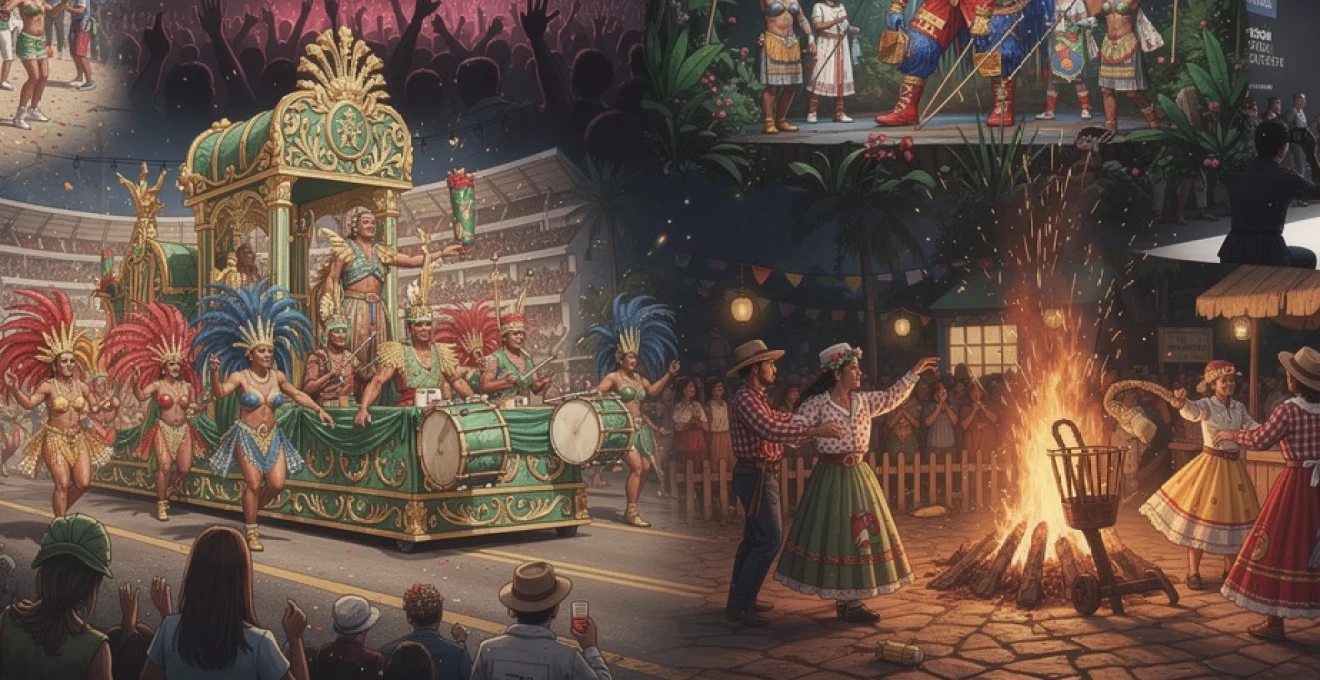
Brazil pulses with an extraordinary rhythm that transcends ordinary celebration, transforming the entire nation into a vibrant tapestry of cultural expression throughout the year. From the thunderous drums of samba schools in Rio’s Sambadrome to the mystical folklore celebrations deep in the Amazon rainforest, Brazilian festivals represent far more than mere entertainment—they embody the soul of a nation built on indigenous traditions, African heritage, and European influences. These spectacular events offer visitors an authentic glimpse into Brazil’s diverse regional cultures, where ancient rituals blend seamlessly with contemporary artistic expression, creating unforgettable experiences that define the essence of Brazilian identity.
The sheer scale and diversity of Brazil’s festival calendar rivals any nation on Earth, with celebrations that range from intimate religious processions to massive street parties attracting millions of participants. Each festival carries deep cultural significance, preserving traditions that have been passed down through generations while continuously evolving to reflect modern Brazilian society. Understanding these cultural celebrations provides invaluable insight into the complex social fabric that makes Brazil one of the world’s most culturally rich destinations.
Carnival rio de janeiro: samba schools and street block celebrations
The Rio de Janeiro Carnival stands as the undisputed crown jewel of Brazilian cultural celebrations, transforming the Marvellous City into the world’s largest street party for five days of unbridled hedonistic revelry. This spectacular event typically occurs between February and March, drawing over two million participants and visitors from across the globe who come to witness the pinnacle of Brazilian artistic expression. The carnival’s origins trace back to Portuguese colonial traditions, which evolved through African influences and indigenous customs to create a uniquely Brazilian celebration that represents the nation’s multicultural identity.
The economic impact of Rio’s Carnival extends far beyond tourism revenue, generating approximately R$4 billion annually for the local economy and supporting thousands of jobs across various sectors. From costume designers and float builders to musicians and hospitality workers, the carnival industry sustains entire communities throughout the year. The preparation process begins immediately after each carnival ends, with samba schools dedicating twelve months to crafting their elaborate presentations for the following year’s competition.
Marquês de sapucaí sambadrome championship competition analysis
The Sambadrome Marquês de Sapucaí serves as the cathedral of samba, where twelve elite samba schools compete in the most prestigious carnival competition on Earth. Each school receives exactly eighty-two minutes to present their themed parade, featuring between 3,000 to 4,000 performers dancing to original compositions that tell complex stories through music, dance, and visual spectacle. The judging criteria encompasses nine categories, including theme development, harmony, costume design, float construction, and overall presentation quality.
The championship competition operates on a promotion and relegation system similar to professional football leagues, where the lowest-performing schools face demotion to lower divisions while successful teams advance. This competitive structure maintains incredibly high standards and ensures continuous innovation in artistic expression. The winning school receives not only prestigious recognition but also significant financial rewards and the honour of representing Brazilian culture on the international stage.
Vila isabel and portela samba schools cultural heritage
Grêmio Recreativo Escola de Samba Unidos de Vila Isabel represents one of Rio’s most culturally significant samba schools, founded in 1946 in the Tijuca neighbourhood. The school gained legendary status through its association with renowned composer Martinho da Vila and its commitment to preserving Afro-Brazilian cultural traditions. Vila Isabel’s parades consistently explore themes related to Brazilian history, African heritage, and social consciousness, making them a favourite among cultural purists and intellectuals.
Portela stands as the most successful samba school in carnival history, with twenty-two championship victories that span from the 1930s to the present day. The school’s blue and white colours have become synonymous with samba excellence, while their headquarters in Oswaldo Cruz serves as a cultural centre that offers year-round activities including dance classes, musical workshops, and community development programmes. These institutions function as vital community centres that preserve cultural heritage while providing educational and social services to their neighbourhoods.
Copacabana and ipanema beach block party dynamics
The street carnival celebrations in Copacabana and Ipanema demonstrate how Rio’s carnival extends far beyond the formal Samb
adrome contests to the informal, spontaneous energy of the blocos (street blocks). In these beachfront neighbourhoods, dozens of official and unofficial blocs parade through the avenues and along the sand, each with its own musical identity, crowd profile, and start time. Some attract families and relaxed spectators in the morning, while others become dense oceans of revelers by late afternoon, fuelled by live bands, sound trucks, and endless choruses of samba, marchinhas, and funk carioca.
Managing crowd flow and safety in Copacabana and Ipanema has become a complex logistical operation involving city authorities, security services, and sanitation teams. Public transport hours are extended, traffic is redirected, and mobile phone coverage is reinforced to handle the surge of millions of users. For visitors, understanding the dynamics of the beach block parties is crucial: arriving early to find a comfortable spot, staying hydrated in the tropical heat, and keeping valuables secure can make the difference between a stressful experience and a magical immersion in Rio’s street culture. As with an elaborate choreography, the blocos move, merge, and disperse, constantly reshaping the social landscape of the city’s iconic shoreline.
Cordão da bola preta traditional street carnival procession
Cordão da Bola Preta is one of Rio de Janeiro’s oldest and most beloved street carnival blocs, founded in 1918 and traditionally parading through the historic centre on the Saturday of Carnival. Its name, which translates roughly as “black polka-dot cord,” reflects its simple yet iconic dress code: white clothes with black polka dots, often reinterpreted in creative and humorous ways. Attracting over one million people in recent years, Bola Preta is a living link to the golden age of Rio’s carnival, when marchinhas—playful, satirical carnival songs—dominated the soundtrack rather than contemporary electronic beats.
Unlike the highly produced performances at the Sambadrome, Cordão da Bola Preta embodies a more democratic and nostalgic form of celebration where anyone can join the procession, sing along, and dance shoulder to shoulder with locals. A traditional brass band leads the way, performing classics that many Brazilians know by heart, creating a powerful sense of shared memory and cultural continuity. If you want to experience the “soul” of Rio Carnival as cariocas reminisce about it, following Bola Preta through the streets is like stepping into a moving museum of carnival heritage—only far louder, sweatier, and more joyful.
Festa junina rural heritage celebrations across brazilian regions
Festa Junina, also known as São João, is Brazil’s great mid-year celebration, turning towns and cities into rural-themed playgrounds each June. Originating from European harvest festivals introduced by the Portuguese, it has absorbed strong Indigenous and African influences, especially in Brazil’s Northeast. Today, Festa Junina is as important to Brazilian cultural identity as Carnival itself, particularly outside the major coastal capitals, where it reinforces ties to the countryside and agricultural life. Colourful flags, rustic wooden stalls, and the scent of roasted corn and bonfires transform urban squares into idealised country villages.
While the celebration is nationwide, each region shapes Festa Junina according to its own traditions and musical preferences, from forró in the Northeast to sertanejo in the Southeast and Centre-West. Some cities, like Campina Grande in Paraíba and Caruaru in Pernambuco, claim to host the “biggest São João in the world,” drawing millions of visitors across multi-week programmes filled with concerts, dance competitions, and food festivals. For travellers, Festa Junina offers a rare chance to experience Brazilian rural heritage in a festive, accessible way—almost like attending a nostalgic, country-style fair staged at a national scale.
Santo antônio, são joão, and são pedro catholic saint festivities
At the heart of Festa Junina lie three Catholic saints: Santo Antônio (Saint Anthony) on June 13, São João (Saint John) on June 24, and São Pedro (Saint Peter) on June 29. Historically, each saint’s day marked different rural concerns—love and marriage, harvest and rain, and protection for fishermen and farmers. In many communities, church masses, novenas, and processions precede or accompany the secular festivities, reminding participants that beneath the fireworks and dancing, this is still a religious season. You’ll often see altars, images of saints, and banners blending faith with folklore in a way that is uniquely Brazilian.
Santo Antônio is popularly known as the “matchmaker saint,” and many people, especially women, perform playful rituals to secure a good marriage or improve their romantic fortunes. São João’s night is the high point of the celebrations, with bonfires, fireworks, and family gatherings echoing the idea of community and protection. São Pedro’s day often closes the cycle, particularly in fishing towns where boats are blessed and processions head toward rivers and the sea. This interweaving of Catholic devotion, rural symbolism, and festive joy shows how Brazilian festivals often function as both spiritual practice and social glue.
Quadrilha folk dance choreography and musical traditions
The quadrilha is the choreographed folk dance that epitomises Festa Junina, typically performed by pairs dressed as country brides and grooms. Inspired by 19th-century European court dances, it evolved in Brazil into a humorous, story-driven performance that parodies rural weddings and village life. A marcador (caller) leads the dance, shouting out instructions—sometimes in comedic, improvised lines—while couples execute carefully rehearsed steps, formations, and “mistakes” that make the audience laugh. Watching a well-prepared quadrilha is like seeing a mini-theatre production blended with a line dance.
Musically, the quadrilha is powered by traditional forró rhythms—especially xote and baião—driven by accordion, triangle, and zabumba (bass drum). In major festivals, quadrilha groups compete in elaborate contests, judged on costume design, synchronicity, originality, and adherence to traditional steps. For visitors keen on cultural immersion, learning a few quadrilha moves can be a memorable way to connect with locals; many city squares and community centres host open dance workshops in June. Think of it as Brazil’s answer to a country square dance—but with more colour, more drama, and far spicier music.
Caipira fashion elements and traditional costume components
Festa Junina fashion celebrates the figure of the caipira—the stereotypical Brazilian country dweller—through playful, exaggerated costumes. Men typically wear checked shirts, patched jeans, straw hats, and painted-on beards or moustaches, often adding fake missing teeth for comic effect. Women’s outfits feature ruffled, brightly coloured dresses, ribbons, pigtails, and freckles drawn with eyeliner, evoking a cheerful, rustic version of a countryside bride. These stylised clothes are not meant as realistic depictions but as affectionate caricatures, similar to how comic strips exaggerate features to convey personality.
Beyond the humour, caipira fashion expresses pride in rural roots at a time when many Brazilians have migrated to cities. Schoolchildren, office workers, and even corporate teams embrace the dress code at themed parties, temporarily stepping into a simpler, agrarian persona. For travellers, joining in this sartorial transformation—perhaps by buying a straw hat from a local stall or adding patches to your jeans—can be an easy way to break the ice. You’ll find that in Brazil, a checked shirt and a smile are often all you need to be welcomed into the dance circle.
Fogueira bonfire rituals and corn-based culinary preparations
Bonfires, or foguerias, are central to Festa Junina, symbolising warmth, community, and the rural practice of gathering around the fire after a day’s work in the fields. Traditionally, each saint is associated with a specific type of bonfire shape, and families or neighbourhoods would build their own small fires in front yards or village squares. Today, safety regulations have limited open flames in some urban areas, but many towns still host controlled bonfires as a visual and emotional focal point for the celebrations. The crackle of firewood, combined with fireworks overhead, creates an atmosphere that feels almost timeless.
Corn-based dishes dominate the Festa Junina food scene, reflecting the crop’s historic importance in Brazilian agriculture. Typical treats include pamonha (a sweet or savoury corn paste steamed in husks), curau (corn pudding), canjica or mugunzá (sweet corn and milk dessert), roasted corn on the cob, and various corn cakes. Peanuts and cassava also appear in favourites like paçoca and pé de moleque. Imagine a farmers’ market crossed with a street food festival: stalls overflow with homemade sweets and hearty snacks, many prepared according to family recipes handed down for generations. For food lovers, Festa Junina is one of the best times of year to explore traditional Brazilian cuisine beyond the usual feijoada and churrasco.
Parintins folklore festival amazonian cultural spectacle
The Parintins Folklore Festival, also known as Festival do Boi-Bumbá, is one of Brazil’s most visually stunning cultural events, held annually in late June on Tupinambarana Island in the state of Amazonas. For three electrifying nights, the normally quiet town of Parintins morphs into a giant open-air theatre, staging a majestic competition between two rival teams—Garantido (red) and Caprichoso (blue). Each side presents a massive, multimedia show in the purpose-built Bumbódromo arena, with floats, costumes, songs, and dances retelling the legendary story of an ox that dies and is miraculously resurrected. The narrative might sound simple, but the performances weave in complex layers of Amazonian folklore, Indigenous cosmology, and regional pride.
Unlike Rio’s carnival, where multiple samba schools compete separately, Parintins is a head-to-head contest, with one team taking the stage at a time while the other side’s fans remain silent as part of the ritual. Judges evaluate criteria such as allegory, choreography, costume design, and the integration of Indigenous and Afro-Amazonian themes. In recent years, both teams have increasingly incorporated messages about environmental protection, Indigenous rights, and the preservation of the Amazon rainforest into their presentations. If you think of Rio’s Sambadrome as a cathedral of samba, the Bumbódromo is more like an Indigenous-inspired opera house under the stars—immersive, symbolic, and emotionally charged.
Logistically, getting to Parintins requires more planning than visiting Brazil’s coastal cities. Most visitors fly first to Manaus, then continue by boat or regional flight along the Amazon River; during festival days, accommodation sells out months in advance and prices rise sharply. However, the journey is part of the experience, offering glimpses of river life and rainforest landscapes rarely seen by mainstream tourists. For those seeking a deep dive into Amazonian culture, the Parintins Festival is a once-in-a-lifetime opportunity to witness how local myths, Indigenous artistry, and contemporary stagecraft merge into a breathtaking cultural spectacle.
Rock in rio international music festival production
Rock in Rio, first held in 1985, has grown into one of the world’s largest music festivals and a major showcase of Brazil’s ability to host complex mega-events. Although the brand has expanded to Lisbon, Madrid, and beyond, its spiritual home remains Rio de Janeiro, where the festival typically takes place over multiple weekends at the purpose-built “Cidade do Rock” (City of Rock). Each edition attracts hundreds of thousands of fans and dozens of global headliners from rock, pop, electronic, and Latin genres. For many Brazilians, attending Rock in Rio is a rite of passage comparable to going to Carnival or a World Cup match.
From a production standpoint, Rock in Rio operates like a small, temporary city, complete with multiple stages, themed streets, food courts, brand experiences, and meticulous security operations. Organisers invest heavily in stage design, sound engineering, and live broadcast infrastructure, ensuring that performances reach not only the onsite crowd but also millions of viewers via TV and streaming platforms. Environmental and social sustainability have become key concerns in recent years, with initiatives focused on recycling, carbon offsetting, and partnerships with NGOs. Attending the festival, you quickly realise that it’s not just about the bands; it’s about experiencing how Brazil blends entertainment, technology, and civic organisation at a global scale.
For international visitors, Rock in Rio can be an ideal gateway into Brazilian culture beyond traditional stereotypes. Between shows, you’ll encounter Brazilian food trucks, local fashion brands, and domestic artists sharing the spotlight with global superstars. Practical planning is essential: tickets often sell out quickly, accommodation near the venue inflates in price, and transport to and from the site can be crowded at peak times. Yet, if you love live music and want to see how Brazil hosts an event that rivals Coachella or Glastonbury—while adding its own tropical flair—Rock in Rio is hard to beat.
São paulo fashion week cultural and economic impact
São Paulo Fashion Week (SPFW) is the largest fashion event in Latin America and a key platform for Brazilian designers to present their collections to global buyers, media, and influencers. Held twice a year, typically in April and October, SPFW transforms venues across the city—often repurposed industrial spaces or cultural institutions—into runways and showrooms. While the event focuses on industry professionals, its influence radiates far beyond the catwalk, shaping trends in Brazilian street style, beauty, and retail. Much like Milan or Paris Fashion Week, São Paulo’s edition reflects the city’s status as a creative and economic powerhouse.
Economically, SPFW generates substantial business for the fashion and textile sectors, as well as for hotels, restaurants, and transportation services. It provides a crucial platform for emerging designers from diverse backgrounds, many of whom draw inspiration from Brazil’s rich cultural mix—Indigenous motifs, Afro-Brazilian aesthetics, urban streetwear, and sustainable materials. In recent editions, there has been a strong push toward inclusivity and representation, with more Black, Indigenous, and plus-size models on the runway and discussions about fair labour practices in the supply chain. You could think of SPFW as a mirror reflecting how Brazil wants to present itself to the world: stylish, diverse, and increasingly socially aware.
For visitors interested in fashion tourism, timing a trip to coincide with SPFW can open doors to special exhibitions, pop-up shops, and public events that run parallel to the main schedule. While most runway shows are invitation-only, many brands and cultural institutions host accessible installations, talks, and markets across the city. Exploring neighbourhoods like Vila Madalena, Pinheiros, and Jardins during fashion week offers a chance to see how trends leap from the runway to the street in real time. Whether you work in the industry or simply enjoy observing style, São Paulo during SPFW feels like a living, walking, talking fashion magazine.
Círio de nazaré religious procession in belém pará
Círio de Nazaré, held every October in Belém, capital of the state of Pará, is one of the largest Catholic religious gatherings in the world, often compared to Holy Week in Seville or pilgrimages to Lourdes. At its core is deep devotion to Our Lady of Nazareth, whose small statue is believed to possess miraculous powers. Over the course of several days, millions of faithful participate in river and land processions, accompanying the image from the Catedral da Sé to the Basílica de Nazaré and back. The main procession alone can stretch for kilometres, with participants walking barefoot, carrying candles, or fulfilling personal vows.
Beyond its religious dimension, Círio de Nazaré is a powerful expression of Amazonian identity and communal solidarity. Streets along the route are decorated with altars, banners, and floral arches, while families open their homes to relatives and guests arriving from rural areas. Traditional foods such as maniçoba (a long-cooked manioc leaf stew), pato no tucupi (duck in a yellow manioc sauce), and various sweets made from Amazonian fruits turn the city into a culinary showcase. The festival’s atmosphere is a unique blend of solemnity and celebration: one moment you might be moved by the sight of pilgrims in prayer, the next you’re drawn into a lively street market or cultural performance.
For travellers, attending Círio requires sensitivity and respect, as this is first and foremost an act of faith, not a tourist spectacle. Crowd density can be overwhelming, heat and humidity are intense, and accommodation must be booked well in advance. Yet, for those prepared, the experience offers rare insight into how religion, culture, and regional pride intersect in northern Brazil. Witnessing the candlelit processions, the chants, and the rivers of people following the small statue of Our Lady is like watching a living river of devotion flow through the heart of the Amazonian metropolis.