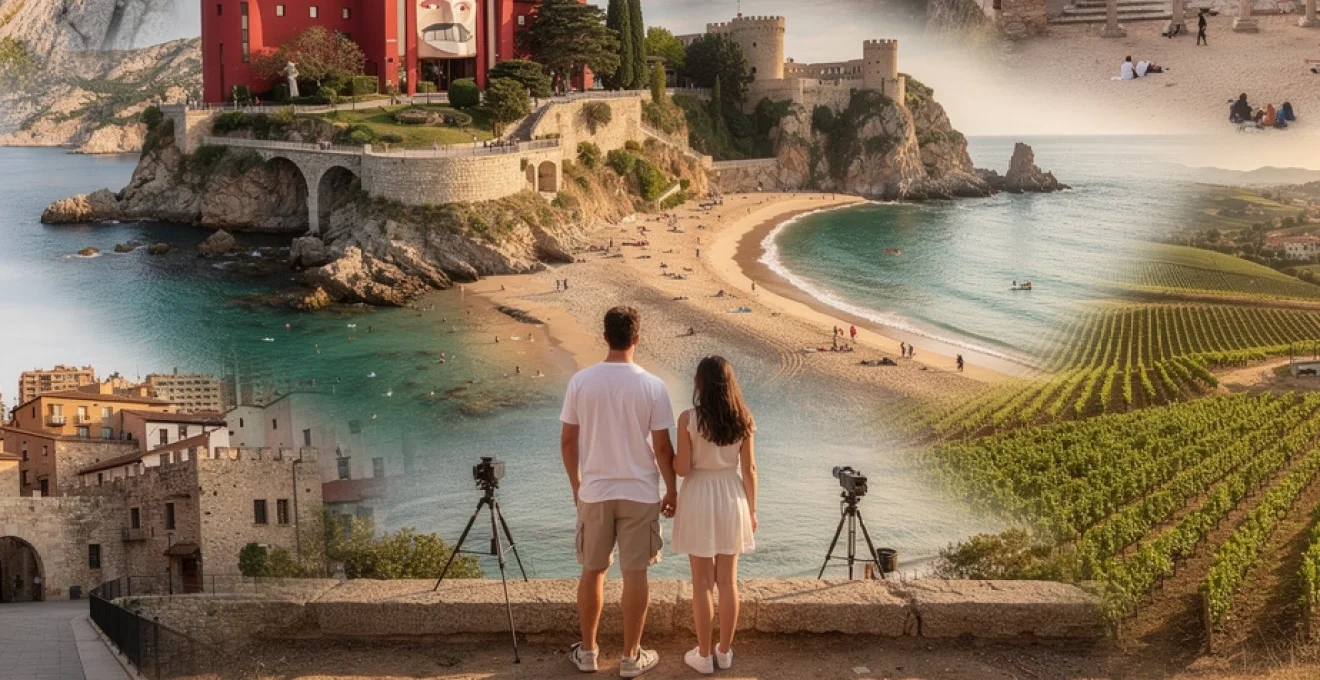
Barcelona’s strategic location in Catalonia transforms the vibrant metropolis into the perfect gateway for discovering some of Europe’s most remarkable destinations. Within a two-hour radius of the city, travellers can immerse themselves in sacred mountain monasteries, explore medieval coastal fortresses, wander through ancient Roman ruins, and experience world-class wine regions that have shaped Spanish culture for centuries.
The diversity of experiences available from Barcelona is truly extraordinary. Morning trains can whisk you away to mystical abbey complexes perched on jagged mountain peaks, whilst afternoon departures lead to sun-drenched Mediterranean coastlines where medieval villages cling to dramatic clifftops. The region’s exceptional transport infrastructure, including high-speed rail connections and scenic cable car routes, makes these adventures both accessible and memorable.
Each destination offers its own unique character and historical significance. From UNESCO World Heritage sites that showcase Roman grandeur to cutting-edge museums celebrating surrealist artistry, these excursions provide profound cultural enrichment beyond Barcelona’s already impressive offerings. The careful selection of these six destinations ensures that every type of traveller—whether seeking spiritual reflection, artistic inspiration, culinary excellence, or natural beauty—will discover their perfect day-long escape.
Montserrat abbey and santa maria de montserrat monastery complex
The mystical mountain range of Montserrat rises dramatically from the Catalan plains, creating one of Spain’s most spiritually significant destinations. This remarkable geological formation, whose name translates to “serrated mountain,” has housed the Santa Maria de Montserrat monastery for over a millennium. The abbey complex, founded in the year 1025, represents the spiritual heart of Catalonia and attracts millions of pilgrims and tourists annually who seek both religious enlightenment and breathtaking natural beauty.
The monastery’s architectural evolution spans nearly ten centuries, blending Romanesque foundations with Gothic expansions and Renaissance additions. The main basilica, rebuilt in the 19th century after Napoleon’s troops destroyed the original structure, showcases neo-Romanesque styling that harmonises beautifully with the surrounding rocky pinnacles. The complex includes not only religious buildings but also residential quarters for the Benedictine community, educational facilities, and cultural institutions that preserve Catalonian heritage.
Rack railway journey via cremallera de montserrat transportation system
The journey to Montserrat begins with the remarkable Cremallera de Montserrat, a rack railway system that has been transporting visitors up the mountain since 1930. This engineering marvel climbs 550 metres over a 5-kilometre route, offering passengers spectacular panoramic views as the train ascends through pine forests and rocky outcrops. The 20-minute journey provides an unforgettable introduction to the mountain’s unique geology, with viewing windows designed specifically to showcase the dramatic landscape.
The railway system operates with Swiss precision, utilising a cogwheel mechanism that ensures safe passage up gradients reaching 17.6%. Modern rolling stock features climate-controlled carriages with panoramic windows, whilst multilingual audio guides explain the mountain’s geological formation and cultural significance throughout the ascent. The experience itself becomes an integral part of the pilgrimage, transforming simple transportation into a meditative journey that prepares visitors for the spiritual encounter awaiting at the summit.
Black madonna shrine and escolania de montserrat boys’ choir performances
At the heart of Montserrat’s spiritual significance lies La Moreneta, the revered Black Madonna statue that has drawn pilgrims since the 12th century. This Romanesque carving, measuring just 95 centimetres in height, depicts the Virgin Mary holding the Christ child whilst displaying the distinctive dark patina that gives the statue its name. Legend attributes the discovery of the statue to shepherds who found it in a mountain cave, accompanied by celestial light and angelic music that convinced local authorities to establish the monastery at this precise location.
The Escolania de Montserrat, one of Europe’s oldest boys’ choirs, performs daily in the basilica, creating an ethereal atmosphere that enhances the shrine’s mystical qualities. Founded in the 13th century, this prestigious musical institution has maintained its tradition of sacred music performance for over 700 years. The young choristers, aged between nine and fourteen, live and study at the monastery whilst receiving world-class musical education that has produced numerous
professional musicians and composers. Hearing their clear voices resonate off the basilica’s stone walls is often described as the most moving moment of a Montserrat day trip from Barcelona. Performance times can vary slightly depending on the liturgical calendar, so it is wise to check the schedule in advance and arrive 15–20 minutes early to secure a good position inside the church.
Access to the Black Madonna shrine is organised via a dedicated queue that leads behind the high altar, where visitors move past the statue in a continuous line. During peak season and religious holidays, waiting times can exceed 45 minutes, so consider arriving early in the morning or later in the afternoon if you prefer a quieter experience. Should you wish to spend more reflective time in the basilica rather than queueing, you can also contemplate La Moreneta from the nave below, where the statue is clearly visible above the altar.
Sant joan funicular access to hiking trails and hermitages
For many visitors, the highlight of Montserrat is not only the monastery but the surrounding network of hiking trails and ancient hermitages scattered across the mountain. The Sant Joan funicular provides the most efficient access to these higher elevations, climbing roughly 250 metres above the monastery in just a few minutes. Its steep incline and glass-roofed carriages offer dramatic views over the abbey complex and the Llobregat Valley, making the ride itself part of the adventure.
At the upper station, clearly signposted paths lead towards several viewpoints and historic hermitages that once housed reclusive monks. Popular short walks include the path to the Mirador de Sant Joan and the route towards the Ermita de Sant Onofre and Ermita de Sant Miquel, which reward you with sweeping vistas over Catalonia’s plains and the serrated rock formations that give Montserrat its name. The terrain is generally well maintained and waymarked, but the gradients can be steep, so sturdy footwear, water and sun protection are essential, especially in summer.
If you are planning a Montserrat hiking day trip from Barcelona, allow at least three to four hours on the mountain to combine the monastery visit with a moderate walk. Think of the monastery as the “ground floor” and the funicular as an express lift to the rooftop terrace of Catalonia: from there, you can choose short scenic loops or longer hikes that continue along the ridgeline. In cooler months, layers and a windproof jacket are advisable, as conditions at higher altitude can be markedly colder than in the city below.
Montserrat museum art collection and archaeological exhibits
Beyond its religious and natural appeal, Montserrat also houses an unexpectedly sophisticated cultural institution: the Montserrat Museum. Located within the monastery complex, this museum holds more than 1,300 works and has been recognised as one of Catalonia’s most important art collections. Its galleries display masterpieces by artists such as El Greco, Caravaggio, Dalí, Picasso and Miró, creating an impressive contrast between cutting-edge modern art and centuries-old religious heritage.
Alongside fine art, the museum’s archaeological exhibits trace human activity in the region from ancient Mesopotamia and Egypt through to Roman-era Catalonia. Artefacts include Phoenician jewellery, Egyptian sarcophagi and Roman inscriptions, offering a broader Mediterranean context for Montserrat’s own history. For travellers interested in culture, this makes a Montserrat day trip feel less like a simple excursion and more like a compact survey of European art and archaeology wrapped into one mountain visit.
Entry to the Montserrat Museum is usually not included in basic transport tickets, so you may need to purchase a combined pass or pay a separate fee at the entrance. If you are planning your Barcelona itinerary with limited time, it is worth deciding in advance whether to prioritise hiking, the basilica and Black Madonna, or the museum, as experiencing all three in depth can easily fill an entire day. A good strategy is to visit the Black Madonna and attend the boys’ choir earlier in the day, then reserve the museum galleries for the quieter late afternoon period before descending back to Barcelona.
Costa brava coastal route: girona medieval quarter and tossa de mar
Stretching north from Barcelona to the French border, the Costa Brava offers some of Spain’s most dramatic coastal scenery and well-preserved medieval towns. Combining Girona and Tossa de Mar in a single day delivers an ideal mix of history and seaside relaxation, making this one of the most rewarding coastal day trips from Barcelona. With efficient train connections to Girona and regular buses or private transfers onwards to the coast, it is perfectly possible to experience both destinations without renting a car.
This Costa Brava route is especially appealing if you enjoy walking through atmospheric old quarters in the morning and unwinding beside the Mediterranean in the afternoon. Girona’s medieval core and Jewish quarter are remarkably intact, while Tossa de Mar’s fortified headland and sandy bay present the classic postcard view of the Catalan coastline. Travellers who prefer a slower pace can also choose to focus on just one of these locations, but visiting both showcases the region’s variety in a single, well-balanced day.
Girona cathedral gothic architecture and jewish quarter walking tour
Perched above the Onyar River, Girona’s Old Town is dominated by the monumental Cathedral of Santa Maria, whose broad Baroque staircase leads to one of the widest Gothic naves in the world. Construction of the cathedral began in the 11th century and continued for several centuries, resulting in an intriguing architectural blend of Romanesque cloisters, Gothic nave and Baroque façade. Stepping inside, you are immediately struck by the sense of vertical space, much like entering a vast stone ship turned upright and anchored above the city.
A self-guided or organised walking tour of Girona’s medieval quarter typically begins at the cathedral, then continues along the restored city walls that offer panoramic views across the terracotta rooftops. From here, narrow lanes lead down into the Call, Girona’s historic Jewish quarter. Considered one of the best-preserved in Europe, this neighbourhood of tight alleyways and inner courtyards once housed a thriving Jewish community until their expulsion in the late 15th century. Today, the Museum of Jewish History and discreet plaques embedded in the cobblestones provide context about this chapter of Catalan history.
Allow at least two to three hours to explore Girona at a relaxed pace, including a coffee break in one of the arcaded squares near the river. Comfortable walking shoes are essential, as the streets are cobbled and the climbs to the cathedral and ramparts can be steep. If your priority is maximising your Costa Brava day trip from Barcelona, taking an early high-speed train (around 40 minutes from Sants station) allows you to enjoy Girona in the morning before continuing to the coast after lunch.
Game of thrones filming locations in girona’s historic centre
In recent years, Girona has gained additional fame as a major filming location for HBO’s Game of Thrones, making it a magnet for fans seeking to trace the footsteps of their favourite characters. The cathedral’s grand staircase doubled as the Great Sept of Baelor in King’s Landing, most memorably during Cersei’s walk in season six. Walking up these steps today, you are likely to recognise the angles and perspectives from the series, adding a layer of cinematic déjà vu to the historic setting.
Other Girona locations stand in for the free city of Braavos, including the narrow streets around the Arab Baths and sections of the old walls. If you are short on time, you can simply follow your own instincts and compare your surroundings to stills from the show. However, dedicated fans may prefer to join a specialised Game of Thrones walking tour that highlights specific filming points and shares behind-the-scenes anecdotes from production. Even if you have never watched the series, these routes serve as excellent introductions to Girona’s architectural highlights.
Balancing television references with genuine history can make the city feel more approachable, especially if you are travelling with friends or family who have different interests. Think of the Game of Thrones locations as a treasure hunt layered onto an already fascinating medieval map: while one person admires Gothic stonework, another is busy recreating a favourite scene on the cathedral steps. Either way, Girona’s compact size and pedestrian-friendly layout make it easy to explore on foot before heading to Tossa de Mar or returning to Barcelona.
Tossa de mar vila vella medieval fortifications and beach access
About 90 minutes north-east of Barcelona by bus or car, Tossa de Mar offers a unique combination of preserved medieval fortifications and an attractive sandy bay. The walled old town, known as Vila Vella, rises on a headland at the eastern end of the beach and is the only remaining fortified medieval town on the Catalan coast. Walking through its stone gate and winding up towards the lighthouse feels a little like entering a time capsule, with cobbled alleys, stone houses and sea views unfolding at every turn.
The circular path along the ramparts provides some of the best coastal panoramas on the Costa Brava, looking back over Tossa’s crescent-shaped main beach and out towards rocky coves dotted with fishing boats. After exploring the fortifications, you can descend to the waterfront for a swim, rent a kayak to reach nearby coves, or simply relax at one of the seaside cafés. If you have already visited busy urban beaches in Barcelona, Tossa’s more scenic and enclosed bay often feels like a refreshing change of pace.
Planning a Tossa de Mar day trip from Barcelona works particularly well in the warmer months from late spring to early autumn. To avoid the heaviest crowds, consider arriving mid-morning and walking the ramparts first, when temperatures are still mild, then reserving the afternoon for beach time. Bus schedules can be seasonal, so it is important to check return departure times in advance and book your preferred service where possible, especially in July and August.
Dalí theatre-museum in figueres and castell gala dalí
Art enthusiasts often choose to extend their Costa Brava itinerary by including Figueres, birthplace of Salvador Dalí and home to the extraordinary Dalí Theatre-Museum. Created by the artist himself within the ruins of the town’s former theatre, this museum is frequently described as the world’s largest surrealist object. Its exterior—pink walls crowned with giant eggs and golden figures—acts as a visual preamble to the eccentric installations, paintings and sculptures housed inside.
Exploring the Dalí Theatre-Museum is an immersive journey into the artist’s imagination, with optical illusions, holograms and multi-layered compositions that reward slow viewing. Many visitors underestimate how long they will want to spend inside; to truly appreciate the collection, you should allocate at least two to three hours. For a fuller Dalí-focused day trip from Barcelona, it is possible to combine the Figueres museum with a visit to Castell Gala Dalí in the village of Púbol, the castle Dalí purchased and decorated for his wife and muse.
Castell Gala Dalí offers a more intimate look at the couple’s private world, with rooms, gardens and sculptures reflecting both Gala’s tastes and Dalí’s surrealist interventions. The two sites are connected by regional buses and organised tours, but journey times mean that fitting both into a single Barcelona day trip can feel rushed. If Dalí is a major focus of your travels, consider dedicating a full day solely to Figueres and Púbol; otherwise, pairing the Figueres museum with nearby Girona often provides a more relaxed itinerary.
Tarragona roman archaeological heritage and unesco world heritage sites
Southwest of Barcelona along the Costa Daurada, Tarragona offers one of the richest collections of Roman remains in Spain and has been recognised by UNESCO as a World Heritage Site since 2000. Known in antiquity as Tarraco, this was the first major Roman settlement on the Iberian Peninsula and later became the capital of the province of Hispania Citerior. Today, its compact historic centre and seaside location make Tarragona an ideal choice for a culturally focused day trip from Barcelona.
The city’s most iconic monument is the 2nd-century Roman amphitheatre, dramatically positioned on a slope overlooking the Mediterranean Sea. Here, you can stand on the same terraces where spectators once watched gladiatorial combats, with the rhythmic sound of the waves now replacing the roar of the crowd. Nearby, the ruins of the provincial forum, circus and defensive walls help you piece together Tarraco’s original urban layout, much like reconstructing a three-dimensional puzzle from scattered yet still impressive fragments.
Beyond its Roman core, Tarragona boasts a magnificent cathedral that blends Romanesque and Gothic elements, as well as a charming medieval quarter of narrow streets and shaded plazas. Many travellers like to split their day between archaeology and seaside relaxation, as several excellent beaches lie within walking distance or a short bus ride of the centre. Fast trains from Barcelona Sants reach Tarragona in around one hour, and purchasing tickets in advance is advisable during peak travel periods to secure the most convenient departure times.
Penedès wine region: cava production and vineyard tours
West of Barcelona, the rolling countryside of the Penedès region is synonymous with cava, Spain’s celebrated sparkling wine. Vineyards stretch across gentle hillsides between the Catalan coast and the pre-coastal mountain range, creating a landscape that feels a world away from the city despite being less than an hour by train. For wine lovers—or simply those seeking a slower-paced rural experience—Penedès ranks among the most rewarding day trips from Barcelona.
The towns of Sant Sadurní d’Anoia and Vilafranca del Penedès serve as the main gateways to the region’s wineries, including renowned cava houses such as Codorníu and Freixenet alongside smaller, family-run cellars. Typical vineyard tours explain the entire cava production process, from harvesting native grape varieties like Macabeu, Xarel·lo and Parellada to the traditional method of secondary fermentation in the bottle. Descending into cool underground cellars lined with countless ageing bottles feels a little like entering a subterranean cathedral dedicated to sparkling wine.
Most producers offer guided tastings at the end of the visit, often allowing you to compare different styles of cava—brut nature, brut, semi-seco—and occasionally still wines from their portfolios. As with many wine regions, advance reservations are highly recommended, particularly on weekends and during harvest season in September and October. If you plan to visit several wineries in a single day and sample generously, booking a guided tour from Barcelona or arranging private transport is a prudent choice, allowing you to enjoy the experience without worrying about driving.
Vic medieval market town and osona region gastronomy
Located about 70 kilometres north of Barcelona in the fertile Osona region, Vic is a historic market town known for its well-preserved medieval centre and strong culinary traditions. Its spacious main square, Plaça Major, is surrounded by arcaded buildings and hosts twice-weekly markets that have been central to local life for centuries. Visiting on a Tuesday or Saturday gives you the chance to see the square filled with stalls selling produce, cheeses, cured meats and household goods—a scene that feels unchanged in spirit, if not in detail, from medieval times.
Vic’s architectural highlights include its Romanesque bridge, sections of medieval walls and the Cathedral of Sant Pere Apòstol, whose somewhat austere exterior contrasts with the dramatic, almost monochrome murals by Josep Maria Sert that cover much of the interior. Wandering through the narrow streets around the cathedral, you will find traditional shops specialising in embotits—Catalan cured sausages for which Vic is particularly famous. Sampling fuet or llonganissa de Vic with a slice of rustic bread is almost a rite of passage for food-focused travellers.
For those interested in combining history and gastronomy in a single Barcelona day trip, Vic is hard to beat. After exploring the old town on foot, you can enjoy a leisurely lunch in a local restaurant featuring hearty Osona dishes such as stews, grilled meats and seasonal mushroom plates in autumn. Regional trains from Barcelona reach Vic in about 70–80 minutes, making it straightforward to visit independently. As with many smaller Catalan towns, midday closures are common, so planning your sightseeing around the long lunch break ensures you do not find museums or churches unexpectedly closed.
Transportation infrastructure and day trip logistics from barcelona
One of the reasons these six destinations work so well as day trips from Barcelona is the region’s robust and well-integrated transportation network. High-speed AVE and Avant trains connect Barcelona with Girona, Figueres and Tarragona in under an hour, while regional Rodalies services link the city to Montserrat, Vic and many coastal towns. For routes not served directly by rail, modern intercity buses and well-maintained highways provide reliable alternatives, giving you the flexibility to choose between independent travel and organised excursions.
When planning your Barcelona day trips, it is helpful to think in terms of travel time “zones.” Destinations like Montserrat, Vic and Penedès vineyards typically sit within the 60–80 minute range, while Costa Brava towns and Figueres often require closer to two hours each way, depending on connections. As a general rule, if your one-way journey exceeds two and a half hours, consider whether an overnight stay might provide a more relaxed experience. Much like pacing a multi-course meal, spacing out long travel segments ensures you can savour each destination rather than rush through it.
Practical logistics can make a big difference to how enjoyable your day trips from Barcelona feel. Buying train tickets in advance for high-speed routes often secures better fares and preferred departure times, while checking local timetables for buses and funiculars helps you avoid long waits between connections. Comfortable walking shoes, a refillable water bottle and weather-appropriate layers are essential, as many of these excursions involve time outdoors and changes in altitude or coastal breezes.
Finally, think about how each day trip fits into your broader Barcelona itinerary and travel style. Do you prefer to explore independently with public transport and plenty of unstructured time, or would you rather join a small-group tour with a guide to handle the logistics and share local insights? There is no single correct approach; instead, mix and match according to the destination and your priorities. By pairing Barcelona’s urban energy with well-chosen escapes to mountains, vineyards, Roman ruins and medieval towns, you will gain a far richer understanding of Catalonia’s diversity in just a few unforgettable days.