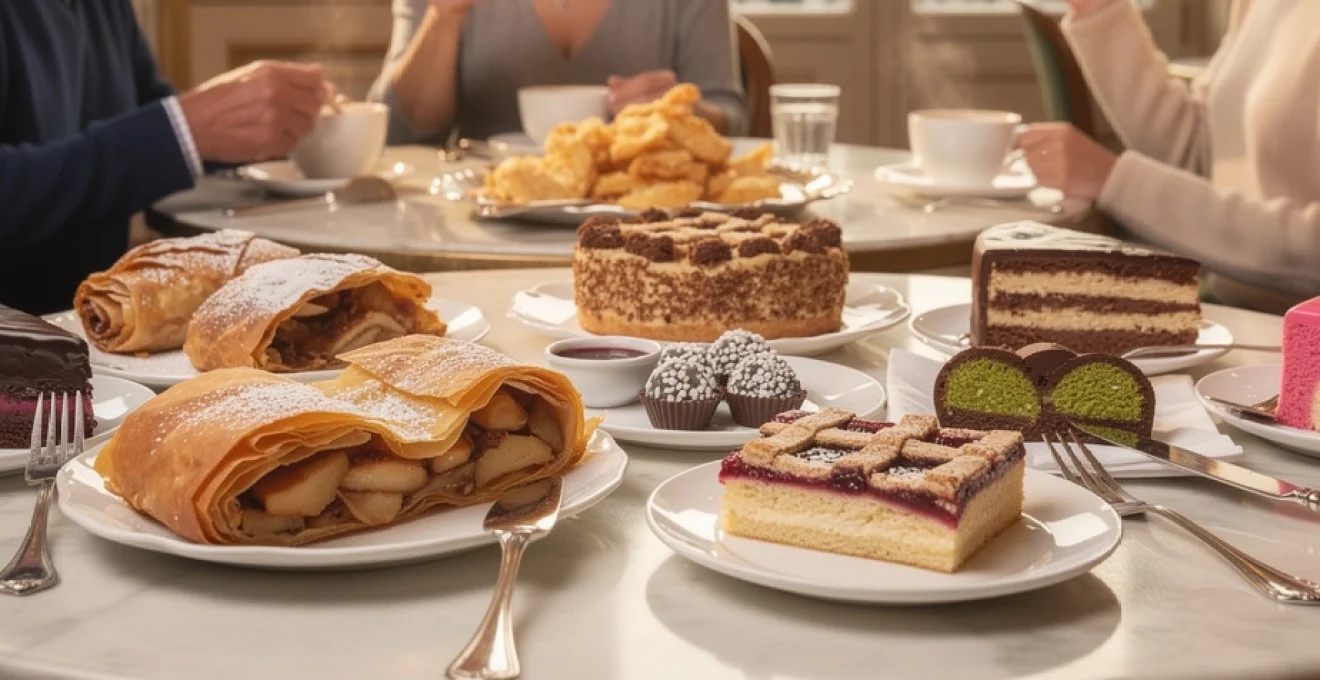
Vienna’s dessert culture represents centuries of imperial tradition woven into the fabric of modern Austrian gastronomy. The city’s legendary coffee houses serve as temples to confectionery artistry, where each torte, strudel, and pastry carries the weight of Habsburg heritage and the innovation of contemporary patissiers. From the world-famous Sachertorte to lesser-known regional specialities, Vienna’s dessert landscape offers an extraordinary journey through Austrian culinary history.
The Austrian capital’s dessert tradition extends far beyond tourist attractions, deeply embedded in daily life where locals still gather for afternoon coffee and cake. Kaffeehaus culture thrives alongside modern patisseries, creating a unique ecosystem where traditional recipes meet contemporary techniques. Each dessert tells a story of imperial courts, seasonal celebrations, and family traditions passed down through generations of Austrian bakers.
Imperial habsburg dessert heritage at café central and demel
The Habsburg empire’s influence on Viennese dessert culture cannot be overstated, with establishments like Café Central and Demel serving as living museums of imperial confectionery. These historic venues maintain recipes and techniques dating back to the 18th and 19th centuries, when court bakers created elaborate desserts for Austrian royalty. The ornate interiors of these establishments reflect the grandeur of their desserts, with gilded décor and marble-topped tables providing the perfect backdrop for ceremonial cake consumption.
Demel, established in 1786, holds the distinction of being the former imperial court confectioner, supplying the Habsburg monarchy with exquisite pastries and chocolates. The shop’s window displays remain legendary among Viennese locals, featuring towering cakes and delicate sugar work that demonstrate the pinnacle of Austrian pastry craftsmanship. Visitors often spend considerable time admiring the artistry before making their selections, as each display represents hours of meticulous handwork.
Café Central, with its soaring gothic arches and literary history, provides an atmospheric setting where desserts become part of a cultural experience. The café’s association with famous intellectuals like Sigmund Freud adds gravitas to the simple act of enjoying afternoon cake. Melange coffee pairs perfectly with traditional tortes, creating combinations that have satisfied Viennese palates for over two centuries.
Sachertorte origins and franz sacher’s 1832 culinary innovation
The Sachertorte stands as Vienna’s most internationally recognised dessert, originating from a 16-year-old apprentice’s creative solution to an imperial culinary challenge in 1832. Franz Sacher’s innovation combined dense chocolate sponge with a thin layer of apricot jam, sealed beneath glossy dark chocolate icing that creates the cake’s distinctive appearance. The original recipe remains a closely guarded secret, stored in the vaults of Hotel Sacher, where the cake continues to be prepared according to traditional methods.
The preparation of authentic Sachertorte requires precise technique, particularly in achieving the perfect balance between chocolate intensity and apricot tartness. Professional bakers spend years mastering the delicate process of creating the smooth chocolate ganache that gives the cake its mirror-like finish. The apricot jam layer serves not merely as flavouring but as a crucial structural element that prevents the chocolate coating from cracking.
The legal battle between Hotel Sacher and Demel over the “Original Sachertorte” designation lasted seven years, finally resolved in 1963 with an agreement allowing both establishments to claim authenticity through different terminology.
Apfelstrudel Hand-Stretched phyllo dough techniques at figlmüller
Traditional Apfelstrudel preparation showcases one of Europe’s most demanding pastry techniques, requiring bakers to stretch paper-thin dough by hand until it becomes translucent. The process demands years of practice to achieve the proper elasticity and thickness, with master bakers able to stretch dough across an entire table without tearing. Figlmüller restaurant demonstrates this ancient technique through live strudel-making sessions, where visitors witness the transformation of simple flour and water into gossamer-thin pastry sheets.
The filling composition varies seasonally, with autumn Apfelstrudel featuring
the tartness of local orchard apples, while winter versions may lean into warming spices like cinnamon, clove, and a generous handful of rum-soaked raisins. Toasted breadcrumbs and chopped walnuts are often added to absorb the juices, ensuring the strudel remains crisp rather than soggy. Once rolled, the pastry is brushed with melted butter and baked until the surface blisters and turns golden. Served warm with vanilla sauce or a scoop of ice cream, authentic Viennese Apfelstrudel is one of the desserts in Vienna that effortlessly bridges rustic comfort and imperial finesse.
For visitors keen to understand why Apfelstrudel is such a pillar of Austrian dessert culture, booking a demonstration or workshop can be invaluable. Watching professionals stretch the dough until it is almost see-through gives you a new appreciation for the dessert’s delicate texture. You quickly realise that while the ingredient list is modest, the technique is anything but simple. Attempting the process at home later can be a rewarding challenge, though many travellers report that nothing quite matches their first bite in a traditional Viennese café.
Kaiserschmarrn imperial shredded pancake preparation methods
Kaiserschmarrn, often translated as “Emperor’s Mess,” occupies a unique space between dessert and main course in Austrian cuisine. Legend attributes its creation to Emperor Franz Joseph I, who supposedly preferred this rustic, shredded pancake over more elaborate court desserts. The base batter resembles that of a thick crêpe, made from eggs, flour, milk, and a touch of sugar, but the secret lies in whipping the egg whites separately to create a light, airy texture. When poured into a buttered pan, the mixture puffs up like a soft soufflé before being torn into bite-sized pieces with spatulas.
Unlike standard pancakes, Kaiserschmarrn is partially caramelised in the pan, often with a sprinkle of sugar that melts and coats the pieces in a delicate glaze. Raisins macerated in rum are a classic inclusion, though some modern Viennese restaurants substitute them with cranberries or omit them altogether for a cleaner flavour profile. The dish is traditionally served with Zwetschkenröster, a slow-cooked plum compote, or with apple sauce, making it one of the most comforting hot desserts to try in Vienna during the colder months. Portion sizes are typically generous, so sharing a pan between two people is common, especially if you are sampling several Austrian desserts in one sitting.
For those interested in mastering Kaiserschmarrn at home, the key challenge is balancing browning with tenderness. Too much heat and the pieces dry out; too little and they never achieve that characteristic caramelised edge. Think of it as cooking a thick omelette and a pancake at the same time, then deliberately “ruining” it in the most delicious way possible by tearing it into shreds. If you want to taste a benchmark version in Vienna, many classic coffee houses and alpine-style restaurants list Kaiserschmarrn both as a dessert and as a standalone main course, underlining its role as a beloved comfort food.
Linzer torte lattice work and ribisel jam integration
While the Linzer Torte is named after the city of Linz, it has long been a staple of dessert menus in Vienna’s traditional cafés. Often considered one of the oldest cakes in the world with a documented recipe, it is characterised by its shortcrust base enriched with ground nuts—typically almonds or hazelnuts—combined with cinnamon, cloves, and lemon zest. The filling is usually made with Ribiselmarmelade, a tangy redcurrant jam whose bright acidity cuts through the richness of the pastry. Some Viennese bakeries offer variations with raspberry or apricot, but purists still insist that redcurrant is essential to a truly authentic Linzer Torte.
The distinctive lattice pattern on top is more than just decoration; it plays a practical role in baking. Carefully cut strips of dough are woven or crisscrossed over the jam, allowing steam to escape and the filling to thicken to a jammy, almost caramelised consistency. This open structure also ensures the spices in the crust perfume the jam as it bakes, creating a complex flavour that unfolds with each bite. In Vienna, Linzer Torte is particularly popular in the colder months and around Christmas, when spiced desserts are in high demand.
If you are exploring desserts in Vienna and prefer something less overtly sweet than many cream-based cakes, Linzer Torte is an excellent choice. It pairs beautifully with black coffee or a strong espresso, offering a balance of nutty richness and fruity sharpness. For home bakers, the lattice work can appear intimidating, but it is a skill that improves with practice, much like braiding bread or shaping croissants. Once you master the technique, this torte becomes a reliable, travel-friendly dessert that keeps well and even improves in flavour after a day or two.
Contemporary viennese patisserie innovations at oberlaa and gerstner
While imperial history still shapes much of Vienna’s dessert culture, contemporary patisseries like Kurkonditorei Oberlaa and Gerstner demonstrate how tradition can evolve. These institutions maintain classic recipes yet experiment with lighter textures, seasonal ingredients, and modern presentation. You will find iconic Austrian desserts reimagined with reduced sugar, gluten-sensitive bases, or innovative flavour pairings such as yuzu, tonka bean, or salted caramel. The result is a dessert scene where you can enjoy both the “original” experience and a more contemporary interpretation in the same afternoon.
Oberlaa, known for its high-quality ingredients and elegant pâtisserie-style cakes, has become a benchmark for refined desserts in Vienna. Gerstner, once a supplier to the imperial court and now a neighbour to the State Opera, expertly bridges past and present with luxurious interiors and meticulously crafted chocolates, petit fours, and tortes. For travellers wondering where to find the best modern desserts in Vienna, visiting these patisseries offers insight into how Austrian pastry is adapting to 21st-century tastes without losing its soul. Think of them as laboratories where Habsburg-era recipes undergo subtle, thoughtful upgrades.
Mozartkugel Marzipan-Pistachio layering techniques
Mozartkugel—those famous round confections named after Wolfgang Amadeus Mozart—are often associated with Salzburg, but high-end chocolatiers in Vienna have elevated them into miniature works of art. At their core, they consist of a pistachio marzipan centre wrapped in nougat, then coated in dark chocolate. The layering process must be precise: too much marzipan and the texture becomes dense; too little and the pistachio flavour gets lost beneath the nougat. Artisanal producers still roll each sphere by hand to maintain symmetry and a clean cross-section when cut.
In contemporary Viennese patisseries, Mozartkugel are sometimes deconstructed into elegant desserts—think pistachio marzipan inserts inside entremets or as components in plated desserts. Oberlaa and Gerstner both highlight pistachio and marzipan in their collections, offering refined takes that move far beyond the mass-produced versions sold in souvenir shops. If you are hunting for truly memorable chocolate desserts in Vienna, ask specifically for hand-crafted Mozartkugel or pralines with visible marzipan-pistachio layering; knowledgeable staff will often point you to limited-edition collections or seasonal flavours.
From a technical perspective, tempering the chocolate shell is critical to achieving the signature “snap” and glossy finish. The marzipan itself is usually made from high-quality almonds and pistachios, ground to a smooth paste with sugar and sometimes a touch of liqueur for depth. Think of the Mozartkugel as a tiny, perfectly balanced cake: multiple textures and flavours compressed into a single bite. Sampling a few side by side from different chocolatiers can be an engaging way to understand how nuanced this classic Austrian dessert has become.
Esterhazy torte buttercream and fondant glazing methods
The Esterhazy Torte, named after the noble Hungarian Esterházy family, is another dessert you will frequently encounter in Vienna’s display cases. At first glance, its defining feature is the marbled fondant glaze on top, usually decorated with concentric circles of chocolate drawn into a feathered pattern. Beneath this elegant surface lie multiple layers of nutty sponge—often hazelnut or almond—alternating with silky buttercream. Achieving a structurally stable yet light torte requires meticulous attention to the ratio of sponge to cream, as well as careful chilling between layers.
In modern Viennese patisseries, the buttercream is often lightened with whipped cream or stabilised with a touch of custard, resulting in a dessert that feels indulgent without being overly heavy. The fondant glaze, traditionally made from sugar and egg whites, must be poured at the right temperature to set with a smooth, opaque sheen. Once spread, lines of chocolate are piped across the surface and quickly dragged with a skewer to create the iconic feathered motif. It is a bit like painting on a very sweet canvas: timing and confidence are everything.
When ordering Esterhazy Torte in Vienna, you may notice subtle variations between cafés. Some emphasise a pronounced nut flavour, others a more pronounced vanilla or rum note in the buttercream. If you are exploring desserts in Vienna as a form of culinary research, try tasting slices from both a historic café and a contemporary patisserie. You will experience firsthand how a 19th-century noble dessert has been translated for today’s palates while preserving its signature decorative flourish.
Topfenstrudel quark cheese filling and vanilla pod infusions
Topfenstrudel is the less-famous cousin of Apfelstrudel, but many locals quietly prefer it. Instead of apples, the filling is made from Topfen, a fresh quark-style cheese that delivers a delicate tang and creamy texture. Mixed with eggs, sugar, lemon zest, and often a handful of raisins, this filling is perfumed with real vanilla, typically scraped directly from the pod. When wrapped in thin, hand-pulled dough and baked, the result is a dessert that sits somewhere between cheesecake and strudel—lighter than the former, richer than the latter.
Vanilla plays a crucial role in elevating Topfenstrudel from simple cheese pastry to a must-try Viennese dessert. High-quality patisseries infuse the cream mixture with split vanilla pods, allowing the seeds and oils to disperse slowly, much like steeping tea leaves for maximum flavour. Some chefs also add a hint of sour cream or crème fraîche to round out the filling’s acidity, creating a balanced, almost custard-like interior. You will often find Topfenstrudel on menus as a warm dessert, dusted with powdered sugar and served with a light vanilla sauce or fruit compote.
For visitors seeking slightly lighter desserts in Vienna without compromising on authenticity, Topfenstrudel is an excellent option. It offers all the craft of traditional strudel-making while avoiding overly sweet or heavy creams. If you attempt it at home, sourcing a good-quality quark or farmer’s cheese is essential; the texture should be smooth but not watery, similar to ricotta. Once you taste a well-made Topfenstrudel in a Viennese café, you will understand why many locals consider it one of the city’s most underrated sweets.
Punschkrapfen Rum-Soaked sponge cake assembly process
Punschkrapfen, or punch cakes, are small, square pastries that stand out in any Viennese display with their vivid pink icing. Traditionally made from leftover cake crumbs and biscuit offcuts, they are moistened with rum or punch syrup, bound together with apricot jam, and sometimes studded with chocolate chips or nuts. This mixture is then pressed into a mould, cut into neat cubes, and coated with a sweet, often brightly coloured fondant. The result is a dessert that is both economical and decadent, embodying Vienna’s resourceful pastry tradition.
The assembly process is akin to building a layered trifle in solid form. First, bakers prepare a base of sponge or genoise, which is then brushed with rum syrup to achieve a moist but not soggy texture. Cake offcuts are mixed with more syrup and jam, forming a dense yet tender interior that sits atop or between sponge layers, depending on the recipe. Once chilled and cut, each cube is skewered, dipped into warm fondant, and set aside to dry, creating the characteristic glossy coating. Some versions are finished with a chocolate drizzle or a tiny piece of candied cherry on top.
If you enjoy boozy desserts, Punschkrapfen should be high on your list of things to eat in Vienna. Alcohol levels vary; traditional recipes can be quite punchy, while modern patisseries sometimes reduce the rum for a more subtle flavour. For those sensitive to strong spirits, it is worth asking staff about the intensity before ordering. In either case, Punschkrapfen offers a fascinating example of how Viennese pastry chefs transform simple ingredients and leftovers into something visually striking and richly satisfying.
Traditional viennese coffee house dessert pairings
No exploration of desserts in Vienna is complete without considering what you will drink alongside them. Coffee house culture is the backbone of the city’s sweet traditions, and specific pairings have developed over time much like wine and cheese combinations. The classic Viennese Melange—similar to a cappuccino but generally milder—is often paired with chocolate-based cakes such as Sachertorte or Esterhazy Torte, its creamy foam softening the intensity of dark chocolate and rich buttercream. Espresso, on the other hand, works beautifully with sweeter, nut-forward desserts like Linzer Torte or Mozartkugel, providing a sharp counterpoint to their richness.
For lighter, fruit-driven desserts such as Apfelstrudel or Topfenstrudel, many locals opt for a simple black coffee (Verlängerter) or even tea, especially in the afternoon. The subtle bitterness of coffee balances the sweetness of the strudel’s filling and the vanilla sauce, much like a good after-dinner digestif. During winter, some cafés also serve Fiaker (coffee with rum) or Irish Coffee, which pair nicely with heavier dishes like Kaiserschmarrn or Punschkrapfen when you want an extra layer of warmth.
If you are unsure which combination to choose, you can treat dessert pairings in Vienna as an experiment. Order a slice of cake and ask the waiter which coffee the locals usually prefer with it; staff in traditional coffee houses are used to these questions and often have strong opinions. Over a few days, you might notice patterns—lighter roasts with nutty tortes, stronger brews with very sweet pastries—that help you fine-tune your preferences. In this way, each coffee and dessert pairing becomes a small ritual, turning a simple café stop into a deeper immersion in Viennese daily life.
Seasonal austrian dessert variations and regional influences
Vienna’s dessert menus change noticeably with the seasons, reflecting both agricultural cycles and long-established holiday traditions. In spring and early summer, you will see more fruit-based desserts, particularly those featuring apricots from the Wachau region, such as Marillenknödel (apricot dumplings) or apricot-studded cakes. Autumn brings a shift toward apple, plum, and nut specialities, with Apfelstrudel, plum cakes, and chestnut-based desserts appearing more frequently. Winter and the Advent season are dominated by spiced tortes, poppy seed rolls, and an array of Christmas cookies like Vanillekipferl and Lebkuchen.
Regional influences also play a role, as the former Habsburg Empire encompassed lands that now belong to Hungary, the Czech Republic, and beyond. As a result, Viennese dessert culture absorbed elements such as Hungarian-inspired Dobos Torte, Czech-style kolaches, and even Balkan nut pastries. You might find, for example, an Esterhazy Torte with a pronounced Hungarian twist in its use of walnuts, or a poppy seed dessert that echoes recipes from neighbouring regions. This blend of influences makes exploring desserts in Vienna feel a bit like travelling across Central Europe without leaving the city.
For visitors, one practical tip is to ask about seasonal specials rather than relying solely on the permanent dessert list. Many cafés and patisseries create limited-time offerings that showcase local produce at its peak—think strawberry cakes in early summer or chestnut Vermicelles in autumn. These dishes often provide a more authentic and time-specific snapshot of Austrian dessert culture than the year-round classics alone. If you enjoy discovering how cuisine changes throughout the year, planning your trip around a particular season can significantly shape your dessert experience in Vienna.
Artisanal dessert shopping districts: naschmarkt and graben
Beyond sit-down cafés, Vienna offers several neighbourhoods where you can browse and buy artisanal sweets to enjoy on the go or take home. Naschmarkt, the city’s most famous open-air market, is a prime destination for food lovers. Alongside fresh produce and international street food, you will find stalls and small shops selling handmade chocolates, nougat, dried fruits dipped in chocolate, and sometimes even freshly baked strudels and cakes. It is an ideal place to sample modern interpretations of Austrian desserts in Vienna while exploring a lively, multicultural environment.
Graben and the surrounding streets in the city centre, including Kohlmarkt and Kärntner Strasse, form another key area for dessert enthusiasts. Here, historic confectioners and luxury chocolate boutiques line the pedestrian avenues, offering beautifully packaged pralines, marzipan figures, and premium Mozartkugel. Stores associated with traditional brands like Demel and Gerstner showcase elaborate window displays that feel like edible museum exhibits. If you are searching for elegant dessert gifts from Vienna, this is where you will find boxes of hand-dipped truffles, fruit jellies, and miniature tortes ready for travel.
When shopping for sweets in these districts, it helps to think like a sommelier: look for producers who emphasise origin of ingredients, cocoa percentages, and small-batch production. Many vendors are happy to offer tastings, allowing you to compare, for instance, single-origin chocolates or different interpretations of marzipan-pistachio combinations. Whether you are picking up a few pralines to enjoy in your hotel room or assembling a curated gift selection, Naschmarkt and Graben provide a concentrated, walkable introduction to the breadth of Viennese dessert craftsmanship.