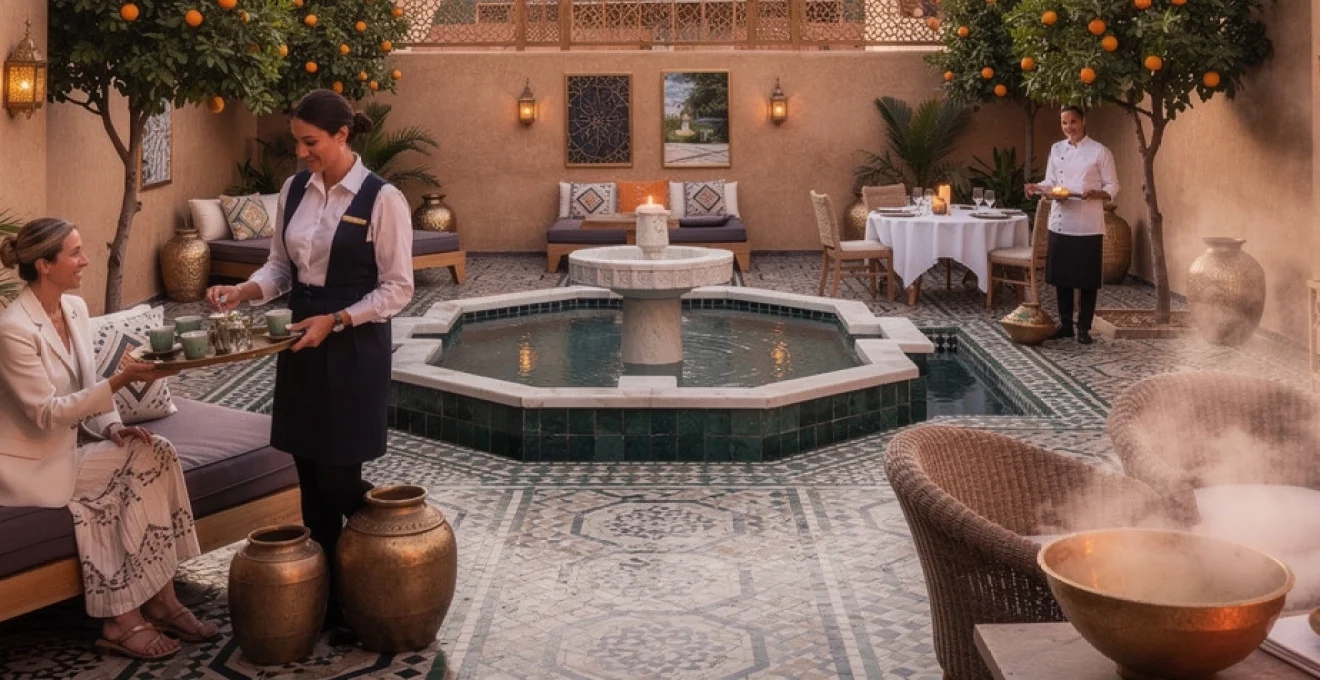
Marrakech’s luxury riads represent the pinnacle of traditional Moroccan hospitality, seamlessly blending centuries-old architectural mastery with contemporary five-star amenities. These former merchant palaces and aristocratic residences, transformed into exclusive boutique accommodations, offer discerning travellers an intimate glimpse into Morocco’s rich cultural heritage whilst delivering world-class comfort and service.
The city’s most prestigious riads showcase exceptional craftsmanship through intricate zellige tilework, hand-carved cedar ceilings, and serene courtyards adorned with marble fountains. Beyond their architectural splendour, these properties provide personalised experiences that standard hotels simply cannot match, from private cooking classes with renowned chefs to bespoke desert excursions tailored to individual preferences.
Modern luxury riads in Marrakech command attention not merely for their aesthetic appeal, but for their ability to transport guests into an authentic Moroccan narrative. Each property tells a unique story through carefully curated art collections, traditional hammam spa treatments, and rooftop dining experiences overlooking the bustling medina and distant Atlas Mountains.
Traditional riad architecture and authentic design elements in marrakech’s medina
The architectural foundation of Marrakech’s luxury riads stems from Islamic principles of privacy and family life, creating inward-facing sanctuaries that shield inhabitants from the bustling medina streets. These structures typically feature imposing exterior walls punctuated by modest doorways, concealing the opulent interiors that lie beyond. The contrast between the austere facades and lavishly decorated courtyards creates a sense of discovery that captivates guests from the moment they cross the threshold.
Authentic riad design prioritises natural climate control through strategic architectural elements. High ceilings promote air circulation, whilst thick walls provide insulation against Morocco’s temperature extremes. The central courtyard functions as a natural cooling system, drawing hot air upward and creating refreshing breezes throughout the property. This ingenious environmental design eliminates the need for intrusive modern air conditioning systems in many premium riads.
Andalusian-influenced courtyard layouts with central water features
The quintessential riad courtyard follows the chahar bagh garden concept, dividing the central space into four symmetrical sections representing the Islamic vision of paradise. Water features serve as both aesthetic focal points and functional cooling elements, with elaborate marble fountains creating soothing ambient sounds that mask the medina’s street noise. These courtyards often incorporate lush vegetation including orange trees, jasmine, and roses, creating aromatic oases that engage multiple senses simultaneously.
Premium riads elevate traditional courtyard design through contemporary interpretations that maintain authentic proportions whilst incorporating modern luxury elements. Swimming pools now frequently replace traditional fountains, maintaining the central water feature concept whilst providing recreational functionality. The surrounding galleries, supported by horseshoe arches and decorated columns, create intimate seating areas where guests can appreciate the interplay of light and shadow throughout the day.
Zellige tilework and tadelakt plasterwork craftsmanship standards
Authentic zellige tilework represents one of Morocco’s most refined decorative arts, requiring master craftsmen who spend years perfecting their technique. Each tile undergoes individual hand-cutting and glazing processes, resulting in subtle variations that create the characteristic shimmer effect when light reflects across zellige surfaces. Luxury riads source these tiles from Fez’s renowned workshops, where artisans maintain production methods unchanged for over a millennium.
The application of tadelakt plasterwork demands equally specialised expertise, involving multiple layers of lime plaster polished with smooth river stones and sealed with black soap made from olive oil. This technique produces waterproof surfaces with a distinctive lustrous finish, traditionally used in hammams and bathrooms. Contemporary luxury riads extend tadelakt applications to bedroom walls and common areas, creating sophisticated monochromatic palettes that complement more vibrant decorative elements.
Carved cedar wood mashrabiya screens and decorative elements
Mashrabiya screens serve dual purposes in traditional riad architecture, providing privacy whilst
mashrabiya screens serve dual purposes in traditional riad architecture, providing privacy whilst allowing controlled daylight and natural ventilation to filter into interior spaces. Hand-carved from fragrant Atlas cedar, these latticed wooden panels are often installed on upper-level balconies, window openings, and along staircases that overlook the central courtyard. Their intricate geometric patterns break up direct sunlight, casting ever-changing shadows that move across tadelakt walls and zellige floors like living works of art. In luxury riads in Marrakech, original mashrabiya pieces are frequently restored by specialist artisans or custom-made to match historic designs, ensuring that any contemporary interventions remain faithful to the building’s architectural DNA.
Beyond screens, carved cedar also appears in coffered ceilings, monumental entrance doors, and decorative cornices. Many of Marrakech’s top riads commission bespoke furniture—headboards, writing desks, and wardrobe doors—from the same workshops that supply royal palaces, maintaining an uncompromising level of craftsmanship. When you run your hand along a polished cedar balustrade or open an intricately carved door to your suite, you’re engaging with an artisanal tradition that has been passed down carefully from master to apprentice for generations.
Geometric islamic art patterns in interior design schemes
Geometric Islamic art forms the visual backbone of authentic riad interiors in Marrakech’s medina. Based on complex mathematical principles and repeating motifs, these patterns symbolise the infinite nature of creation while avoiding figurative representation. In luxury riads, you’ll find these designs expressed in every medium imaginable: from hand-painted zellige mosaics on courtyard floors and pool edges to delicately stencilled motifs on plaster friezes and carved details in cedar woodwork.
Rather than overwhelming the eye, well-executed geometric schemes balance restraint and richness. Many high-end riads pair one dominant motif—such as an eight-pointed star or interlocking arabesque—with a limited colour palette inspired by Marrakech’s natural surroundings: terracotta reds, palm greens, and the inky blues of dusk over the Atlas Mountains. This curated approach allows guests to appreciate the sophistication of Islamic geometry without feeling visually fatigued. For design-conscious travellers, spending a few nights in such a space is like living inside a pattern book, offering endless inspiration for your own interiors back home.
Premium riad accommodations: la mamounia and palais namaskar luxury standards
Whilst many riads in Marrakech are intimate, family-run properties, a select group of luxury addresses operate at the level of grand palace hotels. Icons such as La Mamounia and Palais Namaskar set the benchmark for service, design, and amenities, influencing how newer luxury riads define their own standards. These properties combine historic architecture with expansive grounds, state-of-the-art wellness facilities, and fine-dining restaurants that rival Europe’s best.
For travellers seeking the most luxurious riads in Marrakech, these flagship addresses provide a useful reference point. You can expect impeccably trained staff, highly personalised service, and meticulous attention to detail—from the thread count of your linens to the scent profile of the lobby. Even if you ultimately choose a smaller medina riad, understanding what La Mamounia and Palais Namaskar offer helps you evaluate whether a property truly delivers a five-star riad experience or simply borrows the terminology.
Royal mansour marrakech’s gold leaf detailing and bespoke furnishings
Commissioned by King Mohammed VI and constructed by hundreds of Morocco’s finest artisans, Royal Mansour Marrakech represents the pinnacle of riad-inspired luxury. Rather than a single building, the property is composed of a network of private three-storey riads connected by underground service corridors, allowing staff to move discreetly without disturbing guests. Step inside any of these riads and you’ll notice the lavish use of gold leaf detailing on plaster mouldings, coffered ceilings, and decorative columns, catching the light in a way that feels opulent yet never garish.
Every furnishing at Royal Mansour—from the hand-embroidered silk cushions to the sculpted bronze door handles—has been custom-designed for the property. Suites showcase a harmonious blend of traditional Moroccan craftsmanship and discreet contemporary comforts: underfloor heating, integrated sound systems, and marble-clad bathrooms with deep soaking tubs. If you’re benchmarking other luxury riads in Marrakech, ask whether they feature similarly bespoke furnishings and artisan-made details, or rely instead on off-the-shelf decor. This distinction often separates a pleasant stay from a truly world-class experience.
Villa des orangers’ rooftop terraces with atlas mountains panoramas
Nestled just outside the medina’s historic walls, Villa des Orangers is a Relais & Châteaux property that combines riad intimacy with resort-style amenities. One of its defining features is a series of expansive rooftop terraces, cleverly tiered to offer uninterrupted panoramas of the snow-capped Atlas Mountains and Koutoubia Mosque’s distinctive minaret. At sunrise and sunset, these terraces become some of the most atmospheric vantage points in Marrakech, perfect for a leisurely breakfast or an evening drink above the city’s hum.
Design-wise, Villa des Orangers softens traditional Moroccan elements with Mediterranean influences: terracotta pots overflowing with bougainvillea, sunloungers arranged around heated pools, and shaded pergolas that invite long afternoons with a book. For travellers weighing up different luxury riads in Marrakech, rooftop architecture is a crucial consideration. Does the property offer multiple levels and viewpoints, or just a simple flat roof? Are there shaded areas, plunge pools, and comfortable seating? In a city where much of daily life happens outdoors, the quality of your rooftop can dramatically shape your overall stay.
Riad farnatchi’s contemporary moroccan fusion design philosophy
Riad Farnatchi, tucked deep within the medina, illustrates how a luxury riad can honour tradition while embracing contemporary design. Rather than replicating historic interiors wholesale, its owners have adopted a fusion philosophy: classic zellige flooring and cedar ceilings coexist with sleek, low-slung sofas, modern lighting, and curated artwork that nods to both Moroccan and international influences. The result feels more like a private design-forward residence than a conventional hotel.
Suites at Riad Farnatchi are generously sized, often featuring separate lounges, private patios, and statement bathrooms with sculptural bathtubs and walk-in showers. Thoughtful touches—Molton Brown amenities, plush robes, and high-tech in-room entertainment—highlight the property’s commitment to modern comfort. If you’re drawn to Marrakech’s traditional riad architecture but prefer contemporary interiors, properties following Farnatchi’s design blueprint offer the best of both worlds: a sense of place without sacrificing your usual lifestyle expectations.
La sultana marrakech’s historical preservation and modern amenities integration
La Sultana Marrakech occupies a cluster of lovingly restored riads in the Kasbah district, an area steeped in royal and religious history. Instead of imposing a uniform design language, the hotel has preserved each riad’s unique character, resulting in a labyrinth of courtyards, hidden staircases, and intimate salons. Many original features—hand-painted ceilings, antique doors, and centuries-old stone columns—have been meticulously conserved, effectively turning the property into a living museum of Moroccan craftsmanship.
What makes La Sultana particularly impressive is how seamlessly it integrates modern amenities into this historic fabric. Heated outdoor pools, a fully equipped spa with modern hydrotherapy facilities, and in-room comforts such as climate control and high-speed Wi-Fi are all discreetly incorporated without visually disrupting the heritage architecture. As you compare luxury riads in Marrakech, pay attention to how each property manages this balance. Do modern interventions feel like respectful enhancements, or clumsy afterthoughts? At the top tier, you should never feel that convenience has come at the expense of character.
Exclusive amenities and hammam spa facilities in luxury riads
One of the defining advantages of staying in a luxury riad in Marrakech is access to exclusive amenities on an intimate scale. Unlike large chain hotels, where facilities can feel impersonal, riads typically limit guest numbers, ensuring spa areas, pools, and lounges never become overcrowded. High-end properties transform traditional hammam rituals into complete wellness journeys, often curated to your preferences after a brief consultation.
Expect dedicated spa suites with marble-clad hammam rooms, heated stone benches, and private treatment areas where therapists perform time-honoured rituals: black soap exfoliation, ghassoul clay wraps, and argan oil massages. Many of Marrakech’s best riads now incorporate wellness philosophies from around the world, offering yoga on the rooftop at sunrise, guided meditation, and signature treatments using locally sourced botanicals such as rose, orange blossom, and prickly pear seed. If a restorative escape is one of your goals, it’s worth asking in advance whether the hammam operates on a private or shared basis, how many treatment rooms are available, and whether appointments can be tailored outside standard hours.
Beyond spa facilities, top-tier riads often include heated plunge pools, library lounges, cigar rooms, and boutique shops showcasing designer caftans and artisanal homeware. Some properties even provide in-house tailors or jewellery designers, allowing you to commission custom pieces during your stay. These amenities may seem indulgent, but they’re part of what differentiates a truly luxurious riad experience from a more generic Marrakech hotel. By having everything at your fingertips, you’re free to slow down, disconnect from your usual routine, and fully immerse yourself in the rhythms of Moroccan life.
Michelin-standard dining experiences and traditional moroccan gastronomy
Culinary experiences are central to the appeal of luxury riads in Marrakech. Many properties operate at a standard comparable to Michelin-starred restaurants, even if they don’t hold formal stars due to location and classification criteria. Menus typically celebrate the depth of Moroccan gastronomy—slow-cooked tagines, fragrant couscous, and refined pastries—whilst incorporating contemporary presentation and international techniques. For food-focused travellers, choosing a riad with a serious kitchen can be as important as selecting the right suite.
Top luxury riads employ chefs trained in prestigious restaurants across Europe and the Middle East, who return to Moroccan classics with a fresh eye. You might encounter pigeon pastilla reimagined as delicate parcels, or a tasting menu that pairs seasonal vegetable mezzes with estate-bottled Moroccan wines from Meknès and the Atlas foothills. Crucially, most riads prioritise locally sourced ingredients: market-fresh produce from Jemaa el-Fnaa, herbs grown on their own rooftops, and olive oil pressed in nearby valleys. This focus on provenance doesn’t just enhance flavour; it supports regional farmers and keeps traditional agricultural practices alive.
Another advantage of dining in a riad versus a conventional restaurant is the degree of personalisation. Because guest numbers are limited, chefs can easily accommodate dietary preferences, design bespoke menus, or even adjust spice levels to your taste. Many luxury riads invite guests to choose where they’d like to dine each night—on the rooftop under the stars, beside the courtyard pool, or in a candlelit salon. It’s not uncommon for couples or small groups to enjoy an entire terrace to themselves, creating the atmosphere of a private dinner party rather than a public restaurant. If gastronomy is a key part of your travel plans, don’t hesitate to ask prospective riads for sample menus or details about their culinary philosophy before you book.
Personalised concierge services and authentic cultural immersion programmes
What truly sets the best luxury riads in Marrakech apart is not only their architecture or amenities, but the depth of their personalised concierge services. Because these properties typically host far fewer guests than conventional hotels, staff are able to build genuine relationships and anticipate your needs with remarkable accuracy. From arranging last-minute dinner reservations to sourcing rare antiques in the souks, a skilled riad concierge can turn logistical challenges into seamless experiences.
Increasingly, leading riads are developing structured cultural immersion programmes that go beyond standard sightseeing. Rather than offering generic city tours, they connect you with vetted local experts—art historians, calligraphers, chefs, and Berber guides—who open doors that most tourists never see. This might mean a private viewing of a contemporary art collection, a visit to an artisan’s workshop outside the medina, or tea with a local family in their village home. When evaluating luxury riads in Marrakech, ask what kind of cultural experiences are curated in-house versus outsourced; properties that invest in long-term relationships with local partners typically deliver the most authentic encounters.
Private souk tours with certified local artisan guides
Navigating Marrakech’s labyrinthine souks can be exhilarating—but also overwhelming—especially on your first visit. Many top-tier riads now offer private souk tours led by certified local guides with deep connections to the artisan community. Instead of being shepherded into touristy stalls, you’ll be introduced to workshop owners, weavers, metalworkers, and leather artisans who still craft goods using traditional techniques. This transforms shopping from a transactional experience into an educational journey through Morocco’s living heritage.
A good riad concierge will brief your guide on your interests in advance—be it textiles, ceramics, jewellery, or interior decor—so your tour is tailored rather than generic. You’ll learn how to distinguish handwoven rugs from machine-made copies, how natural dyes differ from synthetics, and what constitutes fair pricing in the local context. Think of your guide as both translator and cultural interpreter, helping you negotiate respectfully and avoid common pitfalls. For many guests, these curated souk experiences result in meaningful purchases that carry stories, not just souvenirs.
Atlas mountains day excursions and berber village experiences
The Atlas Mountains, visible from many Marrakech rooftops, are only a short drive from the city yet feel worlds apart. Luxury riads frequently organise private day excursions with trusted drivers and mountain guides, allowing you to explore terraced valleys, rushing rivers, and traditional Berber villages in comfort. It’s one thing to see the Atlas as a distant backdrop; it’s quite another to hike ancient mule paths, share mint tea with villagers, and hear first-hand how communities adapt to seasonal changes.
Depending on your fitness level and interests, your riad can arrange anything from gentle valley walks to more demanding treks, complete with picnic lunches prepared by the in-house chef. Some programmes include visits to weekly souks, argan oil cooperatives, or family-run pottery workshops where you can try your hand at the wheel. Travelling with children? Tailored itineraries with shorter walks, donkey rides, and interactive farm visits make the Atlas a memorable extension of your Marrakech riad stay.
Traditional moroccan cooking classes with celebrity chefs
For many travellers, the flavours of Marrakech linger long after they return home. To capture a piece of that culinary magic, consider booking a traditional Moroccan cooking class through your riad. High-end properties collaborate with renowned local chefs—some with international TV or cookbook credentials—who demystify classic recipes in a hands-on, accessible way. You might start your day by accompanying the chef to a nearby market, learning how to select the freshest produce and spices before returning to the riad’s kitchen.
Back on site, you’ll don an apron and learn step-by-step techniques: how to layer ingredients in a tagine so they cook evenly, how to achieve the perfect texture for preserved lemon and olive chicken, or how to fold delicate briouates pastries. Classes typically culminate in a leisurely meal where you enjoy the dishes you’ve prepared, often paired with Moroccan wines or freshly pressed juices. Beyond recipes, you’ll gain insight into culinary customs—such as the ritual of tea preparation or the significance of communal dining—that deepen your understanding of Moroccan hospitality.
Exclusive desert camp arrangements in erg chebbi dunes
While Marrakech is a destination in its own right, many luxury riads serve as gateways to more remote Moroccan landscapes, including the Sahara Desert. Some properties maintain partnerships with high-end camps in the Erg Chebbi dunes near Merzouga, allowing them to coordinate seamless multi-day excursions that begin and end at your riad’s doorstep. Imagine leaving the bustle of the medina in the morning and watching the sun set over rolling apricot-coloured dunes the same evening.
Exclusive desert experiences often include private 4×4 transfers, camel treks timed to coincide with golden hour, and overnight stays in tented suites equipped with proper beds, en-suite bathrooms, and fine linens. Evenings are spent around the campfire under an astonishing canopy of stars, with traditional gnawa music, storytelling, and refined Moroccan dinners served in candlelit tents. Because logistics can be complex, working through your riad ensures a higher standard of safety, comfort, and authenticity than booking ad hoc. If a desert extension is high on your wish list, confirm which camps your riad partners with and what level of exclusivity you can expect.
Location analysis: medina proximity versus modern gueliz district access
When choosing among luxury riads in Marrakech, location is one of the most strategic decisions you’ll make. Broadly speaking, properties fall into two categories: those nestled within or immediately around the historic medina, and those situated closer to the modern districts of Gueliz and Hivernage. Each option offers distinct advantages, and the right choice for you depends on how you like to explore a city. Do you want to step straight from your riad into the sensory overload of the souks, or would you prefer a quieter base with easier car access and wider streets?
Medina-based riads immerse you in the atmospheric heart of Marrakech. You’ll navigate narrow alleyways, hear the call to prayer echo between ochre walls, and have major sights—Jemaa el-Fnaa, Bahia Palace, the Ben Youssef Madrasa—within walking distance. However, reaching these properties often involves short walks from vehicle drop-off points, which can be challenging with heavy luggage or mobility limitations. Noise levels can also fluctuate, especially during peak seasons and local festivities. For many travellers, though, this proximity to daily life is precisely what makes a riad stay unforgettable.
In contrast, luxury riads and riad-style hotels in Gueliz, Hivernage, or the Palmeraie offer a more contemporary urban or resort feel. You’ll benefit from straightforward car access, wider boulevards, and proximity to modern restaurants, galleries, and shopping centres. Properties like Palais Namaskar or Nobu Hotel Marrakech provide expansive grounds, larger pools, and resort-style facilities that are difficult to replicate within the dense medina. If you’re planning frequent day trips, golfing, or late-night outings, basing yourself outside the old city can save time and reduce logistical friction.
Ultimately, many seasoned visitors to Marrakech choose a hybrid approach: splitting their stay between a medina riad and a property in Gueliz or the Palmeraie to experience both sides of the city. Whichever location you favour, ask specific questions before booking: How far is vehicle access from the front door? What are typical walking times to key sights? How does the riad manage luggage on arrival and departure? By aligning your riad’s location with your travel style, you’ll maximise both comfort and cultural immersion during your luxury escape in Marrakech.