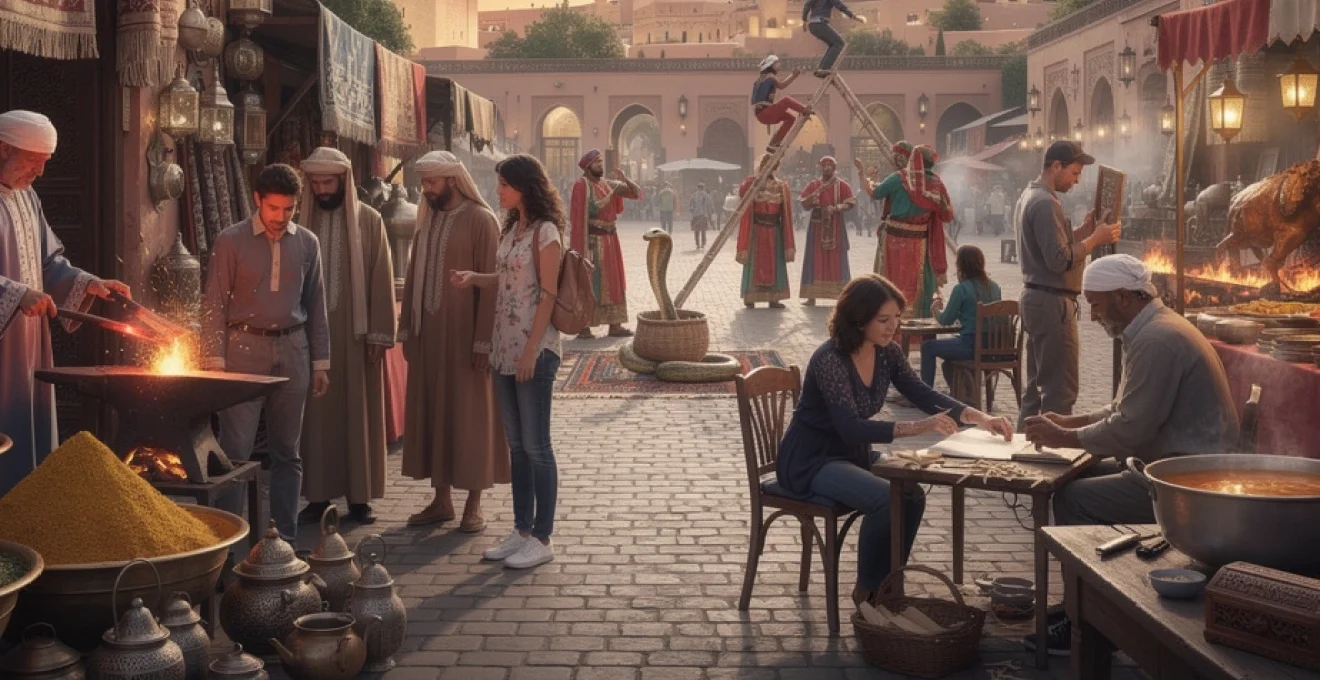
Marrakech stands as a living museum where centuries-old traditions pulse through narrow alleyways, historic monuments whisper stories of dynasties past, and the aroma of saffron and cumin drifts through vibrant market squares. This imperial city offers you an unparalleled opportunity to immerse yourself in authentic Moroccan culture, from the intricate craftsmanship of ancient artisan quarters to the hypnotic rhythms of Gnawa musicians performing under starlit skies. Whether you’re drawn to the architectural splendour of Saadian palaces, the sensory overload of traditional souks, or the spiritual tranquillity of centuries-old madrasas, Marrakech delivers cultural encounters that will fundamentally reshape your understanding of North African heritage. The Red City’s cultural tapestry is woven from Berber, Arab, Andalusian, and African influences, creating a distinctive identity that has captivated travellers, artists, and scholars for generations. Stepping into Marrakech means stepping into a world where time moves differently, where hospitality is sacred, and where every corner reveals another layer of Morocco’s rich cultural legacy.
Navigating the labyrinthine souks of the medina: artisan quarters and traditional markets
The medina of Marrakech, recognised as a UNESCO World Heritage site since 1985, represents one of the most extensive traditional market complexes in the entire Maghreb region. With over 1,000 years of continuous commercial activity, these covered marketplaces showcase the enduring vitality of Moroccan craftsmanship and trade traditions. The souk system divides into specialised quarters where particular crafts have been practised by successive generations of artisans, maintaining techniques that predate Morocco’s modern era. When you first enter this labyrinthine network of narrow passages, the sensory experience can feel overwhelming—the cacophony of metalworkers hammering copper, merchants calling out to passers-by, the visual riot of textiles hanging from wooden beams, and the penetrating fragrances of leather, incense, and spices all compete for your attention simultaneously.
Navigating these souks requires patience and a willingness to occasionally lose your bearings. The traditional layout intentionally confuses outsiders, a defensive design dating to medieval times when the maze-like structure protected merchants and residents from invaders. Today, this same configuration creates an atmosphere of discovery where you might stumble upon a hidden fondouk (caravanserai) or witness a master craftsman at work in a workshop unchanged for centuries. The best approach involves hiring a knowledgeable local guide for your first exploration, then returning independently once you’ve gained confidence with the medina’s geography and customs.
Souk semmarine and souk el-attarine: textile merchants and spice trade routes
Souk Semmarine functions as the medina’s primary commercial artery, stretching from the northern edge of Jemaa el-Fnaa square deep into the heart of the old city. This covered marketplace specialises in textiles, with merchants displaying everything from handwoven Berber blankets to intricately embroidered kaftans and contemporary fashion pieces. The architectural structure itself deserves attention—wooden latticed roofs filter natural light, creating dramatic patterns across the merchandise below whilst keeping the passage relatively cool even during summer’s peak heat. You’ll find yourself negotiating with vendors whose families have occupied the same stalls for multiple generations, their expertise in fabric quality, weaving techniques, and dye processes passed down through apprenticeships beginning in childhood.
Adjacent to the textile quarter, Souk el-Attarine enchants visitors with mountains of aromatic spices, medicinal herbs, and natural cosmetics. The word “attarine” derives from the Arabic term for perfume sellers, and these merchants have supplied Marrakech’s residents with essential ingredients for traditional remedies, cooking, and beauty treatments for centuries. Here you can purchase saffron harvested from Taliouine, ras el hanout spice blends containing up to 30 different ingredients, argan oil pressed from nuts gathered by women’s cooperatives in the Atlas foothills, and rose water distilled in the Dadès Valley. The merchants possess encyclopaedic knowledge about each product’s properties and applications, often sharing recipes and usage
applications with surprising generosity.
As you wander between these textile and spice souks, remember that bargaining is not merely a commercial tactic but a cultural ritual. Negotiation reflects centuries-old trade customs along historic caravan routes linking Marrakech to Timbuktu and beyond. Approach haggling with humour and patience, offering around half the initial price and meeting somewhere in the middle. You are not only purchasing goods; you are participating in a living tradition that has shaped Marrakech’s economic and social fabric for generations.
Souk haddadine: blacksmith craftsmanship and metalwork traditions
Venturing deeper into the medina, you will eventually hear the steady rhythm of hammer on metal that signals your arrival at Souk Haddadine, the traditional blacksmiths’ quarter. Here, narrow alleys open into semi-covered workshops where artisans forge everything from delicate lanterns and teapots to heavy door knockers and elaborate lock systems. Many of these craftsmen belong to families who have occupied the same premises for decades, maintaining techniques that date back to the Almoravid and Almohad periods.
Observing these metalworkers at close range reveals just how labour-intensive handcrafted Moroccan décor can be. Sheets of brass and copper are cut, heated over charcoal fires, and then painstakingly hammered into shape, with patterns etched by hand rather than machine. When you see an intricately pierced lamp casting lace-like shadows on a riad wall, chances are it began life in a place like Souk Haddadine. If you are considering purchasing metalwork, ask about the material quality—solid brass or copper will age gracefully, whereas cheaper alloys may tarnish or warp more quickly.
From a cultural perspective, the blacksmith’s role in Marrakech extends beyond decorative items. Historically, these artisans supplied essential tools for farmers, builders, and caravan traders, forging everything from horseshoes to cooking pots. Their work underpinned daily life in a way modern visitors rarely consider, much like how electricity silently powers our contemporary routines. Taking time to appreciate their skill helps you understand how traditional crafts still support the city’s economy even as tourism and modern industries expand.
Souk cherratine: leatherworking techniques at the tanneries district
North of the medina’s central arteries lies Souk Cherratine, historically associated with leatherworkers and located near Marrakech’s tanneries. The smell of curing hides and natural dyes may reach you before the visual spectacle does, as stacks of leather in ochre, indigo, and forest green shades line the shopfronts. Here you will find finely crafted babouches (slippers), satchels, belts, and ottomans, many of which originate from hides processed in the nearby tanning pits.
Traditional Moroccan tanning combines ancestral techniques with natural materials such as lime, pigeon droppings, and vegetable dyes derived from henna, saffron, and poppy flowers. While the process can appear harsh to modern eyes, it represents an unbroken chain of knowledge stretching back centuries. If you choose to visit the tanneries, be prepared for a strong odour and uneven walking surfaces, and consider going with a licensed guide who can navigate touts and explain what you are seeing in context. A sprig of fresh mint, often offered at the entrance, can help soften the sensory impact.
When purchasing leather goods in Souk Cherratine, examine the stitching and thickness of the material, and do not hesitate to ask which tannery produced the item. Higher-quality leather should feel supple yet substantial, with a consistent dye. Haggling remains customary, but remember that well-made artisanal pieces often justify a higher price. In supporting ethical leatherworkers, you contribute to preserving skills that might otherwise be replaced by mass-produced imports, much as buying from a local farmer supports regional agriculture back home.
Souk nejjarine: woodcarving workshops and cedar artisanship
Tucked away in another corner of the medina, Souk Nejjarine focuses on woodworking and carpentry, particularly the use of fragrant cedar and walnut. Here, workshops open directly onto the alleys, allowing you to observe artisans carving intricate arabesque motifs, geometric patterns, and calligraphic scripts into doors, chests, and furniture. The scent of freshly cut wood mingles with sawdust in the air, creating a sensory contrast to the metallic clang of Souk Haddadine or the pungent smells of the tanneries.
Moroccan woodcarving plays a crucial role in Islamic architectural decoration, from elaborately carved ceilings and mashrabiya screens to ornate doors that guard riad entrances. Craftsmen in Souk Nejjarine often work on commissions for luxury hotels and restoration projects as well as small decorative objects for travellers. If you are drawn to these pieces, consider portable items like jewellery boxes, frames, or small stools that showcase the same artistry as larger works without complicating your luggage.
As with other artisan quarters in Marrakech, visiting Souk Nejjarine offers more than an opportunity to shop. It invites you to reflect on the value of manual skill in an increasingly digital world. Watching a carver patiently chip away at a single panel for hours on end is a powerful reminder that what appears effortless in Moroccan design is the result of time, dedication, and intergenerational teaching. You may leave with a carved keepsake, but you will also carry a deeper appreciation for the craftsmanship embedded in the city’s architectural heritage.
Architectural splendour of bahia palace and el badi palace: saadian dynasty heritage
Beyond the bustling medina souks, Marrakech’s palaces illustrate how political power and artistic ambition converged during the Saadian and later dynasties. Visiting these complexes allows you to step into the world of viziers, sultans, and royal households who commissioned artisans from across Morocco and Andalusia. The contrast between the preserved opulence of Bahia Palace and the haunting ruins of El Badi tells a compelling story about ambition, decline, and the cycles of history. For travellers interested in Moroccan architecture, these sites offer some of the most rewarding cultural experiences in Marrakech.
Bahia palace: zellige tilework and andalusian-moorish design elements
Constructed in the late 19th century for Grand Vizier Si Moussa and later expanded by his son Ba Ahmed, Bahia Palace epitomises the fusion of Moroccan and Andalusian-Moorish aesthetics. Its name, meaning “brilliance,” feels apt as soon as you enter the sunlit courtyards framed by white walls, delicate stucco work, and carved cedar ceilings. The palace complex sprawls across approximately eight hectares, with an intricate layout of intimate salons, lush riad gardens, and private quarters that once housed the vizier’s wives and concubines.
What captivates many visitors is the extraordinary zellige tilework that carpets floors and dados throughout the palace. These hand-cut geometric mosaics, composed of individually chiselled tiles, form starbursts, interlocking polygons, and complex patterns that appear almost mathematical in their precision. Walking through Bahia Palace can feel like moving through a three-dimensional geometry textbook, where every line and curve carries symbolic weight rooted in Islamic art’s aniconic traditions. To fully appreciate the workmanship, pause to examine corners and thresholds where patterns must align perfectly despite architectural irregularities.
As you explore, notice how the architecture choreographs movement using light, shade, and changes in scale. Grand courtyards give way to narrow passageways and low doorways that suddenly open into high-ceilinged reception halls. This spatial sequencing was not accidental; it reflected social hierarchies and privacy rules within elite Moroccan households. Visiting early in the morning typically offers a quieter experience, allowing you to photograph details before tour groups arrive and to absorb the atmosphere at your own pace.
El badi palace ruins: sunken gardens and the koutoubia minbar exhibition
In stark contrast to the well-preserved Bahia, El Badi Palace survives as an evocative ruin that sparks the imagination. Commissioned by Sultan Ahmed al-Mansur of the Saadian dynasty in the late 16th century, the palace was once adorned with Italian marble, Indian onyx, and gold leaf financed by the spoils of the Battle of the Three Kings and the trans-Saharan trade. Contemporary accounts describe it as one of the most magnificent palaces in the Islamic world, yet today only its vast footprint, sunken gardens, and fragmented walls remain.
The palace’s central courtyard, measuring roughly 135 by 110 metres, features large sunken gardens surrounding a central water basin, reflecting the importance of water as a symbol of paradise in Islamic architecture. Storks often nest atop the crumbling ramparts, adding an almost cinematic drama to the skyline. Climbing the remaining walls rewards you with panoramic views over the medina rooftops and the nearby Koutoubia Mosque, especially atmospheric at sunset when the city glows in warm terracotta hues.
One of El Badi’s most significant cultural attractions is the exhibition housing the original minbar (pulpit) of the Koutoubia Mosque, a masterpiece of 12th-century Almoravid woodwork. Crafted in Cordoba and assembled in Marrakech, this minbar showcases intricate marquetry, Kufic calligraphy, and carved decoration that demonstrate the high level of artistic exchange between Al-Andalus and the Maghreb. Seeing it up close offers a rare opportunity to appreciate details that would be invisible from a distance in its original liturgical context.
Dar si said museum: berber jewellery collections and atlas mountain artefacts
Located in a former 19th-century mansion, the Dar Si Said Museum (also known as the Museum of Moroccan Arts) provides another lens into Marrakech’s cultural heritage, focusing particularly on Berber and rural traditions. The building itself rivals many palaces, with carved wooden ceilings, stucco friezes, and zellige panels framing exhibition rooms. Whereas Bahia and El Badi highlight elite urban culture, Dar Si Said shifts attention to the material culture of the Atlas Mountains and surrounding regions.
Among the museum’s most compelling displays is its collection of Amazigh (Berber) jewellery, featuring heavy silver necklaces, fibulae, and headpieces inlaid with coral, amber, and coloured glass. These pieces were not merely decorative; they functioned as portable wealth, social status markers, and talismans believed to ward off misfortune. As you move through the galleries, you will also encounter traditional carpets, wooden doors, and everyday tools that reveal how rural communities adapted artistry to practical needs.
Visiting Dar Si Said can help you contextualise many of the items you see for sale in Marrakech’s souks. Instead of viewing a silver pendant or woven rug as a simple souvenir, you begin to understand the symbolic language and regional variations embedded in their designs. The museum is typically less crowded than the main palaces, offering a calmer environment to absorb information, reflect on what you have seen elsewhere in the city, and perhaps reconsider which crafts you choose to support during your stay.
Jemaa el-fnaa square: unesco intangible cultural heritage and street performance traditions
At the heart of Marrakech’s medina lies Jemaa el-Fnaa, a vast public square whose cultural significance extends far beyond its physical boundaries. Recognised by UNESCO in 2001 as a masterpiece of the Oral and Intangible Heritage of Humanity, Jemaa el-Fnaa functions as an open-air theatre where storytelling, music, food, and trade converge daily. From late afternoon until well into the night, the square transforms into a living stage that encapsulates many of the top cultural experiences to enjoy in Marrakech.
Halqa storytelling circles and gnawa music ensembles
One of Jemaa el-Fnaa’s most distinctive traditions is the halqa, a storytelling circle in which a performer stands at the centre surrounded by an audience. Historically, these storytellers preserved local legends, moral tales, and historical narratives in communities where literacy rates were low. Although the number of traditional storytellers has declined in recent decades, you can still occasionally witness these performances, often conducted in Moroccan Arabic or Amazigh, sometimes with a translator or guide providing summaries.
Interwoven with the storytellers are Gnawa music ensembles whose hypnotic rhythms and chants trace their roots to sub-Saharan African communities brought to Morocco centuries ago. Using the guembri (a three-stringed lute), metal castanets called krakeb, and call-and-response vocals, Gnawa musicians create a trance-like atmosphere that can feel almost otherworldly. Standing in the circle of listeners, you may feel the music reverberate through your chest, blurring the line between audience and participant. If you are curious, do you step closer to follow the beat or linger at the fringes observing from afar?
Supporting these performers with small tips is both customary and appreciated, as many rely on audience generosity rather than fixed fees. When taking photos or videos, it is respectful to ask permission or contribute financially, since you are effectively capturing part of their livelihood. In doing so, you help sustain living traditions that might otherwise fade under pressure from modern entertainment forms and changing tourist expectations.
Traditional acrobatic troupes and snake charmer performances
Elsewhere on the square, acrobatic troupes and snake charmers provide some of Jemaa el-Fnaa’s most visually striking—and sometimes controversial—spectacles. Acrobats, often hailing from rural communities, perform human pyramids, flips, and balancing acts that showcase physical discipline passed down through family lines. Their shows draw spontaneous circles of onlookers, with children in particular captivated by the feats of strength and agility.
Snake charmers, on the other hand, create a scene that many visitors associate instinctively with Marrakech: cobras and other snakes coiled in baskets, lifted and displayed to the sound of flutes and drums. While this tradition has deep roots, modern travellers may feel conflicted about animal welfare concerns. If you choose to watch, maintain a respectful distance, never touch the animals, and be aware that unsolicited photos often result in insistent payment requests. It is perfectly acceptable to decide that this is one aspect of the square you observe briefly before moving on.
These performances highlight a broader question that often arises when navigating cultural experiences in Marrakech: how do we balance curiosity with ethical considerations? Much like attending a circus or zoo back home, the decision is personal, but being informed and deliberate helps ensure your choices align with your values while still acknowledging the historical context of these practices.
Henna artists and calligraphy masters: temporary body art practices
Another layer of artistic expression on Jemaa el-Fnaa comes from henna artists and calligraphers who offer temporary body art. Henna, made from the powdered leaves of the henna plant, has been used for centuries to adorn hands and feet during weddings, religious festivals, and other celebrations. In the square, women (and occasionally men) skilfully apply intricate designs that can last from one to three weeks, providing a tangible, if temporary, connection to Moroccan decorative traditions.
When choosing a henna artist, prioritise those using natural brown or reddish henna rather than “black henna,” which may contain chemicals that can cause skin irritation or allergic reactions. Do not hesitate to ask what ingredients are in the paste and to request to see examples of previous work. Prices should be agreed upon beforehand, and it is wise to carry small change to avoid disputes. Think of the process as commissioning a miniature work of art that you will carry with you long after leaving the square.
Calligraphy masters, meanwhile, create personalised artworks featuring your name or meaningful phrases rendered in elegant Arabic script. Watching them draw fluid lines with reed pens and ink is akin to observing a live painting demonstration. Purchasing a small piece of calligraphy can be an excellent way to bring home a culturally rich souvenir that is lightweight yet deeply symbolic, especially if you take time to learn the meaning of the chosen words.
Evening food stalls: harira soup vendors and mechoui lamb preparation
As daylight fades, Jemaa el-Fnaa undergoes one of its most dramatic transformations when dozens of food stalls materialise almost magically in the central area. Under clouds of steam and smoke, vendors set up temporary kitchens offering a vast array of Moroccan dishes, from grilled brochettes and couscous to seafood and vegetarian options. For many visitors, dining at these communal tables ranks among the top cultural experiences to enjoy in Marrakech, offering a chance to eat shoulder-to-shoulder with locals and travellers alike.
Two specialities to seek out are harira and mechoui. Harira, a hearty soup made from tomatoes, lentils, chickpeas, and herbs, often enriched with lamb and vermicelli, is traditionally consumed to break the fast during Ramadan but appears year-round in the square. Served with dates and chebakia (sesame pastries), it offers a comforting, home-style taste of Moroccan cooking. Mechoui, on the other hand, consists of whole lamb slow-roasted in underground ovens or large pits until the meat becomes fall-off-the-bone tender, seasoned with cumin and salt. Watching vendors pull apart the lamb and serve it on communal platters can feel almost ritualistic.
To navigate the food stalls confidently, look for busy stands frequented by local diners, which is often a reliable indicator of quality and hygiene. Prices should be clearly displayed, and it is perfectly acceptable to ask about ingredients if you have dietary restrictions. While the atmosphere can be intense—think smoke, noise, and enthusiastic touts—embracing the organised chaos is part of the experience. If you ever wondered what a medieval feast might have felt like, Jemaa el-Fnaa at night offers a contemporary approximation.
Islamic architectural monuments: koutoubia mosque and ben youssef madrasa
Marrakech’s skyline and urban fabric are profoundly shaped by its Islamic architectural heritage, with mosques and madrasas serving both spiritual and educational roles. While non-Muslims cannot enter most prayer halls, including the interior of the Koutoubia Mosque, you can still appreciate these monuments from the outside or within their courtyards and associated museums. Exploring them deepens your understanding of how religion, politics, and artistry intertwine in Moroccan society.
Koutoubia minaret: almohad architecture and call to prayer traditions
The Koutoubia Mosque, constructed in the 12th century under the Almohad dynasty, stands as Marrakech’s most iconic religious structure. Its 77-metre-high minaret, visible from much of the city, served as a prototype for later towers such as the Giralda in Seville and the Hassan Tower in Rabat. Clad in sandstone with subtle decorative bands of carved stone and ceramic inlay, the minaret exemplifies the Almohad preference for monumental yet restrained design.
Five times a day, the muezzin’s call to prayer resonates from loudspeakers atop the minaret, structuring daily life much as church bells once did in European towns. Even if you are not participating in the prayers, pausing to listen offers a moment of reflection and connection to the city’s spiritual rhythm. Surrounding the mosque, landscaped gardens and open plazas provide a peaceful vantage point to admire the tower, particularly striking when illuminated at night or framed against the snow-capped High Atlas on a clear winter day.
Historically, the Koutoubia area housed book markets—hence its name derived from kutubiyyin, or booksellers—highlighting the link between religious institutions and scholarship. Today, you might not see rows of manuscripts for sale, but the tradition of valuing knowledge persists in Marrakech’s universities and cultural centres. When photographing the mosque, remember to be respectful of worshippers, especially around Friday midday prayers when attendance is highest.
Ben youssef madrasa: quranic school layout and stucco ornamentation
Ben Youssef Madrasa, originally founded in the 14th century and rebuilt in the 16th by the Saadians, functioned for centuries as one of North Africa’s largest Quranic colleges. Its recent restoration has returned it to its former glory, allowing visitors to explore both the central courtyard and the warren of student cells arranged around multiple floors. Entering the madrasa feels like stepping into an architectural textbook on Islamic decorative arts.
The main courtyard showcases a harmonious blend of carved cedar, stucco, and zellige, with inscriptions praising knowledge and faith running along the walls. A shallow reflecting pool anchors the space, mirroring the surrounding arcades and emphasising the Islamic garden ideal of paradise as a lush, water-filled haven. Intricate stucco panels feature geometric patterns and vegetal motifs so detailed that they resemble lace carved into stone. Standing in this courtyard, you might find yourself wondering how many students over the centuries memorised Quranic verses within these walls.
Upstairs, small, sparsely furnished rooms give insight into the daily life of students who may have travelled from distant regions to study theology, law, and science. Peering into these cells offers a poignant contrast to the decorative richness of the communal spaces, underscoring the values of humility and discipline central to traditional Islamic education. To avoid crowds and fully appreciate the play of light and shadow across the ornament, plan your visit early in the morning or late in the afternoon.
Saadian tombs: dynasty mausoleums and marble colonnade structures
Hidden for centuries behind the walls of the Kasbah Mosque and rediscovered in 1917, the Saadian Tombs constitute one of Marrakech’s most atmospheric historical sites. This necropolis houses the remains of Sultan Ahmed al-Mansur and his family, along with high-ranking officials of the Saadian court. Entering the complex, you follow narrow passages that suddenly open onto gardens and mausoleums decorated with an astonishing level of craftsmanship.
The highlight is the Hall of the Twelve Columns, where white Italian marble pillars support a cedarwood ceiling carved and painted with elaborate motifs. The tombs themselves are inlaid with colourful zellige and inscribed with Quranic verses and epitaphs that testify to the deceased’s status and piety. Despite being a place of burial, the space feels more contemplative than sombre, inviting visitors to reflect on the Saadians’ legacy and the transience of worldly power. After all, a dynasty once strong enough to commission El Badi Palace ultimately left behind only these silent monuments.
Because the site is relatively compact, it can become crowded during peak hours, and queues may form at viewpoints overlooking the most famous tomb chambers. Patience pays off, however, as standing quietly for a few minutes allows you to appreciate fine details—such as the subtle variations in marble veining or the precise alignment of tiles—that a hurried visit might miss. Respectful behaviour is essential, as this remains a burial ground and a site of spiritual significance for many Moroccans.
Jardin majorelle and menara gardens: botanical collections and berber museum
For moments of calm amidst Marrakech’s intensity, the city’s gardens offer both aesthetic pleasure and cultural insight. They reveal how Moroccans have historically managed water, shade, and plant life in an often harsh climate, transforming functional irrigation systems into spaces of contemplation and beauty. Two of the most emblematic green spaces are Jardin Majorelle and the Menara Gardens, each reflecting different eras and design philosophies.
Jardin Majorelle, designed in the 1920s and 1930s by French painter Jacques Majorelle and later restored by Yves Saint Laurent and Pierre Bergé, blends Art Deco architecture with a remarkable botanical collection. Paths wind between towering cacti, bamboo groves, and exotic species from five continents, all set against walls painted in the famous “Majorelle blue,” an intense cobalt shade that seems to vibrate under the Moroccan sun. Walking here feels almost cinematic, as though you have stepped into a carefully composed painting where every plant and colour block has been deliberately placed.
Within the garden complex, the Berber Museum presents artefacts from Amazigh communities across Morocco, including jewellery, textiles, weapons, and ritual objects. Carefully curated displays highlight the cultural diversity of Berber groups and challenge simplified stereotypes about Moroccan identity. Audio-visual materials and clear labelling (often in multiple languages) make the museum accessible even if you are new to the subject, providing a valuable counterpoint to the more Arab-Andalusian focus of many other monuments. Purchasing tickets in advance and arriving early is advisable, as Jardin Majorelle’s popularity often results in long queues.
On the western edge of the city, the Menara Gardens offer a different kind of experience centred on water management and agricultural planning. Established in the 12th century by the Almohads, the site consists of a large rectangular basin fed by an ingenious system of underground channels that once irrigated surrounding olive groves. A pavilion with a green-tiled roof overlooks the reservoir, creating a classic postcard view of Marrakech, especially when the High Atlas peaks are visible in the distance.
Locals often visit Menara for picnics, strolls, and family outings, making it an ideal place to observe everyday life away from tourist-heavy zones. You might see children feeding fish in the basin, couples posing for wedding photos, or elders chatting in the shade of century-old olive trees. While the botanical diversity is less dramatic than at Jardin Majorelle, the sense of space and tranquillity is unmatched, particularly at sunset when the water mirrors the changing colours of the sky. If you are seeking a cultural experience that combines history, landscape, and social observation, an afternoon at Menara provides all three.
Hammam rituals and traditional moroccan spa ceremonies: gommage exfoliation and ghassoul clay treatments
No exploration of Marrakech’s cultural landscape is complete without delving into the world of the traditional hammam, or public bathhouse. For centuries, hammams have played a central role in Moroccan social and religious life, serving as places for purification, relaxation, and community bonding. While modern spas now offer luxury interpretations, the underlying rituals remain rooted in the same principles: cleansing the body, calming the mind, and preparing for prayer or special occasions.
A typical hammam experience unfolds in stages, starting with acclimatising your body to steam-filled rooms of increasing temperature. Once your pores open, an attendant (or you, if you prefer a more private approach) applies black soap made from olive paste and eucalyptus. After allowing the soap to work, comes the famous gommage—a vigorous exfoliation performed with a coarse kessa glove that removes layers of dead skin. The sensation can be intense but leaves you feeling astonishingly light, as though you have shed not just physical but also mental fatigue, much like rebooting a computer to clear accumulated “cache.”
Following exfoliation, many hammams incorporate ghassoul treatments, using a mineral-rich clay sourced from the Atlas Mountains. Mixed with water and sometimes infused with rose or orange blossom, ghassoul is applied as a body and hair mask to absorb impurities and mineralise the skin. Rinsing it off under warm water provides a tactile reminder of Morocco’s deep connection to its natural resources, from mountain clays and desert plants to coastal argan groves. Some establishments add finishing touches such as argan oil massages or scalp treatments, blending tradition with contemporary wellness trends.
When choosing a hammam in Marrakech, you can opt for a neighbourhood public bath—offering the most authentic and affordable experience—or a higher-end spa geared towards visitors, where staff often speak multiple languages and provide more privacy. In both cases, modesty and etiquette matter: bring or request disposable underwear, respect gender-segregated spaces and times, and be prepared for a level of physical contact that may differ from Western spa norms. If you are unsure what to expect, do not hesitate to ask questions at reception; staff are accustomed to guiding first-time visitors.
For many travellers, the hammam becomes a highlight of their stay, not just as a relaxing interlude but as a window into Moroccan conceptions of cleanliness, community, and self-care. Emerging from the steam, skin renewed and mind slowed, you may find that the city’s noise feels different—less overwhelming, more rhythmic—much as a well-tuned instrument suddenly makes sense within an orchestra. In a destination as intense as Marrakech, embracing this ritual can be one of the most restorative and culturally immersive choices you make.