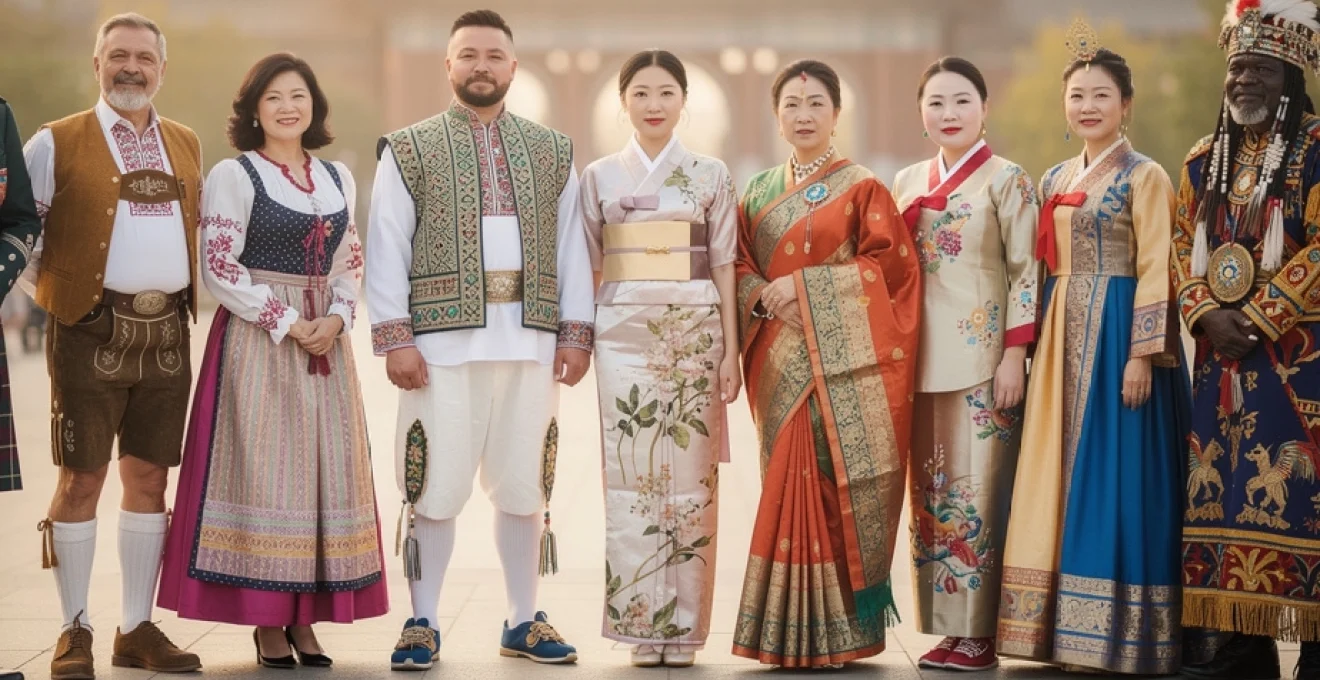
Traditional clothing serves as one of humanity’s most powerful forms of cultural expression, weaving together threads of history, identity, and artistic heritage into garments that transcend mere fashion. From the intricate beadwork of Maasai warriors to the flowing silk of Japanese kimono, these time-honoured vestments carry profound meaning that extends far beyond their aesthetic appeal. Each stitch, colour choice, and pattern holds significance that has been carefully preserved and passed down through generations, creating a rich tapestry of global cultural identity.
The significance of traditional dress becomes particularly evident during ceremonial occasions, where clothing transforms into a visual language that communicates status, spirituality, and belonging. Whether it’s the tartan patterns of Scottish Highland dress indicating clan allegiance or the seasonal motifs adorning a bride’s Indian saree, these garments serve as cultural ambassadors that bridge the past with the present. As globalisation continues to reshape our world, traditional clothing remains a steadfast symbol of cultural authenticity and regional pride.
Cultural significance and symbolic elements in traditional garments
Traditional dress functions as a complex communication system where every element carries specific cultural meaning. The symbolic language embedded within these garments often requires years of cultural knowledge to fully appreciate and understand. Colours, patterns, materials, and construction methods all work together to create a comprehensive narrative about the wearer’s identity, social position, and cultural affiliations.
The power of traditional clothing lies in its ability to instantly convey information about cultural heritage and personal identity. When someone dons their ancestral dress, they become a living representation of their cultural history, embodying centuries of artistic evolution and cultural preservation. This visual storytelling aspect makes traditional garments particularly valuable in maintaining cultural continuity across generations.
Ceremonial functions of indigenous dress codes
Indigenous communities worldwide have developed sophisticated dress codes that govern ceremonial attire, with each garment serving specific ritualistic purposes. Native American regalia, for instance, incorporates sacred elements like eagle feathers, turquoise stones, and specific colour combinations that hold deep spiritual significance. The Plains tribes’ elaborate headdresses aren’t merely decorative; each feather represents a specific deed or honour earned by the wearer.
These ceremonial dress codes often require years of preparation and cultural education to execute properly. The Maasai of East Africa create intricate beadwork patterns that indicate age groups, marital status, and social position within the community. Young Maasai warriors wear specific colour combinations during initiation ceremonies, with red symbolising bravery and blood, white representing purity and milk, and blue connecting the wearer to the divine sky.
The temporal aspect of ceremonial dress adds another layer of complexity to these traditions. Many indigenous cultures have specific garments reserved for particular seasons, moon phases, or agricultural cycles. The Pueblo peoples of the American Southwest create distinct ceremonial attire for corn planting seasons, rain ceremonies, and harvest festivals, with each outfit incorporating elements that honour the natural world and ancestral spirits.
Religious iconography embedded in textile patterns
Religious symbolism permeates traditional clothing across cultures, with sacred iconography woven directly into fabric patterns and garment construction. Byzantine religious robes feature intricate golden threads forming crosses and religious scenes, whilst Hindu temple clothing incorporates sacred geometry and divine symbols like the lotus flower and om symbol. These religious elements aren’t decorative afterthoughts but integral components of the garment’s spiritual function.
Islamic calligraphy appears on traditional Middle Eastern garments, with Quranic verses carefully embroidered onto ceremonial robes and wedding attire. The keffiyeh worn across the Middle East incorporates geometric patterns that reflect Islamic artistic traditions whilst serving practical purposes in desert climates. Buddhist monks’ robes follow specific colour codes mandated by religious texts, with saffron, maroon, and grey representing different stages of spiritual development.
Christian iconography manifests differently across various European traditional costumes. Romanian ie shirts feature protective crosses embroidered at stress points, believed to ward off evil spirits and provide divine protection. Portuguese lavradeiras incorporate religious medals and sacred heart imagery into their festival attire, creating a visual connection between earthly celebrations and divine blessing.
Social hierarchy representation through fabric selection
Across many cultures, laws or customary rules once dictated which fabrics, colours, or adornments different social groups could wear. In premodern China, for example, only emperors and high-ranking officials were permitted to wear bright yellow silk dragon robes, while commoners were restricted to simpler weaves and darker tones. In medieval Europe, “sumptuary laws” regulated the use of luxury fabrics such as velvet, ermine, and gold thread, making clothing a visible marker of class and privilege. Even today, subtle differences in material quality, handwork, and embellishment continue to signal status, particularly in formal and ceremonial traditional dress.
Fabric selection also reveals access to trade networks and economic power. Kente cloth in Ghana, once reserved for Ashanti and Ewe royalty, required access to silk and imported dyes, making it a powerful symbol of wealth and prestige. In India, finely woven Banarasi brocades and Kanchipuram silks are still associated with weddings and high-status events, their metallic zari threads indicating prosperity. When we look closely at these garments, we are not just seeing style choices; we are reading a social code that tells us who holds authority, who has spiritual responsibilities, and who is marking a major life transition.
Regional identity markers in traditional costume design
Traditional costumes often act like visual maps, encoding the wearer’s regional identity through specific cuts, motifs, and colour combinations. The Scottish tartan system is a clear example: each clan or district historically developed its own pattern, allowing people to identify where someone came from at a glance. Similarly, in Mexico and Guatemala, the embroidered designs on a woman’s huipil can indicate her village, marital status, and even religious affiliation. These regional identity markers turn clothing into a living archive of local history and geography.
In Europe, regional folk costumes such as the Norwegian bunad or the French Breton coiffe use embroidery, jewelry, and distinctive headdresses to distinguish one valley or town from the next. In Asia, slight differences in how a sari is draped in Maharashtra versus West Bengal, or the patterns on a Vietnamese non la (conical hat), serve a similar purpose. For travellers and cultural researchers alike, learning to recognise these details is like learning a new alphabet: once you understand the “letters” of cut, colour, and motif, you start to read the complex story of place and belonging woven into every outfit.
European traditional dress heritage and regional variations
Europe’s traditional dress heritage reflects centuries of local craftsmanship, political change, and regional pride. Far from being static museum pieces, these garments have evolved with shifting borders, industrialisation, and modern tourism, yet they still carry deep symbolic weight. From the windswept Highlands of Scotland to the mountain villages of Bavaria and the Mediterranean shores of Greece, European folk costumes show how clothing can embody shared memory and community identity.
Many European traditional costumes experienced a revival in the nineteenth and early twentieth centuries, when nationalist movements looked to rural dress as a pure expression of “folk” culture. That revival continues today in festivals, national holidays, and heritage events, where traditional garments are worn with pride. As we explore some of the most recognisable examples, you’ll notice a common thread: each piece of clothing functions as both everyday wear of the past and a ceremonial emblem of identity in the present.
Scottish highland dress: tartan clan systems and kilt construction
Scottish Highland dress is one of the most globally recognised forms of traditional clothing, yet its details are often misunderstood. At its heart lies the tartan, a woven pattern of coloured stripes arranged in a grid, historically linked to clans, regions, or military regiments. While not every tartan is ancient—many were codified in the nineteenth century—the idea that each design represents a distinct community remains powerful. Wearing a specific tartan is a way of signalling ancestry and allegiance, even for members of the Scottish diaspora around the world.
The kilt itself has evolved from the earlier “great kilt”, a large length of woollen cloth that could be draped, pleated, or used as a cloak depending on the weather. Modern kilts are tailored garments with permanent pleats stitched at the back and a flat front apron, usually made from worsted wool for durability and sharp definition. Accessories such as the sporran (a leather or fur pouch), sgian-dubh (small knife), and decorative belt buckles add both practicality and symbolism, turning Highland dress into a complete system of identity and function.
Today, Highland dress appears at weddings, Highland games, and formal events rather than as daily wear, but its symbolic value has only increased. For many Scots and people of Scottish heritage, putting on a kilt in their family or district tartan is akin to wrapping themselves in their family history. If you ever attend a Highland gathering, notice how the combination of tartan patterns becomes a visual tapestry of Scotland’s complex clan system, past and present.
Bavarian lederhosen and dirndl: alpine cultural preservation
In the Alpine regions of southern Germany and Austria, tracht—a collective term for traditional dress—remains a vibrant part of cultural life. The most iconic examples are men’s lederhosen and women’s dirndl. Lederhosen, knee-length or shorter leather breeches, originated as hard-wearing workwear for farmers and hunters, their durable hide surviving years of rugged use. Decorative embroidery, often featuring edelweiss or oak leaves, added local flair, turning practical garments into markers of regional identity.
The dirndl developed from the working dress of Alpine maids in the nineteenth century: a fitted bodice, blouse, full skirt, and apron. Over time, it evolved into a symbol of Bavarian and Austrian femininity, with variations in colour, fabric, and apron-tying rules hinting at marital status or occasion. A dirndl made from fine silk and detailed embroidery, for instance, signals a formal event, while cotton versions in simpler prints evoke everyday village life. Like many traditional European garments, the dirndl and lederhosen bridge social worlds, appearing both in rural customs and in urban Oktoberfest celebrations.
Interestingly, the popularity of tracht has surged in recent decades among younger generations, not only as costume but as a stylish assertion of local heritage. Contemporary designers experiment with bolder colours, shorter lengths, and modern fabrics, yet still retain core construction techniques. This balance between preservation and playful reinvention illustrates how traditional dress can stay relevant without losing its roots, a lesson with resonance far beyond the Alpine valleys.
Ukrainian vyshyvanka: embroidery techniques and protective symbolism
In Ukraine, the vyshyvanka—a traditional embroidered shirt or blouse—occupies a central place in national identity. At first glance, it may appear to be a simple folk garment, but each stitch carries layers of symbolic meaning. Regional embroidery patterns vary widely: geometric red-and-black motifs dominate in central Ukraine, while more floral and multicoloured designs appear in the west. These differences allow someone with cultural knowledge to identify a person’s origins almost immediately, demonstrating how clothing functions as a geographic signature.
The embroidery itself is more than decorative; it is traditionally believed to have protective qualities. Motifs such as the tree of life, crosses, rhombuses, and stylised birds are placed at strategic points on the garment—around the neck, cuffs, and chest—to act as talismans against illness or misfortune. Many of these designs descend from pre-Christian beliefs that combined nature worship and ancestral veneration, later merging with Christian symbolism. Wearing a vyshyvanka, then, is like carrying a protective shield woven from the blessings of one’s ancestors.
Since 2014, the vyshyvanka has also taken on powerful political and cultural significance, becoming a symbol of resistance, resilience, and national unity. International Vyshyvanka Day, held each May, sees people around the world donning embroidered shirts in solidarity with Ukraine. This modern resurgence shows how a traditional garment can evolve from rural everyday wear into a global emblem, while still preserving its intimate connections to family, region, and spiritual protection.
Greek fustanella: military origins and national identity formation
The Greek fustanella, a white pleated skirt worn by men, offers a vivid example of how martial dress can shape national identity. Its roots lie in the clothing of Balkan warriors and herders, but it became firmly associated with the Greek struggle for independence in the early nineteenth century. The garment’s hundreds of pleats—often said to number 400, symbolising years of Ottoman occupation—turned a practical piece of attire into a patriotic statement. Paired with a fitted waistcoat, sash, and distinctive tsarouchia shoes with pom-poms, the fustanella created a striking silhouette that quickly became iconic.
Today, the most visible wearers of the fustanella are the Evzones, the elite ceremonial guards stationed at the Greek Tomb of the Unknown Soldier and the Presidential Mansion in Athens. Their impeccably tailored uniforms, including starched fustanellas and hand-made footwear, are the result of highly skilled craftsmanship. As they perform the slow, stylised steps of the changing-of-the-guard ceremony, they embody both ancient warrior traditions and modern statehood—a living reminder of how clothing can crystallise a nation’s collective memory.
For visitors, witnessing the Evzones in their ceremonial dress can be a powerful experience, much like seeing a Scottish pipe band in full Highland regalia. In both cases, military-inspired traditional dress has become part of the visual language through which a country introduces itself to the world, blending historical narrative, performance, and textile artistry.
Asian traditional garments and their contemporary evolution
Asia’s traditional garments encompass an extraordinary range of silhouettes, fabrics, and symbolic systems, from the structured elegance of the Japanese kimono to the fluid drapes of the Indian sari. While urban lifestyles and global fashion trends have transformed everyday clothing choices, these ancestral garments still play crucial roles in weddings, religious festivals, and rites of passage. Many are also undergoing thoughtful reinvention, as designers adapt historical forms for contemporary wardrobes.
What makes Asian traditional clothing particularly compelling is how it integrates philosophy, cosmology, and social values into wearable form. Seasonal motifs, auspicious colours, and meticulously codified ways of wearing and tying garments all communicate nuanced messages. As we look more closely at the kimono, sari, qipao, and hanbok, we see how ancient design logics continue to guide modern interpretations, ensuring that cultural meaning is not lost even as silhouettes and styling evolve.
Japanese kimono: seasonal patterns and obi tying techniques
The Japanese kimono is often described as “wearable art”, and for good reason. Its T-shaped structure may seem simple, but the interplay of fabric, pattern, and accessories forms a sophisticated visual language. Seasonal motifs—plum blossoms for late winter, cherry blossoms for spring, maple leaves for autumn—are carefully chosen to harmonise with the time of year, a concept known as kisetsu-kan (a sense of seasonality). Formal kimonos for weddings or coming-of-age ceremonies often feature cranes, pine trees, and waves, all symbols of longevity, stability, and good fortune.
The obi, a wide sash that secures the kimono, is equally important and can be tied in dozens of different styles. The choice of knot signals factors such as age, marital status, and occasion. For example, the elaborate “drum knot” (taiko musubi) is common for formal events, while more playful bows are used for younger women or informal gatherings. Learning to tie an obi correctly can take months of practice, much like learning calligraphy or tea ceremony; it is a discipline in its own right.
In contemporary Japan, daily kimono wearing has declined, but there has been a notable revival among younger generations interested in sustainable fashion and cultural heritage. Vintage kimonos are frequently remade into jackets, dresses, or accessories, while modern designers create kimono-inspired coats and separates in machine-washable fabrics. This blending of old and new ensures the kimono’s visual language continues to be spoken, even as its grammar adapts to twenty-first-century life.
Indian saree draping styles: regional variations from kanjivaram to banarasi
The Indian saree (or sari) is one of the world’s most versatile garments: a single, unstitched length of cloth, typically between five and nine yards, that can be draped in countless ways. Each regional drape encodes specific cultural and practical knowledge. The Nivi style, common in much of North India, features pleats at the front and a gracefully draped pallu (end piece) over the shoulder. In Maharashtra, the nauvari or nine-yard saree is wrapped in a trouser-like fashion that frees the legs, ideal for agricultural work or temple rituals. In Tamil Nadu and Karnataka, variations in pleating and pallu placement mark differences in caste, community, and occasion.
Just as important as the drape are the regional textile traditions associated with specific saree types. Kanchipuram (or Kanjivaram) sarees from Tamil Nadu are famous for their rich silk, contrasting borders, and temple-inspired motifs woven with gold-coloured zari. Banarasi sarees from Varanasi combine fine silk with intricate brocade patterns, often featuring Mughal-inspired florals and lattice designs. Each style is not just a fashion choice but a link to a particular city’s weaving heritage and to centuries of trade, patronage, and ritual practice.
In recent years, urban professionals and younger women have driven a renewed interest in handloom sarees, seeing them as both a sustainable option and a statement of cultural pride. Digital campaigns encouraging people to “rewear and restyle” sarees from their mothers’ or grandmothers’ wardrobes highlight how this traditional dress can adapt to contemporary lifestyles. For anyone curious about regional identity in India, paying attention to how a saree is draped—and where its fabric was woven—offers insights as rich as any history book.
Chinese qipao modernisation: from manchu origins to fashion innovation
The Chinese qipao (also known as cheongsam) illustrates how a traditional garment can be repeatedly reinvented while retaining its symbolic core. Its origins lie in the loose robes worn by Manchu women during the Qing dynasty, but in the cosmopolitan Shanghai of the 1920s and 1930s, it transformed into a sleek, body-skimming dress with high slits and a mandarin collar. This modern qipao became a visual shorthand for Chinese urban sophistication, often associated with actresses, socialites, and educated women.
After 1949, the qipao’s prominence declined on the Chinese mainland but remained strong in Hong Kong, Taiwan, and overseas Chinese communities. Designers experimented with materials such as lace, velvet, and even denim, while retaining hallmark details like the side fastening and frog buttons. In the late twentieth and early twenty-first centuries, global fashion houses drew inspiration from the qipao’s silhouette, sparking renewed interest in its design logic. Today, brides across Greater China often choose red qipao for tea ceremonies, symbolising luck, joy, and continuity with tradition.
Modern reinterpretations soften or exaggerate particular elements depending on the message the wearer wants to send. A high-necked, ankle-length silk qipao with subtle embroidery evokes classical elegance; a shorter version in a bold print reads as playful and fashion-forward. In both cases, though, the garment continues to perform its core function: expressing a specifically Chinese femininity that balances modesty and confidence, history and innovation.
Korean hanbok: jeogori silhouettes and chima construction methods
The Korean hanbok is instantly recognisable by its harmonious lines and vibrant blocks of colour. Women’s hanbok traditionally consists of a short jacket called jeogori and a high-waisted, full skirt known as chima. The silhouette emphasises flowing movement and graceful posture rather than the body’s contours, reflecting Confucian ideals of modesty and balance. Men’s hanbok pairs a longer jeogori with loose trousers, or baji, designed for ease of sitting on the floor and performing daily tasks.
Construction details reveal a sophisticated understanding of pattern-making and fabric behaviour. The jeogori’s curved lines, for example, are engineered to sit smoothly over the shoulders and chest, with inner ties and outer ribbons (the otgoreum) creating a secure yet flexible closure. The chima is typically composed of multiple rectangular panels gathered or pleated at the waistband, creating a voluminous bell shape that moves like a soft wave as the wearer walks. Lightweight silk or fine cotton amplifies this effect, turning the wearer’s motions into a kind of living calligraphy.
In the last decade, a “modern hanbok” movement has gained traction in South Korea and beyond, blending traditional shapes with shorter lengths, pockets, and contemporary fabrics like linen blends. Young people wear casual hanbok-inspired outfits to cafes, concerts, and photo shoots, using clothing as a bridge between historical aesthetics and modern lifestyles. As with other Asian traditional garments, this evolution raises meaningful questions: how can we honour the ritual and philosophical roots of traditional dress while ensuring it remains a living, adaptable form of cultural expression?
African traditional dress craftsmanship and material innovation
African traditional dress showcases some of the world’s most inventive uses of colour, texture, and form, often rooted in deep ecological knowledge and spiritual belief. From the meticulously hand-woven kente of Ghana to the bold wax prints worn across West and Central Africa, fabrics function as both everyday wear and coded messages. Many of these textiles emerged from sophisticated dyeing, weaving, and beadworking techniques that predate industrial production by centuries, yet they continue to influence global fashion houses today.
Craftsmanship and material innovation are central to this story. Tuareg men of the Sahara, for instance, famously wear indigo-dyed veils and turbans—garments that protect against the sun and sand while also signalling adulthood and spiritual discipline. The deep blue dye, once painstakingly prepared from plant sources, stains the skin, earning them the nickname “blue men of the desert”. In East Africa, Maasai beadwork transforms simple wire and glass beads into elaborate collars and cuffs, each colour combination conveying details about age, marital status, and social role. These objects are not just adornments; they are wearable archives of community knowledge.
In many African societies, clothing also marks major life events and social transitions. Yoruba aso-oke handwoven cloth is often reserved for weddings, chieftaincy ceremonies, and festivals, its shimmering threads and intricate patterns symbolising honour and prosperity. The Ethiopian habesha kemis, typically made from hand-spun cotton with woven borders, appears at Orthodox Christian holidays and family celebrations, where its white fabric and crosses evoke purity and faith. Such garments exemplify how traditional dress can embody both sacred meaning and cutting-edge textile skill.
Contemporary African designers are increasingly blending indigenous techniques with modern cuts, creating collections that appeal to global consumers while sustaining local artisans. Collaborations that fairly credit and compensate weavers, dyers, and embroiderers show how “traditional” does not mean static; instead, it becomes a foundation for innovation. As we navigate conversations about cultural appropriation versus appreciation, supporting these creators—rather than mass-produced imitations—offers a concrete way to honour the stories and labour embedded in African traditional dress.
Americas indigenous clothing systems and cultural preservation
Across the Americas, Indigenous clothing systems reflect intricate relationships with land, ancestors, and cosmology. Materials like alpaca wool, cedar bark, deerskin, and cotton are not just practical resources but gifts from the environment, to be transformed with respect. We see this clearly in Andean textiles from Peru and Bolivia, in the ribbon shirts and regalia of North American First Nations, and in the huipiles and woven skirts of Mesoamerica. Each piece is part of a larger system that includes language, ritual, and communal memory.
In the Andean highlands, for example, Quechua and Aymara weavers use centuries-old techniques to create cloths that map out their world. Geometric patterns may represent mountains, rivers, or constellations, while specific colour palettes indicate a wearer’s village or marital status. A poncho from one community is as distinctive as a European coat-of-arms, immediately recognisable to those who know how to read it. Similar principles apply in Guatemala, where the designs on a woman’s huipil can encode myths, Catholic and pre-Columbian symbols, and local flora and fauna, all organised in highly structured grids.
In North America, powwow regalia—often mistakenly called “costume” by outsiders—is in fact sacred clothing, combining beadwork, quillwork, feathers, and fringe to express personal and tribal identity. Each piece may honour a relative, commemorate a victory, or symbolise a spiritual vision, and is treated with great care. The rise of the Native fashion movement has seen Indigenous designers from Navajo, Ojibwe, Cree, and many other nations bringing traditional motifs into ready-to-wear lines, while asserting sovereignty over their cultural imagery. This shift helps counter centuries of misrepresentation and commercial exploitation.
Preserving these clothing systems in the face of colonisation, forced assimilation, and market pressures is a significant challenge. Yet communities across the Americas are investing in language schools, weaving cooperatives, and cultural centres that teach younger generations how to make and wear traditional garments appropriately. For visitors and admirers, the most respectful approach is to learn the stories behind the garments, support authentic makers, and recognise that some items—especially sacred regalia—are not meant to be copied or worn outside of their cultural context.
Modern fashion industry integration of traditional design elements
As global fashion becomes more interconnected, traditional dress around the world increasingly serves as both inspiration and resource. Runway collections regularly feature kimono-style jackets, sari-inspired draping, Maasai-inspired beadwork, or Andean geometric motifs. When done thoughtfully and collaboratively, this integration can celebrate cultural diversity, support artisans, and keep heritage techniques alive. When done carelessly, it can slide into cultural appropriation, stripping garments of context and turning sacred symbols into mere trends.
How can we tell the difference? A useful analogy is that of storytelling: borrowing a story to share it respectfully involves naming the original author, seeking permission where needed, and ensuring they benefit from its retelling. Taking a story without credit, or changing its meaning for profit, is another matter entirely. In fashion, this translates into transparent sourcing, fair pay, and explicit acknowledgment of the communities whose designs are being referenced. Brands that partner directly with Indigenous cooperatives or heritage workshops, for example, help sustain both livelihoods and living traditions.
Consumers, too, play a powerful role in shaping how traditional design elements are used. By asking where and how garments are made, choosing pieces from designers who collaborate ethically, and educating ourselves about the cultural significance of what we wear, we turn clothing into a conscious act rather than a passive purchase. If you’re drawn to a particular traditional style—say, a Nigerian-inspired print or a Japanese-style robe—taking time to learn its history and meaning can deepen your appreciation and guide responsible choices.
Ultimately, the integration of traditional dress into modern fashion is not just about aesthetics; it is about relationships. When we treat garments as “texts” that carry stories of land, labour, and lineage, we approach them with the respect they deserve. In doing so, we help ensure that the world’s rich tapestry of traditional clothing continues to evolve on its own terms, representing not just where we come from, but how we choose to move forward together.