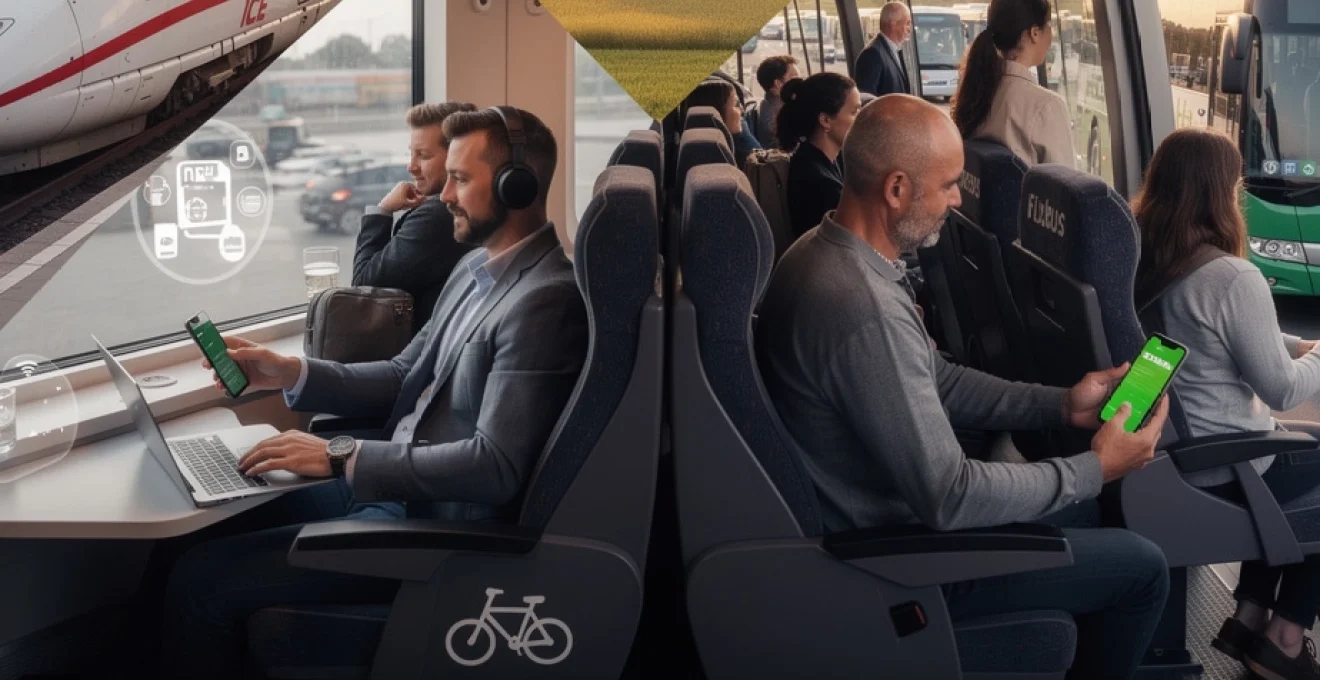
# Train vs. Bus in Germany: Which Is the Better Choice?
Germany’s transport landscape presents travellers with a fascinating dilemma: should you opt for the extensive rail network operated by Deutsche Bahn, or embrace the budget-friendly flexibility of FlixBus? This decision affects not only your wallet but also your journey time, comfort level, and environmental footprint. With Germany’s reputation for engineering excellence extending to its transportation infrastructure, both options offer compelling advantages that merit careful consideration. The country’s geographical position at the heart of Europe makes this choice particularly relevant for both domestic travellers and those exploring cross-border routes. Understanding the nuances between these two dominant modes of intercity transport can transform your German travel experience, whether you’re commuting for business, exploring historic cities, or embarking on a European adventure.
The competition between rail and coach services has intensified significantly since Germany liberalised its long-distance bus market in 2013. This regulatory shift ended Deutsche Bahn’s virtual monopoly on intercity travel, unleashing a wave of innovation and price competition that has fundamentally reshaped how Germans traverse their country. Today’s travellers benefit from unprecedented choice, but this abundance of options brings its own challenges. How do you navigate the complex fare structures, discount schemes, and route variations to make the optimal decision for your specific journey?
Deutsche bahn vs. FlixBus: comparative infrastructure and network coverage
Germany’s rail infrastructure represents one of Europe’s most developed networks, with over 33,000 kilometres of track connecting virtually every corner of the country. Deutsche Bahn operates approximately 40,000 trains daily, carrying roughly 7 million passengers through an intricate web of services ranging from high-speed ICE trains to local Regionalbahn connections. This extensive coverage creates unparalleled accessibility, particularly for business travellers prioritising punctuality and frequency. The network’s density means that even medium-sized towns typically enjoy multiple daily connections to major urban centres.
FlixBus, by contrast, has built a more selective network focused on high-demand corridors and underserved routes where rail connections prove inconvenient or expensive. Since its 2013 launch, the bright green coaches have expanded to serve over 2,000 destinations across Europe, with Germany forming the core of this network. The coach operator strategically targets routes where price-sensitive travellers accept longer journey times in exchange for significantly lower fares—sometimes as little as €5 for intercity trips booked well in advance.
ICE High-Speed rail corridors and regional bahn service density
The InterCity Express network forms Deutsche Bahn’s premium offering, with trains reaching speeds of 300 km/h on dedicated high-speed lines. Major corridors like Hamburg-Frankfurt-Munich and Berlin-Cologne benefit from frequent ICE services, with departures every hour or even more frequently during peak periods. These routes showcase German rail engineering at its finest, delivering journey times that often compete favourably with short-haul flights when you factor in airport transit and security procedures. The ICE fleet features modern rolling stock with onboard Wi-Fi, restaurant cars, and substantial legroom in both first and second class.
Regional services operated under the Regionalbahn and Regional-Express brands provide the connective tissue linking smaller communities to the high-speed network. These trains typically stop at every station along their routes, creating comprehensive coverage but extending journey times considerably. For travellers navigating between secondary cities or venturing into rural areas, these regional services become essential. The frequency varies dramatically by region, with prosperous southern states like Bavaria and Baden-Württemberg maintaining more intensive timetables than some eastern regions still recovering from decades of underinvestment during the GDR era.
Flixbus route network and intercity coach terminal accessibility
FlixBus operates through a hybrid model where independent coach operators run services under the FlixBus brand, creating flexibility and rapid network expansion. The company’s distinctive green coaches serve approximately 300 German cities, focusing particularly on routes where rail services command premium prices or require inconvenient connections. Major hubs like Munich’s Central Bus Station (ZOB) and Berlin’s various coach terminals have evolved into bustling transit centres rivalling traditional railway stations in passenger volume.
Coach terminal locations present both advantages and challenges compared to centrally-located railway stations.
In larger cities, ZOBs are often located slightly outside the historic core or next to major railway stations, which can add 10–20 minutes to your overall journey time compared to stepping off an ICE directly in the city centre. On the other hand, in some medium-sized towns and at airports, FlixBus stops can actually be closer to motorway exits, making them convenient if you are connecting from a car or arriving late at night. You will generally find fewer amenities at bus terminals than at Germany’s grand Hauptbahnhöfe, though this gap is narrowing as operators add cafés, luggage storage, and digital information boards. When you compare train vs. bus in Germany from an access point of view, trains still win for centrality and overall integration with local public transport, but buses can be surprisingly convenient on certain corridors.
Rural connectivity: regionalverkehr vs. long-distance coach services
When it comes to rural connectivity in Germany, Deutsche Bahn and its regional partners have a clear structural advantage over long-distance buses. Regionalbahn (RB) and Regional-Express (RE) services, supplemented by S-Bahn and local bus networks, reach deep into small towns and villages, often with hourly or two-hourly frequencies even outside peak times. This dense mesh of Regionalverkehr is usually coordinated within regional transport associations, meaning a single ticket can cover both the local train and connecting bus to your final village stop. For travellers wanting to explore the Black Forest, the Bavarian Alps, or the Moselle Valley without a car, this integrated rail-and-bus ecosystem is hard to beat.
By contrast, FlixBus and other long-distance coach operators tend to focus on point-to-point intercity routes, rarely venturing into very small communities. You might be dropped at a motorway-adjacent stop several kilometres from the historic town centre, with limited onward connections in the evening or on Sundays. In practice, this means you’ll often use a hybrid model: a FlixBus for the long haul, then a regional train or local bus for the “last mile.” If your itinerary is heavy on rural sightseeing rather than city-hopping, the train vs. bus decision in Germany tilts strongly toward rail and local buses, possibly combined with short-term car rentals for isolated attractions.
Cross-border routes to amsterdam, paris, and prague
Germany’s central location makes cross-border routes a key test when comparing Deutsche Bahn vs. FlixBus. High-speed ICE and TGV services connect cities like Frankfurt and Munich with Paris, while ICE and IC trains link Cologne and Frankfurt with Amsterdam multiple times per day. These international trains offer through-tickets, clear connection guarantees, and relatively fast journey times: for instance, Cologne to Amsterdam in about 3 hours 45 minutes, or Frankfurt to Paris in roughly 3 hours 45 minutes on the fastest services. European rail operators coordinate timetables, so you can often travel from a smaller German city to a foreign capital with only one or two simple changes.
FlixBus, however, has carved out a strong niche on cross-border routes to Amsterdam, Paris, and Prague, often undercutting train fares by 30–60% if you book early. Direct overnight buses from Berlin to Paris or Munich to Amsterdam might take 10–12 hours, but they save you both a hotel night and the hassle of early-morning departures. On routes like Dresden–Prague or Munich–Prague, coaches can be nearly as fast as regional trains, especially when rail involves multiple changes. If you prioritise price over speed on international journeys, buses will often be the better choice; if you value time, comfort, and flexible onward connections, long-distance trains usually justify their higher cost.
Fare structures and ticket pricing models across german transport operators
Understanding fare structures is crucial when deciding whether train or bus is better for travelling in Germany. Rail pricing can look complex at first glance, with different ticket types, discount cards, and regional passes. By contrast, FlixBus uses a straightforward dynamic pricing model, similar to low-cost airlines, where early bookers enjoy the lowest fares. Your optimal choice will depend on how far in advance you can plan, how flexible your dates are, and whether you are travelling solo or in a group.
Deutsche bahn sparpreis, flexpreis, and BahnCard discount schemes
Deutsche Bahn’s long-distance fares revolve around three key pillars: Sparpreis (saver fare), Super Sparpreis (super saver), and Flexpreis (flexible fare). Super Sparpreis and Sparpreis tickets are quota-based, non-flexible offers that can be extremely cheap if you book several weeks ahead; Berlin–Munich, for example, can drop below €30 on certain dates. The downside is that these tickets are tied to specific trains, with limited or no refund options, so they suit travellers who can commit to fixed departure times. Flexpreis, by contrast, allows you to take any train on the route that day, providing a high level of flexibility at a premium price, often more than double the saver fare.
BahnCard discount schemes sit on top of this structure and can radically change the train vs. bus cost comparison in Germany, especially for frequent travellers. A BahnCard 25 gives 25% off most long-distance fares, while a BahnCard 50 halves Flexpreis fares and discounts saver fares as well. For students, long-term expats, or professionals commuting between cities, the upfront cost of a BahnCard can pay for itself after just a few medium-distance trips. If you are visiting Germany for only a few weeks, a trial BahnCard (Probe BahnCard) valid for three months can still be worthwhile if you are planning several ICE journeys.
Flixbus dynamic pricing algorithms and early booking discounts
FlixBus uses dynamic pricing algorithms that closely resemble airline yield management: prices start very low and rise as the departure date approaches or seats fill up. It’s not unusual to see Hamburg–Berlin or Munich–Prague tickets for €9.99 or less if you book four to six weeks in advance, while the same seat might cost €29.99 on the day of departure. This makes buses especially attractive for travellers who plan early and are flexible with departure times, as off-peak journeys often remain significantly cheaper than peak-hour services. Conversely, spontaneous last-minute travellers may find that the price advantage over trains narrows or even disappears on popular routes.
Another key point is that FlixBus has a simpler fare structure: there is usually one main fare per departure, with modest surcharges for extras like seat selection or additional luggage. You don’t have to navigate discount cards or complex regional offers, which can be a relief if you’re new to German transport. However, the apparent simplicity can mask variability: during holidays, festivals, or major events, dynamic pricing ramps up quickly. To get the best value from buses in Germany, you should treat them like budget airlines—book early, travel off-peak, and compare multiple departure days if your schedule allows.
Deutschland-ticket €49 monthly pass integration
The introduction of the Deutschland-Ticket (often still called the “€49 ticket,” though prices can be adjusted over time) has significantly changed the train vs. bus equation for many travellers within Germany. This monthly pass offers unlimited travel on regional and local public transport nationwide: that includes S-Bahn, U-Bahn, trams, city buses, and all RB and RE trains, but excludes long-distance services such as ICE, IC, and EC. For commuters, students, and digital nomads spending a month or more in Germany, this creates a powerful baseline of mobility at a predictable cost. You can, for example, ride from Munich to Nuremberg or Cologne to Dortmund on slower regional trains without paying anything extra beyond the monthly fee.
From a practical standpoint, the Deutschland-Ticket doesn’t integrate directly with FlixBus or other private long-distance coach operators, but it can be used for feeder journeys to and from bus terminals. If you are willing to accept longer travel times on regional trains, the pass can dramatically reduce your overall transport spend, especially when combined with occasional Sparpreis tickets for very long distances. For travellers staying in Germany for only two or three weeks, the subscription model is a bit less convenient, as you pay per calendar month and must remember to cancel in time. Still, if your stay spans most of a month and includes multiple intercity hops, the Deutschland-Ticket can tilt the balance decisively toward regional rail.
Interrail and eurail pass validity on german rail networks
For non-resident visitors planning a multi-country European itinerary, Interrail (for Europeans) and Eurail (for non-Europeans) passes are another critical factor when evaluating train vs. bus in Germany. These passes generally include travel on Deutsche Bahn’s long-distance trains, including ICE, IC, and EC services, though you may need to pay small reservation fees on certain high-demand routes. With a flexible pass, you can wake up, check the DB Navigator app, and decide spontaneously whether to head to Hamburg, Cologne, or Leipzig, without worrying about individual ticket prices. This kind of freedom is hard for any bus network to match, especially when you factor in frequent rail departures on core corridors.
However, Interrail and Eurail passes do not cover FlixBus or other private coach operators, though some companies offer separate discount partnerships. This means you will usually choose either a rail-pass-centric strategy or a bus-centric budget strategy, rather than trying to blend the two for long-distance segments. If your main goal is to maximise spontaneity and cover many cities in a short time, rail passes are extremely attractive despite their upfront cost. If you are focused on ultra-low costs and don’t mind slower journeys and fixed departure times, booking individual FlixBus tickets can still work out cheaper than even the most economical pass options.
Journey time analysis: munich to berlin and hamburg to frankfurt routes
Journey time often proves decisive when travellers compare train vs. bus in Germany. On flagship routes like Munich–Berlin, the difference is dramatic: ICE trains on the dedicated high-speed line take as little as 3 hours 55 minutes, with departures roughly every hour. FlixBus coaches on the same corridor typically need between 7 and 9 hours, depending on intermediate stops and traffic conditions. When you consider that train stations are centrally located and require minimal check-in time, door-to-door travel by rail can be less than half as long as by bus, especially if you are staying near the city centre.
A similar pattern emerges on Hamburg–Frankfurt. High-speed ICE connections cover the roughly 500-kilometre distance in about 3 hours 40 minutes on the fastest services, while most buses take around 7–8 hours. Buses can become competitive only if you exploit overnight services, effectively turning travel time into sleep time and saving a hotel night. Even then, the quality of rest on a night bus is rarely comparable to a bed, which matters on business trips or short city breaks. For travellers on tight schedules, the faster trains usually justify their higher ticket prices, particularly when Sparpreis fares are available.
There are, however, corridors where the time gap between trains and buses shrinks. On medium-distance routes with no dedicated high-speed line, such as Nuremberg–Prague or Dresden–Prague, buses can be similar in duration or just an hour slower than regional trains, sometimes with the advantage of a direct, no-change journey. In these cases, the choice comes down to whether cost savings or on-board comfort matters more to you. As a rule of thumb, the further and faster the journey, the more rail pulls ahead in Germany; for short to medium distances, especially cross-border trips without high-speed infrastructure, the coach can still be a viable contender.
Passenger comfort and onboard amenities comparison
Comfort is another key lens through which to view the train vs. bus debate in Germany. While both Deutsche Bahn and FlixBus have upgraded their fleets in recent years, trains generally provide more space, smoother rides, and greater freedom of movement. On a three- or four-hour ICE journey, you can get up, walk to the Bordbistro for a coffee, or even work standing at a bar table—something hard to replicate in a coach aisle. However, modern long-distance buses have narrowed the gap with features like power outlets, Wi-Fi, and adjustable seats, making them a solid option for budget travellers who don’t mind a cozier environment.
ICE first class compartments vs. FlixBus extra seat options
Deutsche Bahn’s ICE trains offer a clear upgrade path for travellers seeking more comfort: first class. First class compartments provide wider seats, increased legroom, quieter carriages, and more workspace, often with at-seat service and access to DB Lounges at major stations, depending on your ticket type. For business travellers shuttling between Frankfurt, Berlin, and Munich, this can turn travel time into productive working hours. The price difference between first and second class varies by route and booking time, but with Sparpreis First offers, the premium can sometimes be surprisingly modest.
FlixBus, meanwhile, offers a more limited set of comfort enhancements, such as extra-legroom seats and seat reservation options. These upgrades can make a meaningful difference on longer journeys, especially for taller passengers, but they don’t transform the fundamental geometry of a coach interior. On a crowded bus, you are still largely confined to your seat, with narrow aisles and limited standing space. If you imagine comfort as a sliding scale, FlixBus sits somewhere between a budget airline and a regional train, while ICE—particularly in first class—moves closer to the experience of a mobile office or quiet lounge.
Wi-fi connectivity performance on DB navigator and FlixBus platforms
Reliable connectivity has become a deciding factor for many travellers comparing train vs. bus in Germany. Deutsche Bahn offers free Wi-Fi on most ICE trains and an increasing number of IC services, with a tiered system that prioritises stability over raw speed. In practice, this means you can usually handle email, messaging, and light web browsing, though high-definition streaming and large file uploads may be patchy, especially in rural areas or tunnels. The DB Navigator app plays a supporting role here, allowing you to monitor your connection, access the on-board portal, and check real-time train data.
FlixBus also provides free Wi-Fi on nearly all long-distance coaches, but performance can vary more because each route is operated by different partner companies with differing hardware. When the bus is full and many passengers are streaming, speeds can drop significantly, and some routes cap usage per device to keep the network usable for everyone. That said, for basic tasks like checking maps, messaging family, or browsing, both systems are usually adequate. If you absolutely need stable, high-speed internet for work, consider carrying a German SIM with generous data as a back-up, since both train and bus Wi-Fi can be affected by the same mobile coverage gaps along the route.
Luggage allowances and bicycle transportation policies
For travellers with more than just a carry-on, luggage policies can heavily influence whether train or bus is better in Germany. On Deutsche Bahn’s long-distance trains, there is no strict checked luggage system; instead, you can bring multiple bags as long as you can carry them yourself and store them safely in overhead racks or dedicated luggage areas. This informal system is forgiving for travellers with suitcases, backpacks, and even musical instruments, though on very busy services it can be a challenge to find space near your seat. Bicycles can usually be transported on many IC and some ICE routes, but they require a reservation and a separate bike ticket, with spaces limited per train.
FlixBus, by contrast, applies clearer and more formalised luggage limits: typically one large suitcase in the hold and one small item of hand luggage included in the base fare, with surcharges for additional or oversized items. From a planning point of view, this is similar to flying a low-cost airline—you know what you can bring, but exceeding those limits costs extra. On the positive side, many FlixBus coaches offer dedicated bike racks at the rear, allowing you to transport bicycles on selected routes for a modest fee, provided you book in advance. If you’re touring Germany with a bike or multiple large bags, trains generally provide a more flexible and forgiving environment, while buses reward careful packing and adherence to stated limits.
Environmental impact: CO2 emissions per passenger kilometre
Environmental considerations increasingly shape the choice between train and bus in Germany, especially for climate-conscious travellers and students. Rail travel, particularly electric-powered high-speed trains like the ICE, is among the lowest-carbon long-distance transport modes available. According to data from the German Environment Agency, long-distance trains in Germany typically emit well under 50 grams of CO2 per passenger kilometre, and significantly less when powered by renewable-heavy electricity mixes. In practical terms, taking the train from Berlin to Munich can generate a fraction of the emissions compared to driving alone or flying the same route.
Long-distance coaches also perform well from an emissions standpoint, often better than private cars and sometimes close to regional diesel trains, thanks to high occupancy rates and efficient modern engines. Emissions per passenger kilometre can fall below 100 grams, especially on busy routes, making buses a relatively green choice compared to planes or sparsely occupied vehicles. However, because many German trains are electric and the grid is decarbonising, rail generally retains the ecological edge on major corridors. If your goal is to minimise your carbon footprint while travelling around Germany, choosing rail where high-speed or electrified routes exist, supplemented by coaches only when rail options are poor, is usually the most sustainable strategy.
Booking platforms and real-time delay management systems
How you book—and how disruptions are handled—can be just as important as raw ticket prices when you compare train vs. bus in Germany. Deutsche Bahn and FlixBus both offer robust digital platforms, but the level of integration with other modes and the tools for managing delays differ. Efficient booking and real-time updates become particularly valuable if you are planning complex itineraries with multiple connections, or if you need clear documentation for compensation claims.
DB navigator app vs. FlixBus mobile application user experience
The DB Navigator app serves as the central hub for planning and managing rail travel in Germany. It allows you to search journeys across almost all rail operators and many local transport networks, buy tickets, store them digitally, and receive real-time updates on delays, platform changes, and alternative connections. The app can even propose rerouting options during disruptions, which is invaluable when a missed connection could otherwise derail your day. For visitors, the fact that DB Navigator covers not just ICE and IC trains but also S-Bahn, RE, and RB services makes it a near one-stop shop for public transport planning.
The FlixBus mobile app focuses more narrowly on the company’s own bus and train services (FlixTrain), but it does that job efficiently. You can search routes, compare prices across different times, select seats, and store your mobile boarding passes offline. Real-time tracking of your coach and push notifications for delays or platform changes help reduce uncertainty at bus terminals, where information screens can be sparse. While FlixBus’s app doesn’t integrate rivals’ services the way DB Navigator does, its clear interface and simple booking flow make it approachable for first-time users, especially those used to airline-style booking experiences.
Compensation policies for delays and cancellations under EU regulation 261/2004
When things go wrong, understanding your rights can make the difference between a frustrating day and a manageable inconvenience. For rail passengers in Germany, compensation for delays is governed primarily by EU rail passenger rights legislation and Deutsche Bahn’s own “Fahrgastrechte” scheme, rather than EU Regulation 261/2004 (which mainly covers air travel). As a rule of thumb, if your DB long-distance train is delayed by 60 minutes or more at your destination, you are entitled to partial compensation—typically 25% of the ticket price; at 120 minutes or more, this rises to 50%. You can submit claims via online forms or paper vouchers, and DB Navigator now streamlines parts of this process.
For long-distance coaches like FlixBus, passenger rights fall under EU Regulation 181/2011, which sets out compensation and assistance rules for bus and coach travellers on routes over 250 kilometres. If a service is cancelled or heavily delayed, you may be entitled to rerouting, a refund, or in some cases compensation, although thresholds and procedures differ from rail. In practice, FlixBus often handles disruptions by rebooking you on the next available departure or offering vouchers, with cash refunds depending on the circumstances. Because the frameworks for rail, coach, and air are distinct, it is wise to save all tickets and notifications, and to check each operator’s specific compensation policy before submitting a claim.
Integration with omio and GoEuro multi-modal journey planners
For travellers seeking to optimise the entire journey rather than just a single leg, multi-modal platforms like Omio (formerly GoEuro) can be invaluable. These services aggregate timetables and fares across Deutsche Bahn, FlixBus, and many other operators, allowing you to compare train vs. bus in Germany on a single screen. You can quickly see, for example, that an ICE from Frankfurt to Hamburg takes around four hours and costs a certain amount, while a FlixBus departure might be twice as long but half the price. This bird’s-eye view helps you weigh not only cost and time, but also departure times, transfer numbers, and station locations.
Beyond simple comparison, these platforms sometimes surface combinations you might not consider on your own, such as a regional train plus bus connection that beats a direct but slower alternative. They also centralise your bookings and tickets, which is convenient if you are stringing together multiple journeys across several countries. However, it’s still worth cross-checking prices directly on Deutsche Bahn and FlixBus, as occasional promotions or rail-only discounts may not appear in third-party search results. Used thoughtfully, multi-modal journey planners function like a travel control tower, helping you make informed, data-driven decisions about whether the train or bus is the better choice for each leg of your German adventure.