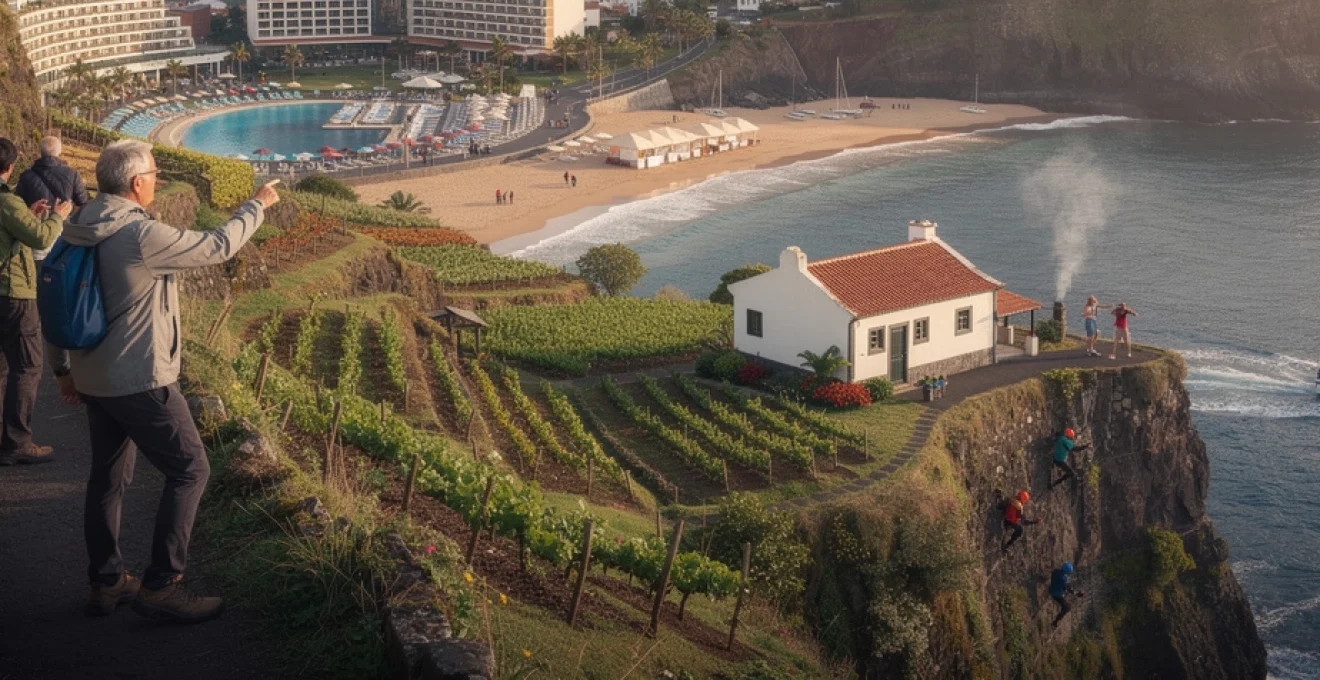
Madeira stands as one of Europe’s most compelling year-round destinations, offering visitors an extraordinary combination of subtropical climate stability, diverse microclimatic zones, and world-class tourism infrastructure. This Portuguese archipelago, positioned strategically in the Atlantic Ocean approximately 560 kilometres from Morocco’s coast, has earned its reputation as the “Pearl of the Atlantic” through centuries of careful development and natural abundance. The island’s unique geographical position creates a fascinating interplay between oceanic influences, mountainous terrain, and volcanic landscapes that produces an environment unlike anywhere else in Europe.
The archipelago’s appeal extends far beyond its famous Madeira wine and dramatic cliff-top views. Modern travellers discover a sophisticated destination where cutting-edge resort developments complement traditional quintas, where ancient levada walking routes traverse landscapes that shift from subtropical forests to alpine peaks within hours. From the bustling marina developments in Funchal to the remote valleys of São Vicente, Madeira offers experiences that cater to luxury seekers, adventure enthusiasts, and cultural explorers alike.
Madeira’s subtropical maritime climate system and microclimatic zones
The foundation of Madeira’s year-round appeal lies in its sophisticated climate system, which creates remarkable stability across seasonal transitions. The island’s position at 32.6°N latitude places it firmly within the subtropical belt, yet its maritime location moderates temperature extremes that would otherwise characterise continental regions at similar latitudes. This positioning creates what climatologists describe as a perpetual spring environment, where temperature variations rarely exceed 10°C between winter and summer months.
Atlantic ocean thermal regulation and temperature stability
The surrounding Atlantic Ocean serves as a massive thermal regulator, maintaining sea surface temperatures between 17°C in February and 24°C in September. This oceanic thermal mass prevents the dramatic temperature swings that characterise continental climates, ensuring that Madeira experiences minimal seasonal variation. The Gulf Stream’s influence further enhances this stability, bringing warm waters from lower latitudes and maintaining the island’s temperate conditions even during European winter months.
Coastal temperatures rarely drop below 15°C or exceed 28°C, creating ideal conditions for outdoor activities throughout the year. The thermal regulation extends inland, where altitude becomes the primary factor influencing temperature rather than seasonal variation. At sea level, visitors can expect comfortable temperatures averaging 19°C in winter and 24°C in summer, while higher elevations offer cooler conditions that rarely become uncomfortably cold.
North-south precipitation gradients across funchal and porto moniz
Madeira’s mountainous spine creates dramatic precipitation differences between its northern and southern coasts, establishing distinct microclimatic zones that offer varied experiences within a compact geographical area. The northern coast around Porto Moniz receives approximately 1,200mm of annual rainfall, supporting lush laurel forests and creating some of Europe’s most spectacular waterfall displays. Meanwhile, Funchal and the southern coastal regions experience significantly less precipitation, averaging just 600mm annually and enjoying over 2,500 hours of sunshine per year.
This precipitation gradient creates opportunities for visitors to experience multiple climate zones during a single stay. Those seeking drier conditions can base themselves in the south while making day trips to experience the verdant landscapes of the north. The variation also means that if weather conditions prove unfavourable in one region, alternative microclimates are typically accessible within a 30-minute drive, providing exceptional flexibility for outdoor activities and sightseeing.
Levada network impact on regional humidity distribution
Madeira’s famous levada system, comprising over 2,500 kilometres of irrigation channels, significantly influences local humidity patterns and creates unique microclimatic conditions along walking routes. These channels, originally constructed in the 16th century to transport water from the wet northern regions to the drier south, now moderate local humidity levels and support diverse flora along their paths. The constant water flow maintains elevated humidity levels that support subtropical vegetation even in areas that would otherwise be too dry.
The levadas create corridors of enhanced humidity that sustain endemic plant species and provide comfortable walking conditions even during warmer months. Walkers frequently encounter dramatic changes in humidity and vegetation as they follow these waterways, moving from dry scrubland into lush forest environments within short distances. This system effectively extends the island’s diverse ecosystems and creates the network of
cool, shaded air that feels noticeably different from the surrounding landscape. For visitors planning a walking holiday in Madeira, following these levada corridors means you can comfortably hike even on warmer days, provided you choose routes that track the more humid, forested sections rather than exposed ridgelines.
From a practical point of view, this engineered water network helps explain why Madeira maintains such lush vegetation across seasons. During drier months, levadas continue to feed agricultural terraces, kitchen gardens and ornamental estates, keeping rural landscapes green when other Atlantic islands may appear parched. For travellers interested in climate-aware itinerary planning, understanding where levadas concentrate moisture can help you choose stays and trails that best match your preferred environments – from misty canyon walks to drier, sunny coastal paths.
Trade wind patterns and orographic precipitation effects
Overlaying this hydrological system is the persistent influence of the northeasterly trade winds, which interact with Madeira’s rugged topography to generate highly localised weather conditions. As moist air masses are forced up over the central mountain chain, they cool and condense, producing orographic clouds and precipitation on windward slopes while leaving leeward areas in partial rain shadow. This mechanism underpins the stark contrast between the wetter north and the relatively drier south, and explains why you can often “drive out of the clouds” simply by crossing a ridge or heading through a tunnel.
These trade-wind clouds typically form between 600 and 1,200 metres, creating a characteristic cloud belt that walkers frequently pass through on high-altitude treks. Above this layer, summits such as Pico do Areeiro often sit in bright sunshine above a sea of cloud, even when coastal areas feel overcast. For you as a visitor, this means that seemingly poor weather rarely cancels a day of exploration; instead, a short change in elevation or aspect often reveals more favourable conditions. Checking local webcams and mountain forecasts before setting out is an effective way to take advantage of this highly layered climate system.
Peak season tourism infrastructure and accommodation capacity
Madeira’s stable climate would not translate into a true year-round travel destination without the parallel development of robust tourism infrastructure. Over the past three decades, the island has invested heavily in accommodation capacity, transport links and visitor services designed to handle peak season demand while remaining sustainable outside traditional holiday periods. The result is a diversified hospitality sector that ranges from large-scale resorts in Funchal to converted farmhouses in rural valleys, ensuring that you can find suitable options whether you visit in January or July.
Crucially, this infrastructure has been developed with seasonality in mind. Many hotels and guesthouses remain open throughout the year, supporting winter sun seekers and long-stay visitors escaping colder climates. Modern road tunnels and upgraded mountain routes shorten travel times across the island, making it feasible to base yourself in one location and still access a wide range of microclimates and activities. This combination of capacity and connectivity is a key reason Madeira can comfortably host increasing numbers of visitors without overwhelming its compact territory.
Funchal hotel district and marina bay resort developments
Funchal, the capital, forms the heart of Madeira’s tourism infrastructure and showcases how the island has adapted to year-round demand. The hotel belt stretching from the historic centre westwards through the Lido district concentrates a wide spectrum of properties, from international-brand hotels to boutique design residences and traditional quintas with subtropical gardens. Many of these establishments have invested in heated pools, spa facilities and indoor wellness areas, ensuring that stays remain attractive even on cooler or windier winter days.
Along the waterfront, the marina and cruise port developments have transformed Funchal into a year-round gateway for Atlantic cruise itineraries and yacht traffic. Marina complexes host restaurants, cafés and excursion providers that operate in every season, offering easy access to whale watching, diving and coastal sightseeing. For travellers, staying near the hotel and marina districts means you can walk to most urban attractions, join daily tours without lengthy transfers, and still retreat to quiet garden courtyards or rooftop terraces at the end of the day.
Quinta do lorde resort and calheta beach infrastructure
Beyond the capital, purpose-built resort zones such as Quinta do Lorde on the eastern tip and Calheta on the south-west coast extend Madeira’s accommodation capacity into areas with distinct climatic and landscape characteristics. Quinta do Lorde, located near the São Lourenço Peninsula, benefits from one of the driest and sunniest microclimates on the island, making it particularly appealing outside high summer. Its integrated marina, apartments and hotel wings allow you to combine coastal walks and boat trips with sheltered poolside relaxation, even in shoulder seasons.
Calheta, by contrast, has been developed as a family-friendly beach hub with two artificial golden-sand bays protected by breakwaters, backed by a growing selection of hotels and self-catering units. Because the south-west enjoys some of the island’s lowest rainfall totals and long afternoon sun, Calheta functions as a reliable base for winter and early-spring visitors seeking both sunbathing opportunities and easy access to levada trails on the Paúl da Serra plateau. The combination of supermarkets, seafront restaurants and marina services ensures that long-stay guests can settle into a comfortable daily rhythm without needing to commute to Funchal.
Rural tourism quintas in santana and são vicente valleys
Complementing these coastal developments is a thriving rural tourism sector focused on traditional quintas and guesthouses in regions such as Santana and the São Vicente valleys. These properties, often converted manor houses or carefully restored farmsteads, offer a different kind of year-round appeal: cooler summer nights, proximity to lush laurel forests, and immersion in agricultural landscapes that change subtly with the seasons. Many operate with fewer rooms than coastal resorts, providing a quieter atmosphere even during the August peak.
For walkers and nature enthusiasts, basing yourself in a rural quinta reduces transfer times to major levada routes and summit trails, while giving you an authentic insight into local life. Hosts frequently provide detailed weather advice, trail updates and flexible meal times tailored to early starts or late returns. Because these valleys capture more rainfall, gardens remain verdant throughout the year, and you can experience everything from autumn grape harvests to spring wildflower displays without needing to move between accommodations.
CR7 pestana hotel and celebrity-branded hospitality expansion
One of the more visible signs of Madeira’s maturing tourism industry is the presence of the CR7 Pestana Hotel on Funchal’s waterfront, a collaboration between the Pestana Group and Madeira-born footballer Cristiano Ronaldo. This celebrity-branded property exemplifies the island’s strategy of attracting international attention while anchoring developments in local identity. Its contemporary design, sports-themed facilities and central location appeal particularly to younger visitors and city-break travellers who might previously have overlooked Madeira in favour of mainland European capitals.
More broadly, branded hospitality investments have encouraged upgrades across the accommodation sector, from higher service standards to enhanced digital booking and information systems. Even if you choose a small guesthouse in the hills rather than a flagship hotel on the promenade, you benefit from the island-wide push towards year-round professionalism: multilingual staff, efficient transfer options and reliable opening hours outside the traditional summer window. This ecosystem of both independent and branded providers supports flexible trip planning, whether you’re booking a spontaneous winter escape or a carefully structured multi-week stay.
Outdoor adventure tourism activities across seasonal transitions
Madeira’s varied topography and stable climate combine to create an outdoor adventure playground that functions almost independently of the calendar. Instead of a stark division between “summer activities” and “winter activities”, you see gentle shifts in emphasis: higher alpine treks feel most comfortable in spring and autumn, while coastal levadas and canyon walks stay inviting on warmer summer days. This continuity is one of the main reasons active travellers return in different months to experience alternative facets of the same landscape.
Because temperature bands overlap throughout the year, activity providers rarely shut down entirely. Guided walking companies, canyoning operators, paragliding schools and marine excursion businesses adjust schedules and meeting points based on short-term forecasts rather than seasonal closures. For you, this means that a January stay can include much of the same hiking, coasteering and whale watching that you would enjoy in May, with the added advantages of quieter trails and more flexible booking options.
Levada walking routes: caldeirão verde to risco waterfall
Levada walking is arguably Madeira’s signature outdoor experience, and routes such as Caldeirão Verde and Risco Waterfall showcase why these paths are viable year-round. Both trails follow irrigation channels at mid-altitudes through the Laurisilva forest, where canopy cover and constant water flow moderate temperature and humidity. Even during summer, sections remain pleasantly cool and shaded, while in winter the forest provides shelter from wind and light rain, much like walking through a natural cloister.
Caldeirão Verde, starting near Queimadas, leads you along narrow ledges and through short tunnels to a dramatic amphitheatre where a high waterfall plunges into a circular basin. Risco, usually combined with the 25 Fontes route in the Rabacal area, delivers a spray-filled viewpoint beneath vertical cliff faces from which multiple streams cascade. Because these levadas sit below the highest ridges, they are often free of the dense cloud that wraps the summits on unsettled days. By checking recent rainfall and local advice, you can choose dates when waterfalls are at their most impressive without trails becoming uncomfortably muddy.
Pico ruivo and pico do areeiro high-altitude trekking
For more demanding high-altitude trekking, the interconnected routes between Pico do Areeiro (1,818m) and Pico Ruivo (1,862m) rank among Europe’s most dramatic ridge walks. Here, seasonality plays out more in terms of cloud dynamics and wind exposure than temperature alone. In summer, early-morning departures avoid midday heat on exposed staircases and tunnels, while in winter you may time your ascent to rise above the cloud layer and enjoy crystal-clear vistas across the island and out to the Desertas Islands.
Because weather can change quickly at these elevations, careful planning is essential: always check official trail status, bring layered clothing and carry a headlamp if starting before dawn to catch sunrise. Yet compared with mountain ranges on the European mainland, the risk of extreme cold or deep snow is relatively low; occasional frost or light snowfall may close paths temporarily, but these events are typically short-lived. For you as a trekker, this means that challenging, alpine-style experiences remain accessible in many months when comparable routes elsewhere would be off-limits.
Cabo girão skywalk and coasteering at machico bay
Not all of Madeira’s outdoor adventures involve lengthy hikes. The Cabo Girão Skywalk, perched on one of Europe’s highest sea cliffs at around 580 metres, offers an accessible adrenaline rush throughout the year. Its glass platform extends over a vertical drop to the terraced fajãs and Atlantic surf below, providing vivid evidence of the island’s tectonic origins. Because access is via a short path from a road-level car park, it remains suitable even on days when you might not want to commit to a longer trail, though those with a fear of heights may still find it a challenge.
At sea level, coasteering and sea-kayaking operations in areas like Machico Bay take advantage of relatively warm water temperatures that fluctuate only mildly between seasons, typically from about 18°C in winter to 24°C in late summer. Wetsuits extend the comfortable operating window, allowing guided groups to scramble, swim and cliff-jump along volcanic shorelines well outside the traditional “beach season”. If you’re planning a multi-activity itinerary, this means you can combine high-cliff viewpoints, coastal scrambling and protected bay swims in a single trip, adjusting the mix according to daily conditions rather than the month on the calendar.
Monte toboggan runs and botanical garden exploration
Closer to Funchal, the Monte neighbourhood illustrates how Madeira blends heritage attractions with climate-resilient outdoor fun. The historic wicker toboggan runs, in which two carreiros guide rattan sledges down steep paved lanes toward the city, operate most days of the year, adjusting hours only in adverse weather. Because the descent is relatively short and supported by road access, it’s an all-ages experience that fits easily into a half-day excursion, whether you visit in February or September.
Nearby, the Monte Palace gardens and the main Botanical Garden above Funchal thrive in Madeira’s perpetual growing season. Here, the island’s stable climate allows for an extraordinary range of subtropical and temperate species to flourish side by side: orchids bloom while camellias and hydrangeas mark the spring and early-summer calendar, and evergreen specimens lend structure even in the wetter months. For travellers who build their holidays around garden visits, Madeira offers reliable interest in every season, from spring flower festivals to autumnal light and lower visitor numbers that make it easier to linger on terraces and overlook viewpoints.
Agricultural tourism and terraced landscape seasonality
Beyond resorts and hiking paths, Madeira’s terraced agriculture plays a significant role in shaping its visual identity and year-round appeal. Stone-walled plots climb improbably steep slopes, planted with vines, bananas, sugar cane, sweet potatoes and a variety of garden crops. Because the island benefits from mild temperatures and carefully managed irrigation, these terraces remain active in virtually all months, offering you a constantly evolving patchwork of colours and textures rather than a stark contrast between “growing” and “dormant” seasons.
For visitors interested in agricultural tourism, this means that farm visits, vineyard tours and rural homestays never feel out of season. Grape harvest typically takes place from late August into September, providing opportunities to observe or participate in traditional treading and pressing activities, while banana plantations along the south coast can be seen producing and ripening fruit at multiple stages across the year. Many quintas now combine small-scale production with guest accommodation and tastings, allowing you to understand how microclimates and levada-fed irrigation regimes influence crop choices on different slopes and elevations.
Marine ecosystem accessibility and whale watching opportunities
Madeira’s position in the North Atlantic, combined with its mild sea temperatures, creates a marine environment that supports cetacean activity throughout the year. More than 20 species of whales and dolphins have been recorded in waters around the archipelago, ranging from resident bottlenose dolphins to migrating sperm whales and occasional orcas. Crucially for tourism, this diversity is not confined to a narrow seasonal window; licensed operators run whale watching and dolphin-spotting trips from Funchal, Calheta and other harbours in most months, adjusting departure times based on daylight and sea conditions.
Peak sighting probabilities for certain species cluster between April and October, when calmer seas and longer days favour offshore excursions. However, year-round residents ensure that even a winter sailing often yields encounters with dolphins or pilot whales. Because ocean temperatures hover between approximately 17°C and 23°C, you can comfortably join marine trips at almost any time, with modern catamarans offering both sun decks and sheltered cabins. As always with wildlife experiences, sightings can never be guaranteed, but Madeira’s combination of deep offshore trenches and nutrient-rich waters gives you a better-than-average chance of success compared with many coastal destinations.
Cultural festival calendar and traditional celebration scheduling
Finally, Madeira’s status as a year-round travel destination is reinforced by a dense cultural calendar that distributes major events across the seasons rather than concentrating them solely in summer. The year begins with one of the island’s most celebrated spectacles: the New Year’s Eve fireworks in Funchal, which have previously held a Guinness World Record for scale and draw visitors from across Europe seeking a milder-climate celebration. In February or March, depending on the liturgical calendar, Carnival brings colourful parades and street parties that enliven both the capital and smaller towns.
Spring is dominated by the Flower Festival, typically held a few weeks after Easter, when Funchal’s streets fill with intricate floral carpets and floats that showcase the archipelago’s botanical wealth. As summer progresses, the Atlantic Festival in June combines music events with weekly fireworks competitions, while late August and early September see the Wine Festival, which celebrates the cultivation and production of Madeira wine through tastings, exhibitions and re-enactments of traditional grape treading. Even in quieter months, village arraiais (festas) honour local patron saints with food stalls, folk music and fireworks, offering you an authentic window into Madeiran community life.
For travellers, this year-round succession of events means that almost any visit can coincide with a meaningful celebration or cultural highlight. Rather than asking whether there is “enough to do” outside the summer peak, you can choose dates that align with your interests: perhaps a walking holiday timed for the Flower Festival, a foodie-focused trip around the Wine Festival, or a winter escape that incorporates the famous New Year fireworks. Combined with Madeira’s stable climate, microclimatic variety and mature tourism infrastructure, this living cultural calendar helps explain why the archipelago continues to attract visitors in every month of the year.