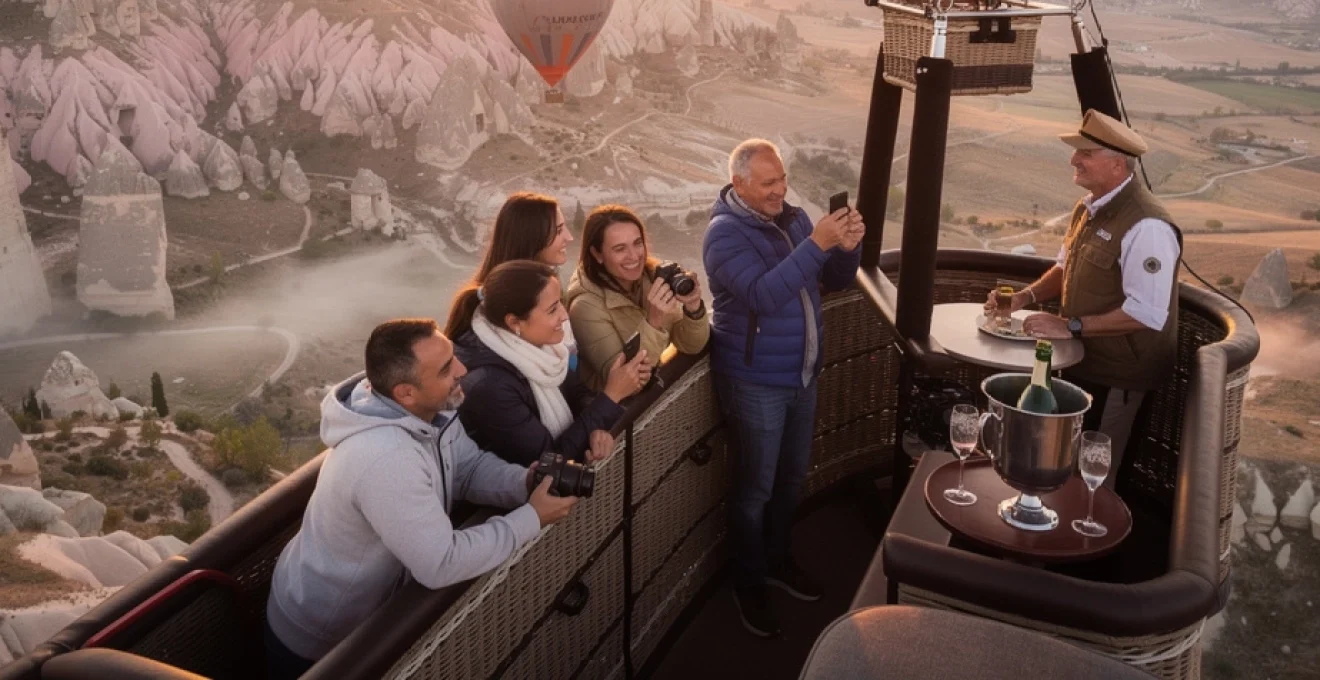
Cappadocia’s ethereal landscape transforms into something truly extraordinary when viewed from hundreds of metres above ground. This UNESCO World Heritage site in central Turkey offers one of the world’s most spectacular hot air balloon experiences, drawing adventurers from across the globe to witness its fairy chimneys, cave dwellings, and volcanic valleys at sunrise. The region’s unique geological formations, combined with exceptional atmospheric conditions, create the perfect environment for ballooning that has captivated travellers for decades.
The experience goes beyond simply floating above remarkable terrain; it represents a profound connection with one of Earth’s most unusual landscapes. Each flight reveals the intricate details of ancient volcanic activity, human settlement patterns carved into rock faces, and the delicate interplay between natural forces that shaped this remarkable region over millions of years. For many visitors, this aerial perspective fundamentally changes their understanding of Cappadocia’s geological and cultural significance.
Cappadocia’s unique geological formation and optimal flight conditions
The extraordinary landscape of Cappadocia emerged through millions of years of volcanic activity, erosion, and geological transformation. Three major volcanic peaks—Erciyes, Hasan, and Melendiz—deposited layers of tuff, a soft volcanic rock that wind and water gradually sculpted into the region’s characteristic formations. This geological foundation creates the perfect backdrop for hot air balloon flights, offering dramatic visual contrasts and varied terrain that changes throughout each journey.
The region’s elevation, ranging from 1,000 to 1,400 metres above sea level, provides optimal atmospheric conditions for ballooning operations. Temperature differentials between ground level and various altitudes create predictable thermal patterns that experienced pilots utilise to navigate different flight paths. These natural air currents allow balloons to follow distinct routes through valleys, over plateaus, and around prominent rock formations, ensuring each flight offers unique perspectives of the landscape.
Fairy chimneys and volcanic tuff landscapes from above
From the balloon basket, the famous fairy chimneys reveal their true scale and intricate formations. These towering rock pillars, some reaching heights of 40 metres, appear as natural skyscrapers across the valleys. The aerial perspective showcases how these formations cluster together, creating natural neighbourhoods where ancient civilisations carved homes, churches, and storage facilities directly into the rock.
The varying colours and textures of the tuff layers become particularly evident from above. Different volcanic eruptions deposited distinct mineral compositions, creating horizontal bands of white, pink, yellow, and grey that stripe the landscape like natural artwork. This geological storytelling becomes most apparent during the golden hour when dawn light illuminates these colour variations with remarkable clarity.
Thermal currents and wind patterns in göreme national park
Göreme National Park’s topography creates distinctive wind patterns that balloon pilots understand intimately. The park’s valleys and ridges channel air currents in predictable directions, particularly during the stable morning hours. These thermal currents allow skilled pilots to navigate between different elevation zones, offering passengers varying perspectives of the same landmarks throughout a single flight.
The interplay between valley floors and elevated plateaus generates natural lift zones where balloons can ascend or descend with minimal fuel consumption. Experienced pilots exploit these atmospheric conditions to extend flight duration and explore diverse sections of the park. Understanding these wind patterns enables balloon operations to maintain consistent safety standards while maximising the scenic value of each journey.
Dawn flight atmospheric stability and temperature inversions
Pre-dawn atmospheric conditions in Cappadocia create ideal stability for balloon operations. Temperature inversions occur naturally during early morning hours, where cooler air sits beneath warmer layers, reducing turbulence and creating smooth flight conditions. This meteorological phenomenon explains why virtually all commercial balloon flights begin before sunrise, when atmospheric stability reaches its peak.
Temperature differences between the ground and higher altitudes remain minimal during these early hours, allowing for gentle ascents and descents. The absence of thermal activity that develops later in the day eliminates unpredictable air movements, ensuring passenger comfort and pilot control. These stable conditions contribute significantly to Cappadocia’s reputation as one of the world’s safest ballooning destinations.
Visibility ranges across devrent valley and pasab
visibility in Cappadocia often exceeds 20–30 kilometres on clear mornings, allowing you to see well beyond the immediate valleys. Over Devrent Valley, also known as Imagination Valley, the lack of cave churches and major settlements means you can focus on the surreal rock shapes that resemble animals and mythical creatures. Pasabag, with its distinctive double and triple-headed fairy chimneys, offers sharper vertical contrasts, which become especially striking when the low sun casts long shadows across the slopes. On days with light haze, pilots will often fly slightly lower along these valleys, so you can still enjoy detailed views of the formations and vineyards beneath the balloon.
These high visibility ranges enhance both the safety and visual impact of your hot air balloon ride in Cappadocia. Clear sight lines help pilots coordinate with other balloons and ground crews, while also giving you uninterrupted panoramas of the UNESCO-listed landscape. As the sun climbs, the colours of Devrent and Pasabag shift from soft pastel tones to more vivid reds and ochres, making each minute in the air feel different from the last. For photographers, this combination of clarity and changing light offers ideal conditions for capturing everything from wide-angle landscapes to close-up textures in the volcanic tuff.
Premium hot air balloon operators and fleet specifications
Choosing the right operator can make a noticeable difference to your overall experience, especially when you consider safety records, fleet maintenance, and passenger comfort. In Cappadocia, several premium hot air balloon companies operate under strict regulations from the Turkish Civil Aviation Authority, undergoing regular inspections and adhering to international safety standards. While most reputable companies offer similar routes and flight durations, their equipment, basket layouts, and group sizes can vary considerably. Understanding these details helps you decide whether you prefer a more intimate flight or a more cost-effective shared basket experience.
Many travellers ask: how do you know which is the best hot air balloon company in Cappadocia for your needs? The answer often lies in a combination of up-to-date safety certifications, pilot experience, and transparent communication about weather conditions and cancellation policies. Premium operators typically invest in modern balloons from respected manufacturers like Cameron Balloons, as well as comprehensive training for their crews. When you compare fleet specifications and passenger capacities, you gain a clearer sense of why some flights cost more, and whether those extras—like smaller baskets or longer flight times—are worth the additional budget.
Butterfly balloons cameron Z-Series equipment standards
Butterfly Balloons is widely known for its focus on smaller group sizes and high-end equipment, particularly its use of Cameron Z-Series envelopes. These British-made balloons are renowned in the industry for their durability, precise handling, and efficient fuel consumption. The Z-Series models are designed with reinforced load tapes and advanced fabric coatings, which help maintain envelope integrity over thousands of flight hours. For you as a passenger, this translates into smoother ascents and descents, along with greater reliability during variable early-morning conditions.
Another advantage of Cameron Z-Series equipment is the way it balances lift performance with fine control. The burner systems paired with these envelopes allow pilots to make subtle altitude adjustments, slipping into different wind layers to find the best route across Cappadocia’s valleys. Butterfly Balloons typically configures these balloons with fewer passengers per basket than many competitors, which not only enhances comfort but also improves weight distribution and manoeuvrability. If you prioritise a premium hot air balloon ride in Cappadocia with extra space to move and photograph, this type of equipment and configuration is especially appealing.
Kapadokya balloons safety certifications and pilot qualifications
Kapadokya Balloons is one of the longest-running operators in the region, and its reputation is built largely on rigorous safety protocols and experienced pilots. All captains must hold commercial pilot licences specific to hot air balloons, with hundreds—often thousands—of flight hours logged in Cappadocia’s unique conditions. Before they carry passengers, pilots undergo extensive training in meteorology, emergency procedures, and local wind pattern analysis. Many also participate in international balloon festivals, keeping their skills current and learning best practices from around the world.
From an operational standpoint, Kapadokya Balloons maintains its fleet according to European Aviation Safety Agency (EASA) standards and the requirements of the Turkish Civil Aviation Authority. Regular inspections of envelopes, burners, and baskets are mandatory, with all maintenance recorded in detailed logbooks. Pre-flight briefings cover landing positions, basket etiquette, and what to expect during take-off and landing, so even nervous first-time flyers feel prepared. If safety is your top concern when booking a hot air balloon ride in Cappadocia, looking at pilot qualifications and third-party certifications—as companies like Kapadokya Balloons showcase—provides essential peace of mind.
Royal balloon basket configurations and passenger capacity
Royal Balloon is often praised for combining luxury touches with well-thought-out basket configurations. Their fleets include both smaller baskets for 8–12 passengers and larger ones accommodating up to around 20, depending on the specific flight program. Each basket is divided into individual compartments, usually designed for two to four people, which helps distribute weight evenly and gives everyone a defined viewing area. This layout reduces crowding at the edges and ensures that you have a clear view of the fairy chimneys and valleys as the balloon rotates in the wind.
When you compare Royal Balloon’s “King” and “Queen” style flights, you will notice that capacity and duration are the main variables. King flights generally have fewer passengers and longer time in the air, offering a more exclusive feel and more flexibility for pilots to explore multiple valleys. Queen flights are slightly more affordable, with a higher passenger capacity but the same professional crew and safety standards. For many travellers, this range of options makes it easy to find a hot air balloon ride in Cappadocia that fits both their budget and their comfort expectations without compromising on quality.
Turquaz balloons flight duration and altitude parameters
Turquaz Balloons positions itself as a boutique operator with an emphasis on well-paced, scenic flights rather than simply reaching maximum altitude. Typical flights last between 60 and 75 minutes, depending on weather conditions and the chosen route for the morning. During this time, pilots vary the altitude from low-level valley cruising—sometimes just metres above vineyards and rock formations—to higher vantage points of 600–800 metres above ground. This vertical range allows you to experience both the intimate details of cave dwellings and the sweeping panoramas that make Cappadocia famous.
Altitude management is a key part of any hot air balloon flight, and Turquaz pilots are trained to read subtle changes in wind direction and speed at different levels. Rather than climbing rapidly to a single height and staying there, they tend to “step” through several layers of air, like an elevator stopping at multiple floors. This strategy maximises your time in visually interesting zones, such as the curves of Rose Valley or the spires of Love Valley. If you are looking for a hot air balloon ride in Cappadocia that prioritises varied scenery over sheer height, these carefully planned altitude parameters are a major advantage.
Strategic launch sites and flight trajectory planning
Behind every seemingly effortless sunrise flight lies a surprising amount of planning. Balloon companies in Cappadocia choose their launch sites each morning based on weather forecasts, real-time wind checks, and airspace coordination with local authorities. Common take-off zones are scattered around Göreme, Çavuşin, and Uçhisar, each offering different initial perspectives of the landscape. By starting in slightly different locations, operators can reduce congestion at any one site and ensure that balloons fan out gracefully across the valleys, rather than clustering too tightly together.
Flight trajectories are shaped by both nature and human expertise. While you cannot “steer” a hot air balloon like an airplane, pilots use altitude changes to tap into wind streams blowing in varying directions, much like a sailor adjusting sails to catch different currents. Pre-flight briefings with ground meteorologists help identify likely paths over Göreme National Park, Love Valley, or Devrent Valley, but the exact route always remains a flexible plan rather than a rigid schedule. This is why two hot air balloon rides in Cappadocia, even with the same company, can feel completely different: slight changes in wind speed or direction can take you along new ridges, over different villages, or closer to particular landmarks.
UNESCO world heritage aerial photography opportunities
For many travellers, a hot air balloon ride in Cappadocia doubles as a once-in-a-lifetime photography session over a UNESCO World Heritage landscape. From the air, patterns that are hard to see at ground level suddenly become clear: the grid-like organisation of vineyards, the winding paths carved by seasonal water flow, and the positioning of cave churches along ancient routes. This elevated perspective is particularly powerful in Göreme National Park, where natural formations and human history are closely intertwined. You will have a front-row seat to observe how monasteries, pigeon houses, and tunnel systems were integrated into the rock over centuries.
To make the most of these aerial photography opportunities, consider the changing light conditions during your flight. In the first minutes before sunrise, the landscape appears in soft, muted tones that are perfect for atmospheric, minimalist compositions. As the sun breaks over the horizon, contrast increases and the golden light reveals more detail on the ridges and rock faces. Think of it as watching a giant darkroom come to life: the same scene gradually “develops” from shadowed outlines into high-definition relief, giving you multiple chances to capture it in different moods.
Göreme open air museum monastery complex perspectives
From above, the Göreme Open Air Museum looks less like a collection of isolated cave churches and more like a vast monastic campus blended into the cliffs. You can trace how chapels, refectories, and living quarters were carved into contiguous sections of rock, connected by stairways and passageways that are not always visible from ground level. Flights that pass near this area often reveal how the complexes align with natural contours and vantage points, suggesting that monks carefully chose their locations for both seclusion and strategic views. Seeing these patterns from the balloon helps you appreciate the planning and labour that went into creating this spiritual hub.
If you plan to visit the museum after your hot air balloon ride in Cappadocia, this aerial preview adds valuable context. Instead of encountering each rock-cut church as an isolated marvel, you will remember how they fit into a broader monastic landscape. Photographically, the early-morning light often casts the façades and entrances into sharp relief, highlighting doorways, windows, and frescoed chambers. While balloons do not fly directly above the museum for preservation and safety reasons, nearby vantage points still allow for compelling wide shots that frame the complex within its surrounding valleys.
Uchisar castle rock formation aerial angles
Uchisar Castle is the highest point in Cappadocia, and from a hot air balloon it appears like a natural citadel rising out of the tuff. Aerial angles reveal how deeply honeycombed the rock is, punctured by windows, tunnels, and rooms interconnected over multiple levels. From ground level, you mostly see the vertical façade; from the air, you can appreciate the castle’s footprint and how it dominates the surrounding plateau. The nearby village spreads out like a necklace at its base, with stone houses and narrow lanes echoing the organic forms of the rock itself.
As your balloon drifts past Uchisar, you may notice how the castle aligns with nearby valleys and ridgelines, suggesting why early settlers chose this spot for defence and lookout purposes. Morning light tends to strike one side of the formation first, creating a strong contrast between sunlit and shadowed faces that photographers can use for dramatic compositions. On especially clear days, you can frame Uchisar against the distant silhouette of Mount Erciyes, underscoring the volcanic origins of the entire region. These aerial viewpoints are among the strongest visual arguments for why a hot air balloon ride in Cappadocia is considered essential for landscape photographers.
Love valley phallic rock pillar formations
Love Valley is perhaps the most instantly recognisable landscape in Cappadocia, thanks to its tall, phallic rock pillars. From above, the valley resembles a surreal forest of stone, with individual columns and clusters forming organic patterns along the valley floor. This is where a balloon’s ability to fly both high and low truly shines: at higher altitudes, you can see the full layout of the valley and how the pillars follow the lines of ancient watercourses; at lower levels, you float close enough to appreciate the textures and weathering on the rock surfaces. The effect is a bit like zooming in and out with a camera lens, but experienced in real time and full scale.
Photographically, Love Valley benefits from the side lighting typical of sunrise flights. The tall spires cast long, tapered shadows that emphasise their height and shape, creating a natural black-and-white sketch on the valley floor. Many visitors find that their most memorable images from a hot air balloon ride in Cappadocia come from this area, especially when other balloons drift in and out of the frame. The juxtaposition of colourful envelopes and pale rock pillars feels almost otherworldly, as if you are looking down on a fantasy landscape rather than a real place.
Rose valley sunrise colour spectrum documentation
Rose Valley is famous for its soft pink and red hues, and a sunrise balloon flight provides the ideal vantage point to watch these colours evolve minute by minute. Before the sun appears, the valley often sits in cool blue-shadowed tones, with only hints of its underlying warmth. As dawn progresses, light begins to skim the tops of the ridges, and the rock faces transition through a spectrum of colours: dusty rose, peach, terracotta, and finally a rich, warm red. For photographers and videographers, it feels like watching a time-lapse unfold in real life.
If you are interested in documenting the full sunrise colour spectrum, consider using a mix of wide shots that capture entire ridgelines and closer frames focusing on the layered rock strata. The undulating shapes of Rose Valley create natural leading lines that guide the viewer’s eye through your images, especially when combined with the curve of the balloon’s shadow on the landscape below. The changing palette here is one more reason why many travellers describe a hot air balloon ride in Cappadocia as a visual feast—one that is difficult to replicate in any other destination.
Seasonal weather patterns and booking optimisation
While Cappadocia offers balloon flights year-round, each season brings distinct weather patterns that affect both the experience and your chances of flying. Spring (April to June) and autumn (September to early November) are widely considered the best times for a hot air balloon ride in Cappadocia, with mild temperatures, relatively stable winds, and frequent clear skies. During these shoulder seasons, average daytime temperatures range from 15–25°C, while early-morning conditions remain cool but manageable with layers. Visibility is often excellent, and the softer light complements the pastel shades of the valleys.
Summer flights (July and August) benefit from very reliable weather, but pre-dawn temperatures can still be warm and the region can feel busier overall. Winter, on the other hand, introduces the possibility of snow, creating an entirely different aesthetic as white blankets cover the fairy chimneys and villages. However, stronger winds and storms mean more potential cancellations in the coldest months. Industry estimates suggest that Cappadocia sees around 260 viable flying days per year, but this can vary depending on larger climate patterns. Because the Turkish Civil Aviation Authority only approves flights on mornings with safe conditions, flexibility is essential—especially if ballooning is a bucket-list priority for your trip.
To optimise your chances of flying, it is wise to book your hot air balloon ride in Cappadocia for your first available morning in the region. That way, if a flight is cancelled due to wind or fog, you have one or two backup mornings to rebook, subject to availability. Booking several weeks to a few months in advance is recommended during peak seasons, as the most reputable operators often fill up quickly. When comparing prices, remember that rates tend to be higher in high season and for smaller-capacity baskets, but these often come with added comfort and better photographic angles. Consider also purchasing flexible travel insurance that covers weather-related cancellations and last-minute itinerary changes, so you can adjust your plans without unnecessary stress.
Post-flight champagne ceremonies and cultural integration
Once your balloon touches down—often with impressive precision onto a trailer—the experience is far from over. Most operators in Cappadocia host a post-flight celebration that traditionally includes a symbolic glass of champagne or sparkling juice. This ritual has its roots in the earliest days of ballooning in 18th-century France, when pilots would offer champagne to farmers whose fields they had landed in, as a gesture of goodwill and thanks. Today, the ceremony serves as a moment to mark the achievement of your flight, share impressions with fellow passengers, and take a few final photos beside the deflating envelope.
In Cappadocia, many companies personalise this tradition with local touches, such as offering Turkish delight, nuts, or small snacks alongside the drinks. Some present passengers with flight certificates or commemorative medals, noting the date, approximate altitude, and pilot’s name—a simple but meaningful keepsake of your hot air balloon ride in Cappadocia. It is also common for pilots to share brief stories about the region’s history or explain the route you just took, connecting the airborne experience with the cultural landscape below. These conversations often bridge the gap between a purely touristic activity and a deeper appreciation of local life and heritage.
For travellers eager to integrate the balloon experience into a broader cultural itinerary, the post-flight window is ideal. Because most flights end around 7:30–8:30 a.m., you have nearly a full day ahead to explore cave churches, local markets, or traditional pottery workshops in Avanos. Many visitors choose to follow their hot air balloon ride with a visit to the Göreme Open Air Museum or a hike through one of the valleys they just flew over, creating a satisfying continuity between aerial and ground perspectives. In this way, the champagne ceremony becomes both a celebration and a transition point—closing one chapter of your morning adventure while opening the door to deeper exploration of Cappadocia’s rich cultural and geological story.