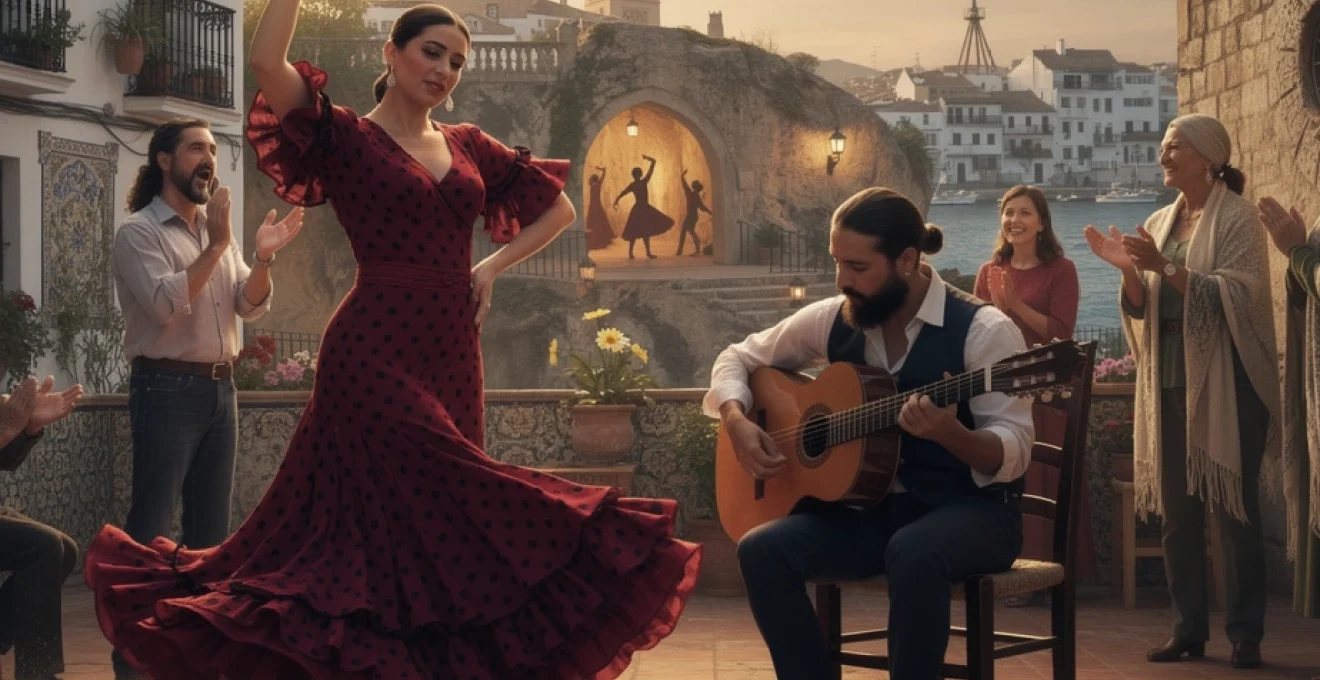
In the sun-drenched hills and whitewashed villages of Andalusia, an art form pulses with such raw emotional power that it transcends mere performance to become something closer to spiritual experience. Flamenco—with its anguished vocals, intricate guitarwork, and percussive footwork—has evolved over centuries from the margins of society into one of the world’s most recognizable cultural expressions. This isn’t simply entertainment; it’s a living chronicle of struggle, passion, and the human capacity to transform suffering into sublime beauty. Understanding why flamenco remains the very soul of Andalusian culture requires exploring its multicultural origins, technical complexity, and the communities that have safeguarded its essence through generations of marginalization and triumph.
The gitano origins and moorish influences in flamenco development
Flamenco’s genesis lies in one of history’s most remarkable cultural syntheses. Between the 15th and 18th centuries, Andalusia became a crucible where diverse traditions collided, merged, and ultimately gave birth to an entirely new artistic language. The Romani people, Arab Muslims, Sephardic Jews, and Andalusian peasants each contributed essential elements that would coalesce into what we now recognize as flamenco. This wasn’t a deliberate artistic movement but rather an organic process born from shared spaces, common hardships, and the universal human need to express what words alone cannot convey.
The romani migration routes through andalusia in the 15th century
The Romani people arrived on the Iberian Peninsula around the 15th century, having travelled westward from northern India through Persia, the Byzantine Empire, and various European territories. While they dispersed throughout the continent, significant numbers settled in southern Spain, particularly in the regions that would become the flamenco heartlands. Lower Andalusia—encompassing Seville, Cádiz, and Jerez de la Frontera—proved especially hospitable despite the marginalization these communities faced. The Romani brought with them a musical sensibility characterized by emotional intensity, complex rhythmic patterns, and a vocal style that prioritized feeling over formal structure.
What made the Romani contribution so transformative wasn’t merely the technical elements they introduced but their philosophical approach to artistic expression. For communities living on society’s periphery, facing discrimination and economic hardship, music became both catharsis and resistance. The concept of duende—that ineffable quality of raw authenticity that distinguishes transcendent flamenco from mere technical proficiency—has its roots in this Romani understanding of art as existential necessity rather than aesthetic exercise. This visceral approach to performance would become flamenco’s defining characteristic.
Sephardic jewish musical elements in cante jondo vocal techniques
The Jewish communities of medieval Spain left an indelible imprint on flamenco’s vocal traditions before their expulsion in 1492. The mournful melismatic singing style found in synagogue chants—where single syllables extend across multiple notes—bears striking similarity to the ornamented vocal lines of cante jondo, flamenco’s deepest and most profound song form. Scholars have identified intervallic patterns and melodic contours in seguiriyas and soleares that echo Sephardic liturgical music, suggesting a direct transmission of musical DNA across cultural boundaries.
The Jewish contribution extended beyond mere technique to encompass thematic content. Flamenco lyrics frequently explore themes of exile, loss, and the pain of separation from homeland—experiences deeply embedded in Sephardic collective memory. Even after their forced departure, the musical legacy of Spain’s Jews persisted in the songs of those who remained, eventually becoming woven into the broader tapestry of Andalusian expression. This convergence of Jewish melodic sensibility with Romani emotional intensity created a vocal tradition of unparalleled expressive power.
The nasrid dynasty’s impact on flamenco rhythmic structures
The Arab-Islamic civilization that flourished in Al-Andalus for nearly eight centuries left profound traces throughout flamenco’s musical architecture. The Nasrid Dynasty, which ruled Granada until 1492, presided over a sophisticated court culture where music and poetry held central importance. Arab musical theory,
transmitted through treatises like those of al-Fārābī and Ibn Bājja, emphasized cyclical rhythmic patterns and intricate accentuation. In Andalusi court music, we already find asymmetrical cycles and syncopations that anticipate flamenco’s famous compás. The twelve-beat structures of soleá and bulerías, with their shifting accents and off-beat claps, bear clear resemblance to North African nūba rhythms and other Maghrebi forms that developed in parallel from the same medieval sources.
Beyond rhythm, the Nasrid legacy survives in flamenco’s modal language and ornamentation. The use of the so‑called “Phrygian mode” (often called the “Andalusian cadence”)—that haunting descent you hear in countless flamenco falsetas—echoes maqām-based systems in Arab music. When we listen to a deep cante jondo palo, we are essentially hearing centuries-old Andalusi aesthetics reimagined by Romani and Andalusian communities living under very different historical conditions.
Cross-cultural synthesis in the sacromonte caves of granada
If there is a place where flamenco’s multicultural roots become almost tangible, it is Granada’s Sacromonte. Beginning in the 16th century, this hillside district became home to Romani families who carved cave dwellings into the soft earth above the Darro River. These caves quickly turned into intimate performance spaces where song, dance, and guitar merged in nightly gatherings that blurred the line between ritual, celebration, and survival.
In Sacromonte, you can almost see history layered in the walls: Moorish ornamental motifs, echoes of Gregorian and Sephardic chant from nearby Albaicín, and the earthy reality of Romani life under constant suspicion and persecution. Here, the zambras gitanas—festive dances linked to wedding rituals—preserved Arab-Andalusian forms while adapting them to new social realities. Clapping patterns recall North African palmas, while the raw cante channels the lament of exile. This is cross-cultural synthesis in its purest form: not a museum piece, but a constantly evolving language forged in shared, lived experience.
Flamenco palos: the twelve-beat compás and regional variations
To understand why flamenco is the soul of Andalusian culture, we also need to understand its internal architecture. Flamenco is not a single style but a constellation of palos—distinct song and dance forms—each with its own rhythm, mood, and regional roots. Many of the most emblematic palos are built on complex twelve-beat cycles that at first feel bewildering to newcomers. Yet once you feel the compás in your body, these patterns become as natural as a heartbeat.
Different Andalusian provinces have developed their own flamenco dialects. Jerez, Cádiz, Seville, Málaga, Huelva, Granada, and Córdoba each imprint their history and temperament onto specific palos and rhythmic approaches. Listening across these regional variations is like traveling a musical map of Andalusia: the same twelve beats can sound tragic in one city and explosively joyful in another.
Soleá and seguiriya as the foundation of tragic flamenco expression
Among the dozens of palos, soleá and seguiriya are often described as the backbone of tragic flamenco. Both use asymmetric twelve-beat structures, but their emotional worlds are distinct. Soleá is contemplative and inward-looking, a kind of sung monologue where the cantaor or cantaora meditates on loneliness, betrayal, or the weight of existence. Seguiriya, by contrast, is like a cry torn from the throat—abrupt, broken, and almost unbearable in its intensity.
From a rhythmic standpoint, both palos distribute accents in ways that defy Western classical expectations. Instead of a simple 1‑2‑3‑4 pattern, the compás of soleá and seguiriya shifts weight in cycles that might be counted as 12‑3‑6‑8‑10, creating a sensation of constant off-balance tension. This instability mirrors the lyrical themes: just as life for many Andalusian and Romani communities was precarious and uncertain, the rhythm never quite lets us rest. When you hear a master singer deliver a soleá por bulería or a spine-chilling seguiriya, you are hearing Andalusia’s collective memory of hardship distilled into pure sound.
Bulerías tempo acceleration and polyrhythmic complexity in jerez de la frontera
If soleá and seguiriya embody tragedy, bulerías is flamenco’s explosive release valve. Born and perfected in Jerez de la Frontera, bulerías takes the same twelve-beat grid and accelerates it until it becomes an ecstatic whirlwind of clapping, footwork, and call-and-response singing. What makes Jerez-style bulerías so fascinating is its polyrhythmic complexity: while the underlying compás stays constant, singers, palmeros, and dancers play with subdivisions, syncopations, and cross-accents that can feel almost jazz-like in their sophistication.
In a Jerez juerga, a single bulería can morph fluidly as different participants take turns entering the circle. One person might emphasize a straight three-beat subdivision, another might float phrases across bar lines, while a dancer punctuates the air with heel and toe strikes that land just behind or ahead of the beat. For an outsider, it may seem chaotic; in reality, everything is anchored to a shared internal pulse. It is here that we see how flamenco compás functions not only as rhythm but as social glue, binding a community together through a shared, embodied sense of time.
Malagueña and fandango de huelva: coastal andalusian palos characteristics
Moving from inland Jerez to the Mediterranean and Atlantic coasts, we encounter palos that reflect the sea’s wider horizons. Malagueñas, associated with Málaga, and fandango de Huelva from the province of Huelva, both descend from older Iberian fandango traditions. While they share common ancestry, their evolution within flamenco has produced distinct characters. Malagueñas tend to abandon strict compás in favor of free, rubato phrasing—what musicians call cante libre. The singer stretches time like taffy, lingering on notes and ornaments, while the guitarist follows closely, echoing and anticipating each gesture.
Fandango de Huelva, by contrast, remains firmly anchored in a lively 3/4 or 6/8 feel, with clear, danceable accents. Its melodies often carry a folk-like brightness, even when lyrics touch on sorrow. These coastal palos reveal another side of Andalusian identity: one shaped by seafaring, trade, and exchange with Portugal, the Canary Islands, and even Latin America. Listening to them, we hear how flamenco absorbed and reinterpreted these influences, just as the tides constantly reshape the shoreline.
Tangos flamencos versus tangos de cádiz: structural distinctions
The word “tangos” can be confusing, since flamenco tangos have little to do with the Argentine tango most people know. Within flamenco itself, there are also important distinctions. Tangos flamencos—a broad family of 4/4 palos—are among the most accessible to newcomers because their groove feels immediately familiar, close to many forms of popular music. They feature a steady, earthy pulse, with lyrics that range from playful to defiant, often used in social gatherings where dancing and improvisation are encouraged.
Tangos de Cádiz, while part of this wider family, carry the specific flavor of the Cádiz bay area and its rich carnival tradition. Structurally, they often incorporate melodic turns and rhythmic breaks reminiscent of chirigotas and other carnival songs. The rhythmic drive is sharp and punchy, with a tendency toward witty, ironic lyrics that reflect Cádiz’s reputation for humor and satire. Comparing these two types of tangos is like comparing different dialects of the same language: the grammatical skeleton is similar, but the accent, vocabulary, and attitude reveal where they come from.
The sacred triangle: guitar, voice, and zapateado footwork interplay
At the heart of any flamenco performance lies a dynamic conversation between three main protagonists: the voice (cante), the guitar (toque), and the dance (baile), especially the percussive zapateado footwork. This “sacred triangle” is not a fixed hierarchy but a constantly shifting relationship in which each element can lead or follow. In one moment, the singer’s anguished melisma dictates the pace; in the next, the dancer’s footwork challenges the guitarist to respond with new rhythmic ideas.
For the listener, this interplay can feel like watching a conversation that moves from whispered confession to heated debate. The guitarist weaves harmonic and melodic textures that frame the singer’s lines, while the dancer uses the body as a drum set, carving patterns into the floor that both affirm and disrupt the underlying compás. When everything locks in—when voice, guitar, and footwork breathe together—we experience that electric jolt Andalusians call pellizco: the pinch that makes you shiver because you know you have witnessed something irreproducible.
Paco de lucía’s revolutionary falseta compositions and modern virtuosity
No discussion of the flamenco guitar’s role in Andalusian culture can ignore Paco de Lucía. Born in Algeciras (Cádiz) in 1947, he transformed flamenco guitar from a primarily accompanying instrument into a vehicle for virtuosic solo expression without severing its roots. His falsetas—short melodic phrases that punctuate and comment on the cante—redefined what was technically and harmonically possible, incorporating jazz chords, classical techniques, and influences from Latin America while remaining unmistakably flamenco.
Paco’s revolutionary impact can be compared to that of Miles Davis in jazz: he expanded the genre’s vocabulary and audience while staying anchored in its deepest traditions. In pieces like “Entre dos aguas” or his collaborations with Camarón de la Isla, we hear not just speed and dexterity but a profound understanding of compás and melodic line. For contemporary guitarists, his legacy is both inspiration and challenge: how do you push the instrument further while maintaining the raw emotional core that makes flamenco what it is?
Camarón de la isla’s melismatic vocal ornamentation techniques
If Paco de Lucía remade the flamenco guitar, Camarón de la Isla reshaped modern flamenco singing. Born in San Fernando (Cádiz) in 1950 into a Romani family, Camarón possessed a voice that seemed to channel centuries of cante jondo while striking an unmistakably contemporary tone. His melismatic ornamentation—those rapid, cascading runs on a single syllable—drew from older traditions but pushed them into new expressive territory, often stretching and bending pitches in ways that felt almost improvised, like a saxophone solo.
Technically, Camarón’s singing fused precise control of breath and resonance with an instinctive sense of when to break the voice, when to roughen the tone to claw at the listener’s heart. Albums like “La leyenda del tiempo” scandalized purists when they first appeared in 1979, blending electric instruments and rock influences with age-old palos. Today, they are considered landmarks, illustrating how flamenco can evolve while still articulating the struggles and aspirations of Andalusian and Romani communities.
Antonio gades and the theatrical evolution of baile flamenco
While cante and toque were evolving, baile flamenco was undergoing its own transformation under figures like Antonio Gades. Born in Elda (Alicante) but artistically forged in Andalusian contexts, Gades helped bring flamenco dance to international theater stages without reducing it to folkloric cliché. Through works like “Bodas de sangre,” “Carmen,” and “El amor brujo,” he fused traditional steps and zapateado with narrative structures drawn from literature and opera.
Gades approached choreography like a storyteller, using the body’s angles, stillness, and sudden eruptions of movement as narrative tools. His collaborations with filmmaker Carlos Saura in the 1980s introduced global audiences to a theatrical flamenco that remained rooted in compás and duende. Today’s stage productions—from Sara Baras’s large-scale shows to avant-garde works by Rocío Molina—owe a clear debt to this theatrical turn, which showed that flamenco could inhabit the world’s greatest theaters without losing its Andalusian soul.
Flamenco geographical heartlands across andalusian provinces
Flamenco may now be performed in Tokyo, New York, or Buenos Aires, but its emotional epicenter remains in Andalusia. Within the region, several provinces and neighborhoods are considered true terruños—soil where flamenco grew organically from daily life rather than institutional planning. Each of these heartlands has developed its own stylistic nuances, favored palos, and legendary lineages of artists.
When we speak of Seville’s Triana, Jerez’s barrios of Santiago and San Miguel, Cádiz’s old town, Málaga’s Perchel and La Trinidad, or Córdoba’s Jewish Quarter, we are not just naming places on a map. We are referring to microcosms where language, accent, social rituals, and even patterns of walking and gesturing have shaped the way flamenco is sung, played, and danced. Exploring these geographies is essential for anyone who wants to understand flamenco as lived culture rather than abstract art form.
Triana district in seville: the cradle of professional flamenco artistry
The Triana district of Seville, located across the Guadalquivir River from the historic center, has long been mythologized as one of flamenco’s principal cradles. Historically a working-class neighborhood with a strong Romani presence, Triana was home to blacksmiths, potters, and day laborers whose songs echoed in courtyards and workshops. By the 19th century, many of these artists began performing in cafés cantantes, marking the transition from private, family-based flamenco to professional stage artistry.
From Triana emerged influential singers and dancers who helped codify forms like soleá de Triana and specific styles of bulerías and tangos. Even today, when you walk through Triana’s narrow streets or visit one of its peñas flamencas, you sense that flamenco is not just a show for tourists but a local language. Behind closed doors, in family celebrations and neighborhood bars, the art continues to be transmitted informally, ensuring that professionalization does not completely sever the link to its communal roots.
Peña flamenca juan breva and málaga’s café cantante heritage
Málaga occupies a special place in flamenco history thanks in part to its 19th-century cafés cantantes and legendary figures like Juan Breva. Born Antonio Ortega Escalona in 1844, Juan Breva became one of the first flamenco stars, renowned for his malagueñas and his ability to blend popular song with deep cante. Today, the Peña Flamenca Juan Breva, founded in 1958, serves as both a performance venue and a living museum dedicated to preserving this heritage.
Within its walls, you can find historic guitars, photographs, and recordings that trace Málaga’s contribution to flamenco, particularly in free-form palos like malagueñas and other cantes de levante. The peña model—a member-based association devoted to hosting recitals and nurturing young artists—has been replicated across Andalusia as a grassroots way to safeguard flamenco outside commercial circuits. In Málaga, this tradition keeps alive the memory of the old cafés while adapting to contemporary audiences and digital platforms.
Cádiz carnaval chirigotas and their influence on festive palos
Cádiz, with its breezy Atlantic light and centuries of maritime history, brings a very different energy to flamenco. The city’s world-famous Carnaval, especially its satirical chirigotas (comic musical ensembles), has deeply influenced flamenco’s more festive palos. The witty wordplay, social critique, and catchy refrains of chirigotas seep into tanguillos de Cádiz, alegrías, and certain types of bulerías, giving them a playful, ironic edge.
Structurally, you can hear the carnival’s impact in the way choruses are built, how humor punctuates serious themes, and how audiences are invited to participate. In Cádiz, flamenco is as likely to make you laugh as it is to make you cry, often within the same verse. This duality reminds us that Andalusian culture has always balanced tragedy with sharp, self-deprecating humor—a combination that has helped communities weather political repression, economic crisis, and social marginalization.
Córdoba’s jewish quarter and the preservation of traditional cante
Córdoba, once the capital of the Umayyad Caliphate in Al‑Andalus, carries a quieter but no less significant flamenco legacy. Its Jewish Quarter, with its labyrinthine streets and echoes of medieval synagogues, embodies the city’s long history of convivencia between Muslims, Jews, and Christians. While Córdoba may not be as associated with flashy dance as Seville or Jerez, it has been an important repository of traditional cante, especially in cantes por soleá and seguiriyas.
Local peñas and small venues have played a crucial role in preserving older singing styles that might otherwise have been overshadowed by more commercial trends. Here, the emphasis often falls on sobriety and depth rather than virtuosic display. Listening to a veteran cantaor in Córdoba’s old town can feel like entering a time capsule, where the melodic turns and textual imagery still bear the imprint of Sephardic poetry and Andalusi muwashshah forms, faint but unmistakable.
UNESCO intangible cultural heritage status and contemporary preservation
In 2010, UNESCO inscribed flamenco on its Representative List of the Intangible Cultural Heritage of Humanity. This recognition did more than add another accolade to Spain’s cultural portfolio. It formally acknowledged flamenco as a living, community-based tradition that requires active safeguarding—not just as entertainment, but as a repository of memory, identity, and social resilience for Andalusian and Romani communities in particular.
UNESCO status has brought increased funding, educational programs, and academic research, but it has also raised difficult questions. How do we protect flamenco from the very forces—over-commercialization, superficial tourism, and cultural appropriation—that its global popularity can unleash? Institutions, peñas, and artists are experimenting with answers: from school programs in Andalusian towns to digital archives and online masterclasses that reach new generations without severing ties to local contexts. As spectators, one concrete way we can contribute is by seeking out performances and platforms that respect flamenco’s roots, support Romani and Andalusian artists, and prioritize depth over cliché.
Tablao performances versus juerga gatherings: authentic flamenco contexts
For many visitors, the first encounter with flamenco in Andalusia happens in a tablao: an intimate venue designed for staged performances, often with set programs and multiple shows per night. Well-run tablaos can offer high-caliber artistry, providing stable income for performers and a comfortable setting for audiences. The lighting, sound, and choreography are carefully planned, showcasing a range of palos within a single evening. If you are new to flamenco, a good tablao can be an ideal introduction, giving you a structured, close-up view of the guitar, voice, and dance at work.
Yet flamenco’s deepest roots lie in less formal contexts known as juergas: spontaneous gatherings in homes, courtyards, or small bars where friends and family come together to sing, dance, and play late into the night. In a juerga, there is no clear line between performer and audience; anyone might suddenly contribute a verse, a rhythmic palmas pattern, or a few steps of bulerías. Time stretches, palos emerge organically, and what matters most is not technical perfection but truthfulness—the elusive duende that appears when no one is trying to impress, only to express.
Are tablao shows less “authentic” than juergas? The reality is more nuanced. Both contexts reflect different facets of flamenco as a living art. Professional stages have helped elevate and spread flamenco worldwide, while juergas keep it grounded in everyday social life. As a listener or traveler in Andalusia, the key is to approach both experiences with respect: learn to recognize the compás, listen to the lyrics, notice how artists respond to one another. In doing so, you will start to feel why, beyond the clichés, flamenco truly remains the soul of Andalusian culture—an art form where history, identity, and emotion converge in a single, irreducible cry.