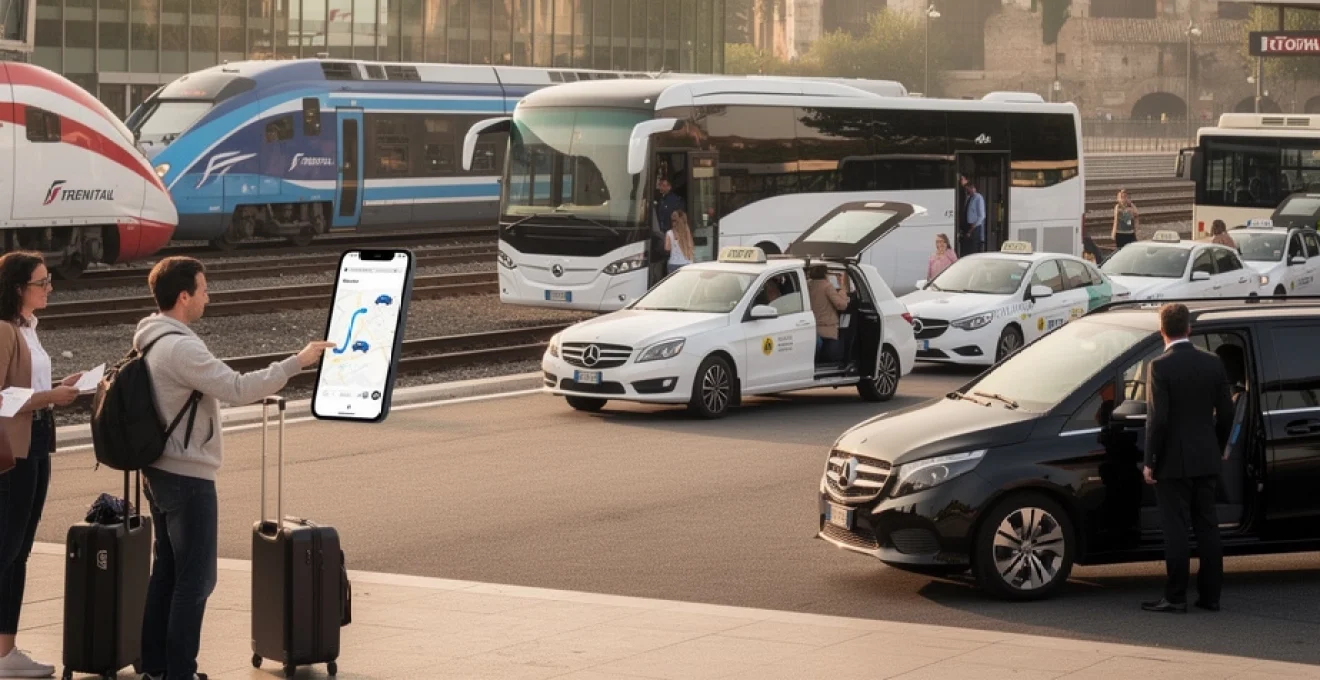
Navigating from either of Rome’s airports to the heart of the Eternal City presents travellers with an array of choices that can significantly impact your arrival experience. Whether you’re touching down at the sprawling Leonardo da Vinci-Fiumicino Airport or the more compact Ciampino facility, understanding the nuances of each transfer method—from express rail connections to pre-booked chauffeur services—ensures you’ll spend less time worrying about logistics and more time soaking in the timeless atmosphere of Italy’s capital. With prices ranging from as little as €6 for shared coach services to upwards of €60 for executive vehicles, selecting the right transfer option depends on your budget, schedule, group size, and tolerance for navigating unfamiliar public transport systems.
Leonardo da Vinci-Fiumicino airport transfer solutions
Leonardo da Vinci-Fiumicino Airport, commonly referred to simply as Fiumicino or FCO, sits approximately 34 kilometres southwest of Rome’s historic centre and processes more than 40 million passengers annually. As Italy’s busiest aviation hub, the facility offers travellers a comprehensive selection of ground transport options that balance speed, convenience, and cost-effectiveness. The airport’s modern infrastructure includes dedicated rail platforms, organised taxi ranks, and clearly signposted coach departure bays, making it relatively straightforward to continue your journey regardless of which transfer method you select.
When evaluating your options, consider not just the upfront cost but also factors such as journey duration during peak traffic periods, luggage capacity, proximity of the drop-off point to your accommodation, and whether you’ll need to navigate additional connections once you reach central Rome. Many seasoned travellers recommend researching your hotel’s exact location before arrival, as this knowledge significantly influences which transfer solution offers the best value proposition for your specific circumstances.
Roma termini railway station express train connections
The Leonardo Express represents the fastest and most reliable connection between Fiumicino Airport and central Rome, whisking passengers directly to Roma Termini Railway Station in precisely 32 minutes. This dedicated airport rail service operates every 15 minutes throughout the day, with departures commencing at 6:08 from the airport and continuing until 23:23, whilst the return service from Termini begins at 5:20 and concludes at 22:35. Standard adult tickets cost €14 when purchased in advance or from vending machines located throughout the airport terminal and at the rail station platform.
The train station at Fiumicino is located approximately a ten-minute walk from the customs exit, though the entire route features moving walkways, escalators, and lifts, making it manageable even with substantial luggage. Termini Station serves as Rome’s principal transport hub, providing immediate access to both Metro Line A and Metro Line B, as well as extensive local bus connections and regional rail services. This interconnectivity makes the Leonardo Express particularly valuable if your accommodation sits near any metro station, as you can seamlessly continue your journey without requiring additional taxi transfers.
An alternative rail option exists in the form of FL1 regional trains, which operate every 15 to 30 minutes and cost just €8 per journey. However, these services take approximately 50 minutes and bypass Termini entirely, instead stopping at Trastevere, Ostiense, Tuscolana, and Tiburtina stations. If your hotel sits in or near the charming Trastevere district, this regional service offers exceptional value, delivering you closer to your final destination at nearly half the cost of the express service.
Travellers should note that standard Rome public transport passes and the Roma Pass do not provide validity for Leonardo Express journeys, requiring separate ticket purchases regardless of your other transport arrangements within the city.
Private chauffeur services from FCO to city centre
For those prioritising comfort, convenience, and a stress-free arrival experience, private chauffeur services provide door-to-door transportation with a professional driver meeting you in the arrivals hall holding a personalised name sign. These pre-booked transfers eliminate the uncertainty of queue waiting times, language barriers, and navigation challenges, whilst offering vehicles ranging from executive sedans to spacious vans accommodating larger groups or families with substantial luggage requirements.
Standard private transfer pricing typically begins around €59 for
Standard private transfer pricing typically begins around €59 for an executive sedan transporting up to three passengers, rising to approximately €89 for a Mercedes Viano seating four to seven travellers, and around €95 for a larger Mercedes Vito accommodating up to eight people. These rates usually operate on a flat-fee basis for destinations within the Aurelian Walls, meaning you will not pay extra for moderate delays caused by traffic or for normal amounts of luggage. Many providers include flight monitoring, so if your plane lands early or late your driver will adjust the pick-up time accordingly, often with a short grace period for waiting included in the price. If you are travelling as a family or small group, dividing the fare between passengers can make a private transfer surprisingly cost-effective compared with multiple individual train or coach tickets. For late-night arrivals, travellers with mobility issues, or those unfamiliar with Rome’s layout, this “door-to-door” convenience can feel as reassuring as having a local friend waiting at the airport.
Shared shuttle bus routes via via marsala and piazza della repubblica
Shared shuttle buses from Fiumicino Airport offer a middle ground between low-cost public coaches and more expensive private transfers, combining door-to-door elements with budget-friendly pricing. Several operators run fixed or semi-flexible routes from the airport to central Rome, often following corridors around Via Marsala, Termini Station, and Piazza della Repubblica before continuing to popular hotel districts. Prices generally start from around €19–€25 per person one way, with discounts sometimes available for round trips or for groups booking multiple seats in advance.
These shared shuttles are particularly appealing if your accommodation lies within walking distance of Termini, Via Nazionale, or the Repubblica area, as you can often disembark at a stop only a few hundred metres from your hotel. However, since the vehicle may serve multiple passengers, journey times can be unpredictable—if your hotel is last on the route, expect additional time added to the typical 45–60 minute transfer. On the positive side, you avoid the stress of finding the correct city bus or metro with heavy luggage after a long flight. Think of a shared shuttle as a “carpool for the airport”: not as fast as a direct taxi, but far more convenient than navigating public transport with several suitcases in tow.
Most companies require online pre-booking, where you will provide your flight details and hotel address to allow route planning. You will then receive instructions on where to meet your driver, usually at a designated meeting point in the arrivals hall or just outside Terminal 3. If your flight is delayed, operators typically accommodate the change within reason, but at very busy times you might be shifted onto the next available vehicle. For travellers who prioritise predictable costs and a relatively simple journey into the city centre, shared shuttle transfers via Termini, Via Marsala, and Piazza della Repubblica can be an excellent compromise.
Official taxi tariffs and fixed-rate schemes to vatican city
Rome’s official white taxis operate from regulated ranks directly outside the arrivals area at Fiumicino, providing a straightforward means of reaching the city centre or Vatican City without pre-booking. For journeys between Fiumicino and any destination within the Aurelian Walls—including most central neighbourhoods such as the Historic Centre, Trastevere, and the Vatican area—the city has established a fixed fare of around €48–€50. This official flat rate includes luggage and up to four passengers and is designed to protect visitors from unexpected surcharges or route manipulation.
Travelling specifically to Vatican City or the surrounding Prati district, you can expect to pay this same fixed-city rate, which often compares favourably with private transfer prices, especially if you are sharing the taxi with two or three companions. The journey typically takes 40–60 minutes depending on traffic, with rush-hour congestion around the ring road and near St Peter’s Square sometimes extending travel times. As with many popular tourist destinations, unlicensed drivers may approach you inside the terminal offering “cheap taxis”; to avoid being overcharged, always decline these offers and instead join the official taxi queue outside.
Official taxis are easily recognisable: they are white, have a roof-mounted “TAXI” sign, and display their licence number on the doors and inside the vehicle. Before departure, you can confirm the fixed rate with the driver and check that the official tariff card is visible. While most drivers accept card payments, systems occasionally fail, so carrying sufficient cash as a backup is wise. If you prefer extra peace of mind or need an English-speaking driver, booking a private transfer remains a good alternative; however, for many travellers heading straight to Vatican City or central Rome, the fixed-rate taxi scheme offers a transparent and efficient solution.
Ciampino airport ground transportation methods
Ciampino Airport (CIA) lies roughly 15–16 kilometres southeast of Rome’s historic core and primarily handles low-cost carriers such as Ryanair and Wizz Air. Although smaller and more compact than Fiumicino, Ciampino lacks a direct rail connection, meaning all airport transfers rely on road-based options. The good news is that the limited size of the terminal makes navigating ground transport options relatively straightforward: bus stands and taxi ranks are just a short walk from the arrivals exit, with clear signage indicating the main coach operators and local services. Whether you prioritise cost, convenience, or speed, understanding the strengths and weaknesses of each transfer method will help you leave this budget-friendly airport with minimal hassle.
Because Ciampino’s passenger volume is high relative to its size, peak arrival times can produce queues both for shuttle buses and official taxis. Planning ahead—by pre-booking coach tickets or arranging a private transfer—can therefore be particularly valuable here. If your accommodation is near Termini Station, direct coaches are typically the simplest choice, while travellers heading to areas such as Trastevere or Testaccio might prefer a pre-booked car to avoid changing buses or metro lines with luggage. As with Fiumicino, we recommend checking your hotel’s precise location before choosing your transfer, as this often determines whether the lowest-priced option is really the best value in practice.
Terravision and SitBusShuttle coach services to termini
Among the most popular Ciampino Airport transfer solutions are the direct coach services operated by Terravision and SitBusShuttle, both of which connect the terminal with Roma Termini Station. Tickets typically cost from €6–€7 one way per adult, with occasional discounts for round trips or early online bookings, making these coaches one of the cheapest ways to travel between Ciampino and central Rome. Journey times average around 40–45 minutes, though heavy traffic during peak hours or on busy weekends can extend this to an hour.
Terravision buses usually depart from bus stop 1 just outside the arrivals terminal and run frequently throughout the day, with schedules aligned to many low-cost airline arrivals. SitBusShuttle services operate from nearby bus stop 2, following a similar route into the city and often including intermediate stops such as Vatican City or Via Aurelia on certain departures. Both operators allow you to purchase tickets online in advance, at airport kiosks, or directly from the driver if seats remain available. However, during high season or holiday periods, coaches can sell out, so advance booking is strongly recommended if you want to avoid waiting for later departures.
For travellers staying within walking distance of Termini or easily reachable via Metro Line A or B, these coach services strike an excellent balance between price and practicality. You simply collect your luggage, follow the signs to the bus stops, and board the next scheduled departure. For families or groups, the low per-person fare can represent significant savings compared with taxis. That said, if your flight lands late at night or you are travelling with very young children or bulky luggage, you might find a door-to-door taxi or private transfer more comfortable, even at a higher cost.
ATRAL regional bus links to anagnina metro station
Budget-conscious travellers who do not mind an extra connection can opt for the ATRAL regional bus service from Ciampino Airport to Anagnina, the southeastern terminus of Metro Line A. Single tickets start from around €2 per person, making this one of the absolute cheapest Rome airport transfers available, even after adding the small cost of a metro ticket into the city centre. The bus journey from the airport to Anagnina usually takes 15–20 minutes, after which the metro covers the remaining distance to central hubs such as Termini, Barberini, and Spagna in roughly another 20–25 minutes.
This combined bus-and-metro route works particularly well if your accommodation lies along Metro Line A—for example near stations like San Giovanni, Re di Roma, Flaminio, or Ottaviano (for the Vatican area). You simply board the ATRAL bus outside the terminal, alight at Anagnina, then transfer directly onto the metro network with minimal walking involved. Because both ATRAL and the metro operate at relatively high frequencies, total waiting times are usually short, especially during daytime hours. However, during late evenings or on public holidays, reduced timetables can make this option less convenient.
One caveat to consider is luggage: while there is space for bags on ATRAL buses and the metro, travelling with very large suitcases at rush hour can be uncomfortable, particularly when coaches or train carriages are standing-room only. Additionally, understanding where to change lines or which station is closest to your hotel may require some advance research. If you enjoy using local public transport and want to minimise your overall spend, the ATRAL–Anagnina–metro combination can feel like an efficient puzzle to solve. But if you prefer to avoid crowds and stairs after a flight, the small savings compared with a direct coach or taxi may not justify the additional complexity.
Pre-booked transfer vehicles to trastevere and testaccio districts
Travellers staying in characterful neighbourhoods such as Trastevere or Testaccio often find that pre-booked transfer services from Ciampino deliver the smoothest arrival experience. Because these districts sit a little outside the main rail and metro axes, reaching them via coach and public transport can require multiple changes—typically a bus or coach to Termini, followed by a tram, secondary bus, or taxi. By contrast, a pre-arranged car or minivan will collect you directly from the arrivals area and drop you right at your accommodation, eliminating the need to manage luggage across several crowded vehicles.
Prices for private transfers from Ciampino to central areas like Trastevere and Testaccio generally start from around €59 for a sedan (up to three passengers) and increase for larger vehicles such as Mercedes V-Class vans capable of carrying families and groups with extensive luggage. When you divide this cost among several travellers, the per-person price can rival or even undercut a combination of coach tickets and subsequent taxi fares. Many providers offer transparent flat rates that include waiting time for moderate flight delays and assistance with luggage, which can be especially helpful if you are arriving late at night or travelling with children.
Another advantage of pre-booked vehicles is the ability to specify additional requirements in advance, such as child seats, accessibility needs, or extra space for sports equipment like bicycles or ski gear. Your driver will typically track your flight number, meet you in the arrivals hall, and escort you to a nearby parking area where the car or van is waiting. For many visitors, this seamless transition from plane to private vehicle can turn what might otherwise feel like a stressful first encounter with Rome’s transport network into a calm, predictable experience—much like stepping into a hotel lobby rather than a busy bus terminal.
App-based ride-hailing platforms: uber, free now, and IT taxi
Alongside traditional taxis and pre-booked chauffeur services, Rome also offers several app-based ride-hailing options, including Uber (in its licensed forms such as Uber Black), Free Now, and IT Taxi. Unlike in some cities where Uber operates a low-cost peer-to-peer model, Italian regulations mean that app-based services primarily function as a way to request licensed taxis or chauffeur-driven hire cars (NCC), often at rates comparable to or slightly higher than standard cabs. The key advantage lies in convenience and transparency: you can see estimated fares in advance, track your driver’s approach in real time, and pay securely via the app without needing cash.
From either Fiumicino or Ciampino, you can use these apps to arrange a pick-up once you have collected your luggage and passed through customs, though at peak times you may face a short wait while drivers navigate airport traffic and security checkpoints. Because fares are influenced by distance, time, and occasional surge pricing, costs from Fiumicino to central Rome typically fall somewhere between the official taxi fixed rate and the higher-end private transfer tariffs. From Ciampino, the shorter distance often translates into more modest fares, though you should always compare the in-app estimate with known fixed-tariff options before confirming your ride.
For travellers who prefer digital receipts, card payments, and the ability to rate their driver, ride-hailing apps can feel like the best of both worlds: you still travel in a licensed vehicle, but with the user-friendly interface of a familiar platform. Do you worry about language barriers when explaining your hotel address? App-based bookings largely remove this issue, as your destination is communicated directly via the app. That said, coverage can fluctuate during major events or strikes, and pick-up points at airports may be slightly removed from the main taxi ranks, requiring you to follow in-app directions carefully to avoid confusion.
Rome public transport integration: metro line A and B connections
Rome’s public transport network, operated primarily by ATAC and Trenitalia, plays a crucial role in many airport transfer strategies, particularly for travellers keen to minimise costs or avoid road traffic. While neither Fiumicino nor Ciampino has a metro station at the terminal itself, both airports connect efficiently to the metro grid via trains, buses, and dedicated coach services. Once you reach a major hub such as Termini, Tiburtina, or Anagnina, Metro Lines A and B allow you to move quickly across the city, linking key landmarks—from the Vatican Museums and Spanish Steps to the Colosseum and EUR district—with your accommodation.
When planning your airport transfer in Rome, thinking of the metro as the “spine” of your journey can be helpful, with trains and buses feeding into it like ribs. For example, the Leonardo Express delivers you straight into Termini, where you can hop onto either Line A or B, while ATRAL buses from Ciampino drop you at Anagnina on Line A. Many visitors choose to purchase integrated tickets or passes that cover metro, bus, and tram travel within the city, which can offer excellent value if you expect to use public transport frequently after your airport transfer. However, it is essential to understand which services are included and which—such as the Leonardo Express—require separate tickets.
Anagnina and laurentina terminus points for airport access
Anagnina (Line A) and Laurentina (Line B) serve as important terminus points for travellers using Rome’s metro in conjunction with airport buses. As mentioned earlier, ATRAL buses from Ciampino link directly to Anagnina, making it a strategic gateway for those heading towards central locations like Termini, Barberini, or Spagna, as well as to Vatican-area stops such as Ottaviano. Because Anagnina lies outside the most tourist-heavy zones, trains departing from here often have more available seating, which can be a welcome relief if you are carrying luggage.
Laurentina, at the southern end of Metro Line B, does not have a dedicated airport bus from Fiumicino or Ciampino, but it is a key reference point for travellers staying in the modern EUR business district or using regional buses that intersect with the metro network. Some Cotral or regional services from Fiumicino stop at metro-accessible points like Eur-Magliana or Cornelia, which then connect you quickly to Laurentina or Anagnina via Line B or Line A respectively. While this approach requires more planning than a straightforward coach to Termini, it can save both time and money if your hotel is located closer to these outer metro hubs.
If you enjoy navigating city systems, using these terminus stations can feel like solving a satisfying puzzle: match the airport bus or train to the nearest metro node, then ride underground to within a few blocks of your accommodation. For others, however, the need to change between different modes of transport—sometimes with stairs or escalators involved—may make a direct taxi or private transfer more appealing. As always, the right choice depends on your luggage load, arrival time, and comfort level with urban transit.
ATAC bus network routes 40, 64, and night services
Once you have reached central Rome via airport train, coach, or shuttle, the ATAC bus network can provide the “last mile” connection to your hotel, especially if you are not staying directly on a metro line. Two of the most commonly used routes by visitors are bus 40 and bus 64, both of which run from Termini toward key historic districts. Route 40 offers a faster, limited-stop service towards Piazza Venezia and the Vatican area, while route 64 makes more intermediate stops but follows a similar general path towards St Peter’s Basilica.
If your flight arrives late or you anticipate being out after the metro closes (around 23:30–00:30 depending on the day), Rome’s night bus network can become an important part of your transfer strategy. Several night routes radiate from Termini and other hubs, allowing you to reach many neighbourhoods even in the small hours of the morning. However, frequencies are lower than daytime services, so you may experience longer waits; checking updated schedules on ATAC’s official website or app before travel is strongly advised. Night buses can be busier on weekends, and while they are generally safe, common-sense precautions—such as keeping valuables out of sight—remain important.
For many travellers, combining an airport coach or train with a short ATAC bus ride offers an excellent balance of cost and coverage. A typical itinerary might involve landing at Fiumicino, taking the Leonardo Express to Termini, then boarding bus 64 to reach a hotel near the Vatican. Or, from Ciampino, you could ride a Terravision coach into Termini and then use bus 40 to approach central landmarks like Largo Argentina. Because standard ATAC tickets and passes cover both buses and metro, you can often complete your final segment without any additional fare purchases beyond your regular urban ticket.
Trenitalia regional trains from tiburtina to fiumicino
While most visitors associate Fiumicino with the Leonardo Express, Trenitalia’s FL1 regional train line also provides a valuable connection between the airport and several key city stations, including Tiburtina. For travellers staying in or around the Tiburtina area—or needing onward regional or high-speed rail connections—using the FL1 can be both cheaper and more direct than travelling via Termini. A single ticket from Fiumicino to Tiburtina costs around €8, roughly half the price of the Leonardo Express, with journey times of about 45–50 minutes depending on intermediate stops.
Tiburtina itself functions as a major transport hub, hosting long-distance buses, regional trains, and high-speed services to cities like Florence, Bologna, and Milan. If you are planning to continue your journey beyond Rome immediately after landing, routing via Tiburtina instead of Termini can sometimes simplify your itinerary and reduce total travel time. The station also connects to Metro Line B, allowing easy access to districts such as the Colosseum area, EUR, and the central business zones. However, if your accommodation is located near Termini or on Metro Line A, the Leonardo Express combined with a short metro ride may still be more efficient despite the higher fare.
When deciding between the FL1 and the Leonardo Express, consider your final destination in Rome, your budget, and your tolerance for slightly longer journey times. The FL1 behaves rather like a “commuter rail” service: less glamorous and a bit slower, but often more practical for reaching specific neighbourhoods like Trastevere, Ostiense, or Tiburtina without needing to backtrack from Termini. Remember that FL1 tickets must be validated in the green or yellow machines before boarding to avoid fines, and that standard urban transport passes typically do not cover this airport segment unless explicitly specified in your ticket conditions.
Roma pass validity and integrated ticketing options
Many visitors to Rome consider purchasing tourist passes such as the Roma Pass or Rome travel cards, which bundle museum entries with public transport access. Understanding how these passes interact with airport transfers is crucial for avoiding unexpected costs. In general, urban travel components included in most city passes cover ATAC buses, trams, Metro Lines A, B, and C, and certain local rail services within the city zone. However, premium airport connections like the Leonardo Express are usually excluded and require separate tickets, even if you hold a valid pass for standard public transport.
Some package products—such as combined Rome Tourist Cards or 72-hour travel cards—offer optional airport transfer add-ons, often via coach services from Fiumicino or Ciampino to Termini. If you know you will be relying on public transport heavily during your stay, opting for a bundle that includes both city transport and airport transfers can deliver solid value and simplify your planning. Conversely, if you plan to walk most of the time and only use the metro sporadically, buying single tickets or a simple daily pass while keeping your airport transfer separate may prove more economical.
When evaluating integrated ticketing options, think of your total mobility “budget” for the trip: how many journeys are you likely to make per day, and how many involve the airport itself? Because airport transfers often account for a disproportionate share of your transport spend, it makes sense to compare the cost of dedicated transfer tickets against any promised savings from bundled products. Carefully reading the small print—especially regarding which trains and zones are included—will prevent surprises, such as boarding a service you assumed was covered only to discover it is not. If in doubt, treat airport transfers as special cases outside your usual urban transport calculations.
Luxury transfer options: mercedes V-Class and executive sedan services
For travellers who prioritise comfort, privacy, and a premium arrival experience, luxury transfer services using vehicles such as Mercedes V-Class vans and executive sedans represent the top tier of Rome airport transport. These services are typically pre-booked and include personalised meet-and-greet in the arrivals hall, assistance with luggage, and spacious, climate-controlled interiors that feel more like a mobile lounge than a standard taxi. Whether you are arriving for a business trip, special occasion, or simply prefer to start your Roman holiday in style, such transfers transform the journey from airport to hotel into an integral part of the overall experience.
Pricing for luxury airport transfers from Fiumicino or Ciampino to central Rome generally ranges from around €70–€120 depending on vehicle class, time of day, and extras such as champagne or multilingual chauffeur service. A Mercedes E-Class sedan might sit at the lower end of this range for up to three passengers with light luggage, while a Mercedes V-Class or similar premium van suitable for families, executive groups, or travellers with substantial baggage will usually command a higher fee. Unlike metered taxis, these transfers are almost always offered as flat-rate packages, so you know the final cost in advance regardless of minor route changes or traffic conditions.
In addition to superior comfort, luxury transfers often include subtle but valuable benefits: drivers familiar with high-end hotels and embassy districts, discretion for VIP passengers, and the flexibility to accommodate last-minute itinerary changes within reason. If you are travelling with elderly relatives or clients, the ability to avoid crowded coaches, escalators, and ticket machines can be worth far more than the additional euro cost. Think of these services as the “business class” of ground transport—an indulgence not strictly necessary for everyone, but one that can significantly reduce travel fatigue and set a positive tone for the rest of your stay.
Cost-benefit analysis: comparing transfer methods from EUR 6 to EUR 60
With Rome airport transfer prices spanning from as little as €6 for basic coach services to well over €60 for luxury private vehicles, deciding which option suits you best requires balancing several factors: budget, time, comfort, and complexity. Low-cost buses like Terravision or SitBusShuttle from Fiumicino and Ciampino offer unbeatable prices for solo travellers or couples who do not mind sharing space with other passengers and potentially facing traffic-related delays. At the opposite end of the spectrum, executive sedans and Mercedes V-Class vans deliver maximum comfort and simplicity, especially for groups or families who can split the fare, but at a significantly higher upfront cost.
For many visitors, mid-range solutions such as the Leonardo Express, FL1 regional trains, or shared hotel shuttles deliver the best overall value. The Leonardo Express, for instance, costs more than the bus but offers predictable 32-minute journeys unaffected by road congestion, which can be invaluable if you are catching a train or tour soon after landing. Similarly, FL1 regional trains and ATRAL–metro combinations appeal to those comfortable with public transport who want to save money while still maintaining reasonable travel times. When comparing options, it helps to calculate not just the absolute ticket price, but also the “hidden cost” of potential delays, extra connections, and physical effort in moving luggage between modes.
So how should you choose? If you are travelling light, arriving during the day, and staying near Termini or a metro station, trains and coaches provide excellent value. If you are landing late at night, carrying heavy luggage, or staying in a district poorly served by direct public transport—such as parts of Trastevere, Testaccio, or the Vatican area—a taxi or pre-booked private transfer may save you stress and, in some cases, even money once you factor in additional local transit. Families and groups should always divide the total fare by the number of travellers; often, what appears expensive at first glance becomes quite reasonable on a per-person basis.
Ultimately, choosing the best Rome airport transfer is less about finding a single “perfect” solution and more about matching the right tool to your specific journey. Just as you would not use a sports car to move house or a removal van for a quick trip to the shop, different transfer methods shine in different scenarios. By weighing your priorities—speed versus savings, simplicity versus flexibility—you can create a tailored plan that turns your arrival in the Eternal City into a smooth prologue to the adventures that await.