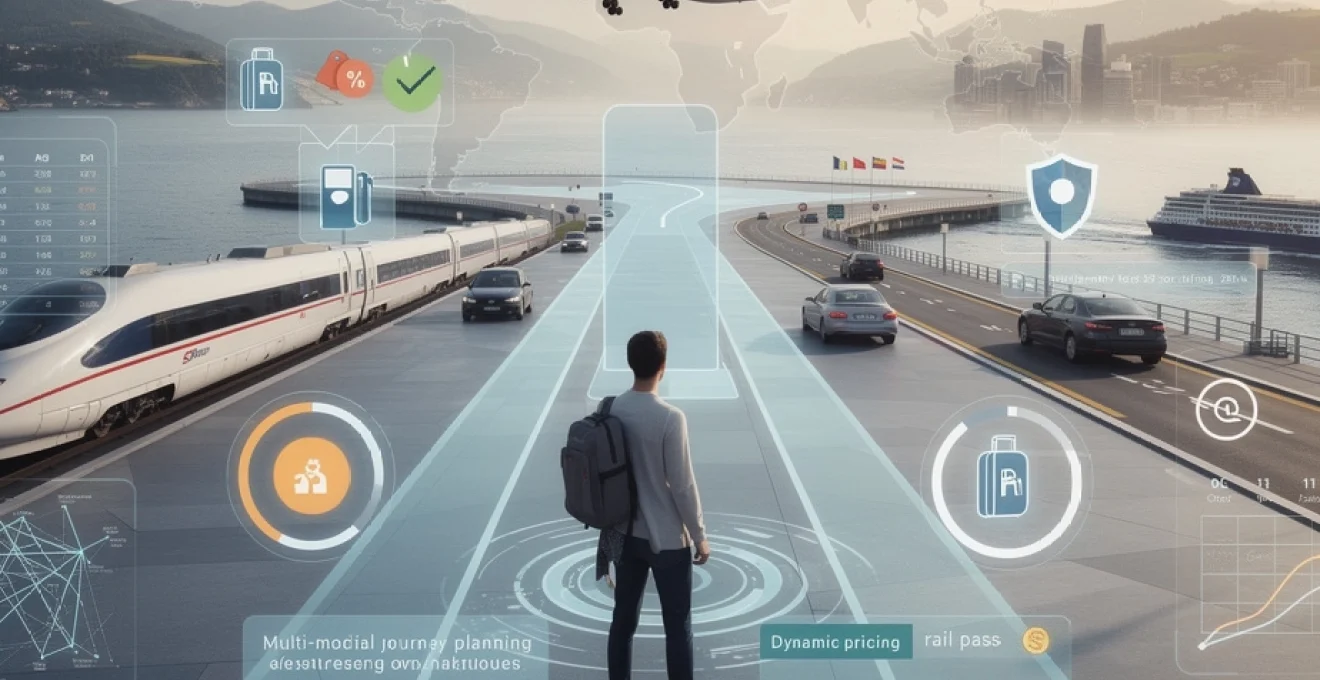
Modern travel presents an overwhelming array of transportation options, each with distinct advantages and limitations that can significantly impact your journey’s success. Whether you’re planning a business trip across Europe, a family holiday to distant shores, or a weekend getaway to neighbouring countries, selecting the optimal transport mode requires careful consideration of multiple factors including cost, time efficiency, comfort levels, and environmental impact. The transportation landscape has evolved dramatically in recent years, with high-speed rail networks expanding across continents, budget airlines revolutionising air travel accessibility, and digital platforms transforming how travellers plan and book their journeys.
The complexity of modern transport systems means that what appears to be the most obvious choice isn’t always the most practical or economical option. A seemingly inexpensive flight might become costly when factoring in airport transfers, baggage fees, and time spent in terminals, whilst a more expensive train ticket could offer superior value when considering city-centre to city-centre convenience and productivity during travel. Understanding these nuances and developing a systematic approach to transport selection can save you significant time, money, and stress whilst enhancing your overall travel experience.
Modal transport classification and journey duration analysis
Understanding the fundamental characteristics of different transport modes provides the foundation for making informed travel decisions. Each transportation category operates within specific parameters of speed, capacity, infrastructure requirements, and operational constraints that directly influence their suitability for particular journey types. The modern traveller must navigate between traditional transport methods that have been refined over decades and emerging mobility solutions that leverage technological advances to offer new possibilities.
High-speed rail networks: eurostar, TGV, and shinkansen comparative performance
High-speed rail represents one of the most significant advances in ground transportation, offering commercial speeds exceeding 250 kilometres per hour whilst maintaining exceptional safety records and environmental efficiency. The Eurostar network connects London with continental Europe through the Channel Tunnel, achieving journey times of just over two hours between London and Paris, effectively competing with air travel when considering total door-to-door travel time. The French TGV system extends this high-speed capability across France and into neighbouring countries, with some services reaching operational speeds of 320 kilometres per hour on dedicated tracks.
Japan’s Shinkansen, often considered the gold standard for high-speed rail, demonstrates remarkable punctuality with average delays of less than one minute, combined with frequencies that allow departure intervals of just four minutes during peak periods. These systems excel for medium-distance journeys between major urban centres, typically offering optimal efficiency for distances between 200 and 800 kilometres. The infrastructure investment required for high-speed rail is substantial, but the resulting capacity can handle over 400,000 passengers daily on busy corridors, making it an exceptionally efficient mass transit solution.
Commercial aviation route efficiency and hub-and-spoke versus point-to-point models
Commercial aviation operates through two primary network models that significantly influence route availability, pricing, and journey times. The traditional hub-and-spoke model, employed by major legacy carriers, concentrates flights through central airports where passengers connect to reach their final destinations. This system maximises aircraft utilisation and enables service to smaller destinations that couldn’t support direct flights, but often increases total journey time and introduces connection risks.
Point-to-point operations, pioneered by low-cost carriers, focus on direct routes between city pairs with sufficient demand to support regular service. This model typically offers faster journey times and reduces the risk of missed connections, but limits destination options and may result in higher fares for less popular routes. The choice between these models affects not only your travel experience but also pricing structures, with hub-and-spoke systems often offering more complex fare rules and point-to-point carriers emphasising transparent, simple pricing.
Road transport logistics: motorway networks and cross-border regulations
Road transport offers unparalleled flexibility and door-to-door convenience, but journey efficiency depends heavily on infrastructure quality and traffic management systems. European motorway networks provide generally excellent connectivity between major cities, with consistent standards for road quality, signage, and services. However, journey times can vary significantly based on traffic conditions, seasonal patterns, and time of day, making accurate planning more challenging than with scheduled transport modes.
Cross-border travel by road involves additional considerations including tolls, fuel prices, insurance requirements, and driving regulations that vary between countries. The European Union has standardised many aspects of cross-border motoring, but trav
isation of driving licences, vehicle standards, and basic road rules, but travellers must still familiarise themselves with country-specific regulations such as speed limits, low-emission zones, and vignette requirements for motorways. Additionally, right-of-way rules, drink-driving limits, and requirements for carrying safety equipment (such as reflective vests or warning triangles) can differ substantially. For long-distance trips, you should also factor in rest periods, potential border checks in non-Schengen areas, and the availability of service areas that match your needs for fuel, food, and rest.
Journey duration by road is particularly sensitive to congestion, road works, and incidents, making real-time navigation tools essential for accurate planning. Intelligent transport systems and apps that provide live traffic data can significantly reduce delays by suggesting alternative routes or departure times. When comparing road transport to rail or air for your trip, it is useful to consider not only the nominal driving time but also predictable bottlenecks, peak-hour patterns, and seasonal tourist flows. In practice, road transport is most competitive for flexible itineraries, multi-stop trips, and routes where public transport coverage is limited, whereas fixed-schedule modes tend to win on predictability and stress reduction for longer journeys.
Maritime ferry services and cruise liner scheduling considerations
Maritime transport occupies a unique position in the spectrum of travel options, combining both functional point-to-point services and leisure-focused journeys. Ferries are a practical means of crossing straits, channels, and archipelagos where bridges or tunnels are not available or convenient. In regions such as Scandinavia, the Mediterranean, and Southeast Asia, regular ferry routes operate on fixed timetables, with journey durations ranging from under an hour for short hops to overnight sailings for longer crossings. These services often allow passengers to travel with vehicles, making them a key component in door-to-door itineraries that mix road and sea.
Cruise liners, by contrast, prioritise the travel experience over speed, effectively turning the journey into the destination. Cruise itineraries follow seasonal patterns, optimising for weather and port availability, and can involve complex scheduling around port slots, fuel optimisation, and international maritime regulations. For travellers, the main considerations when choosing maritime transport include sailing frequency, onboard facilities, cabin comfort, and the reliability of schedules in adverse weather conditions. While ferries and cruises rarely offer the fastest means of transport, they can provide cost-effective and enjoyable alternatives, particularly when overnight travel reduces the need for hotel stays.
Cost-benefit analysis framework for transport selection
Developing a structured cost-benefit framework allows you to compare transport options on more than just ticket price. True journey cost includes not only the fare, but also transfers, baggage fees, meals in transit, and the value of your time. On the benefit side, we must consider convenience, comfort, productivity during travel, and flexibility if plans change. Thinking of your trip like a small project budget can be helpful: you allocate money, time, and energy, and aim to maximise the overall return in terms of experience and efficiency.
To apply this framework, start by defining your priorities for the specific journey. Is your primary goal to minimise expenses, arrive as quickly as possible, reduce your carbon footprint, or maintain a high level of comfort? Once your priorities are clear, you can assess each mode of transport using a simple scorecard that evaluates total cost, total time door-to-door, level of stress, and environmental impact. This structured approach also makes it easier to justify choices for business travel, where policy, duty of care, and sustainability targets may influence acceptable options.
Dynamic pricing algorithms in airline booking systems
Airline pricing is a textbook example of dynamic algorithms working in real time to balance supply and demand. Rather than fixed fares, airlines use revenue management systems that adjust prices based on booking pace, historical demand, competition, and remaining seat inventory. This is why the same flight can display multiple prices within a single day and why booking too late or too early can sometimes be more expensive than securing a seat in a “sweet spot” window, often 6–8 weeks before departure for short-haul and 2–4 months for long-haul routes. For popular holiday periods or major events, algorithms anticipate higher demand, pushing prices up as departure approaches.
From a practical standpoint, how can you work with, rather than against, these dynamic pricing systems when choosing the best means of transport for your trip? Monitoring fares over several days, setting price alerts, and being flexible with departure times or nearby airports can unlock significant savings. It can help to think of airline prices like a constantly moving stock ticker: what you see at one moment is not static, and small changes in search dates, times, or even the number of travellers in a single booking can trigger different fare buckets. Combining flight search with comparisons against rail or coach options ensures you are not misled by an apparently attractive fare that may become less competitive once all fees and constraints are accounted for.
Rail pass economics: eurail, BritRail, and regional transport cards
Rail passes such as Eurail, Interrail, and BritRail offer an alternative pricing structure to single tickets, particularly attractive for itineraries involving multiple legs across several days or weeks. Instead of paying per journey, you purchase access for a certain number of travel days within a fixed period, gaining flexibility to adapt your route on the go. The economic value of these passes depends on how intensively you use them: the more medium- to long-distance trips you make on your travel days, the lower the effective cost per journey. For travellers planning two or three major rail segments in a week, passes can already start to rival or undercut individual ticket prices, especially when you include reservations in high-speed services where required.
Regional and city transport cards extend this logic to local travel, bundling buses, trams, and suburban trains into flat daily or weekly rates. When comparing a rail pass to point-to-point tickets, consider not just headline prices but also reservation costs, peak versus off-peak restrictions, and potential discounts for youth, seniors, or families. A useful analogy is a buffet versus à la carte dining: if you plan to “consume” lots of train kilometres, the buffet-style rail pass is likely good value; if you are only “snacking” with occasional journeys, individual tickets or advance-purchase deals might be more economical. Reviewing sample itineraries and adding up hypothetical single fares before committing to a pass is a simple but effective sanity check.
Vehicle rental total cost of ownership including insurance and fuel
Rental vehicles can appear inexpensive at first glance, but a full cost-of-ownership perspective quickly reveals additional layers. Beyond the base daily rate, you need to factor insurance (collision damage waiver, third-party liability, theft protection), fuel consumption, tolls, parking fees, and possible one-way drop-off charges. In some destinations, young driver surcharges or cross-border fees can substantially increase the daily cost, making other modes of transport more attractive. When choosing the best means of transport for your trip, especially for small groups or families, it is important to calculate the per-person cost of a rental car versus rail or coach alternatives.
A good way to visualise this is to imagine a spreadsheet with columns for every foreseeable cost category: rental rate, insurance, fuel estimate based on distance and average consumption, road tolls, parking at both ends, and any extras such as child seats or GPS units. By filling in realistic numbers, you can compare the car’s total cost with the combined cost of public transport tickets for all travellers. Sometimes the car wins decisively for rural itineraries with dispersed attractions; in other cases, high parking costs in major cities erode any advantage. Being transparent with yourself about all these elements helps you avoid the common trap of underestimating road travel expenses.
Budget airline ancillary revenue models and hidden cost structures
Low-cost carriers have transformed short-haul travel by offering headline fares that can be dramatically lower than traditional airlines. However, these fares are underpinned by ancillary revenue models that monetise almost every aspect of the journey beyond the basic seat. Checked baggage, cabin baggage above minimal allowances, seat selection, priority boarding, payment method fees, and even airport check-in can attract surcharges. From a cost-benefit perspective, this means that what looks like the cheapest option may no longer be so once you add the services you genuinely need.
To navigate these hidden cost structures effectively, start by listing your minimum requirements for a comfortable and workable journey. Do you need a checked bag, or can you travel light with a cabin-sized suitcase? Are you happy with a random seat assignment, or is sitting together as a group essential? Think of the base fare as an entry ticket, with every additional feature priced à la carte. When you add up the total, compare it not only to other low-cost flights, but also to high-speed rail or coach services, which often include luggage and seat choice in their standard fares. In many busy European corridors, once all extras are included, rail can match or even beat the real cost of budget flights whilst also reducing airport-related friction.
Geographical route optimisation and infrastructure assessment
Choosing the best means of transport for your trip also depends heavily on geography and the quality of local infrastructure. Travel across dense, well-connected corridors such as London–Paris–Brussels, Tokyo–Osaka, or New York–Washington presents a very different optimisation problem from navigating sparsely populated regions or islands with limited public transport. Efficient route planning requires you to look beyond simple point-to-point distances and consider the topology of networks: where are the main hubs, which corridors have high-frequency services, and where do natural barriers like mountains or seas impose constraints?
One practical approach is to compare realistic door-to-door times for at least two competing options on your key segments. For example, moving between two European capitals might involve a direct high-speed train, a short-haul flight, or a long-distance coach. On paper, the flight appears fastest, but once you include transfers to and from airports, security screening, and boarding procedures, the rail option often comes out ahead for distances under 800 kilometres. In regions with limited rail infrastructure, improved motorway networks may tip the balance in favour of driving, especially when you can combine multiple stops in a single day. As you evaluate your route, consider not just how you will reach major nodes but also how easy it is to access your exact accommodation, meeting venues, or attractions from each terminal.
Infrastructure resilience and reliability are equally important. Are the railways in your destination known for punctuality and frequent service, or are delays and cancellations common? Are seasonal weather patterns likely to disrupt road or air travel, such as heavy snowfall, monsoons, or hurricane seasons? An analogy that often helps is to think of your itinerary as a chain: its overall strength depends on the weakest link, be that an infrequent ferry crossing, a congested mountain pass, or a single daily flight that leaves no room for missed connections. By identifying these potential pinch points early, you can introduce buffers into your schedule or choose alternate modes that offer greater redundancy.
Passenger experience metrics and service quality indicators
Beyond time and cost, the quality of your journey can strongly influence whether you arrive energised or exhausted. Passenger experience metrics help translate subjective impressions into more comparable criteria. Common indicators include seat pitch and width, noise levels, cleanliness, onboard Wi‑Fi, availability of power outlets, catering quality, and staff responsiveness. For business travellers, the ability to work productively en route can be a decisive factor, turning travel time into usable office hours rather than wasted downtime. For families, space to move, child-friendly facilities, and easy access to toilets may matter more than pure speed.
How can you assess these service quality indicators before you travel? Reviews from other passengers, independent quality rankings, and operator-provided specifications all play a role. Many rail operators and airlines now publish seat maps, cabin layouts, and amenity listings online, allowing you to compare comfort levels in advance. Think of these metrics as similar to hotel star ratings: while not perfect, they provide a helpful baseline. A slightly slower train with roomy seating, quiet carriages, and reliable connectivity might deliver a far better overall experience than a cramped flight filled with queues and restrictions, especially on medium-distance journeys where the time difference is marginal.
Accessibility and inclusivity are vital components of the passenger experience, particularly for travellers with reduced mobility, sensory sensitivities, or specific medical needs. When choosing the best means of transport for your trip, consider whether terminals and vehicles offer step-free access, priority seating, assistance services, and clear signage. Some transport modes, such as modern high-speed trains and newer metro systems, tend to perform better in this regard than older rolling stock or small regional airports. Evaluating these factors in advance not only reduces stress but also ensures that all members of your travel party can move comfortably and safely throughout the journey.
Environmental impact assessment and carbon footprint calculations
As climate awareness grows, environmental impact has become a central consideration in transport selection. Different modes of transport have markedly different carbon footprints per passenger-kilometre. According to the European Environment Agency, domestic flights can emit several times more CO2-equivalent per passenger-kilometre than modern electric rail services, while long-distance coaches often perform competitively with trains due to high occupancy rates. Choosing the best means of transport for your trip increasingly involves weighing these environmental costs alongside time and budget.
Calculating your travel carbon footprint no longer requires complex manual work. Many airlines, rail operators, and independent tools provide emissions estimates during booking, allowing you to compare options in real time. A useful analogy is thinking of your carbon budget like a financial one: each journey “spends” a portion of it, and you can decide where higher-impact travel is justified and where lower-impact alternatives are acceptable. For example, you might opt for rail or coach on medium-distance routes to keep emissions low, reserving air travel for intercontinental legs where alternatives are impractical. Some travellers and organisations go further by incorporating internal carbon prices into their decision-making, effectively treating high-emission modes as more expensive than their ticket prices alone would suggest.
Beyond CO2, environmental assessment can also consider noise pollution, air quality around terminals, and land-use impacts of infrastructure. Urban rail and tram systems, for instance, can reduce car dependency and congestion, contributing to more liveable cities. Car-sharing and ride-pooling schemes can lower the number of vehicles needed to move the same number of people, especially for commuting or airport transfers. When you apply an environmental lens to your route planning, you often discover that more sustainable choices—such as walking or cycling for short distances, using high-speed rail between major cities, or combining public transport with occasional rideshare for the “last mile”—also reduce stress and sometimes even total travel time.
Digital booking platforms and multi-modal journey planning systems
The final piece of the puzzle is how you actually plan and book your chosen combination of transport modes. Digital booking platforms and multi-modal journey planners have transformed this process by aggregating data from airlines, rail companies, bus operators, car rental agencies, and urban mobility providers. Instead of researching each segment separately, you can now compare complete door-to-door itineraries that combine, for example, a regional train, a high-speed rail leg, and a local tram, all within a single interface. These systems often present estimated total travel times, fares, transfer durations, and even platform or gate information, helping you see at a glance which option best fits your schedule and budget.
For travellers, one of the greatest advantages of multi-modal platforms is the ability to test “what if” scenarios quickly. What if you left two hours later—would a slower but cheaper train become viable? What if you flew into a secondary airport and finished the journey by express bus—would you still arrive on time for your meeting? In a sense, these tools function like advanced navigation systems for the entire transport ecosystem, allowing you to chart an optimal route through a complex landscape. They can also surface real-time updates on delays, cancellations, and gate changes, enabling you to adjust plans proactively rather than reactively.
When using digital platforms to choose the best means of transport for your trip, it is still important to apply critical judgement. Not all operators are always included in every search engine, and some tools may favour partners with commercial relationships. Cross-checking key legs on official operator sites, especially for rail and long-distance bus services, can reveal additional fare classes or promotions. For frequent business travellers or families planning multi-stop holidays, creating a simple, repeatable workflow—identify your top two route options, compare them on cost, time, comfort, and emissions, then monitor any critical segments for schedule changes—can turn what once felt like guesswork into a reliable, data-informed process.