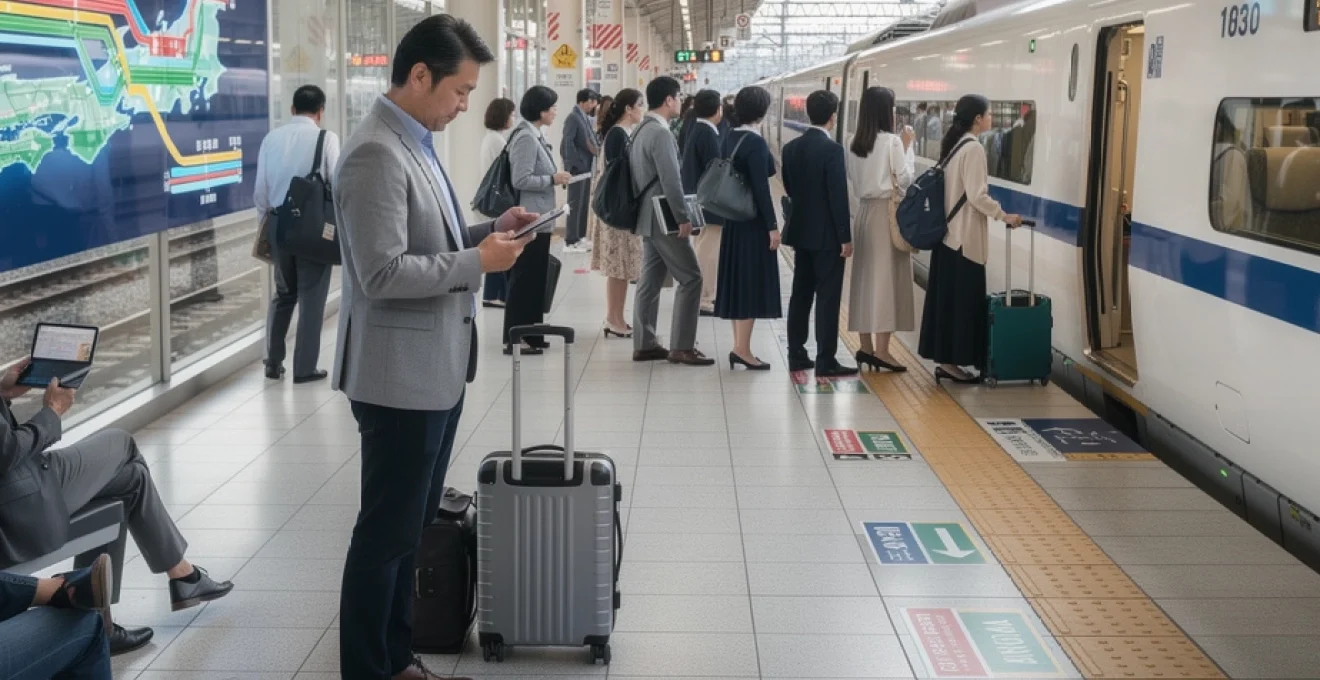
Japan’s Shinkansen represents the pinnacle of high-speed rail technology, transforming the way millions of passengers traverse the archipelago daily. Since its inaugural journey in 1964, this revolutionary transport system has maintained an impeccable safety record whilst consistently delivering punctual service across multiple prefectures. The bullet train network spans over 2,700 kilometres, connecting major urban centres with remarkable efficiency and comfort that continues to set global standards for rail transportation.
Mastering the Shinkansen system requires understanding its complex operational structure, reservation protocols, and the nuances that separate casual tourists from seasoned travellers. The network’s sophistication extends beyond mere speed, encompassing intricate scheduling systems, multiple service classifications, and regional variations that can significantly impact your journey experience. Whether you’re planning a business trip between Tokyo and Osaka or exploring Japan’s northern territories, comprehending these operational intricacies will transform your rail travel experience from potentially overwhelming to seamlessly efficient.
Understanding japan’s High-Speed rail network architecture and route classifications
The Shinkansen network operates through a sophisticated hub-and-spoke system that interconnects Japan’s major population centres via dedicated high-speed tracks. Unlike conventional railways that share infrastructure with freight services, the Shinkansen maintains exclusive rights-of-way, enabling consistent high-speed operations without interference from slower traffic. This architectural decision, implemented during the original Tōkaidō line construction, has proven instrumental in maintaining the system’s legendary punctuality rates exceeding 99.9%.
Each Shinkansen line operates under distinct service classifications that determine stopping patterns, journey times, and fare structures. The fastest services, designated as Nozomi and Mizuho, connect major metropolitan areas with minimal intermediate stops, whilst slower classifications serve regional destinations more comprehensively. Understanding these service hierarchies enables strategic journey planning that balances travel time against accessibility to specific destinations throughout Japan’s diverse geographical landscape.
Tōkaidō shinkansen: Tokyo-Osaka corridor operations and service patterns
The Tōkaidō Shinkansen forms the backbone of Japan’s high-speed rail network, handling approximately 165 million passengers annually along the 515-kilometre corridor between Tokyo and Shin-Osaka. This line operates three distinct service classifications: Nozomi trains complete the journey in approximately 2 hours and 15 minutes, stopping only at Shinagawa, Shin-Yokohama, Nagoya, and Kyoto stations. The semi-express Hikari services add approximately 30 minutes to the journey time whilst serving additional stations including Odawara, Atami, and Hamamatsu.
The local Kodama services provide comprehensive coverage of all 17 stations along the route, requiring approximately 4 hours for the complete Tokyo-Osaka journey. During peak periods, the line operates up to 13 trains per hour in each direction, with headways as short as 4 minutes between consecutive departures. This intensive scheduling demonstrates the sophisticated traffic management systems that coordinate train movements across multiple service patterns simultaneously.
Sanyō and kyūshū shinkansen: western japan network integration
The Sanyō Shinkansen extends the high-speed network from Shin-Osaka to Hakata, covering 644 kilometres through western Honshū. This line integrates seamlessly with Tōkaidō operations, allowing through-running services that connect Tokyo directly with Hiroshima, Kokura, and Hakata stations. The Mizuho and Sakura services provide express connectivity along this corridor, with journey times from Shin-Osaka to Hakata requiring approximately 2 hours and 30 minutes for the fastest services.
The Kyūshū Shinkansen branches from Hakata southward to Kagoshima-Chūō, completing Japan’s western high-speed rail spine. This 289-kilometre extension operates integrated services with the Sanyō line, enabling direct connectivity from Tokyo to southern Kyūshū in under 7 hours total journey time. The network’s western sections traverse diverse topographical challenges, including significant tunnel sections through mountainous
terrain and coastal plains. As a result, operational planning on these western Shinkansen lines pays particular attention to seismic monitoring and weather-related speed restrictions, especially during typhoon season. For travellers, the integration between Tōkaidō, Sanyō, and Kyūshū lines means you can board a single through-service in Tokyo and arrive deep in Kyūshū with only a seat reservation change, if any, rather than multiple platform transfers.
Tōhoku, jōetsu, and hokuriku lines: northern corridor service distinctions
The northern corridor comprises the Tōhoku, Jōetsu, and Hokuriku Shinkansen lines, radiating from Tokyo Station toward the Tōhoku region, Niigata, and the Sea of Japan coast. These routes employ a tiered service structure similar to the Tōkaidō line, with premium fast services such as Hayabusa and Kagayaki operating alongside semi-fast and all-stop patterns. For instance, the Tōhoku Shinkansen’s Hayabusa services can reach speeds of up to 320 km/h, linking Tokyo and Shin-Aomori in just over three hours under optimal conditions.
The Jōetsu Shinkansen focuses on connecting Tokyo with Niigata, serving important leisure destinations such as Echigo-Yuzawa, a key gateway to ski resorts and hot spring areas. The Hokuriku Shinkansen, meanwhile, links Tokyo with Kanazawa and now extends to Tsuruga, significantly enhancing access to the Hokuriku region. Service names such as Kagayaki, Hakutaka, and Asama denote different stopping patterns; understanding these distinctions allows you to optimise journey times while still reaching intermediate destinations like Nagano or Toyama without complex transfers.
On these northern lines, some services operate as coupled sets that split en route, such as combined Hayabusa/Komachi formations that separate at Morioka. If you are travelling on a split service, seat reservations clearly indicate the correct car, but it is essential to board the right train section from the outset. This operational pattern is analogous to a motorway that branches off mid-way: you remain “in the right lane” from departure, rather than changing lanes at the junction, simplifying navigation once you understand how train formations are labelled on departure boards.
Hokkaido shinkansen: seikan tunnel operations and weather considerations
The Hokkaido Shinkansen extends the Tōhoku corridor beyond Shin-Aomori through the Seikan Tunnel to Shin-Hakodate-Hokuto, bridging Honshū and Hokkaidō beneath the Tsugaru Strait. This 53.85-kilometre tunnel, one of the longest undersea rail tunnels in the world, introduces unique operational constraints, including strict speed and safety protocols for mixed traffic with freight trains on shared sections. For passengers, this section feels no different from any other Shinkansen segment inside the train, but timetable planning must account for limited paths through the tunnel, which keeps service frequency lower than on the Tōkaidō corridor.
Weather is a critical factor for Hokkaido Shinkansen operations, especially in winter when heavy snowfall and strong coastal winds can affect surface sections north of the tunnel. Advanced snow-mitigation infrastructure, heated points, and real-time weather monitoring systems minimise disruption, yet you should still allow extra buffer time in itineraries during January and February. Much like planning a flight through a region known for winter storms, checking for operational advisories on the day of travel can help you adjust connections, particularly if you are transferring to conventional lines toward Sapporo or ski resorts.
Looking ahead, the planned extension from Shin-Hakodate-Hokuto to Sapporo, expected in the late 2030s, will transform this line into a true trunk route for northern Japan. Until that extension opens, seamless transfers at Shin-Hakodate-Hokuto to limited express services remain the norm. For travellers seeking to use the Shinkansen like a pro, this means carefully coordinating Shinkansen arrivals with onward conventional services, especially in winter when minor delays can cascade into missed connections.
JR pass purchase strategies and regional rail pass optimisation
The Japan Rail Pass ecosystem offers powerful tools for reducing Shinkansen travel costs, but it is most effective when matched precisely to your route plan. Rather than defaulting to a nationwide pass, experienced travellers analyse their projected long-distance journeys, tally the cumulative ticket cost, and then compare that figure against various JR Pass and regional pass options. This strategic approach can yield substantial savings, especially on itineraries that concentrate travel within a specific region such as Kansai, Tōhoku, or Kyūshū.
Because Shinkansen base fares, express supplements, and seat reservation fees can accumulate quickly, particularly on premium services, you should consider both travel frequency and class of service. A short, intensive travel window with multiple Shinkansen segments often justifies a pass, whereas a more relaxed itinerary with only one or two long hops may be better served by individual tickets. Think of pass selection as choosing between an all-you-can-eat buffet and à la carte dining: the more you plan to “consume” high-value trips within the validity period, the more attractive a pass becomes.
Ordinary versus green car JR pass Cost-Benefit analysis
JR Passes are available in Ordinary (standard class) and Green Car (first class) variants, and the optimal choice depends on your travel style, budget, and route profile. Ordinary class on the Shinkansen already offers generous legroom, reclining seats, and a generally quiet environment, making it more comfortable than economy class on many airlines. For most itineraries focused on short to medium legs such as Tokyo–Kyoto or Osaka–Hiroshima, an Ordinary JR Pass will provide excellent value without sacrificing comfort.
Green Car passes, however, can be worthwhile if you prioritise a quieter cabin, wider seats in a 2+2 configuration, and a higher likelihood of empty seats nearby, particularly on busy business-hour departures. They are especially appealing on longer runs such as Tokyo–Hakodate or multi-hour traverses along the Sanyō and Kyūshū Shinkansen, where incremental comfort compounds over time. The price premium for a Green Car pass can be thought of as an investment in productivity and rest: if you intend to work on board or arrive at your destination without fatigue, the upgrade may justify itself over multiple segments.
From a strict cost-benefit perspective, we recommend calculating the surcharge you would pay to upgrade single journeys to Green Car class, then comparing that total against the price difference between Ordinary and Green Car passes. If your route includes numerous long-distance segments and you would otherwise frequently purchase Green Car supplements, the Green Car pass becomes more favourable. Conversely, if you anticipate using Green Cars only once or twice, a standard pass plus occasional à la carte upgrades may be more economical.
Regional JR pass options: JR east, JR west, and JR kyushu comparisons
Regional JR passes have become increasingly central to advanced Shinkansen travel planning, particularly after fare revisions to the nationwide Japan Rail Pass. These products focus coverage on specific geographic areas and often include unlimited use of selected Shinkansen services within their zones, sometimes even including premium fast trains that are excluded from the national pass. By tailoring your itinerary to a region such as eastern Honshū, western Honshū, or Kyūshū, you can leverage these passes for significant savings.
JR East offers a suite of flexible passes covering areas such as Tōhoku, Nagano–Niigata, and the entire eastern network, often with non-consecutive travel-day validity that is ideal for travellers basing themselves in Tokyo and taking multiple day trips. JR West focuses on Kansai and Chūgoku, with passes like the Kansai–Hokuriku Area Pass or the Sanyō–San’in Area Pass that include portions of the Sanyō and Hokuriku Shinkansen. JR Kyushu provides northern, southern, and all-Kyūshū passes, optimised for exploring Fukuoka, Nagasaki, Kumamoto, Kagoshima, and associated sightseeing lines without worrying about individual ticketing.
When comparing regional passes, evaluate not just price and coverage but also class eligibility and service restrictions. Some regional passes allow travel on the fastest service categories within their zones, while others may exclude specific premium trains or require seat reservations to be made separately. A simple way to decide is to list your planned Shinkansen and limited express trips in that region, price them individually, and then check whether a regional pass covering those segments yields at least a modest saving; anything beyond that saving effectively becomes “bonus” travel capacity for spontaneous side trips.
Advance purchase requirements and exchange voucher processing
Most JR passes, whether nationwide or regional, can be purchased online before arrival or acquired at major stations in Japan, but the conditions and pricing may differ. Historically, overseas advance purchase often offered a preferential rate and required you to receive an exchange voucher, which you would then convert into a physical pass at a JR exchange office upon arrival. While some systems now allow direct digital purchase and activation, many travellers still encounter the exchange-voucher model, especially when booking through third-party agencies.
Processing an exchange voucher typically involves presenting your passport, verifying your temporary visitor status, and selecting the activation date for your pass at a staffed JR counter. During peak travel seasons—Golden Week, Obon, and New Year—queues at exchange offices can be substantial, so allocating extra time upon arrival is essential if your first Shinkansen journey is scheduled the same day. Think of this step as picking up a rental car key: you cannot start your journey until the paperwork is finalised, so building this into your schedule prevents unnecessary stress.
If you purchase directly via official JR online platforms, you may be able to complete parts of the process digitally and simply present a QR code or booking reference at a machine or counter to collect your pass. In all cases, ensure that the name on your booking precisely matches the name in your passport, and keep digital copies of confirmation emails accessible. Misalignments in spelling or passport number can slow down processing, especially at busy stations where staff must adhere strictly to verification protocols.
Pass activation timing and validity period maximisation techniques
Pass activation is one of the most powerful levers you have for maximising value from a JR Pass. The validity period begins on the date you specify at the time of activation, not necessarily the date you exchange your voucher or purchase the pass in person. This means you can arrive in Japan, use local transport or IC cards for the first few days in a single city, and then start your pass only when your long-distance Shinkansen travel begins.
For example, if you land in Tokyo and remain there for three full days before heading to Kyoto, activating a 7-day pass on the day you depart Tokyo ensures coverage for both the Tokyo–Kyoto and Kyoto–Osaka segments, as well as your eventual return toward the airport if timed correctly. A common optimisation technique is to cluster as many high-value Shinkansen and limited express trips as possible within the pass window, leaving low-cost urban transfers outside that window. In practice, this often means planning your “loop” around Japan to fit inside the pass validity while using local day passes or IC cards at the beginning and end of your trip.
Because JR passes operate on calendar days rather than 24-hour windows, you also gain value by scheduling your first long-distance trip early in the morning and your final covered trip late on the last valid day. This approach allows you to “stretch” the pass across more functional travel hours without extending the validity count. When you plan carefully, a 7-day pass can effectively underpin eight mornings and seven evenings of covered travel, turning a fixed validity period into a flexible framework for intensive exploration.
Shinkansen train categories and speed classifications mastery
Shinkansen services are organised into clearly defined categories that balance speed against station coverage, and understanding these classifications is central to using the network efficiently. Broadly, each line offers a three-tier structure: fastest express services that stop only at major hubs, semi-fast trains that add selected intermediate stops, and all-stop “local” Shinkansen that call at every station. Names such as Nozomi, Hikari, Kodama, Hayabusa, Yamabiko, Kagayaki, and Hakutaka signal these roles, though exact stopping patterns can vary by timetable.
From a practical perspective, the choice between these categories depends on your origin, destination, and the need for transfers. If you are travelling between major cities such as Tokyo and Osaka, choosing the fastest service—Nozomi on the Tōkaidō–Sanyō corridor—minimises travel time but may incur a small surcharge and is not fully covered by some rail passes. Semi-fast trains like Hikari are slightly slower but often more flexible for pass holders, while all-stop services like Kodama are ideal when your destination is a smaller station along the line that express services skip.
Speed classifications also have subtle implications for onboard experience. Fastest services tend to attract business travellers and maintain tighter dwell times at stations, leading to brisker boarding and alighting cycles; semi-fast and local Shinkansen often feel slightly more relaxed, with a more diverse passenger mix. Much like choosing between an express and a local subway train, you can use service type strategically: board an express for long non-stop segments between metropolitan hubs, and switch to a local for the final approach to a smaller city, especially if you are not pressed for time.
Advanced seat reservation systems and platform navigation techniques
Beyond understanding routes and train categories, mastering Shinkansen travel involves efficient use of reservation systems and confident navigation of complex station layouts. Modern booking platforms allow you to select precise seats, synchronise multiple journeys, and even reserve oversize baggage spaces when required. Once at the station, clear yet information-dense signage guides you to the correct platform, car, and door position—provided you know what to look for and how to interpret the codes printed on your ticket or displayed in your app.
For many travellers, this combination of digital planning and on-the-ground execution is where the Shinkansen experience levels up from simply “getting there” to travelling like a local. By learning how reservation websites like Eki-Net, SmartEX, and JR West’s systems interlock with physical platform markings and carriage layouts, you can reduce transfer stress and minimise the time spent searching for your car. Think of it as learning to read a highly efficient visual language: once you decode it, even Japan’s busiest stations become surprisingly intuitive to navigate.
JR-EAST train reservation system and Eki-Net online booking
For travel on the Tōhoku, Jōetsu, Hokuriku, and other JR East-operated lines, the Eki-Net reservation platform is a core tool. This web-based system (with associated apps) allows you to search timetables, compare service categories, and reserve specific seats on Shinkansen and limited express trains. You can often choose preferences such as window or aisle, forward-facing seats, and even position relative to smoking rooms or multi-purpose restrooms, which is particularly helpful if you are travelling with children or have accessibility needs.
Eki-Net supports payment by major credit cards and, in many cases, lets you link reservations to an IC card so you can skip paper ticket collection and simply tap through the gates. Alternatively, you can retrieve physical tickets from JR East ticket machines or station counters using your reservation number and the same card used for payment. For visitors who prefer to plan extensively before departure, Eki-Net’s ability to open bookings up to one month in advance (and sometimes earlier for certain promotions) provides a degree of certainty, especially during peak travel periods when trains can sell out.
Using Eki-Net effectively means paying attention to train names, numbers, and seat map visuals when they are offered. If, for example, you want a view of Mount Fuji on the Tōkaidō Shinkansen segment between Tokyo and Shin-Osaka, you will look for seats on the “E” side (or “D” side in Green Car) in the Tokyo–Osaka direction. Learning these small seat-selection tactics within Eki-Net can turn a standard reservation into a more memorable experience, without any additional cost beyond the standard reservation fee.
Reserved versus Non-Reserved car strategies for peak travel periods
Most Shinkansen sets offer a mix of reserved and non-reserved cars, giving you flexibility to decide how much certainty you want about seating. Reserved seats guarantee a specific seat and car, which is invaluable during busy seasons, long-distance journeys, or when you are travelling in a group and wish to sit together. Non-reserved cars, by contrast, function on a first-come, first-served basis; you simply join the queue at the appropriate section of the platform, board when the train arrives, and take any available seat.
During peak periods—such as Golden Week, Obon, and the New Year holidays—JR designates certain services, like the Nozomi on the Tōkaidō–Sanyō Shinkansen, as fully reserved. In these windows, non-reserved options disappear entirely on those trains, and advance seat reservations become essential. Even outside peak dates, early-morning and evening commuter peaks can see non-reserved cars fill quickly, particularly on popular business routes between Tokyo, Nagoya, Kyoto, and Osaka. If you dislike uncertainty or are carrying larger luggage, prioritising reserved cars is usually the smarter strategy.
On quieter days and less-busy sections of the network, non-reserved seating can still work well, especially if you board at the originating station and arrive 15–20 minutes before departure to secure a good place in line. Think of non-reserved cars as akin to open seating on a domestic flight: fine when loads are low, but less appealing when demand spikes. If you are using a JR Pass that includes free reservations, leveraging that benefit for reserved seating is almost always worthwhile, even for relatively short hops.
Platform signage interpretation and car position markers
Shinkansen platforms may look intimidating at first glance, but they are built on a highly logical system of markings that tell you exactly where to stand. Overhead digital displays show train name, number, departure time, destination, and car composition, often indicating which cars are reserved, non-reserved, Green Car, or Gran Class. On the platform floor and edge, painted numbers and symbols align with specific car numbers and door positions, ensuring that when the train stops, the doors line up precisely with the corresponding markers.
Your ticket or reservation will list the train name, departure time, car number, and seat number; by matching the car number to the platform markings, you can stand in front of the correct door before the train arrives. For example, if your ticket reads “Car 10, Seat 12A,” you simply locate the “10” markers for that departure on the platform and queue there. On lines where multiple services share the same platform, electronic indicators above each boarding position will often cycle through upcoming trains, so double-check that you are in the correct spot for your specific train number, especially if several departures are close together.
Once you learn to “read” these visual cues, navigating even mega-stations like Tokyo, Shin-Osaka, and Nagoya becomes much less stressful. Much like following lane markings on a highway, the key is to identify your lane (car number) early and then stay in it. Arriving on the platform five to ten minutes before departure gives you enough time to re-check the departure boards, confirm any last-minute platform changes, and align yourself at the appropriate car position marker without rushing.
Green car amenities and premium service protocols
Green Cars represent the Shinkansen’s first-class offering on most lines, providing a quieter, more spacious environment that appeals to business travellers and comfort-focused tourists alike. Seating is typically arranged in a 2+2 configuration with generous pitch, wider armrests, and enhanced recline, sometimes including leg rests and adjustable headrests. The atmosphere tends to be markedly calmer than in Ordinary cars, with fewer families and tour groups, making it ideal if you plan to work, read, or rest during longer journeys.
On many Green Car services, additional amenities may include power outlets at every seat, individual reading lights, and complimentary items such as wet towels, although exact offerings vary by operator and rolling stock series. Some lines also support mobile ordering for drinks and snacks via onboard Wi-Fi or QR codes, allowing you to purchase refreshments without leaving your seat. While there is no strict dress code or formality required, observing quiet-car etiquette—keeping conversations soft, using headphones, and avoiding strong-smelling foods—is especially appreciated in this premium space.
When boarding a Green Car, you simply show your Green Car ticket or pass at the gate and proceed to the designated car, just as you would in Ordinary class. Train staff are attentive to seat reservations and may check tickets during the journey, particularly if capacity is tight. If you are considering a Green Car upgrade for only part of your trip, target the longest leg or the busiest time of day; that way, you gain maximum benefit from the enhanced comfort precisely when it matters most.
Luggage management and oversized baggage regulations compliance
Luggage handling on the Shinkansen is straightforward when you understand the constraints of overhead racks, end-of-car spaces, and formal oversize baggage rules. Standard suitcases, backpacks, and smaller roller bags fit comfortably in the overhead racks above your seat or in the leg space in front of you, especially in Ordinary class where seat pitch is generous. For medium-sized suitcases, placing them upright between your seat and the window or in the gap behind your seat can also work, provided you do not encroach on neighbouring passengers’ space or obstruct the aisle.
For larger items, particularly suitcases whose combined dimensions exceed 160 cm, specific regulations apply on the Tōkaidō, Sanyō, Kyūshū, and Nishikyūshū Shinkansen lines. These routes require passengers with oversized baggage to reserve designated “oversized baggage area” seats, usually in the last row of certain cars, where luggage can be stored directly behind the seats. If you board with oversized luggage without such a reservation, staff may direct you to a specific storage area and levy a surcharge, typically around 1,000 yen, which is not covered by most rail passes.
From July 2025, some oversized baggage compartments are scheduled to be trialled as general luggage storage areas without mandatory advance reservation, but the core rule—reserving a seat with an oversized baggage area for items above 160 cm—remains critical to avoid penalties. As a practical strategy, if you know you will be travelling with large suitcases on the Shinkansen, consider using Japan’s highly efficient luggage delivery services (takkyūbin) to ship bags between hotels, travelling with only a smaller day pack on board. This approach not only keeps you compliant with regulations but also makes boarding, alighting, and platform transfers far less stressful, especially in crowded stations.
Station transfer protocols and Inter-Line connection optimisation
Major Shinkansen hubs such as Tokyo, Shin-Osaka, Nagoya, and Hakata function as complex interchange nodes where high-speed lines intersect with conventional JR lines, private railways, and urban subway systems. To transfer efficiently, it helps to understand the distinction between transfers within JR’s paid area and those that require exiting through ticket gates. When connecting from one Shinkansen to another, or from Shinkansen to a JR limited express, you usually remain inside the same paid area and follow clearly marked transfer signs, often labelled in both Japanese and English.
For inter-line connections involving private railways or subways, you will typically exit the JR gate, then enter the other operator’s gate with a separate ticket or IC card tap. Modern stations facilitate this with integrated concourses where multiple sets of gates are adjacent, but it is still wise to allow extra time for wayfinding, especially in large complexes like Tokyo Station or Shinjuku. As a rule of thumb, allocating at least 15–20 minutes for Shinkansen-to-local transfers and 30 minutes for Shinkansen-to-private-rail or subway transfers provides a comfortable buffer, particularly if you are unfamiliar with the station layout.
Connection optimisation also involves choosing the right interchange station when multiple options exist. For example, travellers heading from the Tōkaidō Shinkansen to Kyoto’s subway network may find it more straightforward to transfer at Kyoto Station rather than at Shin-Osaka, depending on their final destination. Similarly, if you are connecting to airport services like the Narita Express or Haruka, selecting itineraries that keep your transfers within the JR ecosystem can reduce ticketing complexity. By combining timetable planning apps with a basic mental map of key hubs, you can streamline inter-line transfers and maintain the Shinkansen’s hallmark efficiency throughout your entire journey.