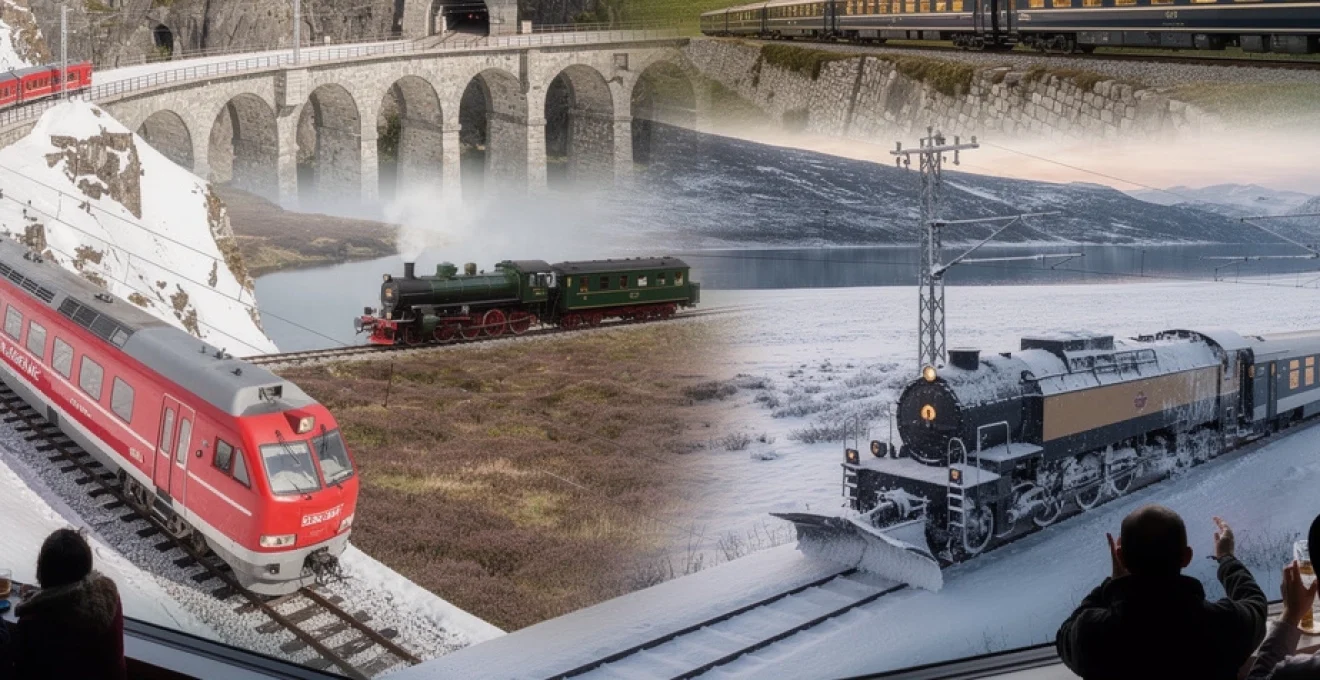
Europe’s railway network represents one of the world’s most sophisticated transportation achievements, offering travellers unprecedented access to breathtaking landscapes through cutting-edge engineering marvels. From the precision-engineered rack railways of the Swiss Alps to the rugged coastal lines hugging Mediterranean cliffs, European rail infrastructure transforms ordinary journeys into extraordinary experiences. The continent’s most spectacular train routes combine technical innovation with natural beauty, creating travel opportunities that rival any destination itself.
These railway masterpieces showcase centuries of engineering evolution, from Victorian-era steam heritage lines to modern panoramic coaches equipped with climate control systems. Each route presents unique challenges conquered through ingenious solutions: spiral viaducts that gain altitude through curved geometries, brake systems designed for extreme gradients, and weather-resistant rolling stock capable of Arctic operations. The result is a network of scenic railways that provide safe, comfortable access to Europe’s most remote and beautiful regions.
Alpine engineering marvels: glacier express and bernina express technical routes
Switzerland’s alpine railway system represents the pinnacle of mountain railway engineering, with routes that traverse some of Europe’s most challenging terrain. The Swiss Federal Railways and private operators have created a network of narrow-gauge lines that climb impossible gradients, cross deep gorges, and navigate through weather conditions that would challenge any transportation system. These railways demonstrate how technical innovation enables access to landscapes previously reserved for mountaineers and hardy hikers.
The engineering achievements of these routes extend far beyond simple track laying. Complex signalling systems ensure safety on single-track sections with passing loops, whilst sophisticated avalanche protection measures including snow sheds and deflection barriers protect the infrastructure year-round. Modern rolling stock features panoramic windows manufactured from specially treated glass to reduce glare at high altitudes, whilst onboard systems automatically adjust air pressure to combat altitude-related discomfort.
Glacier express rack railway systems through oberalp pass
The Glacier Express employs three distinct railway systems across its 291-kilometre route between St. Moritz and Zermatt, with the most technically demanding section crossing the Oberalp Pass at 2,033 metres above sea level. The Abt rack system enables trains to climb gradients of up to 110 per mille through a combination of adhesion and rack-and-pinion technology. Twin rack rails positioned between the running rails engage with cogwheels beneath specially designed locomotives, providing the traction necessary for steep ascents and controlled descents.
During winter operations, the Oberalp Pass section requires sophisticated snow management protocols, with rotary snowploughs maintaining the line through conditions that can produce drifts exceeding five metres in depth. The railway’s maintenance crews operate specialised equipment including rail-mounted snow blowers and hydraulic rail jacks that can lift entire train sets for urgent track repairs during the brief summer construction window.
Bernina express UNESCO world heritage spiral viaducts
The Bernina Express achieves its UNESCO World Heritage status through remarkable engineering solutions that overcome extreme topographical challenges without resorting to rack systems. The route’s signature spiral viaducts, including the famous loops at Brusio, demonstrate how clever design can achieve necessary altitude gains within natural landscape constraints. These circular structures allow trains to climb whilst maintaining manageable gradients through continuous curved geometry.
The Bernina Pass section operates without adhesion aids despite reaching 2,253 metres elevation, relying instead on precision track geometry and advanced brake systems. Modern trains feature regenerative braking that converts descent energy into electrical power, reducing wear on traditional friction brakes whilst contributing to the railway’s environmental sustainability credentials.
Rhaetian railway Metre-Gauge infrastructure analysis
The Rhaetian Railway’s metre-gauge network spans 384 kilometres of track through Graubünden, representing one of Europe’s most extensive narrow-gauge systems. This gauge selection provides optimal balance between construction costs in mountainous terrain and operational capacity for both passenger and freight services. The narrower track width enables tighter curve radii essential for navigating alpine valleys, whilst still accommodating comfortable rolling stock with adequate passenger capacity.
Track construction utilises locally sourced materials wherever possible, with ballast quarried from alpine sources and sleepers manufactured from sustainable timber harvested
from certified forests resistant to freeze–thaw cycles. Rail fastenings are designed to tolerate repeated temperature swings from -20°C to +30°C, minimising track distortion and ensuring precise alignment for smooth, scenic train journeys in Europe. Bridges and tunnels on the network incorporate expansion joints calculated to millimetre tolerances, a necessity when steel structures can expand several centimetres over their length on hot summer days.
For travellers, much of this infrastructure work is invisible, yet it underpins the reliability that Switzerland is famous for. Timetables integrate connections with long-distance services, postal buses and cable cars, allowing you to step off a panoramic coach and transfer seamlessly to a mountain gondola. This orchestration of infrastructure and operations is what transforms a simple mountain railway into a world-class scenic experience that runs to the minute, even in the depths of winter.
Landwasser viaduct limestone construction specifications
The Landwasser Viaduct is perhaps the most recognisable symbol of Swiss mountain railways, carrying the Rhaetian Railway across a 65-metre-deep gorge directly into a tunnel bored into the cliff face. Constructed between 1901 and 1902, this curved limestone structure consists of six arches, each spanning 20 metres, built without scaffolding using cable-mounted cranes and timber formwork. Engineers selected local Jurassic limestone for its compressive strength and durability, crucial for withstanding both dynamic train loads and harsh alpine weather.
From a structural perspective, the viaduct functions as a series of masonry arch rings, each composed of precisely cut stone blocks laid with lime mortar. The curvature of the track—on a radius of just 100 metres—requires exceptionally accurate alignment, achieved through meticulous surveying that still impresses modern engineers. Regular inspections today use drones and non-destructive testing to monitor micro-cracks and stone integrity, helping preserve this UNESCO-listed icon for future generations of rail travellers seeking the best train rides in Europe.
The interface between the viaduct and the adjoining rock tunnel at its eastern end posed a unique challenge. To prevent water ingress and freeze damage at this junction, builders installed drainage layers and carefully shaped portal profiles to deflect snow and ice. Contemporary upgrades have added discreet stainless-steel anchors and waterproof membranes behind the original masonry, reinforcing the structure while preserving its historic appearance. When you glide across this viaduct in a panoramic coach, you are effectively travelling over a living museum piece of early 20th-century engineering.
Scandinavian arctic circle railway networks: flåm and nordland lines
Norway’s scenic train routes push railway technology into some of Europe’s most demanding climatic conditions. From fjord-side branch lines with extreme gradients to long-distance routes crossing the Arctic Circle, these railways prove that comfortable passenger travel is possible even where winter temperatures routinely fall below -30°C. For anyone planning scenic train travel in Europe, Norwegian lines offer a fascinating blend of dramatic landscapes and robust engineering.
The country’s rail infrastructure must contend with avalanche paths, drifting snow, ice accumulation and rockfall, all while maintaining punctual timetables that serve remote communities. As you ride through this landscape, every snow shed, avalanche gallery and tunnel represents a targeted engineering response to a specific local hazard. Understanding how these systems work does more than satisfy curiosity—it helps you appreciate why some departures are timed to daylight hours, and why certain sections slow down during heavy weather.
Flåm railway 55‰ gradient brake system technology
The Flåm Railway’s maximum gradient of 55‰ (5.5%) makes it one of the steepest adhesion-only railways in the world, a fact that shapes every aspect of its design and operation. Unlike rack railways that rely on cogwheels, Flåm’s trains depend purely on the friction between steel wheels and steel rails. To manage this safely, each train is equipped with multiple independent braking systems: dynamic (electric) brakes, pneumatic disc brakes and fail-safe emergency brakes that engage automatically if pressure is lost.
Dynamic braking converts the train’s kinetic energy into heat via the traction motors, which act as generators during descent. This system handles the bulk of the braking effort, reducing wear on mechanical components and ensuring smooth speed control. To prevent overheating on the long, continuous downhill stretch, cooling systems monitor brake temperatures in real time, automatically adjusting braking force distribution between axles. It is rather like descending a mountain pass in a car using engine braking first, keeping the conventional brakes in reserve.
The line’s signalling and operating rules add further layers of safety. Maximum permitted speeds are strictly enforced, and train drivers undergo specialised training that includes simulator sessions reproducing low-adhesion conditions such as wet leaves or ice. Track geometry is designed with conservative curve radii and cant (superelevation) to ensure that even in an emergency stop, passenger comfort and safety remain within acceptable limits. When you look out at the sheer valley walls and cascading waterfalls, it is reassuring to know that every metre of the descent has been modelled, tested and refined over decades.
Nordland line polar circle crossing at saltfjellet
The Nordland Line between Trondheim and Bodø is Norway’s longest railway at 729 kilometres, and its crossing of the Arctic Circle at Saltfjellet is a milestone for many travellers. At around 66°N, the line climbs to more than 680 metres above sea level, traversing a plateau that is frequently battered by strong winds, blowing snow and sudden temperature shifts. Maintaining reliable passenger and freight services here requires infrastructure that can withstand conditions more commonly associated with polar research stations.
To reduce exposure to drifting snow, large sections of track near the Arctic Circle run in shallow cuttings or behind natural rock ridges, using the terrain itself as a barrier. In the most exposed areas, snow fences are installed upwind of the line to encourage drifts to form away from the rails. These fences are carefully oriented based on wind studies, in much the same way that architects use wind tunnels when designing skyscrapers. Bridges and culverts are oversized to handle rapid snowmelt and heavy autumn rains, protecting the line from washouts.
For visitors on this scenic train journey in Europe, the Arctic Circle crossing is often marked by an announcement and a small monument visible from the window. Behind that brief moment lies a complex logistics chain: weather monitoring stations feed data to traffic control centres, which adjust speed limits and deploy plough trains as needed. If you travel in winter, you may notice additional timetable padding across Saltfjellet, giving operations teams flexibility to deal with sudden storms without cascading delays along the entire route.
Norwegian state railways rolling stock winter operations
Running trains reliably through Scandinavian winters requires rolling stock designed from the outset for sub-zero conditions. Coaches and locomotives on both the Flåm and Nordland lines feature reinforced insulation, double-glazed windows and heating systems that can cope with prolonged cold snaps. Door mechanisms are fitted with heating elements to prevent ice build-up, and external cables are routed and sealed to minimise snow ingress and condensation-related faults.
Underframe components receive particular attention. Brake cylinders, air reservoirs and valves are shielded from direct snow blast by aerodynamic fairings, while drainage points are positioned to avoid ice accretion. Bogies are painted in light colours or treated with anti-ice coatings to make cracks and defects easier to spot during inspections—an example of how small design choices enhance safety. Maintenance depots along the line are equipped with heated inspection pits and de-icing facilities so that trains can be turned around quickly, even during storms.
From a passenger perspective, these winter adaptations translate into comfortable interiors and relatively minor disruption, even during heavy snowfall. On-board systems monitor interior temperature and adjust underfloor heating and ventilation to maintain a stable climate, which is especially welcome on long journeys north of the Arctic Circle. If you are planning rail travel in Norway between November and March, booking a window seat on these well-insulated coaches gives you a front-row view of snow-laden forests and frozen fjords without ever needing to step outside.
Aurlandsfjellet tunnel bypass engineering solutions
Before the construction of long road tunnels, the high mountain road over Aurlandsfjellet was often blocked by snow for much of the year. The Flåm Railway effectively provides a rail-based bypass to this challenging pass, whisking passengers from fjord level up to the main Bergen Line at Myrdal regardless of road conditions. Achieving this required careful alignment of tunnels and avalanche protection along the valley slopes above Flåm.
Several rail tunnels on the line are positioned specifically to avoid known avalanche paths, with portals oriented away from prevailing slide directions. Where the track must cross exposed slopes, concrete avalanche galleries shield trains from falling snow and rocks, allowing slides to pass over the structure without impacting operations. These galleries function rather like reinforced concrete umbrellas, deflecting debris while preserving the line beneath. Drainage channels and catchment basins around the portals manage meltwater and prevent erosion of the tunnel entrances.
The integration of the railway with the surrounding transport network further enhances its role as a year-round bypass. Timetables are coordinated with fjord ferries and regional buses, giving visitors flexible options even when mountain roads are temporarily closed. For those interested in engineering, riding the Flåm line during late spring can be particularly revealing: you will see snow still clinging to the upper slopes while the valley floor bursts into greenery, a visual reminder of the vertical climate zones that this compact but complex railway must safely navigate.
British isles steam heritage: west highland line and caledonian sleeper
The British Isles offer some of Europe’s most atmospheric scenic train journeys, combining rugged landscapes with a deep railway heritage. The West Highland Line in Scotland and the overnight Caledonian Sleeper services together showcase how historic infrastructure and modern operations can coexist. Travellers can experience misty lochs, remote moorlands and Victorian-era viaducts by day, then retreat to a comfortable berth that glides through the night to London or the Highlands.
Many sections of these routes were laid out in the late 19th century, when engineers had only limited tunnelling technology and relied instead on viaducts, cuttings and careful contour following. This constraint has become a major asset for today’s scenic rail travel: instead of diving under hills in long base tunnels, the lines run along valley sides and across open moors, giving uninterrupted views. Have you ever wondered why so many Scottish rail photographs feature sweeping vistas? The answer lies in those original route choices.
The West Highland Line, operating from Glasgow to Oban and Mallaig, uses stone and concrete viaducts such as the Glenfinnan structure, which curves gracefully above Loch Shiel on 21 arches. Steam-hauled heritage services in summer, notably the Jacobite, add another dimension, allowing you to experience the line with the sights, sounds and even the smell of mid-20th-century rail travel. Meanwhile, regular diesel units maintain year-round connections for local communities, proving that heritage and everyday utility can share the same track.
The Caledonian Sleeper complements these daytime services by offering overnight travel between London and key Scottish destinations including Inverness, Aberdeen, Fort William and Glasgow. Modern Mk5 sleeping cars, introduced from 2019, feature en-suite cabins, controlled climate systems and improved ride quality compared with older stock. Underneath the contemporary interiors, however, the trains still rely on tried-and-tested braking and coupling systems compatible with Britain’s existing network. This blend of new and old ensures that you can wake up in the Highlands after a comfortable night’s sleep without sacrificing safety or reliability.
From a planning perspective, combining the West Highland Line with a Caledonian Sleeper journey is one of the most efficient ways to explore Scotland by rail. You might, for example, take the sleeper from London to Fort William, ride the scenic section to Mallaig by day, then return via Glasgow for an evening departure south. Because capacity on both the sleeper and the summer steam services is limited, booking several months in advance is advisable—especially if you want specific cabin types or guaranteed window seats on what many consider the most scenic train rides in Europe.
Eastern european mountain railways: semmering and Kalka-Shimla parallels
Mountain railways across Europe and Asia often share common design solutions, even when they were built under very different political and economic conditions. The Semmering Railway in Austria and the Kalka–Shimla Railway in India are a prime example: although separated by continents, both systems pioneered techniques for conquering steep gradients and unstable slopes without modern machinery. For rail enthusiasts comparing the best scenic train journeys in Europe to those farther afield, these two lines offer instructive parallels.
The Semmering line, completed in 1854, was the world’s first true alpine railway and now holds UNESCO World Heritage status. Its designers used a combination of tight-radius curves, stone viaducts and short tunnels to keep gradients within manageable limits for early steam locomotives. Maximum gradients of around 25‰ may seem modest compared with later lines, but for the technology of the time they were close to the threshold of what metal wheels and rails could handle. The result is a route that clings to mountainsides in a series of graceful S-bends, offering extensive views of forested valleys.
By contrast, the Kalka–Shimla line, opened in 1903 in the Indian Himalayas, adopted narrower metre-gauge track and an even denser concentration of tunnels—more than 100 in just 96 kilometres—to gain altitude efficiently. Both lines rely on frequent curves and short spans rather than towering bridges, spreading structural loads across many small elements. In engineering terms, it is akin to building a staircase with many shallow steps instead of a few steep ones, making the climb easier for the trains of their respective eras.
From an operational viewpoint, both railways face similar maintenance challenges: heavy rainfall, potential landslides and freeze–thaw cycles that can destabilise slopes. Modern monitoring technologies such as slope radar and remote weather stations now supplement traditional patrols by track workers, improving early warning for rockfall or washouts. If you travel the Semmering route today, you are benefiting from more than 170 years of accumulated knowledge about how to keep a mountain line safe without compromising its historical character.
For travellers, drawing connections between these railways enriches the experience. As you ride across an Austrian viaduct lined with stone balustrades, you might imagine similar views from a wooden coach rattling through Himalayan pine forests. Both routes prove that well-designed mountain railways can remain relevant long after their original locomotives have been retired, especially when they are integrated into broader networks of scenic and cultural tourism.
Trans-european luxury rail services: venice Simplon-Orient-Express operations
Luxury rail services such as the Venice Simplon-Orient-Express (VSOE) offer a very different perspective on scenic train journeys in Europe. Instead of maximising capacity or speed, their design priorities centre on comfort, atmosphere and service. Yet beneath the polished brass and art deco veneers lies a complex set of operational requirements: modern safety standards, cross-border compatibility and finely tuned timetables that must interface with busy mainline corridors.
The VSOE operates restored 1920s and 1930s coaches, re-engineered to meet contemporary regulations for braking, couplers and electrical systems. Air conditioning, fire detection and retention toilets have been discretely integrated without compromising the historic interiors. This retrofitting process is comparable to modernising a heritage hotel: every upgrade must respect the original fabric while meeting current codes. To run across multiple countries, the train is usually hauled by national rail operators’ locomotives equipped for local signalling and power systems.
Route planning for luxury services is as much about scenery as it is about logistics. Typical VSOE itineraries between Paris and Venice follow established high-speed or intercity corridors but are scheduled to pass the most picturesque sections—such as the approach to the Alps or the Italian lakes—during daylight hours. Speeds are often lower than those of regular expresses, allowing guests to linger over multi-course meals without excessive sway or sudden braking. If you have ever tried to drink coffee on a commuter train, you will appreciate the difference that a smoother, more deliberate timetable can make.
Onboard operations resemble those of a boutique cruise ship more than a conventional train. Kitchens must produce restaurant-quality cuisine within the constraints of a moving, linear workspace, while housekeeping keeps cabins immaculate in the short window between daytime lounge use and evening bed preparation. Staff-to-guest ratios are high, enabling personalised service and rapid response to any issues. For many passengers, the technical details of the journey fade into the background, but without precise coordination between the train operator and infrastructure managers in each country, the illusion of effortless luxury would quickly break down.
For travellers considering whether such a journey is worth the premium, it helps to view it not simply as transport but as an immersive heritage and hospitality experience. You are paying not only for the scenic rail route but also for the maintenance of historic rolling stock, extensive behind-the-scenes planning and the ability to cross multiple borders without touching your luggage. If your goal is to combine iconic European landscapes with old-world glamour, few experiences rival watching the sun rise over the Alps from a vintage dining car.
Mediterranean coastal railway infrastructure: cinque terre and costa brava lines
Mediterranean coastal railways must strike a delicate balance between engineering practicality, environmental protection and tourism demand. The Cinque Terre line in Italy and the Costa Brava routes in Spain illustrate how railways can hug rugged shorelines without overwhelming the very landscapes that attract visitors. For anyone researching the most scenic train rides in Europe, these coastal sections consistently appear near the top of the list.
Between Levanto and La Spezia, the Cinque Terre railway alternates between tunnels bored through hard rock headlands and brief open-air stretches that reveal pastel villages clinging to cliffs. Originally built in the 19th century for strategic and commercial reasons, the line has evolved into a lifeline for local communities and a primary access route for millions of tourists. To manage this pressure, infrastructure managers have implemented signalling upgrades and passing loops that increase capacity without requiring additional track in constrained spaces.
Engineering works here must account for salt-laden air, marine erosion and the risk of rockfall from steep, terraced slopes above the line. Protective mesh, rock bolts and retaining walls stabilise vulnerable sections, while drainage improvements reduce the chance of landslides during heavy storms. Maintenance windows are carefully scheduled outside peak tourist seasons to minimise disruption, though occasional weather-related closures are inevitable. When planning a rail trip through Cinque Terre, it is wise to build some flexibility into your itinerary, especially in late autumn and winter.
On Spain’s Costa Brava and neighbouring stretches of the Catalan coast, coastal railways historically ran much closer to the sea, sometimes directly along beaches. In recent decades, sections particularly vulnerable to storm damage and sea-level rise have been re-routed inland, freeing up waterfront space for promenades and cycle paths. This shift reflects a broader European trend: where feasible, railways are being set back from the most exposed coastal zones, combining improved resilience with enhanced public access to the shoreline.
Despite these realignments, many Spanish coastal routes still offer excellent sea views, especially where the track sits slightly elevated above rocky coves. Double-track sections with modern signalling support frequent regional services, making it easy for you to hop between fishing villages, resort towns and walking trails without a car. If your priority is to photograph trains right on the water’s edge, older lines are becoming rarer; but if you value a sustainable, low-impact way to explore the Mediterranean, these upgraded railways represent a thoughtful compromise between nostalgia and long-term resilience.
Whether you choose the tunnelled drama of Cinque Terre or the more open vistas of the Costa Brava, these Mediterranean lines demonstrate how scenic train journeys in Europe can coexist with fragile coastal ecosystems. As climate change brings more intense storms and coastal erosion, ongoing investment in protective works, intelligent routing and integrated public transport will be essential. For now, you can still sit back, watch the sun glint off the sea and let the train carry you effortlessly from one postcard-worthy bay to the next.