Family vacations often promise connection but deliver logistical stress. Parents navigate rigid hotel schedules, coordinate shared rooms, and watch spontaneous moments evaporate under the tyranny of checkout times and breakfast buffets. Yet certain accommodations fundamentally reshape these dynamics, transforming how families interact, remember, and bond during their time away.
Île de Ré villa rentals represent a qualitative shift in vacation architecture. Beyond offering more space or kitchen access, these properties leverage spatial design and temporal flexibility to catalyze family interactions impossible in conventional tourism. Families exploring vacation rentals through travelparadise.fr access environments specifically engineered for organic memory creation rather than programmed experiences.
The island’s distinctive villa layout reimagines family rhythms from daily routines. Where hotels compartmentalize and schedule, villas integrate and liberate. This architectural intervention enables micro-moments of spontaneous interaction, multigenerational knowledge transfer, and territorial attachment that fundamentally alter post-vacation memory structures. The transformation begins not with activities, but with the spatial envelope families temporarily inhabit.
Why Île de Ré Villas Create Lasting Family Bonds
- Villa architecture generates spontaneous family interactions through open floor plans and threshold spaces that hotel corridors cannot replicate
- Flexible domestic rhythms replace rigid tourist schedules, enabling memory-enhancing spontaneity and island-specific cultural immersion
- Children develop territorial ownership through domestic routines, creating deeper place attachment than passive hotel tourism
- Multigenerational families leverage private kitchen spaces for cultural transmission and storytelling impossible in restaurant settings
- Process-based villa memories encoded through multiple sensory channels outlast snapshot-based hotel experiences in neurological durability
Villa Architecture Shapes How Your Family Actually Interacts
The physical layout of vacation accommodations dictates behavioral patterns families rarely consciously recognize. Hotel architecture enforces separation: isolated bedrooms accessed through corridors, public dining areas operating on fixed schedules, lobbies designed for transit rather than lingering. These spatial constraints fragment family units into discrete nodes requiring constant coordination.
Île de Ré villas operate on fundamentally different architectural principles. The traditional Charentais design integrates kitchen, dining, and living zones into flowing visibility corridors. This configuration creates what environmental psychologists term “multi-generational supervision zones,” where parents maintain gentle awareness of children’s activities while teenagers negotiate autonomy in adjacent spaces.
Research in architectural psychology validates this phenomenon. Studies demonstrate that open-plan living spaces combining kitchen, dining, and living areas create 65% more spontaneous family interactions compared to compartmentalized layouts. These unscripted moments—a child observing bread-making, siblings collaborating on meal preparation, grandparents sharing stories while others cook—form the emotional substrate of durable memories.
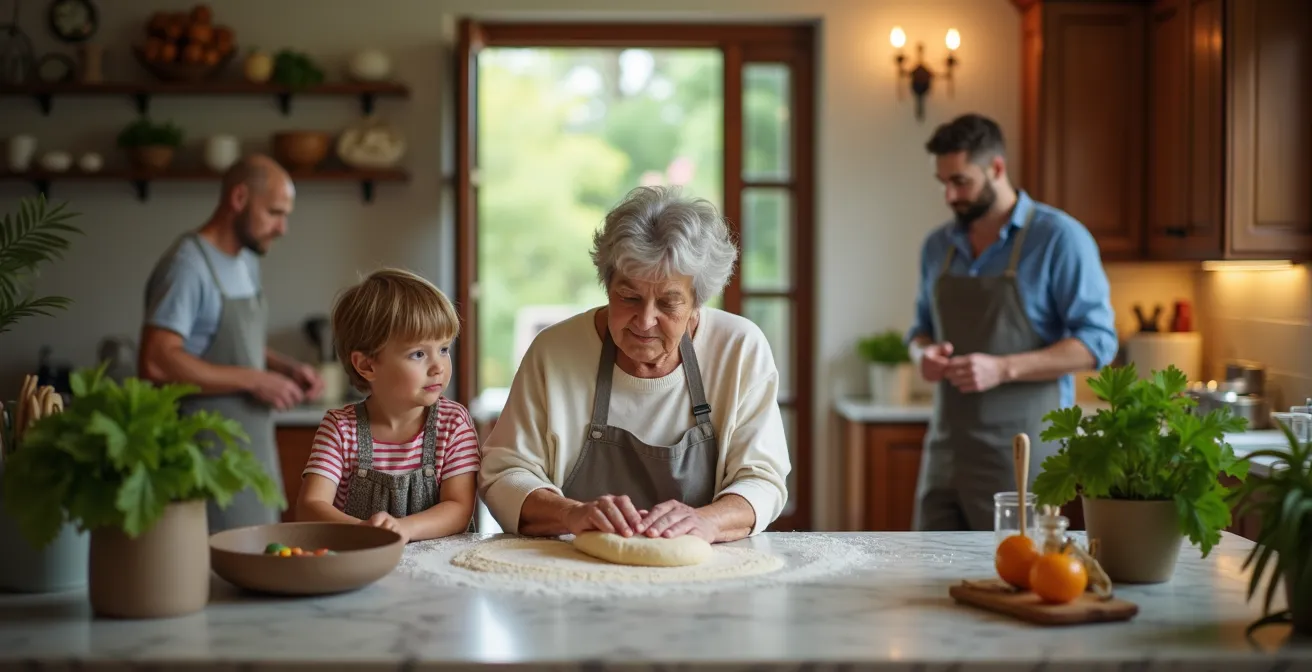
The kitchen emerges as the neuralgic convergence point in villa dynamics. Unlike hotel restaurants where families consume passively, villa kitchens transform routine culinary tasks into participatory rituals. Morning coffee preparation becomes collaborative exploration of local market discoveries. Evening meal assembly converts into multi-sensory experiences anchoring olfactory and tactile memories alongside visual impressions.
Threshold spaces amplify these dynamics further. Terraces, courtyards, and covered outdoor areas unique to Île de Ré architecture function as negotiation zones between togetherness and solitude. Family members organically drift between collective activities and individual pursuits without the binary separation hotels enforce. This spatial fluidity reduces vacation friction—the tension emerging when diverse family members with varying social needs occupy limited shared space.
Spatial Adaptation for Multigenerational Needs
A Brooklyn family with two children transformed their 11-foot-wide row house to accommodate multigenerational needs, demonstrating how strategic spatial design enables families to maintain both togetherness and privacy in compact spaces. Their renovation prioritized visual connectivity across levels while preserving acoustic separation, principles directly applicable to villa selection for extended family vacations.
The contrast effect further enhances villa-based experiences. When families base themselves in intimate domestic environments, excursions to beaches, markets, or cycling paths register as heightened adventure. Hotel-based tourism lacks this baseline intimacy, rendering all experiences uniformly transactional. Villa architecture establishes emotional groundwork that amplifies the perceived value of external activities.
| Space Feature | Villa Impact | Hotel Impact |
|---|---|---|
| Visibility Zones | Multi-generational supervision while maintaining autonomy | Isolated rooms requiring constant coordination |
| Transition Spaces | Terraces and courtyards enable negotiated togetherness | Corridors only for movement |
| Activity Flexibility | Simultaneous different activities in connected spaces | Limited to single room or public areas |
Spontaneous Rhythms Replace Programmed Tourist Schedules
Conventional tourism operates on industrial scheduling principles. Hotels impose breakfast windows, checkout deadlines, and housekeeping routines that prioritize operational efficiency over guest experience. Families unconsciously adapt their natural rhythms to these institutional demands, fragmenting the temporal flexibility essential for authentic connection and spontaneous memory creation.
Villa rentals dismantle this temporal tyranny entirely. The absence of imposed schedules permits families to discover and adopt organic rhythms aligned with both island culture and their unique dynamics. Children wake naturally and initiate morning explorations—collecting shells during low tide, observing fishing boats departing Saint-Martin harbor—inverting the typical parent-directed activity structure.
This temporal elasticity carries psychological significance beyond mere convenience. Memory research demonstrates spontaneous, unplanned experiences generate stronger emotional encoding than scheduled activities. When families respond to immediate weather conditions, adjust meal times to capture sunset moments, or extend beach visits based on genuine engagement rather than reservation commitments, they create neural pathways associated with autonomy and authentic choice.
Industry data reflects growing recognition of this principle. 45% of vacation rental guests now prioritize properties offering flexible schedules and 60% consider flexible cancellation essential according to 2024 analysis. These preferences signal deeper understanding that memorable vacations resist rigid programming.
Morning elasticity exemplifies the transformation. Without breakfast buffet deadlines, families discover individual wake patterns. Early risers explore morning markets, securing fresh bread and local produce. Later-waking family members join naturally, creating staggered interactions rather than forced simultaneous assembly. These organic convergences feel authentic rather than obligatory, reducing the subtle resentment rigid schedules generate.
Meal-time fluidity introduces additional benefits. Villa settings enable late dinners after sunset, creating adult conversation opportunities while children sleep contentedly in familiar spaces. Parents experience guilt-free couple time knowing their children occupy safe, comfortable environments rather than unfamiliar hotel rooms. This temporal flexibility addresses parental vacation stress in ways programmed childcare never achieves.
Weather-responsive flexibility reduces family friction dramatically. Pre-paid hotel activities and rigid itineraries create stress when conditions shift. Villa-based families adjust organically, shifting beach plans to museum visits, rescheduling cycling for clearer weather, or embracing rainy afternoons as indoor cooking projects. This adaptive capacity transforms potential disappointments into alternative opportunities, teaching children resilience through parental modeling.
Île de Ré’s cultural rhythms become accessible through villa immersion. The island’s siesta tradition, market-centric meal planning, and sunset-oriented social patterns resist hotel scheduling. Families adopting these local temporalities experience authentic cultural participation rather than touristic observation. Children internalize rhythm variations—that some cultures prioritize evening social time over early mornings—through lived experience rather than abstract instruction.
For families considering extended stays, exploring holiday villa rentals reveals how temporal flexibility compounds over multi-week periods, establishing routines that feel simultaneously novel and comforting.
Children Develop Island Ownership Through Domestic Immersion
Environmental psychology distinguishes between tourism and habitation through the concept of place attachment. Tourists visit locations; residents inhabit them. This distinction proves crucial for childhood memory formation and emotional development. Villa rentals uniquely position children as temporary residents rather than transient visitors, catalyzing deeper cognitive and emotional engagement with Île de Ré.
Proprietary behaviors emerge rapidly in villa contexts. Children identify “their” boulangerie, develop loyalty to specific beach access points, memorize cycling routes to preferred locations. These territorial markers—absent in hotel-based tourism where all spaces belong institutionally to others—signal psychological ownership. The child transitions from passive consumer to active participant in local geography.
Domestic responsibility sharing accelerates this transformation. Villa living necessitates participation in daily operations. Children accompany adults to morning markets, contributing opinions on produce selection and meal planning. They assist with table setting, dish management, and space maintenance. These contributions, however modest, establish agency and competence impossible in hotels where staff perform all operational tasks.
The psychological impact extends beyond immediate vacation periods. Children who contribute to vacation domestic operations develop enhanced self-efficacy and family role understanding. They internalize that travel involves cooperation, not just consumption. This cognitive shift influences future travel expectations and family dynamics, creating citizens rather than entitled consumers.
Local social integration distinguishes villa immersion from hotel isolation. Repeated interactions with the same market vendors, bakers, and shopkeepers create recognition and familiarity. Vendors remember children’s preferences, greet families by name, offer local insights unavailable to transient hotel guests. These social acknowledgments validate children’s insider status, transforming their self-perception from outsider to temporary community member.
Environmental micro-expertise develops through sustained observation. Children living in villas notice tidal patterns affecting beach accessibility, wind direction influencing cycling comfort, morning light quality varying by season. They develop location-specific literacy—understanding when to visit salt marshes, which beaches offer best shell collecting, how weather patterns typically evolve. This embodied knowledge creates competence and mastery feelings psychologically distinct from guided tour passive reception.
The repetition inherent in villa-based routines proves neurologically significant. Daily market visits, consistent beach access patterns, and repeated cycling routes create neural pathway reinforcement. These routine-based memories demonstrate remarkable durability compared to one-time tourist activities. Children recall “what we did every morning” with greater clarity and emotional warmth than isolated special events.
Multigenerational Transmission Happens in Unscripted Kitchen Moments
Extended family vacations face unique challenges in conventional hotel contexts. Separate rooms isolate generations, restaurant meals enforce public behavior norms incompatible with intimate conversation, and structured activities leave little space for organic intergenerational interaction. Villa environments dissolve these barriers, creating conditions for cultural transmission and relationship deepening impossible in institutional settings.
Culinary knowledge transfer exemplifies these dynamics. Grandparents teaching traditional recipes using local Île de Ré ingredients—incorporating fleur de sel into desserts, preparing seafood using regional techniques—create dual encoding. Children simultaneously acquire culinary skills and relational memories. The sensory richness—salt crystal textures, fresh fish aromas, kneading rhythms—anchors these memories in multiple neural systems, enhancing long-term retention.
Story-anchoring in place transforms abstract family narratives into geographically embedded memories. When grandparents share personal histories while preparing meals in villa kitchens, gazing at island sunsets, or cycling coastal paths, these stories acquire spatial coordinates. Children later recall not just the story content but its physical context, creating “memory places” that can be revisited physically or imaginatively.
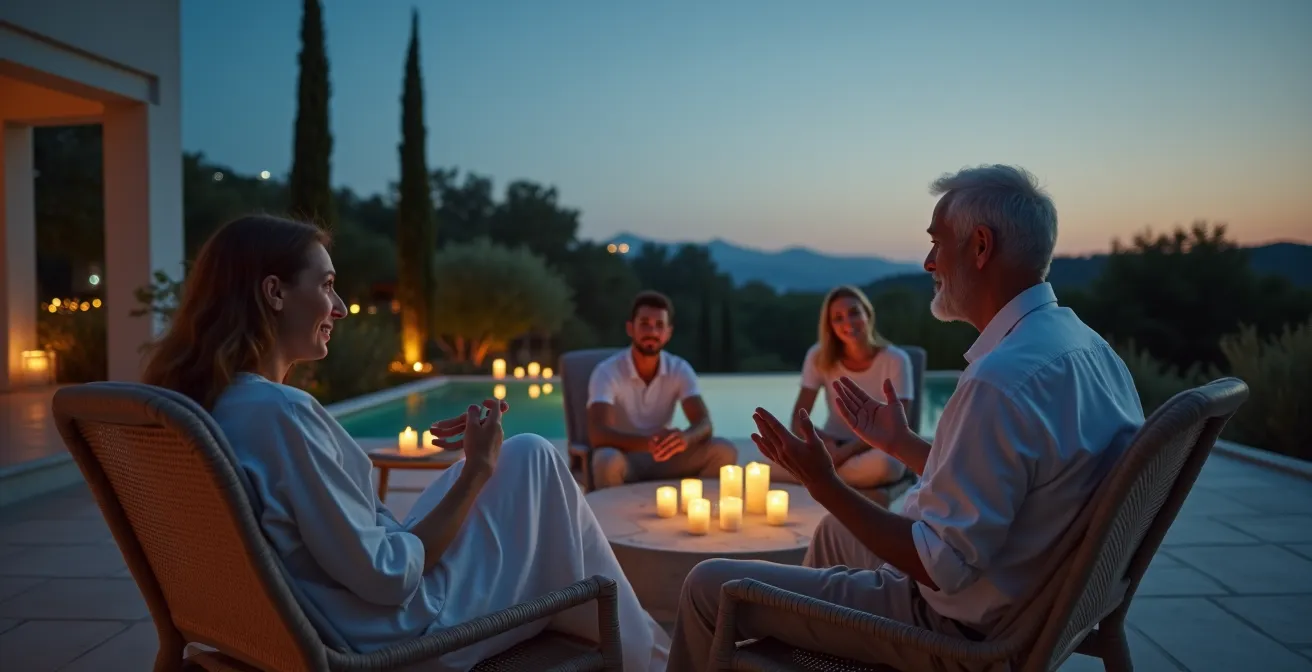
Skill-sharing asymmetry enriches these exchanges. While grandparents transmit traditional knowledge and family histories, children reciprocate by teaching digital photography, navigation apps, and contemporary cultural references. This bidirectional exchange validates both generations’ contributions, reinforcing mutual value. Grandparents feel relevant beyond nostalgic reminiscence; children experience themselves as knowledge holders rather than perpetual recipients.
Extended-family dynamics benefit from villa neutrality. The rented space belongs to no family faction, avoiding the territorial tensions emerging when hosting occurs at one generation’s home. Conflicts that arise can be processed in emotionally neutral territory. Conversely, positive bonding experiences carry enhanced significance because they occurred in deliberately chosen shared space rather than obligatory family home visits.
The unstructured time abundance proves essential. Hotel-based multigenerational vacations often over-schedule to justify expense and coordinate diverse preferences. Villa settings permit expansive unstructured periods where conversations emerge organically. A grandparent teaching a grandchild to identify tidal pool species, sharing political perspectives during market shopping, or explaining family photo albums during rainy afternoons—these cannot be scheduled but require temporal spaciousness villa life provides.
For families seeking to deepen these connections, resources to discover Île de Ré highlight how the island’s cultural richness and accessible scale enhance intergenerational exploration.
Key Takeaways
- Villa architecture creates 65% more spontaneous family interactions through integrated living spaces versus isolated hotel rooms
- Flexible villa schedules enable spontaneous rhythms proven to generate more durable emotional memories than programmed activities
- Children develop territorial ownership and environmental expertise through villa-based domestic routines and repeated local interactions
- Multigenerational cultural transmission flourishes in private villa kitchens through bidirectional skill-sharing and story-anchoring in place
- Process-based villa memories involving multiple sensory channels create stronger neural encoding than event-based hotel tourism
Post-Vacation Memory Architecture Differs from Hotel-Based Trips
Neuroscience distinguishes between episodic memories of discrete events and procedural memories of repeated processes. This distinction illuminates why families recall villa vacations differently than hotel stays. The memory structures created through villa immersion demonstrate qualitative differences in durability, emotional resonance, and family cohesion impact.
Process memories versus snapshot memories represent the fundamental divide. Hotel vacations generate primarily episodic records: visiting specific attractions, dining at particular restaurants, experiencing scheduled activities. These event-based memories, while initially vivid, lack the contextual richness that enhances long-term retention. Families recall “we went to the beach” without embedded procedural detail.
Villa vacations encode differently. Families remember processes: “how we made breakfast together,” “our routine for morning market visits,” “the way we decided which beach based on wind direction.” These procedural memories, involving repeated actions and decision-making patterns, create more robust neural pathways. The cognitive act of doing repeatedly generates stronger encoding than passive single-event observation.
Multi-sensory encoding amplifies villa memory durability. Hotel experiences prioritize visual stimulation—architectural photography, attraction viewing,景观 consumption. Villa living engages olfactory systems through cooking aromas, tactile experiences via ingredient handling and domestic tasks, auditory memories of morning island sounds heard from familiar bedrooms, and gustatory associations with shared meals. This sensory diversity creates multiple retrieval pathways, enhancing memory accessibility.
The neurological principle of encoding specificity explains this phenomenon. Memories encode not just content but context. The richer the contextual encoding, the more retrieval cues exist. Villa environments provide vastly denser contextual matrices than hotels: specific kitchen layouts where conversations occurred, particular terrace configurations where sunsets were watched, distinct bedroom morning light qualities. These spatial specificities function as powerful memory triggers years later.
Collaborative memory reconstruction strengthens family bonds post-vacation. Families reconstruct shared narratives around villa experiences: “Remember when we tried to make that local recipe and couldn’t find the right ingredient?” These collaborative storytelling sessions, supported by procedural detail and sensory richness, become family mythology. The stories get retold, refined, and integrated into family identity in ways hotel event-memories rarely achieve.
Photographic evidence patterns reveal these differences tangibly. Hotel vacation photos predominantly feature family members posed before monuments and attractions—external validation of presence. Villa vacation photos capture interaction: cooking together, playing games, candid terrace conversations, collaborative beach activities. These images document relationship and process rather than tourism completion, creating emotionally resonant visual records.
The memory architecture difference manifests in children’s long-term development. Adults frequently recall childhood hotel vacations vaguely, remembering perhaps a specific attraction but little emotional detail. Villa vacations, by contrast, often emerge as formative memories: learning to cook with grandmother, developing island navigation competence, experiencing parental relationship intimacy unavailable in daily life. These memories shape identity narratives rather than merely populating event timelines.
Families seeking these transformative experiences discover that villa selection itself becomes part of the memory creation process. The choice reflects values—prioritizing connection over convenience, process over programming, authentic immersion over curated tourism. This intentionality frames the entire vacation, signaling to all family members that this experience aims for something qualitatively different than conventional tourism consumption.
Frequently Asked Questions About Villa Rentals and Family Memories
What role does repetition play in vacation memories?
Daily routines in villas, like morning market visits or evening beach walks, create stronger neural pathways than one-time tourist experiences, leading to more durable memories. Repetition enables procedural memory encoding, which demonstrates greater long-term retention than episodic single-event memories.
How do villa rentals differ from hotels for families with young children?
Villas eliminate rigid schedules that stress families with varying child sleep and meal patterns. Parents maintain familiar routines like naptime flexibility and custom meal preparation while children experience new environments. The domestic setting reduces anxiety both children and parents often experience in hotel public spaces.
What makes Île de Ré specifically suitable for villa-based family vacations?
The island’s compact geography enables children to develop spatial competence and independence safely. Its strong local culture and daily market traditions reward domestic villa living with authentic immersion opportunities. The accessible cycling infrastructure and varied beaches support spontaneous family decision-making that villa flexibility enables.
Can villa vacations work for families with teenagers who prefer independence?
Villa architecture specifically addresses this challenge through its multi-zone design. Teenagers access autonomous spaces and independent schedules while remaining within family proximity. The threshold spaces like terraces allow organic interaction without forced togetherness, reducing typical vacation friction while preserving connection opportunities.