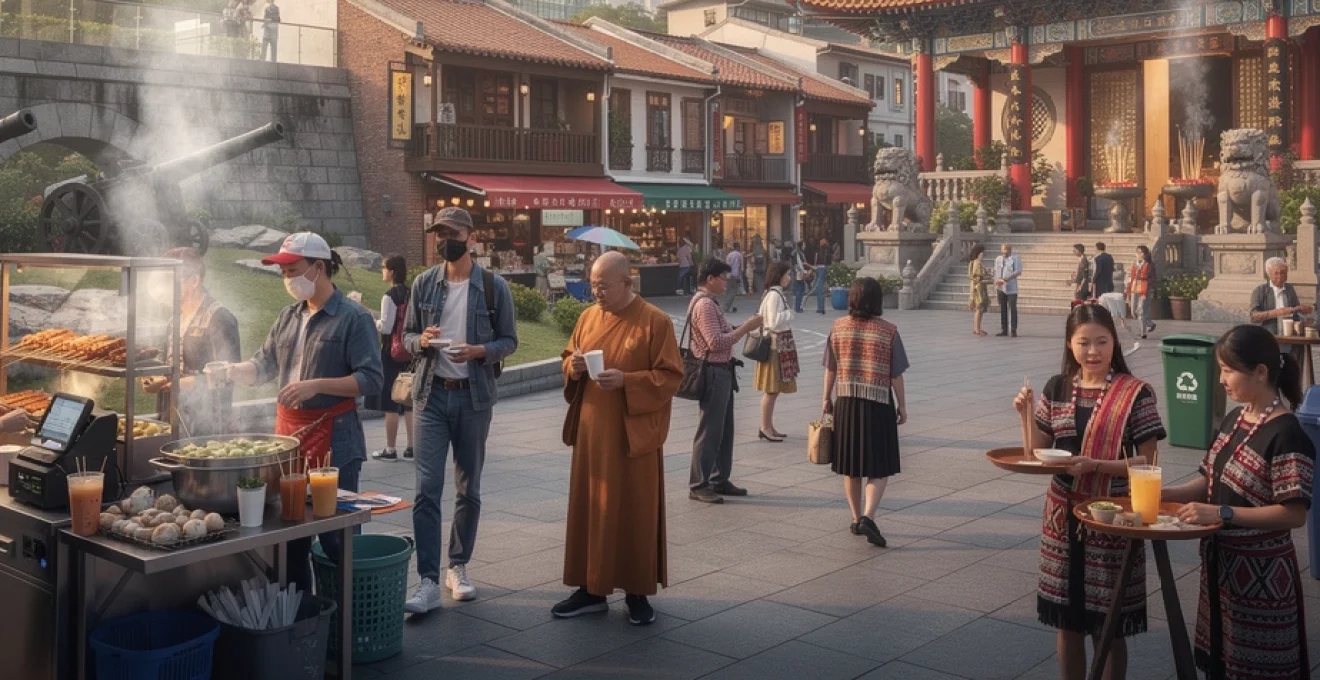
Taiwan stands as one of Asia’s most compelling paradoxes—an island where centuries-old temples nestle beside gleaming tech campuses, where indigenous weaving traditions thrive in districts dominated by semiconductor manufacturing, and where street vendors still prepare fermented delicacies using methods their great-grandparents perfected. This remarkable fusion isn’t accidental; it’s the result of deliberate preservation efforts, adaptive urban planning, and a cultural determination to honor ancestral practices whilst embracing technological advancement. From the marble canyons of Taroko to the neon-lit corridors of Taipei’s financial quarter, Taiwan demonstrates how societies can progress without severing their cultural roots. The island’s 23 million residents navigate daily between these temporal realms with practiced ease, creating a living laboratory for sustainable heritage integration.
Understanding Taiwan’s unique position requires looking beyond simple dichotomies. This isn’t merely old versus new, but rather a sophisticated negotiation between competing values—efficiency and ritual, innovation and continuity, global integration and local identity. The physical landscape itself tells this story, with every city block presenting evidence of this ongoing dialogue between epochs.
Taipei’s architectural dichotomy: taipei 101 and longshan temple urban planning
Taipei’s skyline presents one of the world’s most dramatic architectural conversations. The capital city doesn’t segregate its heritage districts from commercial zones; instead, it interweaves them in ways that force constant recalibration of urban identity. This approach has created neighborhoods where spatial storytelling occurs at every intersection, allowing residents and visitors alike to experience temporal layers simultaneously rather than sequentially.
Xinyi district’s skyscraper corridor and financial quarter development
The Xinyi District represents Taiwan’s aspirations for global economic relevance. Dominated by Taipei 101—which held the world’s tallest building title from 2004 to 2010—this zone concentrates international financial services, luxury retail, and corporate headquarters within a carefully orchestrated landscape. The 508-meter tower incorporates traditional fengshui principles despite its ultramodern design, with eight segments representing the auspicious bamboo plant. Its massive tuned mass damper, a 660-ton golden sphere suspended between floors, serves both engineering and symbolic functions, embodying the Taiwanese philosophy that innovation should acknowledge ancestral wisdom.
Surrounding Taipei 101, the district features wide pedestrian boulevards, underground shopping networks, and integrated transport hubs that move approximately 400,000 people daily through the area. The planning deliberately created what urban designers call “breathing spaces”—plazas and parks that prevent the oppressive density common in comparable Asian financial centers. Yet remarkably, traditional temple committees still maintain small shrines within this commercial ecosystem, conducting morning rituals as workers stream past toward office towers. This coexistence isn’t merely tolerated; it’s architecturally accommodated through setback requirements that preserve sightlines to sacred structures.
Wanhua’s temple architecture and qing dynasty urban fabric preservation
Contrast Xinyi with Wanhua, Taipei’s oldest district, where Qing Dynasty urban patterns remain legible despite two centuries of continuous habitation. Longshan Temple, constructed in 1738, anchors a neighborhood that has successfully resisted complete modernization whilst adapting to contemporary needs. The temple complex receives over 10,000 daily visitors, functioning simultaneously as active worship site, community center, and heritage monument. Its elaborate roof decorations—featuring dragons, phoenixes, and deities crafted through the traditional jiannian ceramic technique—undergo continuous maintenance by craftspeople trained in methods unchanged since the 18th century.
Wanhua’s narrow lanes preserve spatial rhythms from the Qing period, with buildings rarely exceeding four stories. Municipal regulations enforce height restrictions and facade guidelines within designated heritage zones, preventing the architectural erasure that has gutted historic quarters in many Asian cities. Yet these aren’t museum districts frozen in time; ground floors house modern businesses, cafes integrate WiFi networks into century-old structures, and residents enjoy contemporary amenities behind historically appropriate exteriors. This adaptive preservation model has become influential across Asia, demonstrating that heritage protection needn’t require economic stagnation.
MRT network integration: connecting heritage sites with contemporary infrastructure
The Mass Rapid Transit (MRT) system is the circulatory system that allows this dialogue between Taipei’s past and present to function in daily life. Opened in 1996 and now extending over 152 kilometers of track, the MRT connects heritage nodes like Longshan Temple, Beimen (North Gate), and Dadaocheng with contemporary landmarks such as Taipei 101, the Performing Arts Center, and Neihu Technology Park. Stations themselves often serve as interpretive spaces: tiled murals, historical photographs, and bilingual signage explain the stories behind nearby temples, markets, and industrial relics. For visitors, this means you can move from incense-filled courtyards to glass-and-steel business towers in under fifteen minutes, compressing centuries of urban development into a single commute.
From a planning perspective, the MRT network integration offers a model of how transport infrastructure can reinforce rather than undermine cultural heritage. Instead of routing lines through historic neighborhoods in ways that require demolition, many stations are placed at the periphery of older districts, with carefully planned pedestrian corridors leading inward. This approach protects fragile Qing and Japanese-era streetscapes while still granting residents the mobility benefits of a modern metro. For travelers interested in exploring “tradition meets modernity” in Taiwan, the practical takeaway is simple: choose accommodation within walking distance of a major MRT interchange, and you can experience multiple layers of Taipei’s urban history in a single, car-free day.
Leed-certified green buildings versus traditional fengshui orientation principles
Taiwan’s construction boom in the 21st century has seen a rapid rise in green building certifications, with Taipei ranking among Asia’s top cities for LEED and Taiwan’s own EEWH standards. Office towers like Taipei 101 and residential complexes in Neihu and Nangang incorporate double-skin facades, rainwater recycling systems, and high-efficiency HVAC technologies. At first glance, these glass curtain walls and photovoltaic panels might seem worlds apart from wooden beams and courtyard homes aligned to auspicious mountain-water axes. Yet many Taiwanese architects consciously consult fengshui specialists alongside energy consultants, seeking designs that satisfy both environmental metrics and cosmological harmony.
This hybrid approach shows up in subtle orientation choices and spatial flows. Entrances are angled to avoid “cutting” pedestrian energy, lobbies maintain clear sightlines to distant hills or rivers, and water features are positioned not just for evaporative cooling but also to invite prosperity according to traditional belief. Conceptually, it’s like programming with two operating systems at once: one based on measurable data, the other on intangible cultural logic. For sustainability-minded travelers, this convergence means you can stay in eco-certified hotels that still respect long-standing spatial values, turning each building into a tangible example of how Taiwan negotiates between global green standards and localized spiritual frameworks.
Tainan’s living museums: anping old street and fort zeelandia colonial heritage
Move south to Tainan, and Taiwan’s architectural palimpsest becomes even more pronounced. As the island’s oldest city and former capital, Tainan functions as a vast open-air museum where Dutch, Qing, Japanese, and contemporary Taiwanese layers overlap within a few square kilometers. Anping Old Street, with its baroque facades, mansions, and narrow alleys, sits in the shadow of Fort Zeelandia’s remaining redbrick walls, offering a dense concentration of “living history” that still serves everyday needs. Rather than cordoning off heritage into isolated museum zones, Tainan allows shops, homes, and shrines to coexist within structures that predate many modern nation-states.
Dutch east india company fortifications and archaeological restoration projects
Fort Zeelandia, established by the Dutch East India Company (VOC) in the 1620s, marks one of the earliest moments when Taiwan entered global trade networks. Much of the original fortress was dismantled or repurposed during subsequent regimes, but extensive archaeological work since the 1970s has uncovered foundations, cannons, and artefacts that now inform ongoing restoration. Conservation teams balance stabilizing historic masonry with the need to accommodate thousands of visitors annually, reinforcing walls with modern materials discreetly embedded behind original brickwork. Interpretive centers on-site use digital reconstructions to show what the fort looked like at different points in time, effectively turning a ruined stronghold into a layered narrative about colonization, resistance, and urban adaptation.
For urban historians, Fort Zeelandia offers a fascinating case study in how postcolonial societies choose which layers of occupation to foreground. While the VOC period lasted only 38 years, its spatial imprint persists in street grids and property boundaries around Anping. Local planners now incorporate buffer zones that limit high-rise construction in the visual corridor between the fort and Anping Old Street, preserving the low-rise skyline that evokes the 17th century. Visitors who climb the reconstructed watchtower can thus visually trace how Taiwan shifted from European outpost to Qing frontier town, Japanese colonial city, and contemporary heritage tourism destination—all within a single panoramic sweep.
Qing dynasty merchant houses: shennong street adaptive reuse strategies
Elsewhere in Tainan, Shennong Street showcases the island’s mastery of adaptive reuse. Once a bustling thoroughfare for Qing-era merchants dealing in tea, salt, and textiles, the street is lined with qilou shophouses combining recessed ground-floor arcades and residential upper floors. Rather than converting these buildings into generic souvenir shops, the city has encouraged a mix of uses that keep the street alive beyond tourist peak hours: design studios, bookshops, small guesthouses, and micro-roaster cafes operate alongside incense sellers and traditional apothecaries. Facade guidelines preserve original timber windows and decorative stucco, while interiors discreetly integrate air conditioning, plumbing, and fire safety systems.
This approach turns Shennong Street into a real-time laboratory for sustainable heritage management. Think of each building as a “dual-boot” system: one mode runs historic aesthetics, the other supports contemporary functionality. For travelers, the best way to experience this is to visit at different times of day. Morning brings elderly residents heading to markets, afternoon reveals slow-paced browsing in galleries, and evening lights transform the narrow lane into an atmospheric corridor of lanterns and conversation. Booking a stay in a renovated shophouse allows you to quite literally sleep inside Taiwan’s commercial history while enjoying modern comforts.
Chihkan tower’s multi-layered history: from fort provintia to national monument
Just inland, Chihkan Tower (originally Fort Provintia) condenses multiple political eras into a single site. Built by the Dutch in 1653, seized by Ming loyalist Koxinga, reconfigured under Qing administration, and further altered during Japanese rule, the complex now features layered architectural vocabularies: European-style foundations, Chinese pavilions, stone tablets in classical scripts, and Japanese-influenced landscaping. Its evolution mirrors Taiwan’s broader trajectory from contested frontier to modern state, illustrating how each regime reinterpreted and repurposed existing structures rather than starting from a blank slate.
Designating Chihkan Tower a national monument has not frozen it in time; instead, conservation policies treat the site as a text with multiple chapters. Interpretive plaques explicitly note which features belong to which period, inviting visitors to see history as accumulation rather than replacement. For anyone interested in how tradition and modern identity interweave in Taiwan, Chihkan offers a powerful metaphor: just as the complex stands on reused foundations, contemporary Taiwanese culture stands on reworked yet recognizable historical strata.
Traditional snack culture preservation in historic street markets
Heritage in Tainan is not only built from bricks and beams; it is also simmered, steamed, and fried in its markets and alleyways. Anping Old Street and nearby lanes are famous for age-old snacks like douhua (tofu pudding), shrimp rolls, and coffin bread, many prepared by families who trace their recipes back several generations. Municipal programs have started to list certain dishes and preparation methods as intangible cultural heritage, providing small grants and training to help vendors standardize hygiene practices without sacrificing traditional flavors. This ensures that when you bite into a plate of oyster vermicelli, you’re tasting continuity as much as culinary innovation.
For travelers, these historic street markets offer an accessible way to engage with Taiwan’s layered identity. You might tour Fort Zeelandia in the morning, then sit under an awning eating a snack that would have been recognizable to Qing-era dockworkers. The juxtaposition can be striking: QR codes for mobile payment taped beside hand-written menus, or stainless-steel steaming vats occupying the same ground where wooden carts once stood. In this sense, traditional snack culture preservation functions like an edible archive, keeping local memory alive in daily transactions.
Indigenous austronesian communities: taroko gorge and atayal cultural tourism
Beyond the historic Han Chinese and colonial layers, Taiwan is also home to vibrant indigenous Austronesian communities whose histories long predate written records. In regions such as Taroko Gorge and the Central Mountain Range, these communities negotiate their own versions of tradition and modernity, balancing tribal land rights, ecological stewardship, and participation in the tourism economy. For visitors accustomed to thinking of Taiwan primarily in terms of temples and tech, engaging with indigenous cultures adds crucial depth to any understanding of the island.
Marble canyon geology and tribal land management frameworks
Taroko Gorge, with its sheer marble cliffs and turquoise Liwu River, is often presented as a purely natural spectacle. Yet the landscape is also a cultural one, historically inhabited and traversed by the Truku people. National park regulations now explicitly recognize indigenous land claims and co-management roles, integrating traditional ecological knowledge into trail maintenance, hunting restrictions, and disaster preparedness planning. For example, local guides draw on generational observations of rockfall patterns and seasonal water flow when advising park authorities about which paths to close during typhoon season.
This co-management framework illustrates how Taiwan’s commitment to indigenous rights intersects with environmental governance. Rather than treating tribal practices as obstacles to conservation, policymakers increasingly see them as assets—much as an experienced sysadmin understands legacy systems not as dead weight but as repositories of crucial institutional memory. For travelers hiking Taroko’s famous trails, opting for community-run tours or local homestays is one concrete way to support this integrated model while gaining richer insights into the gorge’s human history.
Wulai hot springs and indigenous textile weaving workshops
Closer to Taipei, the Atayal community in Wulai offers a more intimate scale of cultural tourism. The town is known for its riverside hot springs, many of which have been modernized into spa resorts featuring private baths and boutique hotels. At first glance, Wulai could resemble any other Taiwanese hot spring town, but step away from the main street and you’ll find Atayal weaving centers where elders teach younger generations to produce intricately patterned textiles on backstrap looms. These workshops often double as cultural classrooms, explaining the symbolism behind colors and motifs, and how weaving once encoded social status and clan identity.
Municipal and tribal authorities have worked to ensure that tourism revenue supports rather than displaces Atayal culture. Some resorts now partner with local artisans to display textiles in lobbies or sell them in on-site shops, giving weavers direct access to visitors. For you as a traveler, choosing accommodations that highlight these partnerships is akin to selecting open-source software over closed systems: you’re supporting ecosystems that share value and knowledge rather than extracting it. A day soaking in geothermal waters followed by an afternoon in a weaving workshop offers a tangible way to experience how indigenous communities navigate the intersection of wellness tourism and cultural preservation.
Seediq and bunun agricultural terracing systems in central mountain range
Deeper in the Central Mountain Range, Seediq and Bunun communities maintain terraced fields that cling to steep slopes, demonstrating sophisticated adaptations to challenging topography. These agricultural systems, traditionally used for millet and later for rice and highland vegetables, rely on carefully calibrated irrigation channels and communal labor agreements. Modern pressures—including youth migration and changing diets—have threatened some of these practices, but recent years have seen a resurgence of interest driven by eco-tourism and farm-to-table movements in Taiwan’s cities.
Government and NGO initiatives now support “tribal kitchen” projects where visitors can help plant or harvest crops, then cook meals using heirloom varieties under the guidance of local elders. Conceptually, it’s similar to restoring an old codebase: you need to understand the original logic before you can responsibly refactor it for new contexts. Participating in these programs not only provides an alternative to more commercialized tourism but also contributes, however modestly, to the economic viability of maintaining terrace agriculture as a living tradition.
Night market ecosystems: shilin, raohe street, and fengjia culinary innovation
No exploration of tradition and modernity in Taiwan would be complete without stepping into the sensory overload of its night markets. Places like Shilin in Taipei, Raohe Street near Songshan, and Fengjia in Taichung operate as both economic engines and cultural stages, where vendors refine recipes, experiment with fusion snacks, and test new business models under the glow of neon signs. While the atmosphere feels spontaneous—and at times chaotic—the night market ecosystem is increasingly structured by regulations, digital technologies, and sustainability initiatives.
Street food vendor licensing and food safety modernisation programmes
Behind every sizzling wok and bamboo steamer lies a substantial regulatory apparatus. In response to growing tourism and public health expectations, local governments have tightened licensing requirements for night market vendors, including mandatory food safety training and regular stall inspections. In Taipei, for example, over 90 percent of Shilin Night Market vendors are now registered, with visible stall numbers that allow customers to file complaints or compliments through city hotlines. Authorities also encourage standardized refrigeration and waste disposal systems, offering subsidies to vendors who upgrade equipment.
These measures aim to safeguard the very culinary culture that draws visitors in the first place. Taiwan’s approach here is instructive: rather than displacing informal economies, it formalizes and supports them, much like bringing a beloved legacy application into compliance with modern security standards while letting it continue to run. For travelers, a practical tip is to look for stalls that prominently display their license numbers and hygiene grade stickers—an easy heuristic for choosing where to sample iconic dishes like pepper buns or grilled squid.
Xiaochi microcuisine: stinky tofu fermentation and oyster omelette techniques
At the heart of these markets are xiaochi, or “small eats,” which together form a kind of microcuisine reflecting local history and innovation. Stinky tofu, perhaps Taiwan’s most infamous snack, exemplifies how traditional fermentation techniques adapt to urban constraints. Once produced in large earthen vats in backyards, modern operations often use stainless-steel tanks and controlled fermentation times, yet many still rely on proprietary brine cultures handed down within families. The result is a spectrum of aromas and textures—from crispy fried cubes with pickled cabbage in Shilin to softer, braised versions in more traditional districts.
Similarly, the oyster omelette—defined by its slippery starch batter, fresh oysters, and sweet-savory sauce—varies subtly across regions, with Fengjia vendors sometimes adding cheese or chili for a younger crowd. These dishes function like dialects in a living language: rooted in shared grammar but evolving in response to new influences and audiences. When you sample them across different night markets, you’re effectively tasting regional interpretations of shared culinary “source code,” updated nightly by vendors who test tweaks based on customer feedback.
Digital payment integration and QR code adoption in traditional markets
One of the clearest signs of Taiwan’s digital transformation is how quickly QR code payments have spread through even the most traditional market environments. In many stalls at Raohe Street or Fengjia, you can now tap your phone or scan a code to pay via mobile wallets, LINE Pay, or local e-payment platforms, often alongside the option of cash. For small vendors, these systems reduce the need to handle coins, simplify bookkeeping, and provide transaction histories that can be used for microloans or tax reporting.
From the visitor’s perspective, digital payments streamline the experience and reduce the need to carry large amounts of cash, especially useful when hopping between dozens of stalls in a single evening. The visual juxtaposition can be striking: hand-painted menus above, laminated QR codes below, all under strings of red lanterns. It’s a reminder that innovation in Taiwan often takes the form of layering new functions onto existing cultural interfaces rather than replacing them outright.
Circular economy models: zero-waste initiatives in night market operations
As awareness of environmental issues grows, some night markets are becoming test beds for circular economy ideas. Pilot projects in cities like Taipei and Taichung have introduced shared dishware systems, where customers pay small deposits for reusable bowls and chopsticks that are collected, washed, and redistributed. Vendors who adopt compostable packaging receive fee reductions, and recycling stations with staff on hand help sort waste correctly, diverting plastics and organics from landfills. While implementation is uneven, these experiments show how even highly informal food environments can participate in broader sustainability goals.
For travelers interested in responsible tourism, seeking out markets participating in these programs—and choosing stalls that use reusable or clearly labeled compostable containers—is a simple way to align your culinary adventures with environmental values. Think of it as contributing a tiny patch to a large, collaborative software project: your individual action is small, but multiplied by thousands of visitors, it helps validate and scale new models of operation.
Semiconductor industry hub: hsinchu science park and rural hakka village coexistence
While night markets embody Taiwan’s street-level ingenuity, the island’s global reputation today is largely built on the precision of its semiconductor industry. Nowhere is the contrast between cutting-edge technology and deep-rooted tradition more visible than in Hsinchu, home to both vast science parks and centuries-old Hakka villages. Here, chip fabrication plants requiring nanometer-level cleanliness operate within a short drive of timber-framed ancestral halls and terraced tea fields, forcing planners and communities to negotiate everything from water allocation to land zoning.
TSMC manufacturing clusters and agricultural land conversion policies
Taiwan Semiconductor Manufacturing Company (TSMC) and related firms anchor Hsinchu Science Park, which as of the early 2020s hosts over 500 companies and employs more than 150,000 people. Building and expanding fabrication plants—fabs—requires large tracts of land, stable power supplies, and abundant ultra-pure water, creating pressure to convert nearby agricultural zones. In response, the government has implemented stricter environmental impact assessments and compensation schemes, designating certain farmlands as protected while allowing conversion in others under conditions such as water recycling commitments and green buffer zones.
This balancing act raises complex questions: how do you prioritize between global demand for chips and local food security or rural heritage? Taiwan’s evolving policy framework demonstrates an attempt to treat both as critical infrastructure, akin to running mission-critical databases in parallel rather than shutting one down for the other. For visitors touring Hsinchu, it’s increasingly possible to see both sides of this equation: some itineraries now combine stops at corporate visitor centers explaining chip production with visits to nearby farms discussing how irrigation patterns and land values have shifted in the tech era.
Neiwan old street railway heritage and tech worker weekend tourism
Not far from the science park, Neiwan Old Street offers a different slice of Hakka life. Once a logging and mining town connected by a narrow-gauge railway, Neiwan saw economic decline as heavy industry waned. In recent decades, however, it has reinvented itself as a heritage and leisure destination, capitalizing on its preserved station, wooden platforms, and riverside scenery. On weekends, the line is packed with families and groups of engineers and office workers from Hsinchu seeking a slower pace, nostalgic snacks, and photogenic alleys.
The revival of Neiwan illustrates how transport infrastructure can be repurposed from freight to memory. Rather than decommissioning the line, authorities and communities collaborated to maintain and market it as a heritage railway, with themed trains and seasonal events. For tech employees accustomed to working in cleanroom suits and sealed environments, a day trip to Neiwan provides a kind of temporal counterbalance: you step off a modern commuter train into a streetscape where wooden balconies, Hakka dishes, and old signboards evoke pre-digital decades.
Hakka tung blossom festivals and knowledge economy workforce migration patterns
Each spring, hills around Hsinchu and Miaoli turn white with tung blossoms, a tree historically cultivated by Hakka communities for its oil. What was once primarily an economic crop has become the centerpiece of cultural festivals that feature folk performances, craft markets, and guided hikes under falling petals. Local governments and cultural organizations have branded this period as the “snow of April in Taiwan,” drawing both domestic tourists and expatriate tech workers into rural areas that might otherwise see their populations steadily decline.
These festivals sit at the intersection of culture and demography. On one hand, the knowledge economy pulls younger Hakka residents into urban tech jobs; on the other, seasonal events and improved transport links encourage circular migration, with weekend returns that sustain village economies and social networks. Attending a tung blossom festival offers more than just pretty photos—it provides a glimpse into how communities negotiate identity in the shadow of semiconductor fabs, using landscape and ritual as anchors.
Religious syncretism: mazu pilgrimage routes and contemporary spiritual practices
Beneath and alongside all these economic and architectural transformations runs a powerful current of spiritual life. Taiwan is renowned for its religious syncretism: temples often house deities from Buddhist, Taoist, and folk traditions under one roof, and many citizens participate in rituals regardless of their professed beliefs. The figure of Mazu, the sea goddess revered by fishing and trading communities, offers a compelling lens through which to see how ancient devotion adapts to modern logistics and media environments.
Dajia to beigang matsu procession: nine-day walking pilgrimage logistics
One of Taiwan’s most significant religious events is the annual Dajia Mazu pilgrimage, during which a statue of the goddess is carried from Zhenlan Temple in Taichung’s Dajia district to Chaotian Temple in Beigang and back, covering roughly 300 kilometers over nine days. The procession weaves through urban centers, industrial zones, and rural hamlets, accompanied by tens of thousands of devotees, performance troupes, and support vehicles. Organizing such an event now involves GPS tracking of the palanquin, live-streaming for remote followers, coordinated road closures, and mobile sanitation and medical teams—an intricate choreography that marries centuries-old ritual with 21st-century event management.
For observers and participants alike, the pilgrimage transforms Taiwan’s road network into a temporary sacred artery. Local businesses along the route set up free food stations, medical volunteers offer services, and households open their doors to weary walkers. If you join even for a short segment, you’ll experience how religious practice here is as much about community logistics and hospitality as it is about individual belief. It’s a vivid illustration of how tradition survives not by resisting modern tools, but by repurposing them in service of enduring narratives and relationships.
Buddhist monasteries: fo guang shan’s digital dharma and traditional chanting
Down south near Kaohsiung, Fo Guang Shan Monastery demonstrates another facet of Taiwan’s spiritual-modern synthesis. Founded in 1967, this expansive complex follows traditional Chan (Zen) Buddhist architectural principles, with grand halls, courtyards, and a massive seated Buddha statue overlooking the grounds. Monks and nuns still gather for twice-daily chanting and meditation, maintaining lineages that trace back centuries. Yet the organization also runs television stations, multimedia production studios, and sophisticated websites that distribute digital Dharma worldwide, including live-streamed ceremonies and podcasts.
Visitors can attend English-language tours, stay in guest quarters, and participate in meditation retreats that blend ancient teachings with contemporary concerns like stress management and environmental ethics. In this environment, you might hear wooden fish drums resonate through incense smoke while nearby a media team edits footage for online audiences. The coexistence is not seen as contradictory; rather, technology is framed as a new kind of “sutra carriage,” carrying teachings across borders much as printing once did in earlier eras.
Taoist temple committees and urban renewal negotiation frameworks
Back in the cities, smaller Taoist and folk temples play surprisingly influential roles in shaping urban development. Temple committees—elected boards responsible for managing finances, rituals, and property—often own valuable plots of land in central neighborhoods. When urban renewal projects propose demolishing or relocating structures, these committees become key stakeholders, negotiating compensation, preservation measures, and community benefits. Their leverage stems not just from legal ownership but from their role as custodians of local identity and social cohesion.
In practice, this can mean that a proposed high-rise must incorporate a relocated shrine on its ground floor, preserve sightlines to a historic altar, or fund community centers managed by the temple in exchange for development rights. Planners have learned that ignoring these actors is akin to ignoring a critical database in an enterprise system: the project may proceed on paper but will fail in implementation due to local resistance. For travelers walking through Taiwanese cities, the result is urban landscapes where ornate temple roofs peek out between office towers and condominiums—a visual reminder that spiritual institutions remain active participants in shaping how tradition and modernity coexist in everyday space.