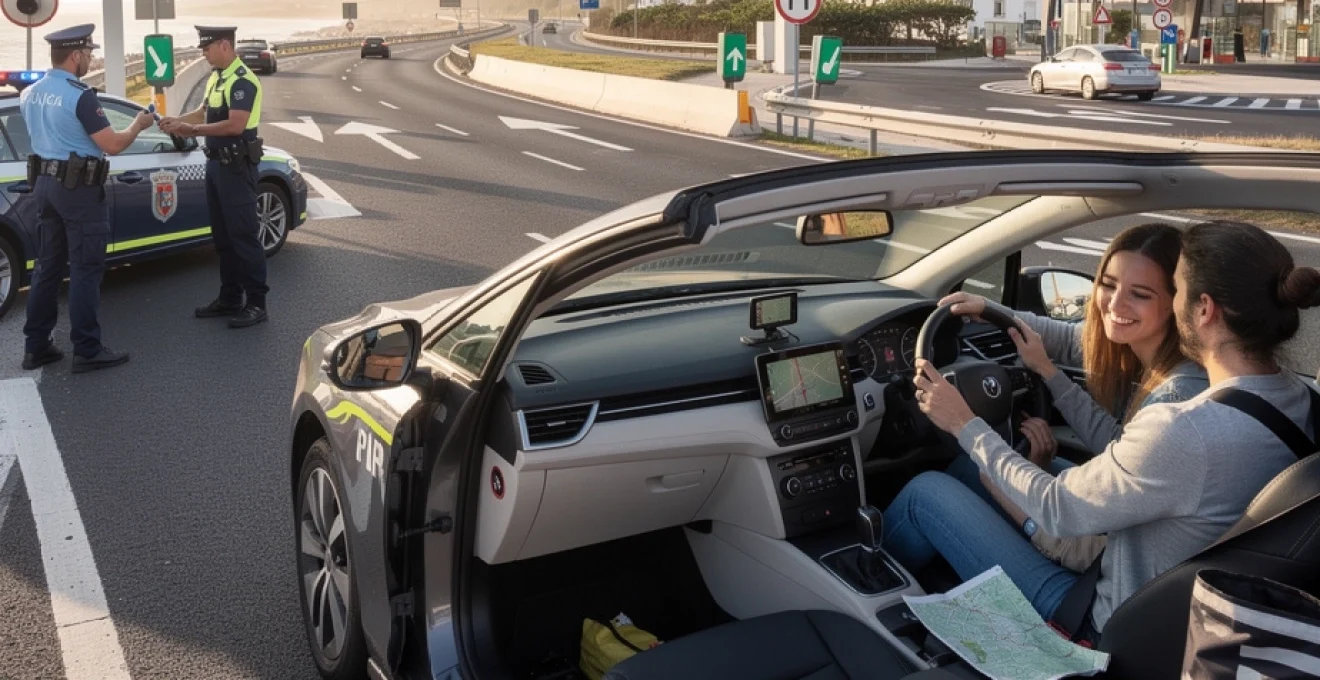
Portugal offers some of Europe’s most scenic driving experiences, from the coastal highways of the Algarve to the winding mountain roads of the north. However, navigating Portuguese roads requires understanding specific regulations, documentation requirements, and payment systems that differ significantly from other European countries. The country’s unique electronic toll system, strict traffic enforcement, and comprehensive mandatory equipment requirements can catch unprepared tourists off guard, potentially resulting in substantial fines or travel disruptions.
Recent statistics show that over 2.3 million foreign vehicles enter Portugal annually, with British tourists comprising nearly 15% of this traffic. Understanding Portuguese driving regulations isn’t merely advisable—it’s essential for avoiding penalties that can reach €2,500 for serious infractions. The Portuguese authorities have implemented increasingly sophisticated enforcement mechanisms, including widespread speed camera networks and automated toll collection systems that leave little room for error.
Portuguese driving licence requirements and international permit regulations
EU driving licence recognition under directive 2006/126/EC
The European Union’s Directive 2006/126/EC establishes the legal framework for driving licence recognition across member states, and Portugal fully complies with these regulations. British drivers holding valid UK licences can legally operate vehicles in Portugal for temporary visits, though post-Brexit changes have introduced additional considerations. The recognition applies to all standard vehicle categories, including motorcycles, passenger cars, and light commercial vehicles up to 3.5 tonnes.
However, the situation becomes more complex for extended stays. While tourist visits allow unlimited driving with a valid UK licence, residents planning to stay beyond 90 days must consider licence exchange procedures. Portugal recognises UK licences issued before Brexit under reciprocal agreements, but new licences issued after December 2020 face different treatment protocols.
International driving permit application process through DVLA
Although Portugal doesn’t require International Driving Permits (IDPs) for UK licence holders during tourist visits, obtaining an IDP provides valuable additional documentation. The DVLA issues two types of IDPs: the 1968 and 1949 versions, with Portugal accepting both formats. Applications must be submitted at least two to three weeks before departure, as processing times can extend during peak travel seasons.
The application process requires completing form D2 or applying online through the DVLA website, providing passport photographs, photocopies of your driving licence, and paying the £5.50 fee. Many experienced travellers recommend obtaining an IDP as insurance against potential complications with car rental companies or local authorities, even when not strictly required.
Non-eu licence conversion procedures and documentation
Non-EU citizens planning extended stays in Portugal must navigate more complex licence conversion procedures. The Instituto da Mobilidade e dos Transportes (IMT) oversees licence exchange programs, which vary based on bilateral agreements between Portugal and the licence-issuing country. Countries with reciprocal agreements typically allow direct exchange, while others require partial or complete retesting.
Required documentation for licence conversion includes authenticated translations of foreign licences, medical certificates, proof of residence, and sometimes driving record extracts. The process can take several months, making advance planning crucial for those considering permanent relocation or extended stays exceeding the tourist threshold.
Minimum age requirements and licence category classifications
Portugal enforces strict age requirements across different vehicle categories, with standard passenger vehicles requiring drivers to be at least 18 years old. Motorcycle regulations are more nuanced: riders of machines up to 125cc must be at least 16, while those operating mopeds not exceeding 50cc face the same minimum age requirement. These age thresholds apply to both Portuguese residents and international visitors.
Car rental companies typically impose higher age requirements, usually setting the minimum at 21 or 25 years, with additional surcharges for drivers under 25. Young drivers should research rental policies extensively, as companies may restrict certain vehicle categories or impose substantial additional fees. Some premium vehicle categories may require drivers to be over 30 with several years of driving experience.
Portuguese traffic laws and road regulation compliance
Speed limit enforcement on A1 motorway and urban zones
Speed limits in Portugal are clearly signposted and strictly enforced, particularly on major arteries such as the A1 motorway between Lisbon and Porto. The general motorway limit for private cars is 120km/h, while main rural roads are typically limited to 90–100km/h and urban areas to 50km/h unless otherwise indicated. On certain key structures, like the 25 de Abril bridge in Lisbon, authorities even impose minimum and maximum speeds, often between 40km/h and 60km/h, to maintain traffic flow and safety. Fixed and mobile speed cameras are common along the A1 and other motorways, and fines for excessive speed can reach €2,500 depending on how far above the limit you are. For tourists, this means using cruise control where possible and always adjusting speed as soon as you see a change in the posted limit.
Local police and the National Republican Guard (GNR) routinely conduct speed checks at motorway access points, tunnels and downhill stretches where drivers are tempted to accelerate. Rental car drivers should remember that fines may be charged automatically to the credit card on file, often with an extra “administration” fee from the hire company itself. If you are driving your own vehicle, speeding tickets can still be issued retrospectively based on automatic number plate recognition data. In practice, Portugal’s speed enforcement system leaves little room for “safe speeding” – if a stretch of road looks perfect for going faster, it will almost certainly be monitored. Staying within the limit not only protects your licence and your wallet, it also reduces fatigue, which is especially important on long cross-country routes.
Blood alcohol concentration limits and roadside testing protocols
Portugal applies lower legal blood alcohol concentration (BAC) limits than England and Wales, which often surprises visiting drivers. For most private motorists, the limit is 0.05%, while professional drivers and those with less than three years’ driving experience must not exceed 0.02%. These thresholds can be reached more quickly than many people realise – even two small glasses of wine with dinner may put you over the limit, depending on your weight and metabolism. Unlike some countries where enforcement is sporadic, Portuguese police perform frequent roadside checks, especially at night, on weekends and during holidays. Refusing a breath test is treated very seriously and typically results in an automatic requirement to provide a blood sample at a medical facility.
Roadside testing usually starts with a portable breathalyser device, which provides an initial reading. If the value is close to or above the legal limit, officers may carry out a more precise test using calibrated equipment, or direct you for a blood test at an approved clinic. Penalties escalate quickly with higher BAC readings and can include heavy fines, suspension of your right to drive in Portugal and, in severe cases, criminal charges and vehicle confiscation. As a visitor, the safest approach is straightforward: if you plan to drive, avoid drinking entirely. Portugal’s public transport, taxis and ride-hailing services are widely available in major cities, making it easy to enjoy local wine and port tastings without risking your licence.
Mobile phone usage restrictions and hands-free device requirements
Using a hand-held mobile phone while driving in Portugal is prohibited and rigorously enforced. That means no texting, browsing, or holding your phone to your ear, even if you are briefly stopped at lights or in heavy traffic. Hands-free systems are permitted, but only when they can be operated without taking your eyes off the road for extended periods. Earphones or headsets that cover both ears are discouraged because they reduce your ability to hear traffic and emergency vehicles. If you are relying on your smartphone for navigation, it must be secured in a fixed holder rather than balanced on your lap or held in your hand.
Fines for improper mobile phone use typically range from around €120 to €600, and foreign drivers can be asked to pay on the spot. Rental companies may also pass on administrative charges if they receive camera-based fines after your trip. A sensible strategy is to configure your route on your navigation device before you start driving and use voice commands or a passenger to make any mid-journey changes. Think of your car as an “offline zone” where your primary job is driving; any call or message that cannot wait a few minutes for a safe stop at a service area probably is not worth the risk.
Mandatory equipment regulations including reflective jackets and warning triangles
Portuguese law sets out strict requirements for the safety equipment that must be carried in your vehicle, and tourists are not exempt. Every car should have at least one reflective jacket accessible from the cabin rather than the boot, so that the driver can put it on before stepping onto the carriageway in the event of a breakdown. A warning triangle is also required to alert approaching traffic if your vehicle is immobilised on the road, although foreign-registered cars from countries where triangles are not compulsory are sometimes granted limited leeway. Motorcyclists and their passengers must wear approved crash helmets at all times, and failure to do so can trigger high fines and even vehicle confiscation.
Headlamp beam deflectors are essential if you bring a right-hand-drive car from the UK or Ireland, as your standard beam pattern will otherwise dazzle oncoming drivers when you switch to driving on the right. Depending on your model, you may use stick-on deflector kits or adjust the beam manually through the vehicle’s settings. While not mandatory, it is wise to carry a basic first-aid kit, spare bulbs and a set of spare fuses, especially if you are planning remote or mountain routes. Police spot checks occasionally verify that required equipment is present, and any missing item can result in on-the-spot penalties. Treat this equipment as your “safety toolkit” – inexpensive to assemble but invaluable when something goes wrong.
Priority rules at roundabouts and right-of-way protocols
Roundabouts are a defining feature of driving in Portugal, particularly around suburban areas and smaller towns where they have largely replaced traditional junctions. Vehicles already on the roundabout have priority, and entering drivers must yield until a safe gap appears. Within the roundabout, drivers should use the interior lane for continuing around and the exterior lane for exiting, signalling right only as they approach their exit. In practice, locals do not always observe correct lane discipline, so you should drive defensively, reduce speed and avoid sudden lane changes. If you miss your exit, it is usually safer to complete another full circle than to cut across lanes at the last second.
Outside roundabouts, the basic right-of-way rule is that vehicles coming from the right generally have priority unless signs indicate otherwise. This can feel counter-intuitive for drivers used to different systems, especially at smaller, unsignalised junctions in urban areas. Emergency vehicles using sirens and flashing lights have absolute priority, and you must move aside or stop if necessary to let them pass. At intersections, drivers should only enter if they can fully clear the junction without blocking cross-traffic, even when they technically have the right of way. Thinking of the system as a series of “courtesy contracts” can help: you follow the rule of priority from the right, but you also anticipate the possibility that other drivers may interpret or ignore it differently.
Toll road systems and electronic payment methods
Via verde transponder installation and account management
Portugal operates an extensive toll road network, and understanding how payment works is crucial if you want a smooth driving holiday. The Via Verde system is the most convenient option for frequent or long-distance users, functioning like an automatic debit system for tolls. A small electronic transponder is attached to the inside of your windscreen and communicates with overhead gantries as you pass through toll plazas or fully electronic toll sections. Each time you cross a toll point, the fee is logged and later debited from your associated account or bank card, allowing you to use dedicated fast lanes marked with the green Via Verde logo without stopping.
For residents, Via Verde contracts are usually linked directly to a Portuguese bank account, but tourists can also access temporary solutions via car rental companies or short-term agreements. Many major hire firms offer vehicles already equipped with a working transponder, charging a modest daily fee plus the actual toll costs. This may appear like an extra expense, but it often saves time, fuel and stress compared with queuing in manual lanes or trying to pay tolls after the fact. If you are driving your own foreign-registered car and expect to use toll roads extensively, registering for a temporary Via Verde device can be one of the most effective ways to simplify your journey.
A22 algarve motorway electronic toll collection
The A22 motorway in the Algarve, which runs roughly parallel to the southern coast, is a prime example of Portugal’s shift to fully electronic tolling. Unlike traditional motorways with staffed booths, the A22 has no cash payment points; instead, tolls are collected exclusively via overhead electronic gantries. Portuguese vehicles typically use Via Verde or licence plate-based billing, but this can be confusing for foreign tourists who are not prepared. If you enter the A22 without a valid electronic payment method, cameras will record your number plate and generate unpaid toll charges that must be settled later, often within a strict deadline.
Because the A22 connects many of the Algarve’s most popular resorts, from Lagos to Faro and beyond, it is difficult to avoid if you want efficient travel times. Before using it, make sure you have either a valid transponder (via your rental company or a temporary subscription) or have registered your vehicle details through one of the visitor-friendly systems described below. Think of the A22 as a “virtual turnstile”: you never physically stop to pay, but a digital record is created every time you pass. Ignoring those digital tolls does not make them disappear; instead, they can evolve into higher fees and complications with rental companies or cross-border enforcement agencies.
Temporary tourist toll solutions and easytoll registration
To accommodate foreign tourists driving their own vehicles, Portugal has developed several short-term toll payment options. One of the most straightforward is Easytoll, a system that links your vehicle registration to a credit or debit card at designated border entry points. As you register, a camera captures your number plate and your card details are securely stored; thereafter, every time your vehicle passes an electronic toll point, the corresponding fee is automatically charged to your card. This system is especially useful if you are entering Portugal from Spain via main border crossings and intend to use motorways like the A22 or A23.
Easytoll registrations are typically valid for a limited period (for example, 30 days), after which they can be renewed if you remain in the country. If you prefer not to register at the border, you may also purchase prepaid Toll Cards or sign up for temporary online services using your licence plate and payment details. Which option is best for you? If your trip is short and involves only a few motorway segments, a simple prepaid card might suffice. If you expect to drive widely across the country, an automatic system such as Easytoll or a rented Via Verde device will usually be more convenient and cost-effective.
Post-payment options through CTT correios network
Drivers who use electronic toll roads without a prior payment arrangement are not necessarily trapped, but the post-payment process requires attention. For many routes, especially where tolls are charged via licence plate recognition rather than transponders, unpaid tolls are transferred to the national postal service, CTT Correios. You can then pay these amounts at post offices, authorised kiosks or online platforms within a fixed time window, often ranging from a few days to a couple of weeks after travel. Failure to pay within the deadline can lead to significant surcharges and, for rental vehicles, additional administrative fees passed on by the hire company.
To check whether you owe tolls, you can use official websites where you enter your vehicle registration and country code to view outstanding charges. This system is particularly useful if you are making a short visit and want to settle everything before leaving Portugal. However, it relies on you taking the initiative; there will not always be a reminder email or letter sent to your home country before penalties escalate. As a practical rule, if you ever use a motorway section where you do not physically stop and pay, make a note of the date and road number and verify any toll obligations soon afterwards through CTT or related portals.
Navigation challenges on portuguese road infrastructure
From newly built motorways to centuries-old cobbled streets, Portugal’s road network presents a mix of modern efficiency and historical charm – and that combination can occasionally challenge visiting drivers. In major cities like Lisbon and Porto, one-way systems, bus lanes and tram tracks require close attention to signage and lane markings. Old town centres often feature extremely narrow streets, tight turns and low-visibility junctions where GPS instructions may not perfectly match reality. In rural areas, you may encounter unpaved sections, faded road markings or sudden changes in road quality when moving from national to municipal routes.
Digital navigation tools are invaluable, but they are not infallible. It is not uncommon for satnav systems to miscount exits on roundabouts or to suggest shortcuts through villages that are unsuitable for larger vehicles or caravans. A good strategy is to think of your GPS as a co-pilot rather than an unquestioned authority: check its instructions against road signs, and if an indicated turn appears unsafe or impractical, continue to the next suitable junction and let the system recalculate. Keeping an offline map or printed route summary as a backup can be particularly helpful if you lose mobile signal in mountainous or sparsely populated regions.
Vehicle insurance requirements and breakdown assistance
All vehicles driven in Portugal must be covered by at least third-party liability insurance, and proof of this cover should be carried at all times. If you are bringing your own car from abroad, check that your existing policy extends to Portugal under the international “Green Card” system or its modern equivalents. Most comprehensive European policies include Portugal, but coverage limits and conditions can vary, so confirming details with your insurer before departure is essential. For rental vehicles, basic third-party cover is usually included in the price, but collision damage waivers (CDW), theft protection and reduced excess options are often sold separately.
Breakdown assistance is another crucial element of a safe road trip in Portugal. Many insurers and roadside assistance companies offer European breakdown cover that includes towing, roadside repairs and, in some cases, onward travel or accommodation if your vehicle cannot be fixed quickly. Motorways and major roads are equipped with SOS phones roughly every 2km, connecting you directly to emergency assistance services. When choosing additional cover, consider not only the cost but also the scope: does it include recovery back to your home country, replacement vehicles or support if your car is immobilised due to an accident rather than a mechanical fault? Treat breakdown and insurance arrangements as your “safety net” – ideally, you will never need them, but if you do, they can turn a major crisis into a manageable inconvenience.
Fuel types and petrol station operations in portugal
Portuguese fuel stations offer a broad range of fuel types compatible with most modern vehicles, including Gasolina 95 (unleaded 95), Gasolina 98 (premium unleaded), and Gasóleo (diesel). Increasingly, you will also find alternative fuels such as LPG and a growing network of electric vehicle (EV) charging points, particularly along major corridors and in urban centres. Fuel prices in Portugal tend to be slightly higher than the EU average, and they can vary significantly between motorway service areas and local stations in towns. Before setting off on long rural or mountainous routes, it is wise to top up your tank, as smaller villages may have limited opening hours or no fuel station at all.
Most petrol stations on motorways and in large cities operate 24/7 and provide both attended service and automated pumps that accept credit and debit cards. In smaller communities, stations may close at night or during extended lunch breaks, and older pumps may only accept local payment cards, so having some cash available can be useful. For EV drivers, national charging networks and apps can help you locate compatible chargers and check availability in real time. As with other aspects of driving in Portugal, a little preparation goes a long way: knowing your vehicle’s fuel type in Portuguese, planning refuelling stops ahead of time, and keeping an eye on your range will help ensure that the only stops you make are the ones you have chosen for the view, not because your tank is unexpectedly empty.