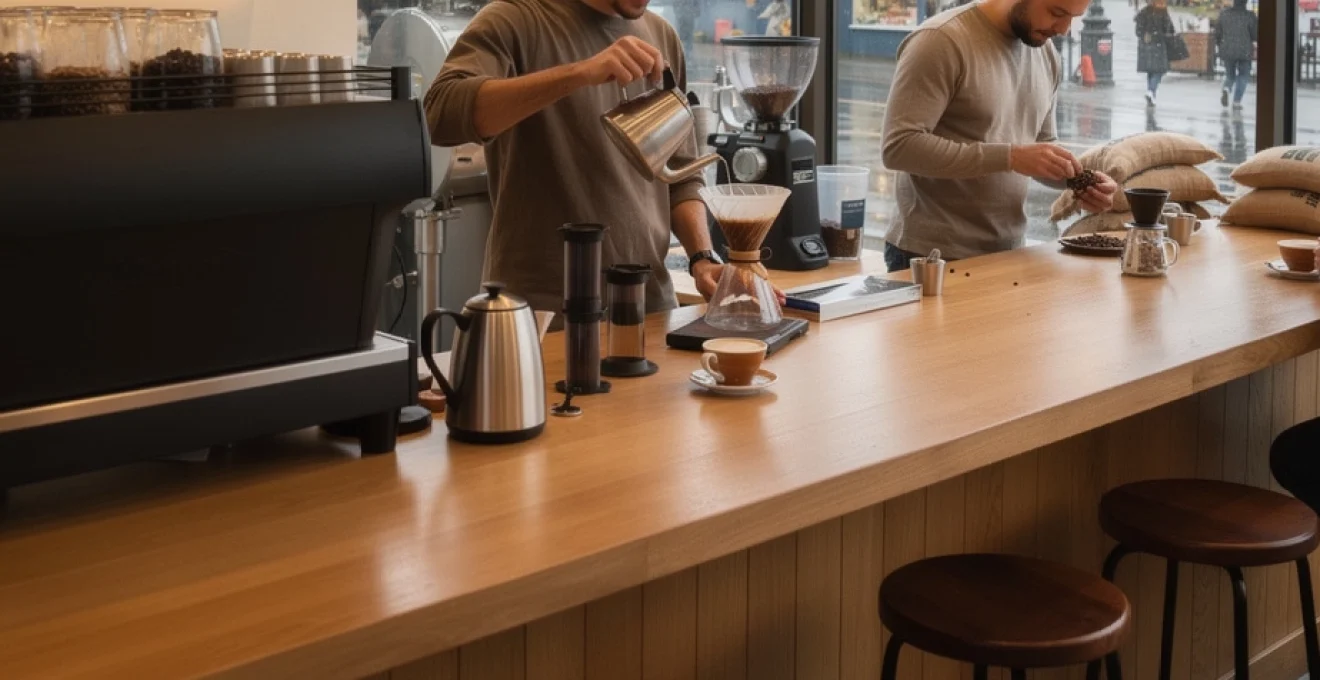
Seattle’s transformation from a city of instant coffee drinkers to the epicentre of America’s specialty coffee revolution represents one of the most remarkable cultural shifts in modern culinary history. What began as a practical response to the Pacific Northwest’s perpetually grey skies has evolved into a sophisticated ecosystem of artisanal roasters, innovative brewing techniques, and direct-trade relationships that influence coffee culture worldwide. The Emerald City’s journey from convenience-driven coffee consumption to meticulous craft standards illustrates how local preferences can reshape entire industries, establishing new benchmarks for quality, sustainability, and community engagement that continue to define specialty coffee culture today.
Historical evolution from folgers to Third-Wave coffee movement in pacific northwest
The Pacific Northwest’s coffee transformation began in the late 1960s when conventional wisdom suggested Americans were content with mass-produced, pre-ground coffee dominated by brands like Folgers and Maxwell House. However, Seattle’s unique climate and cultural disposition created fertile ground for a coffee revolution that would eventually spread across the globe. The city’s residents, accustomed to long, drizzly winters and seeking comfort in warm beverages, gradually developed more discerning palates that demanded higher quality and more complex flavour profiles than mainstream commercial offerings could provide.
Starbucks corporation origins and howard schultz’s espresso bar vision
The foundation of Seattle’s coffee empire began in 1971 when three University of Washington graduates—Jerry Baldwin, Zev Siegl, and Gordon Bowker—opened the first Starbucks store near Pike Place Market. Initially focused on selling high-quality coffee beans rather than prepared beverages, the company represented a significant departure from the instant coffee culture that dominated American households. The turning point came in 1982 when Howard Schultz joined the company and subsequently travelled to Italy, where he experienced the vibrant espresso bar culture that would fundamentally reshape his vision for coffee retail in America.
Schultz’s revolutionary concept of transforming coffee shops into “third places”—spaces between home and work where communities could gather—represented a profound shift in American coffee consumption patterns. His vision extended beyond simply serving better coffee; he envisioned creating an entirely new social infrastructure built around the ritual of coffee drinking. This philosophy would later become a cornerstone of the specialty coffee movement, influencing how independent roasters and cafes approached customer experience and community building.
Seattle’s best coffee and tully’s coffee early market competition
The success of Starbucks inevitably attracted competitors who recognised the growing demand for premium coffee experiences in Seattle. Seattle’s Best Coffee, originally known as the Wet Whisker, emerged in 1970 on Whidbey Island before establishing a significant presence in the Seattle market. The company distinguished itself through a commitment to lighter roasts and direct relationships with coffee farmers, establishing sourcing practices that would later influence the entire specialty coffee industry.
Tully’s Coffee, founded by Tom O’Keefe in 1992, represented another significant player in Seattle’s evolving coffee landscape. The company positioned itself as a more approachable alternative to Starbucks’ increasingly standardised offerings, emphasising handcrafted beverages and locally-inspired menu items. This competitive environment fostered innovation and raised consumer expectations, creating market conditions that would support the emergence of numerous smaller, artisanal coffee operations throughout the region.
Transition from commercial roasting to Small-Batch artisanal methods
The shift from large-scale commercial roasting to small-batch artisanal methods represents one of the most significant developments in Seattle’s coffee evolution. Early pioneers like Alfred Peet, whose Berkeley-based Peet’s Coffee influenced the original Starbucks founders, demonstrated that carefully sourced and expertly roasted beans could command premium prices from discerning consumers. This model inspired a generation of Seattle entrepreneurs to establish smaller roasting operations focused on quality rather than quantity.
These artisanal roasters introduced concepts that were revolutionary at the time: single-origin coffees that highlighted the unique characteristics of specific farms or regions, precise roasting profiles designed to enhance rather than mask natural flavours, and transparent sourcing practices that connected consumers directly with coffee-growing communities. The transition required significant investment in equipment, training, and supply chain development, but it established Seattle as the proving ground for techniques and business models that would eventually define the third-wave coffee movement.
Pike place market’s role in establishing coffee culture foundation
Pike Place Market functions as the symbolic and practical heart of Seattle’s coffee story. Long before specialty coffee became a global phenomenon, the market hosted early roasters, grocers, and coffee counters that accustomed Seattleites to the idea of freshly roasted beans rather than shelf-stable tins. The opening of Manning’s Coffee in 1908, followed decades later by the first Starbucks location inside the market, cemented Pike Place as ground zero for the city’s emerging coffee identity.
As tourism expanded in the late twentieth and early twenty-first centuries, Pike Place Market became a pilgrimage site for coffee enthusiasts seeking to experience the “original” Starbucks and neighbouring independent roasters. Lines of visitors queuing for espresso helped normalise the notion that coffee could be both a daily ritual and a destination experience. At the same time, the market’s dense concentration of food artisans, farmers, and craftspeople nurtured a broader appreciation for origin, seasonality, and craftsmanship—values that dovetail perfectly with third-wave coffee culture.
Importantly, Pike Place served as an incubator for coffee entrepreneurs testing new roast profiles, retail concepts, and drink formats in a high-feedback environment. Baristas and roasters could observe how tourists and locals responded to darker roasts versus lighter, more nuanced offerings, and iterate quickly. Over time, this feedback loop helped elevate expectations for what a “good cup of coffee” should taste like, not only in downtown Seattle but throughout the Pacific Northwest and, eventually, across the United States.
Pioneering specialty coffee roasters defining seattle’s craft standards
As Seattle moved beyond the second wave of espresso bars and branded chains, a cohort of pioneering specialty coffee roasters emerged to set new benchmarks for quality and transparency. These companies treated coffee less like a generic commodity and more like fine wine, emphasising single-origin traceability, direct trade relationships, and meticulous roast development. Their influence extended far beyond city limits, as baristas, café owners, and even international buyers looked to Seattle to understand what cutting-edge specialty coffee could be.
What distinguishes these roasters is not only the calibre of their beans but the rigour of their sourcing and roasting philosophies. Many have invested in long-term relationships with farmers, annual origin trips, and in-house quality control labs that rival those of much larger companies. For consumers, the result is a level of consistency and clarity of flavour that would have been unthinkable in the era of canned supermarket coffee. For the industry, these roasters provide templates for sustainable business models anchored in quality rather than volume.
Victrola coffee roasters’ direct trade sourcing philosophy
Victrola Coffee Roasters, founded in the early 2000s on Seattle’s Capitol Hill, quickly became synonymous with direct trade ethics and meticulous flavour profiling. Rather than relying solely on importers and commodity markets, Victrola invested in building relationships with farmers and cooperatives across Central and South America and East Africa. This direct trade sourcing model allowed them to negotiate prices well above commodity rates, ensuring that producers were compensated for quality and sustainable practices.
From a consumer perspective, Victrola’s approach meant that each bag of coffee came with a story: farm name, altitude, processing method, and even details about the harvest. For many Seattle residents, this was their first introduction to the idea that coffee from Ethiopia could taste radically different from coffee grown in Guatemala, even when brewed using the same method. By offering regular cuppings and public tastings, Victrola helped demystify concepts like “washed process” or “natural process,” turning what might seem like technical jargon into accessible, sensory experiences.
Victrola’s sourcing philosophy also encouraged greater consistency and traceability in the local market. When you know where your beans come from, you can track variables like climate, soil, and processing changes from year to year, much like a winemaker monitoring vintages. This allowed Victrola to refine their roast profiles annually, ensuring that their flagship single-origin and blend offerings remained both familiar and dynamically responsive to each harvest’s unique character.
Lighthouse roasters’ single-origin ethiopian and guatemalan profiles
Lighthouse Roasters, one of Seattle’s earliest independent micro-roasteries, built its reputation on distinctive single-origin coffees, particularly from Ethiopia and Guatemala. At a time when many shops still relied on heavy, smoky roasts that obscured origin character, Lighthouse leaned into medium roasts that highlighted bright acidity, floral aromatics, and complex fruit notes. For many locals, tasting a Lighthouse Ethiopian for the first time was akin to hearing high-fidelity audio after years of listening through a transistor radio.
The roastery’s focus on Ethiopian and Guatemalan profiles was strategic. Ethiopian coffees, often from Yirgacheffe or Sidama, allowed Lighthouse to showcase tea-like body, jasmine aromatics, and citrus or stone fruit sweetness—flavour attributes that challenged the assumption that coffee had to be bitter or harsh. Guatemalan coffees, by contrast, provided a bridge for drinkers accustomed to more traditional profiles, with chocolate, caramel, and nutty notes wrapped in a structured acidity. Together, these origins formed a sort of sensory syllabus for customers learning to distinguish between terroirs.
Lighthouse’s consistent presence in neighbourhood cafés and grocery shelves across Seattle also played a key role in normalising single-origin purchasing. Instead of choosing beans based solely on roast level or brand, consumers began asking more nuanced questions: “What region is this from?” “Is this a washed Ethiopian or a natural?” In doing so, Lighthouse helped embed origin literacy into everyday coffee conversations, a hallmark of mature specialty coffee culture.
Analog coffee’s precision roasting technology and cupping protocols
Analog Coffee represents the more overtly technical side of Seattle’s specialty coffee evolution. Leveraging advances in roasting software, data logging, and environmental controls, Analog treats each roast as a repeatable experiment rather than an art form based purely on intuition. Their roasting profiles are tracked in real time, with variables such as charge temperature, rate of rise, and development time carefully controlled to within seconds and fractions of a degree.
To the casual drinker, these details might sound abstract, but their impact is tangible in the cup. Precision roasting allows Analog to emphasise the sweetness and clarity of high-grade green coffee while avoiding underdevelopment (grassy, sharp flavours) or overdevelopment (charred, flat notes). For cafés and wholesale partners, this consistency is gold: a pour-over of a Kenyan single-origin brewed in January will taste remarkably similar to one brewed in March, assuming identical brewing parameters.
Analog’s rigorous cupping protocols further reinforce their quality standards. Each new lot is scored based on Specialty Coffee Association (SCA) criteria—aroma, flavour, aftertaste, acidity, body, balance, uniformity, and sweetness—before being approved for production. You can think of this process like a lab-based quality control programme in the pharmaceutical industry: every batch must meet defined sensory and technical thresholds before reaching the public. By opening some of these cuppings to baristas and consumers, Analog helps educate the community about what “clean,” “complex,” or “defective” actually mean in specialty coffee terms.
Caffe umbria’s italian espresso traditions in american context
While many Seattle roasters pursued lighter, origin-forward profiles, Caffè Umbria carved out a distinctive niche by honouring Italian espresso traditions within the American specialty coffee context. Founded by the Bizzarri family, whose coffee roots trace back to Perugia, Italy, Caffè Umbria focuses on carefully constructed blends designed for balance, body, and consistency in espresso-based drinks. This approach mirrors the classic Italian philosophy: rather than spotlighting a single farm, use multiple origins to achieve an ideal flavour equilibrium.
In practice, this means that a Caffè Umbria espresso will often lean towards chocolate, toasted nut, and subtle spice notes, with a velvety crema and restrained acidity that holds up well in milk. For Seattle consumers accustomed to bold, often bright single-origin shots, this style offers a familiar, comfort-driven experience that still meets contemporary quality standards. It also provides an important reminder that specialty coffee is not monolithic; there is room for both Nordic-style light roasts and traditional Italian-inspired blends within a mature coffee ecosystem.
Caffè Umbria’s cafés function as bridges between European café culture and Seattle’s third-wave sensibilities. Patrons might sip a classic cappuccino at the bar—served in ceramic, not a paper to-go cup—while still having access to information about origin, roast date, and sustainability certifications. This blending of old-world ritual and new-world transparency illustrates how Seattle’s specialty coffee culture can respect tradition while driving innovation.
Cherry street coffee house multi-location expansion strategy
Cherry Street Coffee House demonstrates how a multi-location brand can scale while maintaining a focus on community and quality. Starting as a single neighbourhood café, Cherry Street expanded across downtown and surrounding areas by identifying high-traffic locations where a welcoming “third place” was lacking. Rather than pursuing a cookie-cutter design, each shop was adapted to its immediate environment, incorporating local art, varied seating, and menu tweaks that reflected nearby office workers, students, or residents.
This expansion strategy leveraged Seattle’s existing coffee literacy. Customers who had learned to appreciate single-origin coffees and latte art in smaller third-wave shops expected similar standards wherever they went. Cherry Street responded by partnering with reputable roasters, investing in barista training, and ensuring that each café had the equipment needed for consistent espresso and brewed coffee. The result was a chain-like footprint with more of an independent-shop ethos, something that appeals to travellers and locals alike.
From a business perspective, Cherry Street illustrates how specialty coffee concepts can scale without sacrificing their soul. Multi-location operations benefit from economies of scale—bulk purchasing, centralised training, shared marketing—yet the brand’s continued emphasis on community events, local partnerships, and staff autonomy keeps it grounded. For other cities seeking to build a specialty coffee culture, Cherry Street’s model offers a useful blueprint: grow wide, but stay local in feel and execution.
Third-wave coffee shop innovation and brewing methodology excellence
By the late 2000s, Seattle’s coffee landscape had evolved from simply serving better beans to exploring how brewing methodology could unlock new dimensions of flavour. Third-wave cafés began to look more like laboratories than traditional coffee shops, with scales, gooseneck kettles, refractometers, and multiple brew devices lining the bar. The underlying belief was straightforward: if coffee is a complex agricultural product, then precision in extraction is essential to reveal its full potential.
For consumers, this shift meant that ordering a “coffee” became a more interactive and educational experience. Baristas might ask whether you preferred a V60 pour-over, a Chemex, or an AeroPress, explaining how each method would affect body, clarity, and perceived sweetness. While this level of choice can be intimidating at first, it also empowers you to tailor your drink much like you might choose between cooking methods for a high-quality steak. Over time, Seattle’s third-wave shops helped normalise the idea that brewing is as important as roasting in defining specialty coffee quality.
Victrola capitol hill’s manual pour-over techniques and v60 mastery
Victrola’s Capitol Hill location became one of the city’s early showcases for manual pour-over brewing, particularly using the Hario V60. Unlike batch-brew drip machines, the V60 allows baristas to control variables such as pour rate, water temperature, and turbulence with remarkable precision. At Victrola, baristas developed standardised recipes—gram-for-gram brew ratios, bloom times, and total extraction times—while still adjusting for subtle differences in roast, age, and ambient conditions.
This methodical approach turned the pour-over bar into a kind of open classroom. Customers could watch their coffee being brewed to order, ask questions about why spiral pouring patterns matter, or learn how grind size affects extraction. Many home brewers in Seattle adopted these techniques, purchasing V60s and scales to replicate café-quality results in their kitchens. In effect, Victrola helped export professional brewing standards into domestic spaces, raising the overall bar for what “good coffee at home” could mean.
From a sensory standpoint, V60 brewing at Victrola emphasised clarity and acidity, making it an ideal platform for showcasing lightly roasted, single-origin coffees. If espresso is the concentrated solo performance, you might think of a V60 as the full symphony, allowing each instrument—floral aromatics, citrus notes, caramel sweetness—to be heard distinctly. This differentiation helped cement pour-over as a core element of Seattle’s specialty coffee identity.
Slate coffee roasters’ nordic influence and light roast specialisation
Slate Coffee Roasters pushed Seattle’s palate further by embracing a Nordic-inspired approach to roasting and brewing. Influenced by Scandinavian roasters who championed very light roasts and high-acidity profiles, Slate focused on roasting just enough to develop sweetness and solubility without sacrificing delicate aromatics. The result was coffee that tasted more like fruit juice or herbal tea than the smoky, robust cups many Americans were used to.
To support this style, Slate introduced tasting formats such as “deconstructed” lattes, where customers were served a shot of espresso, a small glass of steamed milk, and the combined drink side by side. This allowed you to experience how the espresso’s flavour changed when integrated with milk, highlighting balance rather than sheer strength. These educational service models made abstract concepts like “coffee extraction” or “milk integration” concrete and approachable.
Slate’s emphasis on light roast specialisation also sparked broader debates within Seattle’s coffee community. How light is too light? At what point does acidity become overwhelming rather than refreshing? These questions, debated in cafés and on social media, helped refine consumer preferences and encouraged other roasters to experiment with their own roast curves. In this way, Nordic-style light roasts acted as a kind of creative tension within the market, pushing the boundaries of what specialty coffee could taste like.
Milstead & co.’s australian flat white culture integration
Milstead & Co., located near Seattle’s Fremont and Wallingford neighbourhoods, played a pivotal role in integrating Australian and New Zealand café culture—especially the flat white—into the local specialty coffee scene. The flat white, typically a double shot of espresso topped with a smaller volume of velvety microfoam, emphasises coffee flavour over milk volume. Compared with a traditional latte, it is more intense, creamier, and served in a smaller cup.
By putting flat whites and similar drinks at the centre of their menu, Milstead introduced many Seattle residents to a more coffee-forward milk beverage that aligned well with third-wave priorities. Baristas were trained to steam milk to a glossy, paint-like texture, producing microfoam that integrated seamlessly with the espresso rather than sitting on top as a dry cap. This technique not only improved mouthfeel but also created a stable canvas for latte art, further reinforcing visual quality cues for customers.
Milstead’s broader menu and service style reflected a globalised view of coffee culture. You might encounter beans roasted by leading U.S. or international roasters alongside local favourites, mirroring the way Australian cafés often curate coffees from multiple sources. For travellers and locals alike, this approach offered a cosmopolitan experience while still rooted in Seattle’s exacting standards for espresso preparation and brewing methodology excellence.
Elm coffee roasters’ chemex and aeropress brewing precision
Elm Coffee Roasters, based in Pioneer Square, distinguished itself through a dual focus on roasting precision and brew-bar excellence, particularly with Chemex and AeroPress methods. The Chemex, with its thick paper filters and hourglass design, yields a clean, tea-like cup that accentuates sweetness and aromatic complexity. Elm baristas fine-tuned grind sizes, pouring rhythms, and brew ratios to ensure each Chemex extraction hit the desired balance between clarity and body.
The AeroPress, by contrast, offers a versatile, immersion-style brew with both pressure and filtration, making it a favourite among baristas and home enthusiasts who enjoy experimentation. At Elm, AeroPress recipes were often dialled in to maximise body and sweetness for lighter roasts, showing how a compact device could produce café-quality results. Demonstrations and occasional AeroPress throwdowns (friendly competitions) helped demystify the device for curious customers, turning what might look like a scientific instrument into an accessible everyday brewer.
By foregrounding these manual methods, Elm reinforced a core tenet of third-wave coffee: brewing is a variable you can control, not a black box. For anyone eager to improve their home coffee routine, watching Elm’s baristas work with scales, timers, and controlled agitation offers a practical education. It is analogous to watching a skilled chef handle a knife and stove—once you see the technique, you start to understand why the outcome tastes so different from mass-produced alternatives.
Bean sourcing networks and direct trade relationships
Behind Seattle’s impressive array of specialty cafés lies a complex web of bean sourcing networks and direct trade relationships that span continents. Rather than relying solely on commodity exchanges, many Seattle roasters work directly with producers or trusted importers who specialise in high-scoring coffees. These partnerships often involve multi-year contracts, pre-financing for harvests, and collaborative efforts to improve processing infrastructure at origin.
Direct trade relationships serve multiple purposes. Economically, they allow farmers to earn significantly more than the volatile C-market price, rewarding quality and providing a buffer against market shocks. From a quality perspective, they give roasters direct feedback channels: if a lot shows fermentation defects or uneven drying, both parties can investigate and adjust processing for the next harvest. For consumers, this translates into more transparent labels, where you can see farm names, microlot identifiers, and even the premiums paid above market rates.
In recent years, sustainability and social impact have become even more central to Seattle’s specialty coffee sourcing. Many roasters publish annual transparency reports detailing FOB (free on board) prices, certifications, and farm projects supported, such as school construction, water treatment, or climate-resilience initiatives. As climate change increasingly affects coffee-growing regions—pushing suitable elevations higher and increasing disease pressure—these long-term relationships help both sides adapt. For those of us on the consumer end, choosing coffee from roasters who invest in direct trade is one of the most tangible ways to support a more equitable global coffee supply chain.
Barista training programmes and specialty coffee association certifications
Seattle’s reputation as a specialty coffee capital depends as much on its baristas as on its beans and machines. To maintain consistently high standards across dozens of cafés, many roasters and multi-location shops invest heavily in barista training programmes and industry-recognised certifications. New hires often undergo weeks of structured training that covers everything from espresso theory and milk science to workflow efficiency and customer service.
The Specialty Coffee Association (SCA) plays a central role in formalising this education. Many Seattle professionals pursue SCA certifications in brewing, barista skills, sensory analysis, and even green coffee grading. These programmes provide a shared vocabulary and set of best practices, ensuring that when a barista talks about “extraction yield” or “TDS” (total dissolved solids), they are referencing globally understood concepts. For café owners, certified staff are a signal to customers that the business takes quality seriously.
Training, however, goes beyond technical proficiency. Leading Seattle cafés emphasise hospitality, inclusivity, and communication, recognising that even the most perfectly extracted espresso will fall flat if the customer experience is unwelcoming. Many shops incorporate role-playing scenarios into training: how do you explain the difference between a flat white and a latte to someone who has never heard the term? How do you guide a guest from dark roasts to lighter profiles without sounding elitist? By addressing these soft skills, barista programmes help ensure that specialty coffee remains accessible rather than intimidating.
Economic impact on seattle’s tourism and local business ecosystem
The rise of specialty coffee culture in Seattle has had a measurable economic impact on both tourism and the local business ecosystem. According to recent tourism reports, coffee-related activities—from café hopping to guided coffee tours—are now among the top experiences sought by visitors to the city. Tour operators offer walking routes that connect iconic spots like Pike Place Market with neighbourhood roasteries in Capitol Hill, Ballard, and Fremont, generating revenue not only for cafés but also for nearby restaurants, boutiques, and cultural institutions.
Specialty coffee has also driven demand for complementary businesses and services. Local manufacturers of espresso machines and brewing equipment—such as Synesso, Slayer, and La Marzocco USA—employ skilled labour and export high-end equipment worldwide, reinforcing Seattle’s status as a hub for coffee technology innovation. Ancillary sectors, including ceramics, graphic design, and packaging, benefit from partnerships with roasters seeking distinctive branding and custom drinkware. In this way, a single café opening can ripple outward, supporting a network of suppliers and creative professionals.
At the neighbourhood level, cafés often act as anchor tenants that attract foot traffic and encourage street-level vibrancy. A well-known specialty shop can raise the profile of an emerging district, making it more attractive to other independent businesses and, eventually, to visitors seeking “authentic” local experiences. Of course, this growth also raises questions about affordability and gentrification—issues that Seattle continues to grapple with. Some cafés respond by hosting community events, offering sliding-scale programmes, or partnering with local non-profits to ensure that the benefits of coffee-driven development are more widely shared.
For prospective travellers and residents alike, understanding the economic role of coffee in Seattle reveals why the city’s café scene feels so integrated into daily life. It is not just about grabbing a quick latte; it is about participating in an ecosystem where farmers, roasters, baristas, equipment makers, and neighbourhoods all intersect. When you choose to visit a local roastery, attend a cupping, or buy beans from a direct trade programme, you are supporting a complex, interconnected web that has helped make Seattle synonymous with specialty coffee worldwide.