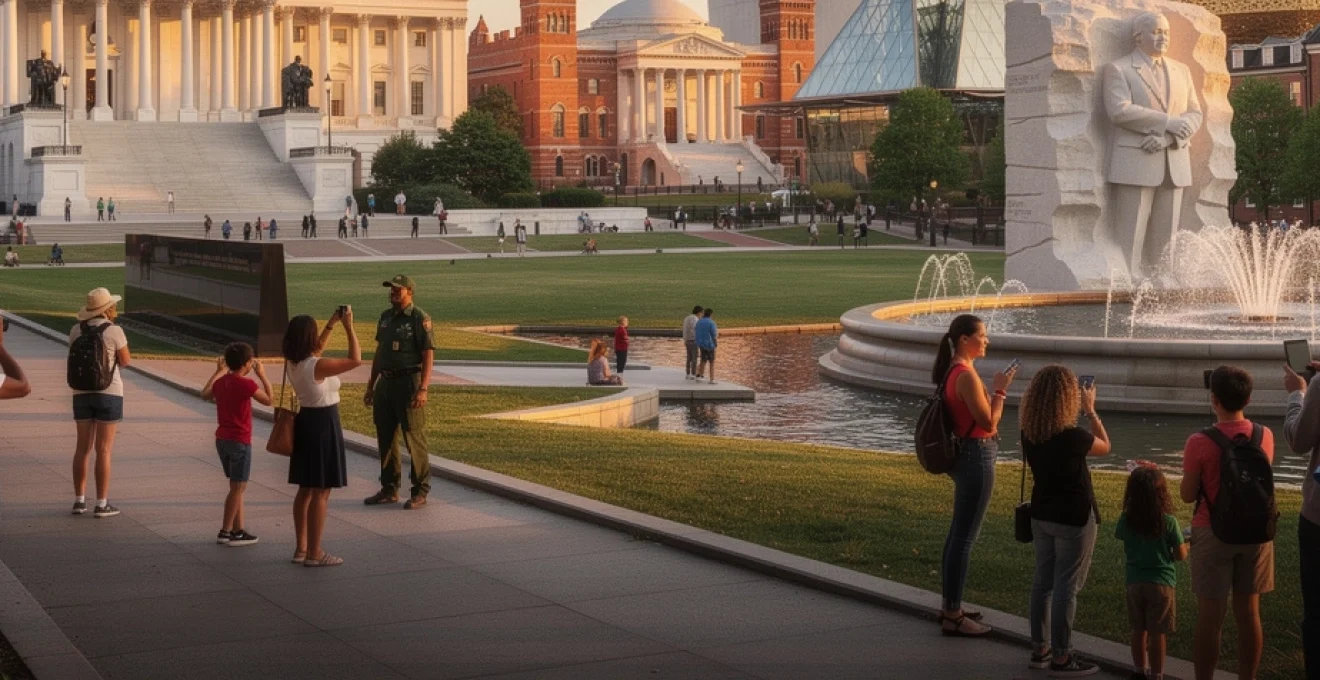
Washington, D.C. stands as America’s cultural epicentre, where architectural mastery meets historical significance in an extraordinary urban tapestry. Beyond its role as the seat of government, the capital city showcases centuries of thoughtful design, from neoclassical grandeur to contemporary innovation. These cultural landmarks represent more than mere buildings and monuments—they embody the nation’s values, aspirations, and evolving identity. Each structure tells a unique story of architectural vision, engineering prowess, and cultural preservation that continues to inspire visitors from around the globe. The city’s landscape reflects a deliberate effort to create spaces that honour the past whilst embracing future possibilities.
Neoclassical federal architecture: the capitol building and supreme court legacy
The foundation of Washington’s architectural identity rests upon the principles of neoclassical design, establishing a visual language that communicates democratic ideals through stone and marble. This architectural movement, drawing inspiration from ancient Greek and Roman civilisations, became the defining aesthetic for federal buildings throughout the early republic. The choice reflected the founders’ desire to associate their new nation with the democratic traditions of antiquity whilst creating a distinctly American interpretation of classical forms.
William thornton’s original capitol design and architectural evolution
William Thornton’s winning design for the U.S. Capitol Building in 1793 established the template for American governmental architecture. His vision combined a central dome with symmetrical wings, creating a composition that balanced grandeur with democratic accessibility. The design evolved significantly over subsequent decades, with each architect contributing unique elements whilst maintaining Thornton’s fundamental concept. The building’s progression from modest beginnings to its current magnificent scale mirrors the nation’s own growth and ambition.
Thornton’s architectural philosophy emphasised the importance of creating spaces that would inspire both lawmakers and citizens. His use of local materials, particularly the distinctive white-painted sandstone, established a precedent for future federal construction projects. The building’s proportions and classical detailing demonstrate sophisticated understanding of architectural harmony, creating visual relationships that remain compelling centuries later.
Cass gilbert’s supreme court building: corinthian columns and marble symbolism
Completed in 1935, Cass Gilbert’s Supreme Court Building represents the pinnacle of American neoclassical architecture. The structure’s sixteen massive Corinthian columns, each standing 30 feet high, create an imposing façade that communicates judicial authority through architectural means. Gilbert’s careful attention to proportion and detail reflects his belief that architecture should embody the dignity and permanence of the law itself.
The building’s Vermont marble construction and meticulous craftsmanship demonstrate the resources and commitment devoted to creating a fitting home for the nation’s highest court. Interior spaces feature elaborate bronze doors, coffered ceilings, and symbolic artwork that reinforce the building’s role in American governance. The Great Hall’s impressive scale and decorative program create an atmosphere of reverence appropriate to the judicial process.
Benjamin henry latrobe’s influence on federal neoclassical standards
Benjamin Henry Latrobe’s contributions to the Capitol Building following the War of 1812 fire established enduring standards for federal architecture. His innovative use of American botanical motifs in column capitals—featuring corn cobs and tobacco leaves—created a uniquely American interpretation of classical orders. This approach demonstrated how architects could honour classical traditions whilst incorporating distinctly national elements.
Latrobe’s engineering innovations, including his advanced understanding of fireproof construction and structural systems, influenced federal building practices for generations. His advocacy for professional architectural education and standards helped establish architecture as a recognised profession in America. The lasting quality of his work at the Capitol demonstrates the value of combining artistic vision with technical excellence.
Capitol dome engineering: thomas U. walter’s cast iron innovation
Thomas U. Walter’s replacement of the original wooden dome with a cast iron structure in the 1850s represented a revolutionary moment in American architectural technology. This engineering feat reduced the dome’s weight by approximately 8 million pounds whilst creating a larger, more impressive profile. The use of cast iron allowed for intricate decorative details that would have been prohibitively expensive in traditional masonry construction.
Walter’s dome design established the Capitol as the visual centrepiece of the federal city, with its height and prominence creating a focal point visible from throughout Washington. The
engineering challenge of supporting such a vast structure atop the existing masonry required meticulous planning and innovative scaffolding techniques. Inside, the soaring Rotunda space beneath the dome became a ceremonial heart of the nation, framed by constant natural light filtering through the oculus and windows. The Statue of Freedom crowning the dome serves as both an artistic flourish and a powerful symbol of national ideals, visible from avenues and neighbourhoods across the city. For visitors today, standing beneath the dome offers a rare opportunity to experience how 19th-century engineering and artistry combined to shape one of Washington, D.C.’s most recognisable landmarks.
Presidential memorials and commemorative monument architecture
Washington, D.C.’s presidential memorials translate political legacies into stone, water, and open space, creating powerful stages for public memory. These cultural landmarks do more than commemorate individual leaders; they frame the way we understand pivotal moments in American history. From the National Mall to the Tidal Basin, each memorial uses architectural language—columns, domes, reflecting pools, and sculptural reliefs—to invite reflection. As you move between them, you experience a curated journey through the nation’s evolving values, from unity and sacrifice to civil rights and global responsibility.
Henry bacon’s lincoln memorial: doric temple design principles
Henry Bacon’s Lincoln Memorial, completed in 1922, adopts the form of a Greek Doric temple to convey timeless dignity and moral authority. The exterior colonnade of 36 fluted Doric columns originally represented the states in the Union at the time of Lincoln’s death, turning the building itself into a symbolic map of national unity. Bacon’s reliance on simple, robust lines and minimal ornamentation underscores the memorial’s focus on character rather than spectacle. The white Colorado Yule marble used throughout reinforces the sense of purity and solemnity that defines the site.
Inside, the seated figure of Abraham Lincoln by sculptor Daniel Chester French rests within a calm, almost chapel-like chamber. Inscriptions of the Gettysburg Address and Second Inaugural Address flank the statue, transforming the memorial into an architectural archive of ideas as much as a tribute to a person. The open front of the memorial and its elevated position overlooking the Reflecting Pool were carefully planned to connect Lincoln’s image to the broader landscape of democracy stretching down the Mall. Today, visitors often experience the space as both a place of quiet contemplation and a natural gathering point for civic expression, echoing its role in events such as the 1963 March on Washington.
John russell pope’s jefferson memorial: pantheon-inspired rotunda structure
John Russell Pope’s design for the Jefferson Memorial drew direct inspiration from the Roman Pantheon, using a circular plan and domed rotunda to honour Thomas Jefferson’s classical tastes and Enlightenment ideals. Completed in 1943, the memorial’s colonnaded portico and shallow dome rest lightly over the Tidal Basin, giving the structure an almost pavilion-like quality. The open-air design allows breezes and sunlight to move freely through the space, blurring the boundary between interior and exterior and reinforcing Jefferson’s affinity for nature and landscape.
Granite steps lead up to the main platform, where a bronze statue of Jefferson stands framed by Ionic columns and an intricately coffered dome. Quotations from Jefferson’s writings encircle the interior, transforming the memorial into a kind of three-dimensional manuscript of revolutionary thought and early American governance. The strategic siting of the memorial, aligned with the White House and surrounded by cherry trees, positions Jefferson within a broader visual dialogue about leadership and the ideals of the republic. For many visitors, the combination of classical form, water views, and seasonal cherry blossoms creates one of the most serene cultural landmarks in Washington, D.C.
Maya lin’s vietnam veterans memorial: reflective black granite methodology
Maya Lin’s Vietnam Veterans Memorial, dedicated in 1982, broke dramatically with traditional monument design by using an understated, earth-hugging form. Rather than rising above the landscape, the polished black granite walls cut into the ground like a deliberate scar, confronting visitors with the physical and emotional weight of conflict. The reflective surface, which mirrors the viewer alongside the engraved names of more than 58,000 service members, creates a powerful, participatory experience. In this way, the memorial becomes less a static object and more a living interface between past and present.
Lin’s methodology relied on minimalism and careful manipulation of scale rather than figurative sculpture or grand architecture. The walls gradually descend to a depth of ten feet at the centre, amplifying the sense of descent into memory before gently returning visitors to the surface. This journey mirrors an emotional arc—from distance to confrontation and, finally, to a kind of quiet reconciliation. For those exploring Washington, D.C.’s cultural landmarks, the Vietnam Veterans Memorial offers an important contrast: proof that powerful commemoration can emerge from restraint, absence, and reflection rather than monumental height.
Friedrich st. florian’s world war II memorial: bronze star fountain integration
Friedrich St. Florian’s World War II Memorial, opened in 2004, occupies a pivotal location between the Washington Monument and the Lincoln Memorial. Its design uses a broad oval plaza, ceremonial arches, and a central fountain to create a space that feels both open and ceremonial. Fifty-six granite pillars, arranged in a semi-circle, represent the states and territories that contributed to the war effort, reinforcing the sense of shared national sacrifice. The careful integration of water features softens the strong stone forms, adding movement and sound to the experience.
One of the memorial’s most poignant elements is the “Freedom Wall,” which features 4,048 gold stars, each star representing 100 American lives lost in the conflict. Positioned above a pool of water, the stars shimmer in changing light, creating a subtle, almost celestial effect that rewards close attention. St. Florian’s integration of sculptural reliefs, inscriptions, and bronze wreaths invites visitors to walk slowly, read, and reflect on both the battlefield and home-front dimensions of World War II. As a cultural landmark, the memorial demonstrates how contemporary commemorative architecture can balance grand national narratives with intimate, human-scale details.
Lei yixin’s martin luther king jr. memorial: stone of hope sculptural technique
The Martin Luther King Jr. Memorial, dedicated in 2011, introduces a powerful new visual language to the National Mall with its “Stone of Hope” concept. Sculptor Lei Yixin carved King’s likeness emerging from a large block of granite that appears to have been pulled forward from a larger “Mountain of Despair,” directly referencing a line from King’s “I Have a Dream” speech. This sculptural technique turns solid stone into an active metaphor for progress, perseverance, and the ongoing struggle for civil rights. The rough sides of the granite contrast with the finely finished figure, echoing the tension between hardship and hope.
The memorial’s surrounding landscape reinforces these themes through a crescent-shaped wall inscribed with selected quotations from King’s sermons, speeches, and writings. Curved pathways and carefully framed views of the Tidal Basin encourage visitors to move slowly and consider how King’s words resonate in contemporary life. Unlike traditional presidential memorials, this site foregrounds activism, social justice, and collective action, reminding us that cultural landmarks can serve as catalysts for conversation and change. For travellers seeking to understand Washington, D.C. beyond its monuments, the Martin Luther King Jr. Memorial offers an essential perspective on the city’s ongoing narrative.
Smithsonian institution complex: museum architecture and cultural preservation
The Smithsonian Institution complex forms one of the world’s most significant concentrations of museums, galleries, and research centres, shaping Washington, D.C. into a true cultural capital. Each building within this network reflects a different moment in architectural history, from 19th-century romanticism to 21st-century innovation. Together, they demonstrate how architecture can support cultural preservation, scientific discovery, and public education on a monumental scale. As you move from one museum to another along the National Mall, you experience a living laboratory of design approaches that continue to influence museum architecture worldwide.
James renwick jr.’s castle building: norman revival architectural elements
The Smithsonian Castle, designed by James Renwick Jr. and completed in 1855, serves as both a visual anchor and a historical touchstone for the entire institution. Its warm red sandstone and distinctive towers draw on Norman Revival architecture, a romantic style that evokes medieval European fortresses and churches. At a time when many American public buildings favoured strict neoclassical forms, Renwick’s choice signalled that the Smithsonian would be a place of imagination and inquiry, not just government formality. The asymmetrical massing and varied rooflines add a sense of picturesque charm that still stands out on the Mall today.
Inside, the Castle originally housed exhibits, laboratories, and living quarters, reflecting a more flexible approach to museum space than we see in many contemporary buildings. Although its role has shifted toward administrative offices and visitor information, the building remains a key cultural landmark that introduces guests to the Smithsonian’s mission. For architecture enthusiasts, the Castle provides a tangible lesson in how stylistic diversity contributes to Washington, D.C.’s layered urban character. Its survival and restoration also underscore the importance of preservation in maintaining the city’s architectural heritage.
Gordon bunshaft’s hirshhorn museum: brutalist cylindrical design innovation
Gordon Bunshaft’s Hirshhorn Museum and Sculpture Garden, opened in 1974, presents one of the most striking examples of Brutalist architecture in Washington, D.C. Rather than a traditional rectangular gallery block, Bunshaft opted for a bold cylindrical form lifted on four monumental piers, creating a hovering concrete ring above an open plaza. This design turns the museum itself into a sculptural object, mirroring the modern and contemporary art housed within. The small number of windows and solid exterior emphasise the building’s mass, while the interior courtyard and surrounding sculpture garden provide surprising moments of openness.
The museum’s textured concrete façade and deep shadows can feel austere at first glance, but they reward repeat viewing as light and weather conditions change. Inside, the circular floor plan guides visitors through a continuous loop of galleries, a layout that encourages both discovery and orientation. The adjacent sunken sculpture garden, with its terraced walls and carefully placed artworks, extends the museum experience into the landscape. For those interested in how cultural landmarks evolve, the Hirshhorn illustrates how mid-20th-century architects pushed against traditional museum typologies to create new kinds of urban presence.
I.M. pei’s east building national gallery: geometric modernist triangulation
I.M. Pei’s East Building of the National Gallery of Art, completed in 1978, transforms a difficult triangular site into a masterclass in geometric modernism. Pei embraced the irregular plot by organising the building around triangles and trapezoids, using sharp angles and crisp lines to create a dynamic composition. The pale Tennessee marble cladding visually links the East Building to the more classical West Building, while the glass-and-steel atrium introduces a distinctly contemporary character. Inside, soaring interior volumes and bridges crisscrossing the central space generate a sense of movement and layered perspective.
The triangulated layout allows for a variety of gallery shapes and sizes, accommodating everything from large-scale installations to intimate viewing rooms. Natural light filters through the vast skylights, bathing the atrium and upper galleries in a soft glow that shifts throughout the day. For visitors, the building itself becomes part of the art experience, inviting you to look up, across, and through as you move between works. Pei’s design demonstrates how thoughtful modern architecture can complement historic surroundings while still asserting a confident, forward-looking identity—a key theme in Washington, D.C.’s cultural development.
David adjaye’s national museum of african american history: bronze lattice façade system
David Adjaye’s design for the National Museum of African American History and Culture, opened in 2016, has quickly become one of Washington, D.C.’s most talked-about cultural landmarks. Its three-tiered, inverted trapezoidal form, inspired in part by Yoruban art and West African crowns, sets it apart from neighbouring neoclassical buildings. The most distinctive feature is the bronze-coloured metal lattice façade, which filters light into the interior while referencing the intricate ironwork crafted by enslaved and free African Americans in the South. This screen creates a shifting play of shadow and reflection, making the building appear to shimmer in different weather and seasons.
Inside, the museum’s vertical circulation takes visitors on a chronological journey from the depths of the building—where galleries explore the history of slavery and segregation—upward toward stories of cultural achievement, activism, and contemporary life. This upward movement through space and light offers a powerful architectural analogy for resilience and progress. The building’s siting on the National Mall, in direct conversation with monuments to presidents and wars, asserts African American history as central to the national narrative rather than a footnote. For travellers seeking deeper cultural immersion, the museum is an essential stop that combines innovative design with rigorous storytelling.
Georgetown historic district: colonial and federal period urban planning
Georgetown, one of Washington, D.C.’s oldest neighbourhoods, offers a rare opportunity to walk through a largely intact colonial and Federal-era streetscape. Long before the creation of the federal city, Georgetown thrived as a bustling port on the Potomac River, and its early street grid still reflects that mercantile past. Narrow, often cobblestoned streets weave between brick row houses, warehouses, and former tobacco inspection facilities, revealing how commerce and domestic life intertwined. Unlike the broad ceremonial avenues of the L’Enfant Plan downtown, Georgetown’s smaller blocks and intimate alleys create a more human-scale environment.
The district’s architecture showcases a rich mix of late 18th- and early 19th-century styles, from modest wood-frame dwellings to grand Federal townhouses with refined door surrounds and symmetrical façades. Many buildings have been carefully restored, with original brickwork, wrought iron, and slate roofs preserved or sensitively replicated. Height restrictions and strict historic preservation guidelines help maintain Georgetown’s cohesive character, even as contemporary retail and dining establishments occupy ground-floor spaces. For visitors, this blend of old and new turns everyday activities—shopping, dining, simply strolling—into an immersive lesson in urban history.
Georgetown’s waterfront redevelopment further illustrates how historic industrial zones can be reimagined as vibrant public spaces without erasing their past. Former wharves and warehouses have given way to landscaped promenades, parks, and mixed-use buildings that open the neighbourhood back up to the river. Interpretive signage and preserved architectural fragments keep the area’s maritime history visible, while modern amenities make it a popular spot for both residents and tourists. If you’re exploring Washington, D.C. cultural landmarks on foot, spending time in Georgetown offers a welcome contrast to the monumental core and a deeper sense of how the city evolved over time.
Embassy row diplomatic architecture: international cultural representation
Stretching along Massachusetts Avenue NW and nearby streets, Embassy Row forms one of Washington, D.C.’s most architecturally diverse corridors. Here, grand Beaux-Arts mansions, Tudor Revival residences, and sleek modernist chancelleries stand side by side, each reflecting the cultural identity and diplomatic priorities of the nation it represents. Many of these buildings were originally constructed as private homes for Gilded Age industrialists and political elites, later adapted for diplomatic use as the city grew into a global capital. This layered history gives Embassy Row an air of both opulence and purpose.
Architecturally, embassies often blend national motifs with Washington’s established design traditions. You might notice distinctive rooflines, decorative tilework, or symbolic emblems integrated into façades that otherwise align with local height limits and setbacks. Some countries choose to express modernity and innovation through glass and steel designs, while others emphasise heritage through stone carvings, courtyards, and traditional ornament. Walking this corridor becomes a kind of open-air gallery of world architecture, offering insights into how nations choose to present themselves on the international stage.
For travellers, exploring Embassy Row is a reminder that Washington, D.C. functions not only as the seat of American government but also as a global diplomatic hub. Many embassies host cultural events, exhibitions, and open-house days, turning their buildings into active platforms for soft power and international exchange. The surrounding streetscapes, lined with mature trees and historic lampposts, provide a dignified setting that reinforces the area’s cosmopolitan character. If you’re interested in how architecture communicates identity, dedicating time to Embassy Row adds an important international dimension to your understanding of the city.
Washington national cathedral: neo-gothic ecclesiastical craftsmanship
Washington National Cathedral, officially the Cathedral Church of Saint Peter and Saint Paul, stands as one of the most ambitious examples of Neo-Gothic architecture in the United States. Construction began in 1907 and continued for more than eight decades, reflecting a long tradition of cathedral building that stretches back to medieval Europe. Flying buttresses, pointed arches, ribbed vaults, and soaring spires all contribute to a vertical emphasis that draws the eye—and the imagination—upward. Clad in Indiana limestone, the exterior appears both solid and finely detailed, with sculpted tracery and carved figures animating the façades.
Inside, the cathedral’s vast nave, intricate stone vaulting, and more than 200 stained-glass windows create a luminous, contemplative atmosphere. Notable features include the Space Window, which incorporates a fragment of lunar rock, and numerous contemporary carvings that sit alongside traditional religious iconography. This blending of old and new themes underscores the cathedral’s role as a living institution rather than a static monument. For many visitors, the building offers a powerful analogue to a symphony: different architectural elements—light, stone, glass, and sound—working together to produce an experience greater than the sum of its parts.
Beyond its religious function, Washington National Cathedral serves as a major cultural landmark and civic gathering place. State funerals, interfaith services, concerts, and lectures regularly draw diverse audiences, turning the cathedral into a national stage for reflection and dialogue. The surrounding 59-acre grounds, featuring landscaped gardens and contemplative paths, invite quiet exploration and views back toward downtown D.C. If you’re charting an itinerary of Washington, D.C.’s defining cultural landmarks, including the cathedral adds a vital spiritual and artistic dimension to your understanding of the city’s architectural story.