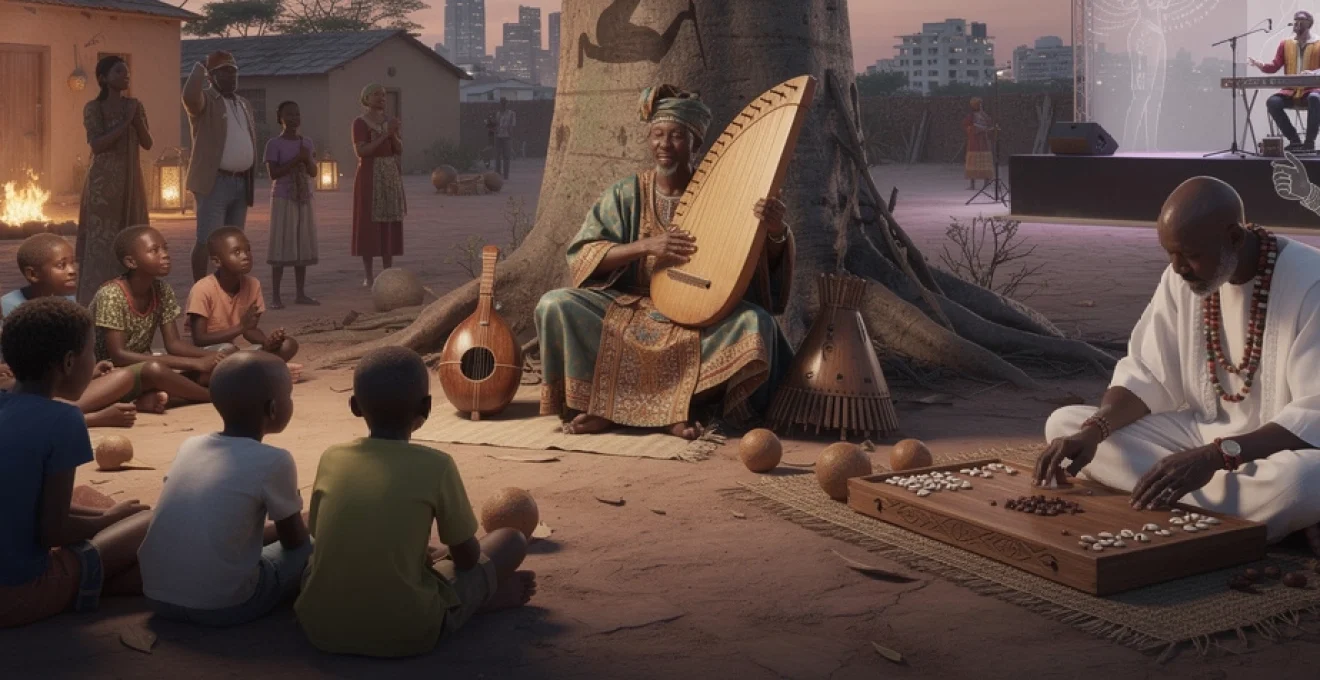
Across the vast landscapes of West Africa, from the Niger River’s meandering banks to the coastal villages of the Gulf of Guinea, an ancient art form has thrived for millennia. Long before the written word became commonplace, communities gathered beneath baobab trees and around crackling fires to share stories that would shape their collective identity. These oral narratives served as living libraries, preserving history, philosophy, and cultural values in the memories of skilled practitioners. The storytelling traditions of West African societies represent far more than mere entertainment; they constitute the very foundation upon which social structures, moral frameworks, and historical consciousness have been built. Today, as digitalisation threatens to overshadow these age-old practices, understanding their complexity and significance becomes increasingly vital for preserving the region’s rich cultural heritage.
The griot tradition: hereditary oral historians in mandinka and bambara cultures
The griot tradition stands as one of West Africa’s most sophisticated systems of oral knowledge preservation. Known as jeli in Mandinka or djeli in Bambara, these professional storytellers occupy a unique social position that transcends simple entertainment. Born into families that have maintained this craft for generations, griots serve as historians, genealogists, musicians, poets, and cultural advisors. Their role in Mandinka and Bambara societies cannot be overstated—they are the living archives who maintain the collective memory of entire communities.
What distinguishes the griot from casual storytellers is the rigorous training and hereditary nature of their profession. From early childhood, aspiring griots undergo intensive mentorship under elder family members, learning not just stories but also the intricate social protocols that govern their performance. They must master vast genealogies spanning centuries, understanding the interconnections between families, clans, and kingdoms. This knowledge empowers them to serve as mediators in disputes, advisors to leaders, and guardians of cultural continuity. The griot’s word carries immense weight in traditional societies, as they possess the authority to confer praise or criticism that can elevate or diminish one’s social standing.
Jaliya system and hereditary knowledge transmission in mali
The jaliya system represents the formal structure through which griotic knowledge passes from generation to generation in Mali and neighbouring regions. This caste-like system designates specific families as the custodians of oral traditions, with membership determined entirely by birth. Within the jaliya framework, knowledge is not merely transferred but embodied through years of apprenticeship and practice. Young griots learn by observing and assisting their elders during performances, gradually absorbing the nuances of timing, intonation, and audience engagement that separate masterful storytelling from mere recitation.
The jaliya system encompasses multiple specialisations within the broader griot category. Some families specialise in particular instruments, others in specific types of narratives, and still others in praise poetry for certain lineages. This specialisation ensures depth of expertise whilst maintaining the overall diversity of the tradition. Interestingly, the jaliya system also includes restrictions—griots traditionally cannot marry outside their caste, and certain occupations remain closed to them. These social boundaries, whilst seemingly restrictive, have paradoxically protected the transmission of oral knowledge by creating dedicated lineages wholly committed to preserving cultural memory.
Kora, balafon, and n’goni: musical instruments in griotic performance
Music forms an inseparable component of griotic storytelling, with instruments serving as more than mere accompaniment. The kora, perhaps the most recognisable of griot instruments, features twenty-one strings stretched across a calabash gourd covered with cow skin. This harp-lute hybrid produces cascading melodies that can evoke joy, sorrow, or contemplation, perfectly complementing the emotional arc of oral narratives. Mastering the kora requires decades of practice, as players must coordinate complex fingering patterns whilst simultaneously singing or reciting.
The balafon, a wooden xylophone with gourd resonators, holds particular significance in Mande culture. According to tradition, the instrument itself can carry spiritual power, as evidenced by legends surrounding the “Sosso Bala”—a sacred balafon allegedly dating back to the thirteenth century and still preserved in Guinea
For many performers, the balafon is not just a musical instrument but a conduit between the human and spiritual realms, its carefully tuned keys echoing lineages, victories, and ancestral blessings. The n’goni, a plucked lute with a dry, percussive tone, often provides rhythmic backbone and melodic motifs that signal shifts in narrative mood. When a griot begins a praise-song, a rapid flurry on the n’goni might announce the name of a patron, while a slower kora passage prepares listeners for episodes of loss or exile. In this way, musical storytelling becomes a kind of emotional map: even if you do not understand the language, you can feel when the story rises toward triumph or descends into tension. The integration of kora, balafon, and n’goni thus transforms griotic performance into a multi-sensory experience that blends history, music, and ritual.
Epic of sundiata keita: preservation of mandé imperial history
Among the many narratives preserved by griots, the epic of Sundiata Keita—founder of the Mali Empire—stands as a cornerstone of Mandé historical consciousness. Rather than existing as a single, fixed text, the Sundiata narrative survives as a constellation of versions, each adapted by griots to their audience and context. Core elements tend to remain stable: Sundiata’s miraculous birth, his childhood disability, his exile, and his eventual triumph over the sorcerer-king Soumaoro Kanté. Around this shared skeleton, performers weave local details, genealogies, and moral reflections that keep the story relevant to contemporary listeners.
Historically, the Sundiata epic has functioned as both a political charter and a moral compass for Mandé societies. By recounting the alliances, betrayals, and oaths that led to the empire’s formation, griots frame authority as something earned through courage, generosity, and respect for communal obligations. When they praise or critique modern leaders, they often invoke Sundiata’s virtues as a benchmark, subtly reminding audiences of the ethical foundations of good governance. For many young listeners, hearing their family names inserted into the narrative—sometimes in the form of praise epithets—creates a powerful sense of belonging to a story that stretches back nearly eight centuries.
In recent decades, scholars and cultural institutions have worked to document different renditions of the Sundiata epic without freezing it in place. Audio and video recordings, annotated transcriptions, and bilingual editions help to preserve valuable variants while recognising that the tradition’s strength lies in its fluidity. You might compare this to a river that changes course over time yet still flows from the same source: each new performance adds fresh layers, but the underlying message about resilience, solidarity, and destiny endures. For students of African oral literature, Sundiata offers a living example of how epic storytelling can sustain imperial history outside written archives.
Contemporary griots: toumani diabaté and the evolution of oral tradition
Contemporary griots continue to adapt their craft to new technologies and audiences, demonstrating that West African storytelling traditions are anything but static. Musicians like Toumani Diabaté, a renowned kora virtuoso from Mali, illustrate how hereditary griot lineages can thrive in global music scenes while staying rooted in ancestral responsibilities. Diabaté’s collaborations with jazz, flamenco, and pop artists introduce the kora’s shimmering sound to international listeners, but his repertoire still includes praise-songs, historical narratives, and melodies associated with specific Mandé families. In interviews, he often describes himself as both a guardian of tradition and a cultural ambassador, bridging village squares and concert halls.
Other modern griots leverage radio, television, and social media to share their performances beyond local communities. You will find jeliw streaming live concerts on YouTube, recording podcasts about Mandé history, or offering personalised praise-poems for diaspora families over messaging apps. While some worry that digital platforms may dilute the intimacy of face-to-face storytelling, they also create opportunities for archiving and wider recognition. In cities like Bamako and Conakry, schools and cultural centres invite griots to teach young people about oral literature, transforming what was once an exclusively hereditary vocation into an object of shared heritage. In this evolving landscape, the core function of the griot—as a mediator between past and present—remains remarkably intact.
Anansi spider tales: trickster narratives across akan and ashanti communities
If the griot embodies the dignified guardian of history, then the trickster Anansi represents the witty, subversive voice of everyday people. Among Akan and Ashanti communities in present-day Ghana and Côte d’Ivoire, Anansi the spider is one of the most recognisable figures in West African storytelling traditions. These tales, known as Anansesem, feature a cunning spider who outsmarts humans, animals, and even deities through clever schemes. At first glance, Anansi seems like a simple mischief-maker; yet beneath the humour lies sharp social commentary about power, greed, and survival.
Traditionally, Anansi stories are told in communal settings, especially in the evenings when families gather after farm work. The storyteller may begin with a formulaic opening—“We do not tell this in the day, lest Anansi himself appear”—to signal that listeners are entering a shared imaginative space. Children learn to anticipate Anansi’s tricks, but they also learn that actions have consequences: the spider’s plans sometimes succeed brilliantly and sometimes backfire spectacularly. Like many West African folktales, these narratives use laughter as a tool to discuss serious issues in a safe, indirect way.
Moral pedagogy through anthropomorphic animal characters
Anansi tales belong to a wider family of West African stories that use anthropomorphic animals to explore human behaviour. Why animals? In many societies, talking animals create enough distance from reality that difficult topics—jealousy, dishonesty, cowardice—can be addressed without directly accusing real individuals. When we laugh at a foolish hyena or greedy tortoise, we are also invited to reflect on our own choices. This strategy of moral pedagogy turns storytelling into a gentle mirror rather than a blunt weapon of criticism.
In Anansi narratives, the spider’s small size and apparent weakness become advantages, allowing him to outwit stronger characters like Elephant, Tiger, or even Sky-God Nyame. For young listeners, this offers an empowering message: intelligence and creativity can compensate for a lack of physical strength or wealth. At the same time, many stories end with Anansi suffering for his arrogance or selfishness, reinforcing the idea that cleverness without empathy can be destructive. Educators and parents across West Africa still rely on such stories to teach problem-solving, critical thinking, and ethical reasoning—long before children encounter these concepts in formal classrooms.
From a literary perspective, Anansi tales showcase key features of African oral literature, such as repetition, call-and-response, and proverb-like closing statements that summarise the lesson. A storyteller might ask, “So, what did Anansi learn?” prompting children to articulate the moral in their own words. This participatory approach turns listeners into co-creators of meaning, rather than passive consumers. Much like a modern interactive workshop, the story becomes a space where community values are negotiated and reaffirmed.
Anansi’s diaspora: caribbean and African-American narrative adaptations
Through the transatlantic slave trade, Anansi travelled far beyond Akan and Ashanti homelands, leaving a lasting imprint on Caribbean and African-American storytelling. In Jamaica, for instance, Brer Anancy appears in dozens of folktales that retain the spider’s role as a clever trickster who resists oppressive forces, often symbolising enslaved Africans outsmarting plantation owners. Similarly, in the southern United States, elements of Anansi stories blend into the Brer Rabbit cycle, where a small, quick-witted rabbit uses words and wit to escape danger. These diasporic adaptations demonstrate how oral narratives can cross oceans, languages, and religions while preserving core themes of resilience and resistance.
In recent decades, scholars and artists have consciously reconnected Caribbean Anansi tales to their West African roots, highlighting a shared heritage that colonial narratives once tried to erase. Children’s books, animated films, and stage plays now present Anansi as a pan-African cultural icon, linking Ghanaian village stories with Jamaican and African-American folklore. Have you ever noticed how many modern superheroes rely more on strategy than brute force? In many ways, Anansi was an early model of this archetype, teaching that oppressed communities could resist domination through creativity and humour. By tracing Anansi’s journey across the Atlantic, we gain a clearer sense of how West African storytelling traditions contributed to global Black cultural expression.
Kwaku ananse stories in ghanaian ceremonial contexts
In contemporary Ghana, Kwaku Ananse stories still feature prominently in both informal and ceremonial contexts. At schools, cultural festivals, and national events, performers don costumes and masks to reenact famous episodes such as “How Ananse Got All the Stories” or “Ananse and the Pot of Wisdom.” These performances often combine spoken narration with drumming, dance, and song, transforming the tale into a full theatrical spectacle. For children who may encounter Anansi first through cartoons or picture books, such live performances provide a deeper, more embodied understanding of their cultural heritage.
During rites of passage—such as puberty rites or community initiation ceremonies—Anansi stories can take on added layers of meaning. Elders may select particular tales that address themes of responsibility, respect for elders, or the importance of communal solidarity. In some communities, storytelling sessions are deliberately scheduled after official rituals to “decode” their symbolism for younger participants. In this way, Kwaku Ananse becomes more than a character; he becomes a pedagogical tool woven into the fabric of social life. Even as urbanisation and digital media reshape leisure activities, many Ghanaians still view Anansi stories as a vital bridge between generations.
Yoruba ifá divination poetry and odù corpus recitation
While Anansi tales and griot epics often unfold in public squares or family compounds, another major strand of West African storytelling traditions operates in more sacred, ritualised spaces. Among the Yoruba people of Nigeria and neighbouring countries, the Ifá divination system preserves an extensive body of oral literature known as the Odù Ifá. Far from being random or improvised, this corpus consists of thousands of verses that encode myths, historical memories, ethical teachings, and practical advice for everyday life. The performance of Ifá literature occurs during divination sessions, where trained priests interpret patterns made by sacred palm nuts or divination chains and then recite relevant verses to guide clients.
Ifá poetry functions simultaneously as religious scripture, philosophical discourse, and narrative art. Many scholars compare it to other world canons such as the Vedas or the Homeric epics, not because it imitates them, but because it demonstrates a comparable level of complexity and depth. Yet unlike written scriptures, the Ifá corpus lives primarily in the memories and voices of its custodians. Each consultation becomes a unique storytelling event, tailored to the client’s circumstances but grounded in a shared, time-honoured repertoire. This blend of fixity and flexibility illustrates how oral literature can sustain a sophisticated knowledge system without relying on books.
Babalawo priests and the 256 odù ifá verses
The custodians of Ifá literature are the babalawo (literally, “fathers of secrets”), highly trained priests who specialise in divination and ritual practice. Central to their work are the 256 principal Odù, each of which contains numerous sub-stories and poetic verses. Rather than memorising a mere 256 lines, a seasoned babalawo may command thousands of verses, a feat comparable to mastering an entire library. Training can take many years, beginning in childhood or adolescence and involving intensive apprenticeship under established priests.
During a divination session, the babalawo casts sacred instruments—often sixteen palm nuts or an eight-chain device called opelé—to generate one of the Odù patterns. Each pattern corresponds to a set of verses that the priest then selects and recites, drawing out meanings that relate to the client’s question. You might think of this process as a sophisticated, spiritually grounded form of “narrative diagnostics,” where the right story helps illuminate the right path forward. The authority of the babalawo does not rest solely on memorisation; it also depends on interpretive skill, ethical reputation, and a deep understanding of Yoruba cosmology.
Orisha mythology integration in ìtàn narrative structures
Much of Ifá literature centres on the exploits and interactions of the Orisha, divine forces or deities that govern aspects of the natural and spiritual world. Stories about Orisha such as Òrúnmìlà (deity of wisdom and divination), Ṣàngó (thunder), Òṣun (river and fertility), and Ògún (iron and warfare) are known as ìtàn—narrative accounts that blend myth, moral teaching, and cosmological explanation. When a babalawo recites an Ifá verse explaining why someone faces repeated obstacles, for example, the story may describe how an Orisha once overcame a similar challenge by making sacrifices or changing behaviour.
These ìtàn narratives situate individual problems within a broader spiritual and historical framework, reminding listeners that they are part of an interconnected universe. For instance, an Odù might recount how Òṣun was initially excluded from a council of male deities, leading to chaos until her contributions were recognised—an allegory often invoked to address gender dynamics and the need for inclusive leadership. By embedding social commentary within divine stories, Ifá literature teaches that human ethics and cosmic order are intertwined. Listeners are encouraged not only to perform prescribed rituals but also to reflect on their character, relationships, and obligations to the community.
Ẹsẹ ifá: poetic devices and mnemonic techniques in oral preservation
The individual verses within each Odù, known as Ẹsẹ Ifá, display a rich array of poetic devices that aid both memorisation and aesthetic enjoyment. Repetition, parallelism, alliteration, and tonal play are all carefully deployed to create rhythms that lodge in the memory. For example, a verse might repeat a key phrase at the beginning of each line, much like a refrain in a song, reinforcing its central message. Metaphors drawn from everyday Yoruba life—farming, market trade, river travel—translate abstract principles into vivid images, making complex ideas more accessible.
These mnemonic strategies highlight a broader truth about West African storytelling traditions: oral literature is not simply “spoken prose,” but a highly refined art form optimised for retention and performance. Just as modern educators use catchy slogans or visual charts to help students remember information, babalawo rely on poetic patterning to retain vast stores of knowledge. Audience participation also plays a role; in some contexts, listeners respond with short refrains or exclamations that punctuate the recitation, keeping everyone focused and emotionally engaged. Over generations, this interplay of artistry and memory has allowed the Ifá corpus to survive despite colonial suppression and religious competition.
Wande abimbola’s documentation of ifá literary heritage
In the twentieth century, scholars and practitioners began systematically documenting Ifá literature to safeguard it from erosion. Among the most influential figures is Professor Wande Abimbola, a Yoruba academic and initiated babalawo whose publications have brought global attention to the richness of the Odù corpus. His works, which transcribe, translate, and analyse numerous Ẹsẹ Ifá, demonstrate that this oral tradition constitutes a complex philosophical and literary system in its own right. By presenting Ifá verses alongside commentary on their symbolism and ritual use, Abimbola helps readers appreciate not only the stories themselves but also the interpretive frameworks that surround them.
Abimbola’s efforts form part of a broader movement to recognise West African oral literature as world-class heritage rather than “primitive folklore.” His research has influenced curricula in universities across Africa and the diaspora, where Ifá is now studied alongside canonical European and Asian traditions. At the same time, he and other custodians stress that documentation should not replace live performance; the written page can preserve texts, but only trained practitioners can fully animate their meaning in ritual contexts. This dual strategy—recording for posterity while nurturing living lineages—offers a model for how we might preserve other vulnerable storytelling traditions in an era of rapid cultural change.
Performance spaces: village squares, baobab gatherings, and communal storytelling contexts
Across West Africa, the physical spaces where stories are told are almost as significant as the narratives themselves. Traditional performance often takes place in village squares, courtyards, or under large trees—especially the iconic baobab, whose broad canopy provides shade and a natural focal point. These locations are not chosen at random; they function as communal hubs where markets, meetings, and rituals also occur. When a storyteller steps into the centre of such a space, they symbolically occupy the heart of the community’s social life.
Night-time storytelling around a fire remains a powerful image precisely because it encapsulates several key features of oral tradition: intimacy, collective attention, and the suspension of ordinary time. Children sit close to elders, listening not only to the words but also observing gestures, facial expressions, and subtle cues about when to laugh or remain silent. In urban settings, this atmosphere may be re-created in cultural centres, school halls, or neighbourhood courtyards, where organisers dim the lights and arrange chairs in a circle. Whether under a baobab or in a city theatre, the goal is the same: to foster a sense that “we are here together, sharing this story in real time.”
These communal storytelling contexts also create informal learning environments. Young aspiring performers watch experienced storytellers manage interruptions, handle difficult questions, or adapt material for mixed-age audiences. Over time, they absorb skills that no textbook can fully convey: timing a punchline, building suspense, or switching dialects to include marginalised listeners. You might compare this to an apprenticeship in a craft workshop, where most knowledge is transmitted through observation and practice rather than formal instruction. In this way, performance spaces become classrooms of cultural continuity.
Call-and-response mechanisms in wolof and hausa narrative performance
One of the most distinctive features of West African storytelling traditions is the extensive use of call-and-response, a participatory technique that turns listeners into active co-narrators. Among Wolof-speaking communities in Senegal and Hausa-speaking communities across the Sahel, storytellers often begin with a signature call—an opening phrase or chant that prompts a fixed response from the audience. This exchange serves several purposes: it gathers scattered attention, signals that a story is about to begin, and affirms the bond between performer and listeners. If the audience’s response is weak, the storyteller may repeat the call until the energy in the space feels right.
During the narrative itself, call-and-response mechanisms maintain engagement and help structure the flow of the performance. The storyteller might pause after a dramatic moment and ask, “Should he go on?” prompting a chorus of encouragement that builds anticipation. Short refrains, clapped rhythms, or repeated proverbs invite even shy participants to join in, transforming the event from a one-way monologue into a shared experience. In Hausa epic singing, for example, a lead bard may chant verses while a chorus responds with a recurring line, much like the hook in contemporary popular music. This cyclical structure makes long performances more memorable and enjoyable.
From a pedagogical perspective, call-and-response also reinforces key messages. When an audience collectively repeats a proverb about honesty, hospitality, or courage, the value it expresses becomes imprinted not just in individual minds but in communal practice. Modern educators and activists in West Africa have adopted similar techniques in health campaigns and civic education, using rhythmic chants and slogans to transmit information about topics such as malaria prevention or voter registration. In doing so, they tap into a deep cultural familiarity with interactive performance as a tool for learning and mobilisation.
Colonial disruption and post-independence revival of indigenous oral literature
The arrival of European colonial powers in West Africa profoundly disrupted indigenous storytelling traditions. Mission schools and administrative systems privileged European languages and written literature, often dismissing oral narratives as “superstitions” or “childish tales.” As formal education became a gateway to employment and social mobility, many families encouraged children to prioritise reading and writing in English, French, or Portuguese over learning local epics, proverbs, and praise-poetry. Some missionary efforts actively discouraged participation in traditional performances associated with precolonial religions, leading to a decline in certain genres.
Yet even during the colonial period, oral literature did not disappear; it adapted, went underground, or took on new functions as a vehicle for resistance. Stories about clever tricksters outsmarting powerful oppressors resonated in fresh ways, while praise-singers sometimes encoded political critique in seemingly innocuous songs. After independence, writers, scholars, and cultural activists across West Africa began to revalue oral traditions as sources of national pride and intellectual depth. Governments sponsored festivals, radio programmes, and folklore collections, recognising that modern nation-states needed roots in precolonial history to forge cohesive identities.
Chinua achebe and literary transcription of igbo oral traditions
Among the figures who helped bridge oral and written forms, Nigerian novelist Chinua Achebe stands out for his deft incorporation of Igbo oral traditions into modern fiction. In works such as Things Fall Apart, Achebe weaves proverbs, folktales, and communal dialogues into English prose, creating a narrative style that feels simultaneously literary and conversational. Igbo proverbs—“When the moon is shining, the cripple becomes hungry for a walk”—do more than add local colour; they crystallise communal wisdom and structure the moral universe of his characters. Readers around the world thus encounter not only a story about colonial encounter, but also the texture of Igbo speech and thought.
Achebe’s approach illustrates how transcription can preserve elements of oral performance without flattening them into mere quotation. By allowing storytellers within his novels to speak, sing, and argue, he honours the social function of narrative as a space of negotiation and reflection. Many subsequent African writers have followed a similar path, drawing on Yoruba, Wolof, Hausa, or Mandé oral forms to shape the rhythms and imagery of their texts. For students and researchers unable to attend live performances, such literature offers a valuable—if partial—window onto the aesthetics and ethics of West African storytelling traditions.
UNESCO intangible cultural heritage recognition of west african storytelling
International organisations have also begun to recognise the significance of West African oral literature as part of humanity’s shared cultural heritage. The United Nations Educational, Scientific and Cultural Organization (UNESCO) maintains a list of Intangible Cultural Heritage elements, several of which relate directly to storytelling traditions in the region. For example, the cultural space of the Sosso-Bala in Guinea—a sacred balafon linked to the Sundiata epic—has been inscribed for its historical and spiritual importance. Likewise, practices connected to Yoruba Ifá divination and other ritual performance systems have gained recognition for their rich oral and philosophical dimensions.
Such designations bring both opportunities and challenges. On one hand, they attract funding for documentation, training, and community-led preservation projects. Museum exhibitions, festivals, and educational materials developed under UNESCO frameworks can increase global appreciation and encourage younger generations to explore their heritage. On the other hand, formal recognition may risk “museumising” living traditions, freezing them in the form they had at the time of inscription. The most successful initiatives therefore involve close collaboration with local custodians, ensuring that safeguarding plans respect the evolving, performative nature of the practices. When managed sensitively, international recognition can complement, rather than replace, community-based efforts to keep stories alive.
Digital archiving projects: the mali manuscript conservation initiative
In the twenty-first century, digital tools have opened new frontiers for preserving and sharing West African storytelling traditions. One prominent example is the conservation and digitisation of the Timbuktu manuscripts and related collections under initiatives often grouped as the Mali Manuscript Conservation projects. Although these manuscripts are written rather than oral, many contain transcriptions of local chronicles, legal opinions, and didactic tales that intersect with oral histories curated by griots. By scanning, cataloguing, and making these materials accessible to scholars and communities, archivists help reconnect contemporary Malians with intellectual traditions that span centuries.
Similar digital archiving efforts focus explicitly on oral performance. Universities, cultural NGOs, and community groups now record griot epics, Anansi storytelling sessions, Ifá recitations, and praise-poetry events in audio and video formats. These recordings are then stored in online repositories or community media centres, sometimes accompanied by transcriptions and translations. Of course, digital preservation is not a panacea; issues of data ownership, consent, and technological access all require careful consideration. Yet when handled ethically, these projects can function like modern “memory banks,” safeguarding fragile knowledge against the twin threats of political instability and cultural neglect.
For educators, researchers, and members of the African diaspora, such archives offer invaluable resources. Imagine a young Ghanaian in London listening online to a master storyteller perform Kwaku Ananse tales in Twi, or a Nigerian-American student hearing authentic Ẹsẹ Ifá for the first time. Digital technology, often blamed for eroding attention spans, can also be harnessed to reconnect scattered communities with the deep wells of wisdom contained in West African storytelling traditions. The challenge—and opportunity—for all of us is to use these tools not as substitutes for live interaction, but as bridges that lead back to the firesides, village squares, and sacred groves where the stories first came to life.