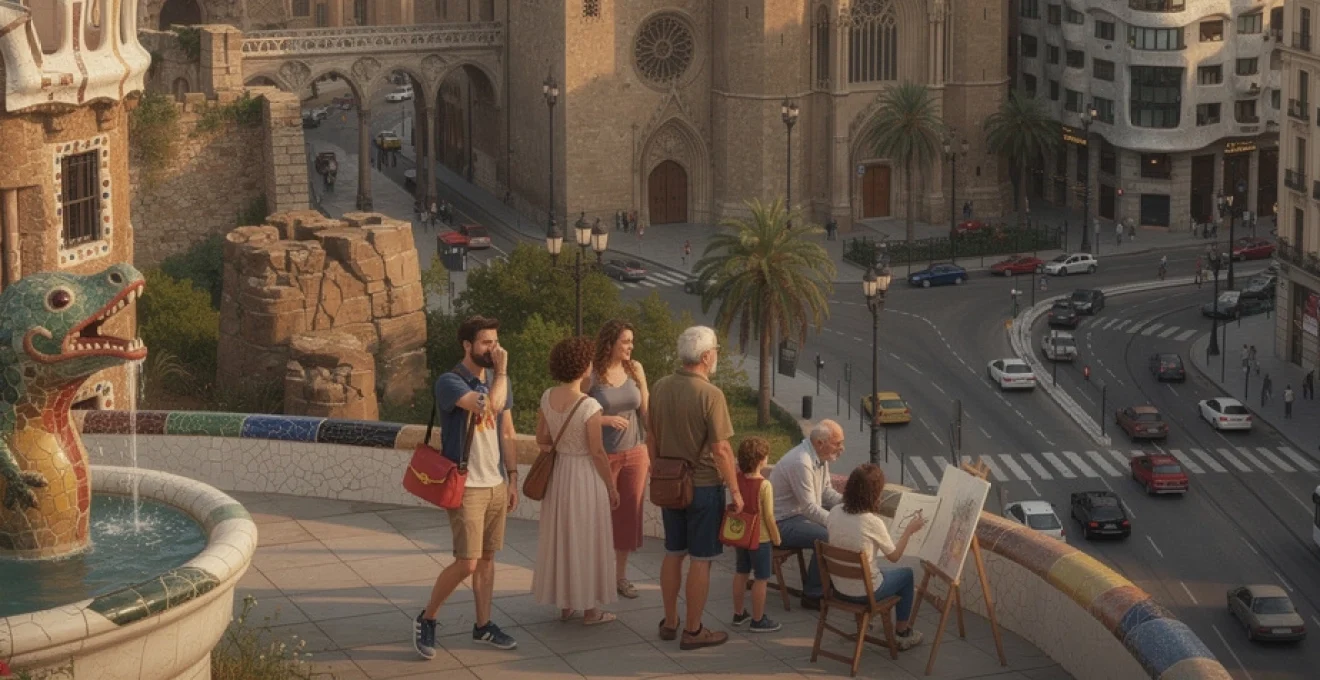
Barcelona stands as one of Europe’s most visually compelling cities, where every street corner, façade, and public square tells a story of cultural evolution, political resilience, and artistic innovation. The built environment here serves as more than mere shelter or infrastructure—it functions as a three-dimensional archive of Catalan identity, capturing centuries of social movements, economic transformations, and creative ambition. From the sinuous forms of Gaudí’s masterworks to the rational grid of Cerdà’s Eixample, from medieval stone walls to contemporary glass towers, Barcelona’s architecture embodies the complex relationship between tradition and modernity that defines Catalonia itself. Understanding this architectural language offers you profound insights into how physical spaces can express collective memory, political aspirations, and cultural distinctiveness in ways that transcend verbal communication.
Gaudí’s modernisme: architectural symbolism in sagrada família and park güell
Antoni Gaudí remains the most internationally recognized figure of Catalan Modernisme, a movement that flourished between 1880 and 1920 as an expression of Catalan cultural renaissance. His architectural philosophy rejected the rigid geometry of industrial-age construction in favour of organic forms inspired by natural structures—tree columns that branch toward cathedral ceilings, façades that undulate like living tissue, and decorative elements drawn from Mediterranean flora and fauna. This approach represented more than aesthetic preference; it embodied a spiritual conviction that divine creation could be understood through careful observation of natural patterns and mathematical relationships found in the physical world around us.
Catalan nativity façade: biblical narratives through organic sculptural forms
The Nativity Façade of the Sagrada Família, completed under Gaudí’s direct supervision between 1894 and 1930, transforms biblical narrative into a symphony of stone where every surface teems with symbolic meaning rooted in Catalan religious traditions. Unlike conventional ecclesiastical sculpture that maintains clear separation between architectural structure and decorative elements, Gaudí created an integrated organic composition where structural columns emerge as palm trees, pinnacles become harvested wheat stalks, and the entire façade suggests a sacred grotto rather than constructed masonry. The sculptural program includes over one hundred plant and animal species native to Catalonia, grounding universal Christian themes in the specific landscape of the Mediterranean region.
This localization of religious iconography served a deliberate cultural purpose during a period when Catalan language and customs faced suppression from Spanish centralist policies. By embedding regional botanical and zoological references within Catholic imagery, Gaudí created a visual language that simultaneously affirmed orthodox faith and distinct Catalan identity. The technical execution required unprecedented collaboration between architect and craftsmen—sculptors like Carles Mani and Llorenç Matamala worked directly from Gaudí’s plaster models and verbal descriptions to create forms that had never before existed in architectural vocabulary.
Trencadís mosaic technique: recycled ceramic heritage in parc güell’s serpentine bench
The trencadís technique—creating mosaics from irregular fragments of broken ceramic tiles—represents one of Modernisme’s most distinctive contributions to decorative arts, and nowhere does this method achieve more spectacular results than in the serpentine bench that crowns Park Güell’s main terrace. This 110-metre continuous seating structure, designed between 1900 and 1914, transforms functional public furniture into a kaleidoscopic artwork that changes character with every shift in viewing angle and lighting condition. The technique itself embodied Catalan values of resourcefulness and craftsmanship, utilizing broken factory seconds and discarded materials to create surfaces of extraordinary beauty and complexity.
Beyond its visual impact, the bench demonstrates Gaudí’s integration of ergonomic considerations with aesthetic ambitions—the undulating form provides individually contoured seating positions, while the backrest angle offers optimal lumbar support for extended periods. The ceramic surface remains cool during Barcelona’s hot summers and drains rainwater efficiently through carefully calculated slopes. This marriage of practical functionality with artistic expression reflects a broader Modernisme philosophy that rejected the separation between fine arts and applied crafts, treating everyday objects as opportunities for creative excellence. The collaborative process involved Josep Maria Jujol, who contributed much of the ceramic composition, selecting colour combinations that reference Catalan landscape—azure
and citrus tones alongside earthen reds and greens. In doing so, the ensemble becomes a chromatic map of Catalonia’s coasts, orchards, and hillsides. For many visitors, sitting on this bench is their most direct physical contact with Gaudí’s aesthetic: an everyday act—resting in a public park—elevated into a tactile encounter with Barcelona’s cultural identity.
Hyperbolic paraboloid structures: mathematical expression of mediterranean spirituality
While Gaudí is often associated with free-form curves, much of his work is rooted in rigorous geometry, particularly the use of ruled surfaces like hyperbolic paraboloids, hyperboloids, and helicoids. In the Sagrada Família and in Park Güell’s colonnaded pathways, these mathematically defined shapes appear in vaults, roofs, and structural supports that seem almost impossibly fluid. They allow thin, lightweight construction that channels loads efficiently, creating airy interiors where light and shadow interplay like waves on the Mediterranean Sea.
This marriage of mathematics and mysticism reflects a distinctly Catalan synthesis of rational thought and spiritual depth. Gaudí used gravity-based hanging models and chain catenaries to simulate the most efficient structural forms, then inverted them to design columns and vaults that appear to grow organically from the ground. For you as an observer, the result is a spatial experience in which engineering logic becomes a kind of silent liturgy, expressing ideas of transcendence, balance, and harmony without a single written word.
These hyperbolic paraboloid structures also speak to the region’s embrace of scientific innovation during the late 19th and early 20th centuries. Catalonia was modernizing through industry, engineering, and technology, yet it refused to abandon its spiritual and artisanal roots. Gaudí’s work manages to embody both aspirations simultaneously: stone that feels alive, geometry that feels devotional, and a built environment that turns abstract mathematics into a physical expression of Mediterranean spirituality.
Dragon salamander fountain: mythological references to catalan coat of arms
At the main entrance of Park Güell, the colorful mosaic salamander—often called the “dragon”—has become one of Barcelona’s most recognizable symbols. This creature, formed entirely from trencadís, is far from a simple decorative fountain. It operates as a condensed symbol of Catalan mythology, Christian allegory, and civic identity. Many scholars link it to the dragon of Sant Jordi (Saint George), Catalonia’s patron saint, whose legend of slaying the dragon is a key narrative in the region’s folklore and visual culture.
The creature’s position on the central staircase, mediating between the everyday world of the city below and the idealized garden-city of Park Güell above, reinforces its role as a threshold guardian. Its scales shimmer in the colors of the Catalan landscape and, in some interpretations, echo the heraldic patterns of the Catalan coat of arms. By integrating such mythological references into a public park, Gaudí codified local stories into the very infrastructure of urban leisure.
For visitors today, the salamander works on multiple levels: a beloved tourist icon, a playful sculptural object for children, and a deeper reminder of Catalonia’s narrative traditions. When you photograph or simply contemplate this dragon, you are participating in the ongoing circulation of a visual symbol that condenses centuries of cultural memory into a single, unforgettable figure.
Medieval gothic quarter: urban morphology of roman and barri gòtic heritage
Moving from Gaudí’s modernist hillsides down into the dense fabric of the Ciutat Vella, you encounter a very different yet equally revealing architectural language. The Gothic Quarter (Barri Gòtic) overlays the ancient Roman settlement of Barcino, preserving an irregular street network that sharply contrasts with the rational order of the Eixample. Narrow alleyways, sudden widening into small plazas, and layered façades tell the story of a city that has grown by accretion rather than by single master plan.
This medieval urban morphology reflects a culture forged in proximity, negotiation, and resilience. Buildings share party walls, religious and civic structures crowd into compact spaces, and everyday life unfolds in public squares that double as markets, stages, and meeting points. If Gaudí’s architecture articulates Catalonia’s aspirations, the Gothic Quarter expresses its deep historical roots—Roman, medieval, and early modern—still alive in today’s urban experience.
Carrer del bisbe bridge: neo-gothic fabrication and historical authenticity debate
One of the most photographed elements of the Gothic Quarter is the ornate bridge crossing Carrer del Bisbe, near the Palau de la Generalitat. Despite its apparently medieval character, this bridge was constructed in 1928 as part of a broader campaign to “medievalize” the area. Architect Joan Rubió i Bellver designed it in a Neo-Gothic style that blends pointed arches, tracery, and sculptural detail into a dramatic urban gesture intended to reinforce the political symbolism of Catalan self-government.
This deliberate fabrication raises an important question: how do we define authenticity in a city where history is constantly reinterpreted? Critics argue that the bridge creates a stylized, almost romanticized version of the Middle Ages, more aligned with early 20th-century nationalism than historical accuracy. Supporters counter that architecture is always a palimpsest, and that the bridge honestly reflects the cultural and political concerns of the time it was built—specifically, the desire to visually anchor Catalan institutions in a heroic medieval past.
For you as a visitor or observer, Carrer del Bisbe’s bridge becomes a case study in how architecture both records and constructs identity. It demonstrates that Barcelona’s cultural narrative is not frozen; it is actively shaped by successive generations who use architectural language to assert continuity, legitimacy, and belonging, even when the stones themselves are younger than they appear.
Santa maria del mar basilica: catalan gothic purity and maritime trade prosperity
Just a short walk from the Gothic Quarter proper, the basilica of Santa Maria del Mar in the Born district stands as a powerful embodiment of Catalan Gothic architecture. Built between 1329 and 1383, it differs from many European Gothic cathedrals in its structural clarity and lack of excessive vertical dramatization. The interior features slender octagonal columns, high but relatively unadorned walls, and a unified nave that creates a sense of spatial coherence rather than fragmented chapels.
This architectural “purity” mirrors the social forces that produced it. Santa Maria del Mar was funded largely by the merchant class and port workers rather than aristocracy or the church hierarchy. Its construction coincided with Barcelona’s rise as a Mediterranean trading power, and the building can be read as a monumental expression of civic pride and commercial prosperity. Light entering through large stained-glass windows washes the interior with a maritime luminosity, reinforcing the link between spiritual life and seafaring economy.
When you stand beneath its vaults, you are experiencing more than masterful engineering; you are inhabiting a space where a community of sailors, guilds, and traders inscribed their aspirations into stone. In contrast to the more vertical and ornamental Gothic of northern Europe, Catalan Gothic here emphasizes horizontal continuity and structural legibility, aligning with a culture that valued collective effort, practical ingenuity, and a grounded sense of the sacred.
Plaça reial: neoclassical arcades and post-medieval urban regeneration
Plaça Reial, just off La Rambla, represents another layer in Barcelona’s evolving cultural identity—this time through 19th-century Neoclassicism. Designed by Francesc Daniel Molina and inaugurated in the mid-1800s, the square features uniform façades, rhythmically spaced arcades, and palm trees framing an orderly open space. It replaced a former convent, part of a broader wave of post-medieval urban regeneration that sought to modernize the old city while imposing new civic order.
The use of symmetrical elevations and repeated window modules reflects Enlightenment ideals of rationality and balance. Yet the square has never been a purely formal composition; it has always served as a social condenser where cafés, bars, and nightlife mix with everyday pedestrian traffic. Even Gaudí leaves a subtle signature here in the form of early lamp posts featuring stylized helmets and winged dragons, hinting at the city’s willingness to insert innovation into classical frameworks.
Plaça Reial demonstrates how Barcelona layered new identities over old structures without completely erasing what came before. For you, walking under its arcades offers a tangible sense of how 19th-century planners tried to reconcile the dense, irregular medieval fabric with emerging bourgeois desires for open, representational public spaces—an early step towards the more systematic urbanism of the Eixample.
Roman wall remnants: ancient barcino foundations in contemporary urban fabric
Beneath and behind the Gothic and Neoclassical façades lie the even older traces of Roman Barcino. Segments of the Roman wall, towers, and street alignments remain visible near the Cathedral and Plaça Nova, often integrated into later constructions. These remnants remind us that Barcelona’s apparent continuity is built on successive reuses of the same strategic site: a compact hill near the sea, defended by fortifications that once marked the edge of the known urban world.
Rather than isolating these ruins in open-air museums, the city has largely chosen to weave them into the existing urban fabric. You can see ancient stone bases supporting medieval structures, or Roman arches embedded within residential blocks. This approach reinforces the perception of Barcelona as a living archive where historical layers remain in active dialogue with daily life, not frozen as distant artifacts.
In planning and heritage terms, the Roman remains anchor contemporary debates about preservation and redevelopment. They force planners, architects, and residents alike to confront questions of continuity: how much of the past should visibly shape the future, and how can a dynamic metropolis maintain legible traces of origins that date back nearly two millennia?
Eixample district: ildelfons cerdà’s grid system and catalan renaixença movement
Leaving the tight medieval core, you encounter a radically different urban vision in the Eixample district, planned by engineer Ildefons Cerdà in the mid-19th century. Conceived as an antidote to the overcrowded walled city, the Eixample is characterized by a strict orthogonal grid, wide streets, and uniform blocks designed to optimize light, ventilation, and mobility. Each block was originally intended to be built on only two or three sides, with interior gardens providing green lungs for residents.
This expansion coincided with the Renaixença, a cultural movement that revived Catalan language and identity. The Eixample became the physical canvas for this renaissance, attracting an industrial bourgeoisie eager to express status and regional pride through architecture. As a result, the district combines Cerdà’s egalitarian, hygienist ideals with the expressive façades of Modernisme and later styles, turning the grid into a showcase of Catalan creativity and entrepreneurial ambition.
Chamfered corners (xamfrà): traffic flow innovation and urban visibility enhancement
One of Cerdà’s most distinctive contributions to urban design is the systematic use of chamfered corners, or xamfrans, at each intersection. By cutting off the sharp right angle of the block, he created octagonal junctions that improved turning radii for vehicles, increased sightlines for pedestrians, and expanded space for social interaction at street level. In the 19th century, this was a forward-looking response to emerging forms of mobility, from horse-drawn carriages to, later, trams and automobiles.
These chamfered corners also have an important social and visual function. They open up the façade to the intersection, turning private buildings into part of a shared urban stage where balconies, shopfronts, and cafés engage in constant dialogue. In commercial corridors like Passeig de Gràcia or Rambla de Catalunya, the xamfrà multiplies the amount of “corner” frontage, which is the most valuable in retail terms, reinforcing the district’s role as a space of commerce and display.
From a cultural identity perspective, the xamfrà encapsulates the Catalan tendency to align practicality with sociability. The same design element that improves traffic flow also encourages neighbors to see and be seen, turning intersections into micro-arenas of urban life where architecture, business, and everyday ritual intersect.
Casa milà (la pedrera): biomimetic façade design and ventilation courtyards
On Passeig de Gràcia, Casa Milà—popularly known as La Pedrera—demonstrates how Gaudí exploited the Eixample’s structural logic while challenging its aesthetic conventions. Completed in 1912, the building replaces the typical flat façade and regular window pattern with a flowing, stone exterior that resembles a weathered cliff face. Wrought-iron balconies twist like seaweed or vines, and the rooftop chimneys transform functional exhaust systems into sculptural warriors overlooking the city.
Beneath this expressive skin lies a rational, highly innovative plan organized around two large interior courtyards. These voids bring daylight and cross-ventilation deep into the building, a passive climate strategy that anticipated contemporary concerns with sustainability and indoor comfort. The free-plan floors, supported by internal columns rather than load-bearing walls, allowed flexible apartment layouts—a practical response to changing family structures and social norms.
La Pedrera thus becomes a built manifesto of Barcelona’s architectural identity: rooted in the Eixample grid yet willing to push its possibilities to the limit. When you step into its courtyards and look up at the undulating walls pierced with windows, you experience how biomimetic design, structural innovation, and urban context can combine to create a building that feels simultaneously local and ahead of its time.
Casa batlló: marine morphology and sant jordi dragon allegory in roof design
Just a short walk away, Casa Batlló offers a more overtly narrative approach to Modernisme. Gaudí’s 1904–1906 renovation of an existing building transformed its façade into a marine tableau: bone-like columns suggest vertebrae, balconies resemble masks or shells, and the surface shimmers with blue and green trencadís evoking underwater light. The effect is that of a living organism emerging from the otherwise orderly Eixample streetscape.
The roofline, often interpreted as the spine of a dragon, ties the building explicitly to the legend of Sant Jordi. The turret and cross at one end can be read as the saint’s lance piercing the beast, while the scaled tiles and sinuous silhouette reinforce the creature’s presence. In this reading, Casa Batlló becomes an architectural retelling of a foundational Catalan myth, embedded not in a remote monument but in a residential and commercial building on a major boulevard.
For you as an observer, this layering of marine morphology and heroic allegory shows how Barcelona’s architecture often operates on multiple registers. At one level, Casa Batlló is a luxurious urban residence; at another, it is a public artwork communicating narratives of struggle, protection, and identity to anyone who passes along Passeig de Gràcia.
Montjuïc: olympic architecture and catalonian political expression through built form
Southwest of the city center, the hill of Montjuïc serves as both physical lookout and symbolic vantage point over Barcelona’s cultural evolution. Historically fortified and later developed for the 1929 International Exposition, Montjuïc was dramatically reimagined for the 1992 Olympic Games. This transformation signaled Barcelona’s rebirth after decades of dictatorship, projecting an image of openness, modernity, and democratic confidence to the world.
The architecture of Montjuïc during this period did more than provide venues for sports; it articulated a new relationship between Catalan identity, the Spanish state, and the international community. Facilities were carefully integrated into the landscape, emphasizing public access, views of the city, and connections to existing cultural institutions. In many ways, Montjuïc became an urban laboratory where Barcelona experimented with how large-scale events could catalyze long-term improvements in public space and infrastructure.
Palau sant jordi: arata isozaki’s tension structure and post-franco democratic identity
Palau Sant Jordi, designed by Japanese architect Arata Isozaki and completed in 1990, stands at the heart of this Olympic ensemble. Its low, domed profile and use of a sophisticated tension structure distinguish it from the more monumental, vertical stadium typologies of the past. The arena’s retractable seating and flexible interior layout allow it to host everything from gymnastics to concerts, embodying a new, multi-purpose understanding of civic architecture.
Symbolically, the building’s calm, almost meditative form contrasts sharply with the authoritarian monumentalism of earlier regimes on the Iberian Peninsula. Instead of imposing power through mass and height, Palau Sant Jordi expresses confidence through technical refinement, spatial generosity, and integration with the surrounding landscape. For many observers, it became a built emblem of Spain’s and Catalonia’s post-Franco democratic identity—open, plural, and globally connected.
When you enter Palau Sant Jordi, you participate in a narrative where advanced engineering, international collaboration, and inclusive public programming converge. It shows how architecture can help reframe a city’s image not only abroad but also in the minds of its own citizens, encouraging them to see themselves as protagonists in a renewed democratic story.
Fundació joan miró: josep lluís sert’s rationalist mediterranean architecture
Also on Montjuïc, the Fundació Joan Miró showcases another facet of Barcelona’s architectural identity: rationalist modernism adapted to Mediterranean climate and topography. Designed by Josep Lluís Sert and opened in 1975, the museum complex features white, cubic volumes, roof terraces, and carefully modulated natural light. Sert’s design employs brise-soleil, patios, and skylights to create interiors that are both luminous and controlled, ideal for displaying Miró’s vibrant works.
The building reflects Miró’s and Sert’s shared commitment to a modern architecture rooted in local conditions rather than abstract international formulas. Its forms recall traditional Mediterranean farmhouses and monasteries, translated into a clean, geometric language that feels timeless rather than tied to a single era. For you, walking through its galleries and courtyards is akin to moving through a three-dimensional abstraction of the Catalan landscape—sun, shadow, stone, and sky.
In cultural terms, the Fundació Joan Miró demonstrates how Barcelona embraced modernism not only through exuberant forms like Gaudí’s, but also through quieter, more austere expressions that nonetheless remain deeply connected to place. It adds another note to the city’s architectural “voice,” one that values clarity, proportion, and the subtle poetry of light.
Magic fountain cascades: 1929 international exposition and noucentisme aesthetics
The Magic Fountain of Montjuïc, originally designed by Carles Buïgas for the 1929 International Exposition, represents yet another layer of the hill’s architectural palimpsest. The fountain and its cascading pools form a grand axial composition leading up to the Palau Nacional, combining hydraulic engineering with theatrical lighting effects. At night, water, light, and music merge into a popular spectacle that has become one of Barcelona’s enduring attractions.
Aesthetically, the ensemble reflects Noucentisme, a Catalan movement that reacted against the exuberance of Modernisme by advocating for classical order, civic dignity, and Mediterranean clarity. The symmetrical staircases, balustrades, and terraces frame the dynamic fountain in a language of controlled grandeur, more institutional yet still accessible. For locals and tourists alike, the Magic Fountain transforms monumental architecture into an interactive experience, blurring the line between formal representation and popular entertainment.
As you watch the choreographed water displays with the city spread out below, you are engaging with a century-old vision of Barcelona as a cosmopolitan capital. The fountain’s continued use and periodic technological upgrades illustrate how heritage structures can adapt to contemporary expectations while preserving their original symbolic roles.
Contemporary interventions: jean nouvel’s torre glòries and diagonal mar urban development
In the 21st century, Barcelona has continued to evolve through bold contemporary interventions that test how far its architectural identity can stretch without breaking. Two of the most emblematic examples are Jean Nouvel’s Torre Glòries (formerly Torre Agbar) and the large-scale redevelopment of the Diagonal Mar area. Both projects sit on the city’s eastern flank, where industrial lands have been transformed into the 22@ innovation district and new residential and commercial neighborhoods.
Torre Glòries, completed in 2005, stands as a luminous landmark at the junction of Avinguda Diagonal and Gran Via de les Corts Catalanes. Its bullet-shaped profile and iridescent glass and aluminum skin reinterpret traditional Catalan motifs, from the colors of pottery glazes to the shimmering surfaces of the Mediterranean at sunset. While some residents initially criticized its form, the tower has gradually been absorbed into Barcelona’s mental map, joining older icons like Sagrada Família and Montjuïc on postcards and skyline photographs.
The Diagonal Mar area, largely developed around the turn of the millennium, replaced obsolete factories and warehouses with a mix of high-rise housing, shopping centers, office complexes, and a large coastal park. Urbanistically, it marks a departure from the dense, low-to-mid-rise fabric of the Eixample, embracing taller volumes and more open ground planes. For you, walking through Diagonal Mar can feel like encountering a parallel Barcelona—airier, more globalized in its architectural language, and closely tied to the sea.
These contemporary projects raise important questions: how can a city rooted in masonry, craftsmanship, and human-scale streets incorporate glass towers and large-format developments without losing its soul? Barcelona’s answer has been to insist on strong public-realm design—parks, promenades, and transit connections—that weave these new forms into the existing urban life. The success of 22@ as a technology and creative cluster, for instance, rests not only on iconic buildings but also on its walkable streets, preserved industrial structures, and integration with surrounding neighborhoods.
Preservation versus progress: UNESCO world heritage sites and urban densification challenges
As Barcelona’s architectural reputation has grown, so too has the pressure on its built environment. Several of Gaudí’s works, including Sagrada Família, Park Güell, Casa Batlló, and Casa Milà, are inscribed as UNESCO World Heritage Sites, underscoring their universal value. This recognition brings economic benefits through tourism but also strict guidelines on alteration, restoration, and adjacent development. Balancing these international preservation standards with the city’s need for housing, infrastructure, and sustainable mobility has become one of Barcelona’s central planning challenges.
Urban densification pressures are particularly acute in districts like Eixample and Ciutat Vella, where demand for short-term rentals, offices, and high-end housing can drive up prices and displace long-term residents. At the same time, Barcelona’s commitment to a compact, transit-oriented urban model discourages unchecked suburban sprawl. The result is a complex negotiation in which height limits, façade protections, and heritage overlays sometimes collide with calls for more flexible, energy-efficient building typologies.
For you as a student of architecture or urbanism, Barcelona functions as a living laboratory where preservation and progress are in constant dialogue. Initiatives such as “superblocks” (superilles), which reconfigure traffic to prioritize pedestrians and cyclists, illustrate how the city is attempting to retrofit existing fabrics without erasing their character. Ongoing debates around the completion of the Sagrada Família, the regulation of tourism, and the reuse of industrial structures in 22@ show that identity is not a static asset but a shared project, renegotiated generation after generation.
In this context, architecture becomes both mirror and instrument: it reflects deeply rooted cultural values while also providing tools to imagine and construct new ways of living together. Whether you are drawn to the organic forms of Modernisme, the disciplined grid of the Eixample, or the glass skins of contemporary towers, each layer of Barcelona’s built environment invites you to read the city not just as a place on the map, but as an evolving expression of Catalan cultural identity.