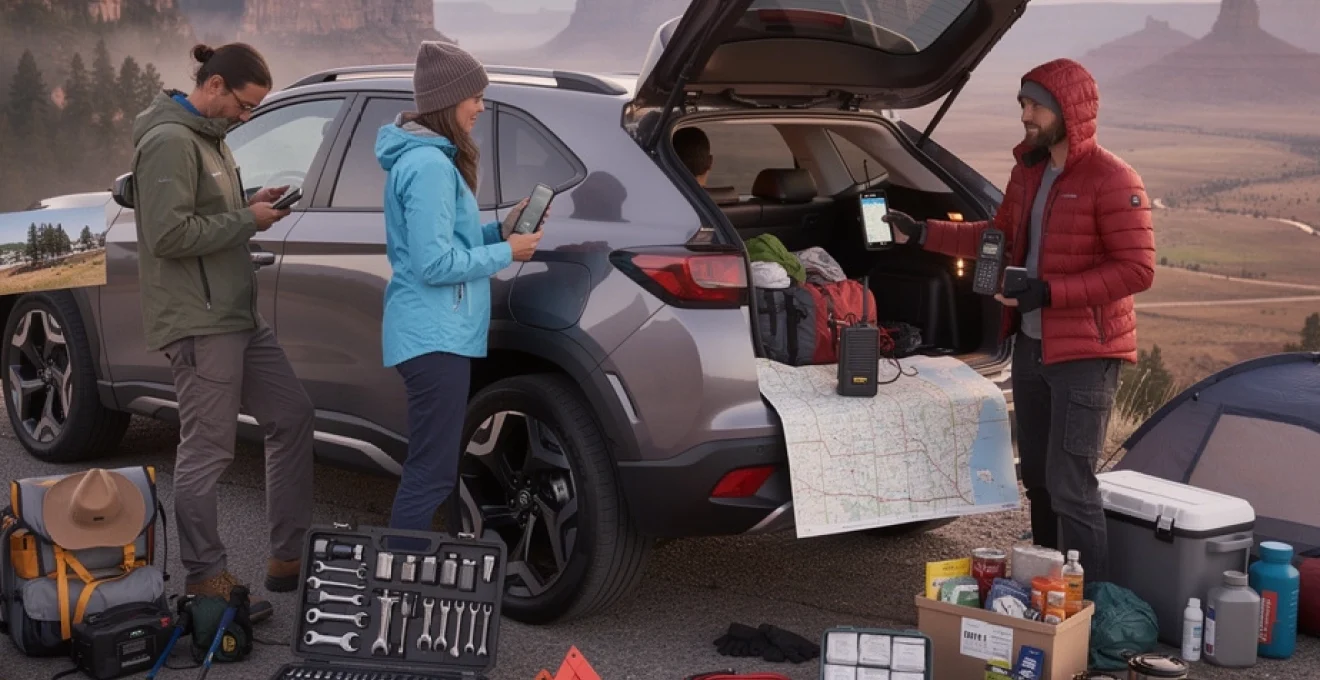
Embarking on a cross-country road trip across the United States represents one of the most exhilarating adventures available to modern travellers. The sheer diversity of American landscapes—from the Pacific Northwest’s temperate rainforests to the Southwest’s arid deserts—demands meticulous preparation and strategic packing. Success hinges on understanding that you’ll traverse multiple climate zones, encounter varying terrain challenges, and potentially face emergency situations thousands of miles from home. The key lies not in packing everything imaginable, but in selecting versatile, high-quality items that serve multiple purposes whilst fitting within your vehicle’s constraints. This comprehensive guide addresses the essential equipment categories that separate memorable adventures from disastrous experiences, ensuring you’re prepared for America’s vast and varied territories.
Essential vehicle preparation and emergency equipment for Cross-Country travel
Vehicle reliability becomes paramount when traversing America’s extensive interstate highway system, where the next service station might be hundreds of miles away. Professional automotive preparation extends far beyond basic maintenance checks, requiring comprehensive emergency equipment that addresses mechanical failures, weather-related incidents, and unexpected roadside situations. The investment in quality emergency equipment often means the difference between minor inconveniences and potentially dangerous situations in remote areas.
Advanced automotive tool kit: spanners, torque wrenches, and diagnostic equipment
A comprehensive automotive tool kit should include adjustable spanners ranging from 8mm to 19mm, alongside a reliable torque wrench for precise mechanical adjustments. Professional-grade diagnostic equipment, such as an OBD-II scanner, enables real-time monitoring of engine performance and early detection of potential issues. These tools prove invaluable when addressing minor mechanical problems in locations where professional automotive services remain unavailable for extended periods.
Socket sets with both metric and imperial measurements accommodate the diverse range of vehicles encountered on American roads. Combination wrenches, Phillips and flathead screwdrivers of various sizes, and needle-nose pliers complete the essential hand tool collection. Quality matters significantly in this category, as inferior tools may fail precisely when you need them most, potentially leaving you stranded in challenging conditions.
Emergency roadside safety arsenal: warning triangles, High-Visibility vests, and flares
Roadside safety equipment protects both you and other motorists during emergency situations, particularly crucial on high-speed interstate highways where visibility challenges create dangerous conditions. Reflective warning triangles should be deployed at minimum distances of 100 feet behind your vehicle, with additional triangles placed at 200 and 300-foot intervals on major highways. High-visibility safety vests ensure you remain visible to approaching traffic whilst addressing mechanical issues or changing tyres.
Emergency flares provide backup illumination when electronic warning devices fail or when battery power becomes compromised. LED emergency beacons offer longer operational periods and greater reliability than traditional flares, though carrying both types ensures maximum preparedness. Consider investing in magnetic emergency lights that attach securely to your vehicle’s metal surfaces, providing 360-degree visibility enhancement during roadside repairs.
Comprehensive first aid medical supplies for remote interstate incidents
Medical emergencies can occur anywhere along America’s extensive road network, often in areas where professional medical assistance remains hours away. A comprehensive first aid kit should include sterile gauze pads, medical tape, antiseptic wipes, and elastic bandages for treating cuts, scrapes, and sprains. Pain relief medications, including aspirin and ibuprofen, address common travel-related discomfort whilst antihistamines manage allergic reactions to unfamiliar regional allergens.
Specialised medical supplies such as instant cold packs, thermometers, and emergency blankets prove essential for treating more serious conditions. Include personal medications in sufficient quantities to last the entire journey, plus additional supplies for unexpected delays. Emergency contact information, including medical insurance details and emergency contacts, should be readily accessible within the first aid kit for rapid reference during crisis situations.
Vehicle recovery equipment: tow straps, jump leads, and portable battery packs
Modern portable jump starters eliminate dependence on other vehicles for battery-related emergencies, offering compact solutions that fit easily within vehicle storage compartments. These devices typically provide multiple jump-start attempts and include USB charging ports for electronic devices. Quality tow straps with appropriate weight ratings enable
vehicle recovery in situations ranging from shallow mud to light snow. When selecting tow straps, prioritise models with reinforced loops and clearly marked working load limits that exceed your vehicle’s gross weight. A compact tyre inflator powered via the 12V socket or battery pack also proves invaluable, allowing you to correct low tyre pressure without hunting for a service station in an unfamiliar town.
Traditional jump leads still have their place in a cross-country road trip kit, particularly when travelling in convoy or in more populated regions. Opt for heavy-gauge copper cables with robust clamps, as cheaper alternatives often underperform in cold climates or with larger engines. Store all recovery equipment in a dedicated container so that in low-visibility or high-stress conditions, you can access what you need without rummaging through your entire boot.
Spare parts inventory: belts, hoses, fuses, and critical replacement components
Carrying a strategic selection of spare parts transforms a minor mechanical issue from a trip-ending disaster into a manageable roadside repair. At minimum, include spare fuses for all primary circuits, a replacement serpentine belt, and essential hoses for your specific vehicle model. Many long-distance drivers also pack spare headlight bulbs and brake light bulbs, as driving without proper lighting on rural American highways can be both unsafe and illegal.
Consult your vehicle’s service manual or a trusted mechanic before departure to identify weak points and high-wear components that commonly fail around your vehicle’s current mileage. If you are driving an older car on your road trip across the United States, consider adding a spare fuel filter, hose clamps, and a small quantity of the correct engine oil and coolant. Organise these critical replacement components in labelled bags or small bins so that, in the event of a breakdown, you or a roadside technician can locate the right part within seconds.
Climate-adaptive clothing systems for diverse american geographical zones
Packing clothing for a cross-country road trip in the USA is less about sheer quantity and more about adaptability. In a single two-week itinerary, you might experience coastal fog in San Francisco, triple-digit heat in Phoenix, and evening frost in Wyoming’s high plains. Rather than stuffing your car with bulky items, build a modular clothing system that you can layer, strip back, and reconfigure as you move between regions. Think of your wardrobe like a toolkit: each item should work in several climates and pair easily with the rest.
Fabrics play a crucial role when you drive across multiple climate zones. Technical materials such as merino wool, Gore-Tex, and modern synthetic blends regulate temperature better than heavy cotton, which tends to stay damp and uncomfortable. Prioritise pieces that pack down small, dry quickly, and resist odours—key advantages when laundromats may be several days apart. With the right system, you can step out of your air-conditioned vehicle into almost any American landscape feeling prepared rather than exposed.
Pacific northwest waterproof layering: Gore-Tex systems for oregon and washington
The Pacific Northwest is famous for its dramatic coastlines and emerald forests, but also for its persistent drizzle and sudden downpours. To stay comfortable while exploring Oregon and Washington, pack a three-layer waterproof system: a moisture-wicking base layer, an insulating mid-layer, and a breathable Gore-Tex or equivalent shell. This combination allows you to adapt quickly when a sunny morning in Portland turns into a misty afternoon in the Columbia River Gorge.
Waterproof does not always mean comfortable, especially if the garment traps sweat. Look for jackets with pit zips, adjustable cuffs, and storm hoods that fit over a cap or beanie. Lightweight waterproof trousers that pull on over jeans or hiking pants can make the difference between a brief shower and a day of soaked clothing. Since many coastal towns and cities in the Pacific Northwest also have brisk evening breezes, a packable fleece or synthetic-insulated jacket is essential for waterfront walks and late-night campfires.
Desert southwest heat management: UV protection for arizona and nevada territories
In the Desert Southwest—Arizona, Nevada, and parts of Utah—the challenge is not rain but relentless sun and extreme temperature swings. Daytime temperatures on a summer road trip in the USA can easily exceed 100°F (38°C), while desert nights drop sharply. Prioritise heat management and UV protection with lightweight, long-sleeve shirts in UPF-rated fabrics, wide-brimmed hats, and breathable, loose-fitting trousers that protect your skin without trapping heat.
Cotton t-shirts feel comfortable at first but tend to hold sweat, making you feel heavy and overheated during long hikes in national parks like Zion or Joshua Tree. Technical fabrics that wick moisture behave more like a personal climate control system, pulling sweat away and allowing it to evaporate quickly. A light neck gaiter or bandana serves multiple purposes: sun protection, dust filter on windy desert roads, and even a makeshift cold compress when soaked in water. Remember, in regions where the sun feels like a blowtorch rather than a lamp, your clothing is as much a safety tool as your water bottle.
Rocky mountain altitude clothing: thermal regulation for colorado high country
Crossing the Rocky Mountains introduces a different challenge: altitude and rapid weather changes. In Colorado’s high country, you might encounter sun, wind, and snow within a single day, even in late spring or early autumn. Effective thermal regulation begins with a breathable base layer that keeps your skin dry, since moisture next to the body accelerates heat loss. Merino wool base layers are particularly effective, combining warmth, breathability, and odour resistance—ideal when you’re wearing the same set across several states.
A lightweight insulated jacket (down or synthetic) offers excellent warmth-to-weight ratio and packs easily into a daypack for mountain hikes. Pair this with a windproof shell to block the strong gusts that sweep across high passes and alpine lakes. Don’t underestimate cold extremities: pack thermal socks, a beanie that covers your ears, and thin liner gloves that still allow you to handle zips, camera buttons, and navigation devices. When you step out at a scenic overlook above 10,000 feet, you’ll be grateful you treated your clothing like mountaineering gear rather than casual streetwear.
Great plains weather variability: wind-resistant garments for kansas and nebraska
The Great Plains stretch across states such as Kansas, Nebraska, and South Dakota, where the primary weather characteristic is variability. Strong winds, sudden thunderstorms, and significant temperature swings between morning and late afternoon are common. A wind-resistant outer layer becomes indispensable, functioning almost like portable shelter when you stop at exposed viewpoints or small-town parks. Look for softshell jackets that balance wind protection with breathability, preventing that clammy feeling during longer walks.
Layering remains key on these long, flat stretches of highway. A simple combination of t-shirt, light sweater or fleece, and wind jacket allows you to adapt quickly when a sunny day turns stormy. Since services can be sparse on certain routes across the Plains, pack a spare set of dry clothes in a small compression bag in case you are caught in heavy rain far from your luggage. Think of it as your personal “weather insurance” that keeps you comfortable and focused when driving long distances across open country.
Navigation technology and communication equipment for interstate highway systems
Efficient navigation transforms a road trip across the United States from a stressful exercise in wrong turns into a smooth, enjoyable journey. While smartphone apps have made navigation more accessible than ever, relying solely on a single device is risky. Battery failures, dead zones, and software glitches can leave you disoriented on complex junctions or rural backroads. A robust navigation strategy includes dedicated GPS devices, physical maps, and backup communication tools that work together like overlapping safety nets.
Beyond simply finding the shortest route, modern navigation technology can help you discover scenic byways, avoid severe weather, and locate fuel, food, and accommodation precisely when you need them. As you plan your cross-country itinerary, think of your navigation and communication equipment as mission-critical infrastructure, not optional extras. When you are hours from the nearest town and a storm closes the main highway, the right tools can quite literally change your day—and sometimes your safety outcome.
GPS device selection: garmin DriveSmart vs TomTom GO for long-distance routing
Dedicated GPS units such as the Garmin DriveSmart and TomTom GO series remain valuable allies on long-distance American road trips, even in the age of smartphones. These devices often provide more reliable lane guidance at complex interchanges and display upcoming services, rest areas, and speed limits clearly on larger screens. When comparing models, prioritise lifetime map updates, real-time traffic information (via Bluetooth to your phone), and clear voice prompts that are easy to follow over road noise.
The Garmin DriveSmart line tends to excel in North American coverage, offering extensive points of interest and intuitive interfaces tailored to US drivers. TomTom GO devices are similarly capable and sometimes preferred by travellers familiar with European systems. Ask yourself: do you want a device that simply gets you from A to B, or one that actively helps you find scenic detours, national park entrances, and lesser-known viewpoints? Investing in a high-quality GPS for your road trip across the USA is akin to hiring a co-pilot who never gets tired.
Satellite communication devices: garmin inreach for remote area connectivity
In many remote regions of the American West—such as parts of Utah, Montana, or eastern Oregon—mobile coverage can be patchy or non-existent for dozens of miles. For travellers who plan to venture down forest roads, explore remote national parks, or camp away from established facilities, a satellite communication device like the Garmin inReach offers a crucial safety margin. These compact units allow you to send text messages via satellite, share your live location, and trigger an SOS to global emergency coordination centres when needed.
Think of a satellite communicator as a modern equivalent of a flare gun combined with a tracking beacon. You may never need its full capability, but if your vehicle breaks down on a remote dirt road or you suffer an injury on a backcountry hike, it can be the difference between a long wait and a rapid rescue. Subscription plans vary in cost, so evaluate how often you will be off-grid and choose a package that balances budget with peace of mind. For many cross-country adventurers, especially solo travellers, this piece of equipment ranks alongside first aid kits and recovery gear in importance.
Physical atlas requirements: rand McNally road atlas for digital backup
Despite the impressive capabilities of digital tools, there is still no substitute for a well-designed physical atlas on a road trip across the United States. A classic Rand McNally Road Atlas provides an invaluable big-picture overview of your route, helping you understand regional context in ways a small screen cannot. When you spread the pages across a motel desk or picnic table, you can trace alternative routes, identify scenic byways, and spot small towns that might otherwise remain invisible in digital zoom levels.
Physical maps are also immune to dead batteries, cracked screens, or software crashes. Many seasoned drivers mark their progress with highlighters, jot notes about favourite diners or viewpoints, and circle campgrounds for future visits. In a sense, your atlas becomes both a navigation tool and a travel journal, evolving with your journey. Keeping one within easy reach, rather than buried under luggage, ensures that when your digital devices falter, you still have a reliable guide to the American road network.
Mobile network coverage solutions: signal boosters and dual-SIM configurations
Maintaining reliable mobile connectivity across a continent-sized country poses real challenges, particularly if you work remotely while travelling. Signal boosters designed for vehicles can amplify weak cellular signals, turning a marginal one-bar connection into a usable link for calls and basic data. These systems typically use an external antenna mounted on the vehicle roof and an internal repeater, creating a small improved coverage zone inside your car or RV. For many long-term travellers, a booster is like carrying your own miniature cell tower wherever you go.
Another strategy involves using dual-SIM phones or carrying two separate SIM cards from different carriers, since no single network dominates coverage everywhere in the USA. For example, one provider might perform better in the Midwest, while another excels in the Mountain West. By diversifying your connectivity options, you reduce the risk of being completely offline at critical moments. Before departure, download offline maps, travel guides, and emergency information so that even when all signals drop, you still have the digital equivalent of a fully stocked glove box.
Specialised gear for iconic american destinations and terrain types
Beyond the general packing list for a road trip across the United States, certain destinations demand specialised gear to truly enjoy them safely and comfortably. Hiking in Utah’s slot canyons requires different equipment than strolling along the beaches of the Outer Banks, just as driving the snowy passes of the Sierra Nevada calls for unique preparation compared with cruising the Florida Keys. Think of these items as targeted upgrades that unlock specific experiences you might otherwise skip.
For national parks and wilderness areas, sturdy hiking shoes or boots with good traction are non-negotiable, particularly on rocky or sandy trails. Trekking poles can reduce strain on your knees during steep descents in places like the Grand Canyon or Glacier National Park. In coastal and humid regions, quick-drying water shoes, lightweight rain ponchos, and dry bags for electronics keep you comfortable during boat tours, kayak trips, or sudden storms. Tailoring your packing list to your planned stops ensures you can say “yes” to more opportunities along the way.
Food storage and preservation systems for extended highway travel
Eating well on a cross-country road trip in the USA is less about finding the perfect diner at every exit and more about having a reliable on-board food system. A quality cooler or 12V portable fridge allows you to store fresh produce, dairy, and pre-cooked meals safely for several days. This not only reduces food costs compared with constant restaurant dining but also gives you healthier options when service stations offer little beyond fast food and sugary snacks. Consider your cooler an extension of your kitchen, not just a place for drinks.
Non-perishable staples—such as oats, nut butters, tinned fish, and trail mix—provide a nutritional safety net when you are hours from the next supermarket. Reusable containers and silicone bags help you portion leftovers, pack lunches, and prevent leaks inside your vehicle. If you plan to camp or stay in basic motels, a compact electric kettle or small induction hob combined with a single lightweight pan can transform simple ingredients into satisfying meals. With a bit of planning, your food storage and preservation setup turns long stretches of highway into opportunities for picnics at scenic rest areas rather than rushed, expensive stops.
Accommodation equipment and camping gear for Budget-Conscious travellers
Accommodation costs can quickly become the largest expense on a road trip across the United States, but thoughtful gear choices give you far more flexibility. A well-rated three-season tent, combined with quality sleeping bags and insulated sleeping pads, opens up a vast network of public campgrounds and dispersed camping areas, particularly in the West. When your sleep system is warm and comfortable, you are more likely to choose a star-filled campground over a costly last-minute hotel room. Think of this setup as your portable bedroom, ready to deploy wherever regulations and conditions allow.
For travellers who prefer a hybrid approach—alternating between motels, short-term rentals, and campsites—compact items such as travel pillows, lightweight blankets, and blackout eye masks improve sleep quality in unfamiliar spaces. A small headlamp or lantern proves indispensable at campsites and dim roadside lodgings alike, freeing your hands for setting up gear or navigating unfamiliar paths after dark. Budget-conscious road trippers also benefit from loyalty programmes and discount apps for campgrounds and motels, but the fundamental savings come from having the option to sleep comfortably almost anywhere. When your bed, in effect, travels with you, the entire United States becomes your potential guest room.