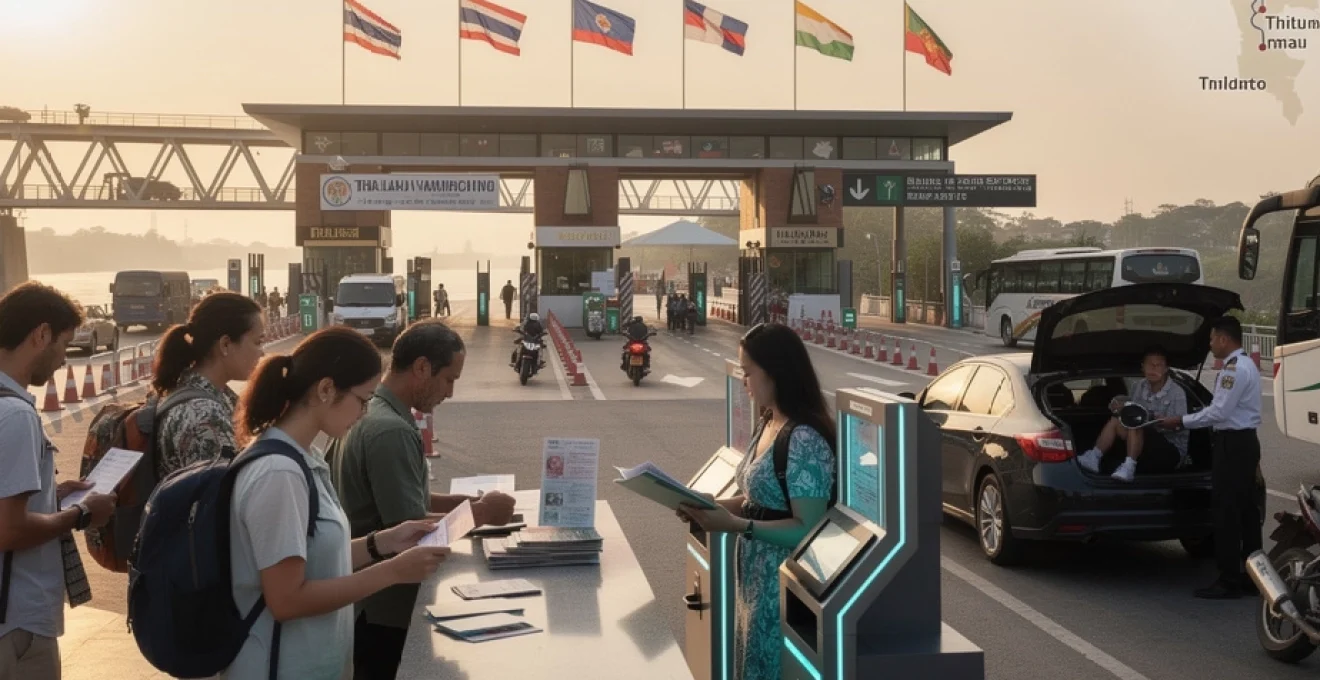
Traversing Southeast Asia by land offers an extraordinary journey through diverse cultures, landscapes, and experiences that air travel simply cannot match. The region’s interconnected mainland territories—spanning Thailand, Cambodia, Vietnam, Laos, Myanmar, Malaysia, and Singapore—present travellers with unique opportunities to witness gradual cultural transitions, enjoy significant cost savings, and engage with local communities along the way. Understanding the complexities of cross-border documentation, visa requirements, and transportation logistics becomes essential for anyone planning to explore this fascinating region through overland routes.
Border crossings in Southeast Asia have evolved significantly over the past decade, with digital immigration systems and streamlined procedures making overland travel more accessible than ever before. However, each crossing point maintains its own specific requirements and procedures that travellers must navigate carefully. The experience can range from straightforward passport stamps to complex visa-on-arrival processes, customs declarations, and biometric screenings that vary dramatically between different border checkpoints.
Essential documentation requirements for ASEAN land border crossings
Proper documentation serves as the foundation for successful land border crossings throughout Southeast Asia. The Association of Southeast Asian Nations (ASEAN) has implemented various agreements to facilitate regional travel, yet specific requirements continue to vary between member countries and crossing points. Understanding these nuances prevents costly delays and potential entry denials that could derail your entire travel itinerary.
Passport validity standards and Six-Month rule applications
The six-month passport validity rule remains a non-negotiable requirement across virtually all Southeast Asian border crossings. Immigration authorities consistently enforce this standard, refusing entry to travellers whose passports expire within six months of their intended departure date. This requirement applies regardless of your actual planned stay duration, making it essential to verify your passport expiry date well before embarking on any overland journey.
Some countries implement additional restrictions beyond the standard six-month rule. Thailand, for instance, requires that your passport contains at least two blank pages for entry and exit stamps, whilst Cambodia mandates that the passport photo page remains in excellent condition without any tears or water damage. These seemingly minor details can become major obstacles at remote border crossings where alternative solutions are limited.
Border officials at land crossings often maintain stricter documentation standards than their airport counterparts, as they typically have fewer resources to verify document authenticity and handle exceptional cases.
Visa-on-arrival procedures at Poipet-Aranyaprathet and friendship bridge crossings
Visa-on-arrival facilities at major border crossings have revolutionised overland travel convenience, particularly at high-traffic points like the Cambodia-Thailand border at Poipet-Aranyaprathet. The process typically involves completing an arrival card, providing a passport photograph, and paying the required fee in US dollars—the preferred currency for most ASEAN visa-on-arrival services. Processing times range from 15 minutes during quiet periods to several hours during peak tourist seasons.
The Nong Khai-Vientiane Friendship Bridge crossing exemplifies modern visa-on-arrival efficiency, with dedicated processing lanes and electronic payment systems that significantly reduce waiting times. Laos charges $35 USD for most nationalities, with an additional $1 USD processing fee during weekends and after-hours services. Cambodia’s visa-on-arrival costs $30 USD, though travellers should expect additional “processing fees” that vary depending on the specific border crossing and time of day.
International driving permit classifications for Cross-Border vehicle transit
Driving your own vehicle across Southeast Asian borders requires an International Driving Permit (IDP) that corresponds to the specific treaty recognition of your destination country. The 1968 Vienna Convention and 1949 Geneva Convention create two distinct IDP categories, and not all countries recognise both versions. Thailand and Vietnam accept both conventions, whilst Cambodia and Laos primarily recognise the 1949 Geneva Convention version.
Your domestic driving licence must remain valid throughout your entire journey, as the IDP serves as a translation rather than a replacement document. Some border crossings require both documents to be presented simultaneously, along with vehicle registration papers and proof of insurance coverage. The complexity increases when transitioning between countries that recognise different convention standards, potentially requiring multiple IDP versions for extended overland journeys.
Because IDP rules can change and are sometimes interpreted differently at provincial police checkpoints, we recommend printing or saving official government guidance from your home country and checking recent reports from other overland travellers before you drive across any border. If you are renting a car or motorbike in one country and plan to drive it into another, confirm in writing with the rental agency that cross-border use is permitted and that their insurance coverage extends to neighbouring states.
Carnet de passages en douane documentation for private vehicle import
For most casual travellers using buses, trains, and boats, the Carnet de Passages en Douane (CPD) will never be needed. However, if you are driving your own overland vehicle—such as a car, campervan, or large motorbike—across multiple Southeast Asian borders, the carnet can become critical. A CPD is essentially a vehicle passport: an internationally recognised customs document that guarantees you will not sell the vehicle locally and that you will export it again when you leave.
Within Southeast Asia, requirements for a carnet vary. Malaysia and Singapore tend to be strict and often expect foreign vehicles to carry a valid CPD, while Thailand, Laos, and Cambodia have historically been more flexible, instead issuing temporary import permits at the border. Myanmar, on the other hand, regularly requires organised tours or special permits for foreign vehicles, and a carnet is typically part of that package. Because rules are periodically revised, overlanders should always confirm current CPD requirements with national automobile associations or specialist overland travel forums before departure.
Obtaining a carnet is not a simple administrative task. You usually apply through your national motoring organisation, pay a substantial security deposit or bank guarantee based on the value of your vehicle, and wait several weeks for processing. Think of the carnet as a financial promise to customs authorities: if you fail to export the vehicle as declared, customs can claim against your deposit. For long-term overland expeditions between Europe, the Middle East, and Asia, this single booklet can save countless hours at remote customs posts and may be the only way to secure legal entry for your vehicle.
Strategic border crossing routes between thailand, cambodia, and vietnam
The land borders between Thailand, Cambodia, and Vietnam form one of Southeast Asia’s most popular overland travel corridors. These crossing points combine dense tourism flows, significant commercial trucking routes, and, in some areas, a reputation for scams or informal “fees.” By understanding how each major crossing works in practice, you can choose the route that best fits your budget, time constraints, and comfort level.
While low-cost flights now link Bangkok, Phnom Penh, Ho Chi Minh City, and Siem Reap in under two hours, overland routes still appeal to travellers who want to see the countryside and cut costs. The trade-off is that you must navigate visa-on-arrival counters, land transport changes, and occasionally chaotic border towns. Below, we examine four strategic land corridors and highlight what you should expect at each stage of the journey.
Moc Bai-Bavet corridor commercial transit operations
The Moc Bai–Bavet border crossing is the primary overland gateway between Phnom Penh and Ho Chi Minh City. Located on the main highway linking the two capitals, it handles thousands of passengers and heavy trucks every day. International bus companies run direct services between Phnom Penh and Ho Chi Minh City that include assistance at immigration, making this one of the most straightforward ways to cross between Cambodia and Vietnam by land.
From the Cambodian side at Bavet, travellers complete exit immigration procedures and walk or are guided across to the Vietnamese entry point at Moc Bai. Vietnam does not typically offer visa-on-arrival for land crossings, so most nationalities must secure a visa in advance or use an e-visa specifically valid for the Moc Bai checkpoint. Once cleared through Vietnamese immigration and customs, passengers re-board the same bus, which continues to Ho Chi Minh City’s central bus station or designated drop-off points.
Commercial truck operations along the Moc Bai–Bavet corridor can affect passenger traffic. During peak freight hours, you may experience longer queues at customs or crowding at the shared facilities, especially around midday when multiple buses and convoys arrive at once. To minimise delays, choose morning departures from Phnom Penh or Ho Chi Minh City and carry printed copies of your Vietnam visa approval, hotel bookings, and onward travel proof. A well-prepared folder can mean the difference between a 30-minute stop and a frustrating multi-hour wait at this busy crossing.
Chau Doc-Vinh xuong mekong delta gateway procedures
For travellers exploring the Mekong Delta, the Chau Doc–Vinh Xuong crossing offers an atmospheric alternative to the main highway routes. This river border connects the town of Chau Doc in Vietnam with Kaam Samnor on the Cambodian side, serving speedboats and passenger ferries that run between Phnom Penh and the Mekong Delta. Rather than a dusty bus terminal, you enter or exit through compact riverside immigration offices where officials process both passports and vessel manifests.
Most travellers use this crossing in conjunction with a boat ticket from Phnom Penh to Chau Doc or vice versa. Travel agencies and boat operators usually collect passports in advance, handle group processing at both border posts, and guide you through any required forms. Cambodia’s side processes exit formalities, after which the boat continues upriver or downriver to the Vietnamese checkpoint at Vinh Xuong. As at Moc Bai, Vietnam visas generally must be obtained in advance or via a valid e-visa that lists Vinh Xuong as the port of entry.
The Mekong Delta gateway has a slower, more relaxed pace than highway crossings, but that doesn’t mean you can ignore regulations. You should still plan for seasonal variations in river levels, which can affect departure times, and allow buffer time in case immigration systems slow down or boats share docking space. If you are carrying high-value equipment such as cameras or drones, pack them in a way that is easy to display during any customs check—tight, efficient packing will reassure officers that you are a genuine tourist rather than a commercial importer.
Aranyaprathet-poipet casino route navigation protocols
The Aranyaprathet–Poipet crossing is arguably Southeast Asia’s most infamous land border, known for its cluster of casinos, visa “helpers,” and aggressive touts. It is the main overland route between Bangkok and Siem Reap, with large numbers of budget travellers, tour groups, and cross-border workers passing through every day. Because of this high volume and a long history of informal practices, you must approach this crossing with clear expectations and a firm grasp of official procedures.
On the Thai side, at Aranyaprathet, you will clear exit immigration before walking through a duty-free and casino zone towards Cambodia. It is in this no-man’s-land area that many travellers encounter “visa agencies” who try to funnel you into side offices to pay inflated visa fees. For most nationalities, the correct procedure is simple: proceed directly to the official Cambodian visa-on-arrival window, complete the form, provide a passport photo, and pay the official $30 USD fee plus any clearly posted overtime charges.
How can you tell if you are dealing with an official counter? Look for government insignias, posted fee schedules in English and Khmer, and uniformed officers behind glass windows. Anyone approaching you outside these controlled areas, especially with laminated signs or unmarked offices, is likely trying to charge an unofficial surcharge. Once your visa is issued, you will move to the main immigration hall for entry stamping, followed by baggage security checks and access to Poipet’s bus and taxi stands. Many travellers report success by pre-booking a reliable bus operator that includes onward transport to Siem Reap, thereby avoiding haggling with touts at the border gate.
Nong Khai-Vientiane Thai-Lao friendship bridge crossing systems
The Nong Khai–Vientiane Friendship Bridge is one of the most efficient and structured land borders in mainland Southeast Asia. Linking northeastern Thailand with the Lao capital region, it offers a well-organised system of shuttle buses, clearly signed immigration halls, and dedicated queues for foreigners and ASEAN citizens. Online traveller reports consistently highlight this crossing as a model for how modern land immigration can function when systems are properly integrated.
From the Thai town of Nong Khai, you will clear Thai exit immigration and then board a compulsory bus that transports all passengers across the bridge to the Lao side. At the Lao checkpoint, you can obtain a visa-on-arrival if your nationality is eligible, paying the standard fee (typically $30–$42 USD depending on passport) plus a small overtime surcharge outside office hours. Once stamped into Laos, you will find organised transport options to Vientiane, including shared minibuses and taxis with posted fares.
Because the Friendship Bridge is a major artery for trade between Thailand and Laos, it benefits from digital immigration systems and frequent staffing. Nonetheless, the crossing can still become congested during holidays such as Songkran and Lao New Year, when both locals and tourists travel in large numbers. To maintain a smooth experience, complete any required online arrival cards in advance where available, keep small USD and Thai baht notes handy for official fees, and avoid taking photos on the bridge itself, which is considered a sensitive security zone.
Myanmar land border access points and restricted zone regulations
Myanmar’s land borders have historically offered some of the most intriguing yet complex overland routes in Southeast Asia. Unlike the relatively open corridors between Thailand, Cambodia, Laos, and Vietnam, Myanmar maintains stricter controls on where foreign travellers can enter, exit, and move once inside the country. Military sensitivities and ethnic conflicts in certain regions mean that rules can change quickly, sometimes with little public notice.
The main land border crossings accessible to tourists are Myawaddy–Mae Sot, Kawthaung–Ranong, and, in more limited circumstances, Tachileik–Mae Sai. Each crossing has its own specific regulations regarding whether you may both enter and exit Myanmar by land, or whether one direction requires an arrival or departure by air. Some routes previously popular with backpackers have been suspended or restricted during periods of political instability, underscoring the need to check up-to-date information from embassies and local travel operators before finalising your itinerary.
Additionally, large portions of Myanmar away from the main tourist centres—such as Yangon, Bagan, Mandalay, and Inle Lake—are designated as restricted or special permit zones. Travelling overland through these areas may require a government-approved guide, convoy arrangements, or pre-authorised permits that take time and money to arrange. Think of Myanmar’s internal travel map as a patchwork quilt rather than an open road system: just because a highway exists on Google Maps does not mean it is legally or practically accessible to foreign visitors.
When crossing into Myanmar overland, visas are rarely issued on arrival. Instead, travellers typically must obtain an e-visa in advance and ensure that the chosen border post is listed as an approved entry point on their approval letter. Immigration officers will expect a printed copy of the e-visa, a passport with at least six months’ validity, and sometimes a record of accommodation for at least the first night. Failing to meet any of these conditions can lead to refused entry, lengthy delays, or the costly necessity of returning to the nearest Thai, Lao, or Indian town to reorganise your plans.
Indonesia overland connections via Entikong-Tebedu sarawak gateway
Unlike the interconnected mainland of Indochina, Indonesia is an archipelago where most international arrivals occur by air or sea. However, one important land corridor connects Indonesian Borneo (Kalimantan) with Malaysian Sarawak: the Entikong–Tebedu crossing. This gateway serves both local border communities and long-distance travellers moving between Kuching, Pontianak, and beyond.
On the Indonesian side, Entikong functions as the main land border facility, with immigration and customs offices handling both passenger traffic and commercial trucks. From Pontianak, long-distance buses and shared minivans run towards Entikong, where passengers disembark for exit procedures. After receiving an Indonesian exit stamp and clearing customs, you proceed to the Malaysian post at Tebedu for entry formalities into Sarawak, which is part of East Malaysia and has its own immigration controls distinct from Peninsular Malaysia.
Malaysia’s visa policy is generally liberal for many nationalities, offering visa-free stays of 30 to 90 days, but you should verify that your passport qualifies and that multiple entries are permitted if you plan to travel back and forth. At Tebedu, officials may ask about your planned itinerary in Sarawak, your exit route from Malaysia, and your financial means to support your stay. Once cleared, you can continue by bus or shared taxi to Kuching or other towns within Sarawak’s extensive road network, linking eventually to Brunei and Sabah for travellers pursuing a full Borneo overland route.
Because Entikong–Tebedu is less trafficked by foreign tourists than mainland Thai or Cambodian borders, you will find fewer English-language signs and less informal tourist infrastructure. To avoid confusion, carry printed copies of your accommodation bookings, maintain a small cash reserve in both Indonesian rupiah and Malaysian ringgit, and double-check bus timetables in advance. For travellers who value off-the-beaten-path experiences, this crossing provides a compelling glimpse into day-to-day border life between Indonesian and Malaysian Borneo.
Cross-border transportation infrastructure and logistics networks
Successful overland travel in Southeast Asia relies not only on visas and passports but also on a dense web of transportation infrastructure. From regional bus companies and rail lines to informal motorcycle taxis at remote checkpoints, each component influences how long it takes you to move between countries and how comfortable—or stressful—the trip will be. As you plan your journey, it helps to think of the region as a layered network of main arteries, feeder routes, and “last-mile” solutions.
Most travellers combine multiple modes in a single day: a night bus into a border town, a short shuttle across a bridge, and a minivan onward to the next city. Understanding how these pieces fit together allows you to schedule realistic connections and avoid getting stranded in small towns after dark. It also helps you anticipate when to book in advance and when you can safely rely on turn-up-and-go services that depart once enough passengers have gathered.
Regional bus operators and international route scheduling
Regional bus operators form the backbone of overland travel across Thailand, Cambodia, Laos, and Vietnam. Large companies run direct international services between key city pairs—such as Bangkok–Siem Reap, Phnom Penh–Ho Chi Minh City, and Vientiane–Hanoi—that include guided support at border checkpoints. Smaller operators and local buses connect secondary towns to major crossings, often with less formal ticketing systems and more flexible schedules.
In high-demand corridors, buses typically depart multiple times per day, with a mix of daytime and overnight options. Overnight sleeper buses, common in Vietnam and Laos, can save you the cost of a hotel night but sometimes come with cramped berths and variable safety standards. Because timetables are subject to change due to seasonal demand, holidays, or roadworks, we recommend confirming departure times one or two days in advance at the bus station or via the operator’s website where available.
When comparing routes, consider total door-to-door time rather than just the advertised travel hours. Does the bus drop you directly in the city centre, or at an out-of-town terminal that requires a separate taxi or tuk-tuk ride? Does the company have a good reputation for handling immigration formalities, or are you expected to navigate everything independently? By asking these questions up front, you can choose operators that reduce stress at critical moments—especially when language barriers and bureaucracy combine.
Motorcycle taxi services at remote border checkpoints
At many remote border posts in Laos, Cambodia, and Myanmar, formal bus or taxi stands are limited or non-existent. Instead, motorcycle taxis (often called motodops or simply “motos”) provide the essential last-mile link between the checkpoint and the nearest town. These services are usually unmetered and rely on negotiated fares, so you should agree on a price before hopping on the bike.
Because distances from border posts to towns can range from a few kilometres to 20 km or more, you may be tempted to walk. In some cases this is feasible, but tropical heat, heavy luggage, and sporadic traffic can quickly turn a short stroll into an exhausting ordeal. Motorcycle taxis, when used carefully, offer a pragmatic alternative and are often the only option after dark when public buses have stopped running. For safety, always wear a helmet when provided, keep your bag securely fastened, and avoid riding with drivers who appear intoxicated or overly aggressive.
Negotiating with moto drivers can feel intimidating if you are new to the region. One strategy is to ask immigration officers or fellow travellers what a reasonable fare should be, then use that as your baseline. Treat the process as a normal part of the local economy rather than an adversarial encounter—polite firmness usually works better than confrontation. As with any informal transport, trust your instincts: if something feels off, wait for another driver or share a ride with other travellers heading in the same direction.
Private vehicle customs declaration procedures
If you are crossing borders in your own car or motorbike, customs formalities become more complex than simply stamping a passport. Most ASEAN countries require a temporary import permit for foreign vehicles, which details your licence plate number, chassis number, intended routes, and authorised length of stay. This document functions as a promise that you will not leave the vehicle behind or sell it locally, similar in spirit to a carnet but often issued free or for a modest fee.
At the border, you will usually first complete immigration procedures for the driver and passengers, then proceed to customs with your vehicle registration, proof of ownership or authorisation from the owner, and any existing CPD documentation. Officers may ask you to complete forms in duplicate, inspect the vehicle for its condition, and record mileage. Some crossings issue vehicle entry stickers or windscreen tags that must remain visible throughout your stay; losing these can create difficulties when you try to exit the country.
Failing to follow customs rules for private vehicles can have serious consequences, including fines, impoundment, or being barred from re-entering with a vehicle in the future. Because enforcement is sometimes stricter at exits than at entries, keep all documents organised in one folder and back them up with digital scans. Think of this paperwork as your vehicle’s “travel insurance” for crossing Southeast Asia’s land borders: slightly tedious to manage, but invaluable if any questions arise.
Third-party insurance coverage requirements across ASEAN nations
Third-party vehicle insurance is mandatory in most ASEAN countries, and foreign-registered vehicles are no exception. Just as you would not drive without liability coverage at home, you should not cross an international border in Southeast Asia without confirming that your policy is valid in the next country. In some border zones, insurance kiosks operate right next to customs, selling short-term policies (often 7–30 days) tailored to tourists and truck drivers.
Coverage levels and prices vary widely. In Thailand, for instance, minimum third-party insurance for visiting vehicles can be obtained at most land borders and provides basic liability protection but not comprehensive coverage for your own vehicle. In Laos and Cambodia, border insurance desks may be less formal and sometimes cash-only, issuing simple paper certificates that you must keep handy in case of a police check. Because police roadblocks are common on major highways, particularly near cities, having proof of local insurance is essential to avoid fines or vehicle detention.
Before setting off, review your existing policy from your home country and any regional coverage extensions. Some specialised overland insurance providers offer multi-country policies that span several ASEAN states, which can be more convenient than buying separate coverage at each border. However, local regulations always take precedence: if a country’s law requires a locally issued policy, you must obtain it even if you have global coverage. As a rule of thumb, treat third-party insurance as non-negotiable whenever you drive across Southeast Asia’s land borders—it protects both you and the communities you travel through.
Digital immigration systems and biometric processing technologies
Over the past decade, Southeast Asian governments have increasingly adopted digital immigration platforms and biometric technologies to manage the growing flow of travellers. E-visas, online arrival cards, fingerprint scanners, and facial recognition systems are now common at major land borders, particularly along the busier Thailand–Cambodia and Thailand–Laos corridors. For overland travellers, these changes have reduced paperwork in some areas while adding new digital steps in others.
Many countries now offer e-visa systems that allow you to apply online, upload a photo, and pay fees before travel. Vietnam, Cambodia, Laos, and Myanmar all operate some form of e-visa platform, though each lists specific border checkpoints where the e-visa is accepted. It is crucial to verify that your intended land border—such as Moc Bai, Bavet, or Myawaddy—appears on the official list. An e-visa that is valid only for airports will not be honoured at a land crossing, potentially leaving you stranded or forced to backtrack.
At the border itself, biometric processes are increasingly standard. Fingerprint scans and digital photographs help authorities verify identity and track entries and exits more accurately than traditional stamp-only systems. While this can slightly lengthen processing time per traveller, it also reduces the likelihood of lost records or stamp errors that could cause issues when you later depart the region. To keep the line moving smoothly, remove hats and sunglasses when approaching the counter, follow staff instructions closely, and be ready to place the correct fingers on the scanner when prompted.
Digital arrival cards and pre-clearance forms are another growing trend. Malaysia’s Digital Arrival Card (MDAC), for instance, must be completed online before arrival, and similar systems are being piloted at other ASEAN borders. For overland travellers who may not always have reliable internet access near remote checkpoints, this creates a new planning challenge: you need to complete online forms while still in a town with good connectivity. Treat these digital requirements as part of your packing checklist—just as important as your passport and visa—so that your journey across Southeast Asia’s land borders remains as seamless and enjoyable as possible.