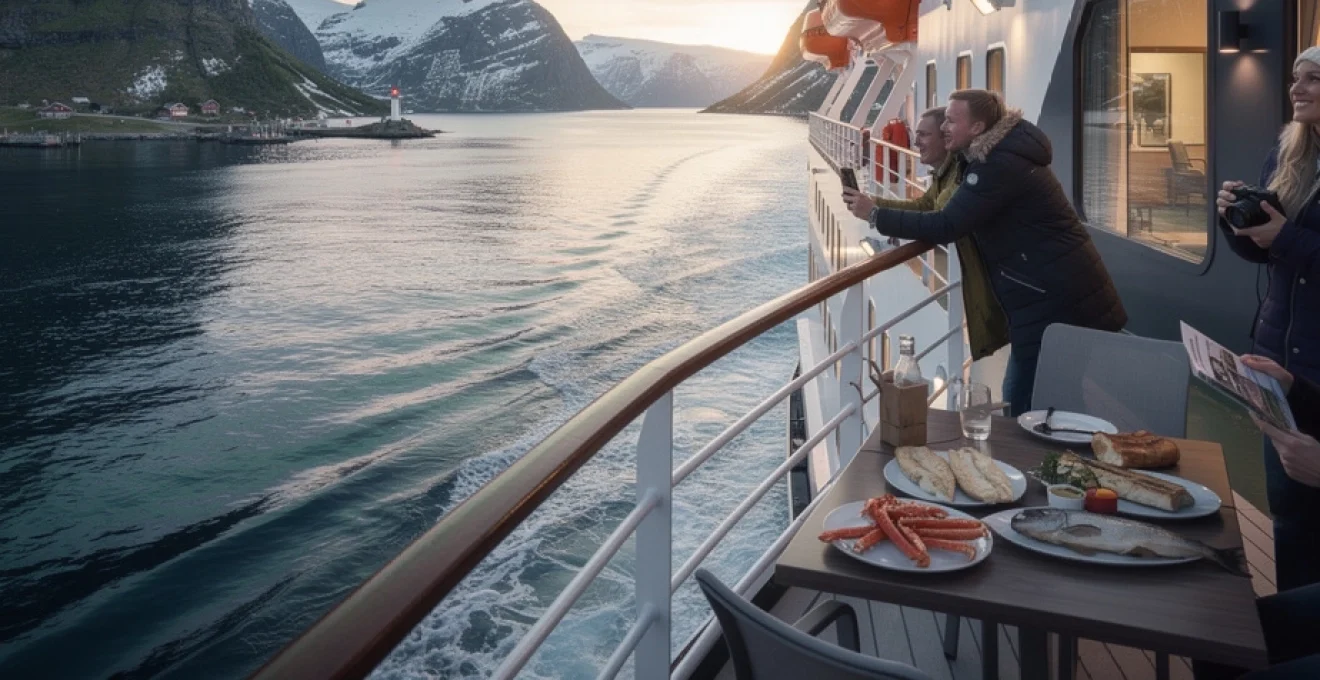
Norway’s coastal ferry service represents one of the world’s most remarkable maritime journeys, blending functional transport with spectacular scenic touring. For over 130 years, these working vessels have connected remote communities along Norway’s western seaboard, carrying passengers, cargo, and mail through some of the planet’s most dramatic coastal landscapes. Today, this historic route offers travellers an authentic glimpse into Norwegian coastal life whilst simultaneously delivering an unforgettable cruise experience through fjords, past towering mountains, and into the heart of the Arctic Circle.
The journey between Bergen and Kirkenes encompasses everything from UNESCO World Heritage fjords to midnight sun phenomena, from Art Nouveau architecture to indigenous Sámi culture. Unlike conventional cruise ships that visit tourist hotspots for brief photo opportunities, these coastal ferries maintain daily schedules regardless of season, calling at 34 ports where local residents depend on the service for essential connectivity. This dual identity—part working ferry, part cruise experience—creates a uniquely immersive travel experience that reveals Norway’s coastal character in its most authentic form.
Understanding hurtigruten and havila voyages: norway’s coastal express routes
Two companies currently operate Norway’s coastal express service, each maintaining the historic Bergen-Kirkenes-Bergen route that has served Norwegian communities since 1893. Hurtigruten, the original operator, runs seven vessels along the route, whilst the newer competitor Havila Voyages operates four modern ships. Both companies follow identical timetables and call at the same 34 ports, ensuring consistent service regardless of which operator you choose. The Norwegian government subsidises both operators to maintain this essential public transport link, particularly crucial for remote settlements where ferry connections remain the primary transportation option.
The competitive dynamic between these operators has driven improvements in passenger amenities, environmental performance, and service quality. Hurtigruten brings over a century of operational experience, whilst Havila introduces cutting-edge technology and sustainable engineering. This competition benefits passengers through enhanced offerings, from dining experiences featuring regional Norwegian cuisine to enrichment programmes led by expedition teams. Both operators honour the route’s working ferry heritage, loading cargo and welcoming local passengers alongside tourists taking the full voyage.
The bergen to kirkenes classic route: 2,500 nautical miles through 34 ports
The complete roundtrip voyage covers approximately 2,500 nautical miles over 11 nights and 12 days, traversing Norway’s entire western coastline from Bergen at 60°N to Kirkenes at 69°N, just kilometres from the Russian border. The northbound leg takes six days, whilst the southbound return requires five days, with different ports visited during daylight hours on each direction. This asymmetry means roundtrip passengers experience varied perspectives of the same locations—some ports approached by night going north appear in brilliant daylight heading south, revealing landscapes previously hidden in darkness.
Port calls vary dramatically in duration, from brief 15-minute stops at tiny settlements like Kjøllefjord to extended three-hour stays in major cities such as Trondheim and Tromsø. At smaller ports, you’ll witness the ferry’s essential function as a lifeline: loading supplies, transferring mail, and transporting residents between isolated communities. The ship operates with military precision, adhering to tight schedules that have remained largely unchanged for decades. Captains navigate narrow straits, negotiate challenging weather conditions, and dock at exposed harbours with remarkable consistency, maintaining punctuality that rival European rail services.
Hurtigruten’s fleet: MS finnmarken, MS nordnorge, and Hybrid-Powered vessels
Hurtigruten’s seven vessels range from classic ships like MS Vesterålen, the smallest and most traditional in the fleet, to modernised hybrids including MS Nordlys, MS Nordnorge, and MS Nordkapp. These ships underwent significant refurbishments between 2016 and 2020, introducing hybrid propulsion systems that combine traditional engines with battery technology, reducing emissions by up to 20% in certain operating conditions. MS Richard With and MS Kong Harald represent mid-generation vessels offering comfortable facilities without the newest technological innovations, whilst MS Polarlys rounds out the fleet with reliable service and well-appointed public spaces.
Each Hurtigruten vessel carries between 400 and 650 passengers depending on configuration, with
interiors and amenities tailored more towards intimate coastal cruising than mass-market entertainment. You can expect panoramic lounges with floor-to-ceiling windows, lecture theatres for daily talks from the expedition team, libraries, cafés, and often outdoor hot tubs and saunas. Rather than casinos or water slides, the focus is firmly on the scenery and on-board learning, making Hurtigruten an appealing choice if you value a quieter, more destination-focused voyage along the Norwegian coast.
Havila voyages’ Battery-Powered ships: havila capella and havila castor
Havila Voyages operates one of the most modern fleets on the Norwegian coastal ferry route, with ships such as Havila Capella, Havila Castor, Havila Polaris, and Havila Pollux. These vessels are built from the keel up around sustainability, using some of the world’s largest maritime battery packs combined with energy-efficient gas engines. In practical terms, that means the ships can sail for up to four hours on silent, emission-free battery power—particularly valuable when gliding through sensitive fjords and near small coastal communities.
On board, Havila’s design language is contemporary and Nordic, with muted colours, large windows, and plenty of natural materials. Cabins feel bright and modern, public spaces are uncluttered, and energy use is carefully monitored—from heat recovery systems to smart ventilation. If you are interested in low-impact travel or simply want to experience one of the most environmentally advanced coastal ferries in the world, Havila offers an impressive balance between comfort and sustainability on the classic Bergen–Kirkenes route.
Northbound versus southbound sailings: daylight and port call variations
Although the timetable is technically the same in both directions, the experience of sailing northbound versus southbound can be surprisingly different. Because of the timing of departures and arrivals, certain ports you pass in darkness on the way north will appear in full daylight on the return leg, and vice versa. For example, Ålesund, Bodø, and Tromsø each feature long calls in one direction and shorter, often late-night visits in the other, changing how much time you have for shore excursions or independent exploration.
Season also plays a huge role. In summer, northbound sailings bring you steadily deeper into the land of the midnight sun, meaning extended twilight or even 24-hour daylight in the far north. In winter, a southbound voyage may give you more opportunities for northern lights sightings after you’ve crossed the Arctic Circle. If you are planning a one-way trip, many travellers favour northbound for more daytime calls at iconic ports, but southbound itineraries reveal a different side of the same route. For the most complete experience, a full roundtrip allows you to see many harbours twice, under different light and weather conditions.
Cabin categories and onboard accommodation standards
Accommodation standards on Norway’s coastal ferries are closer to small-ship cruise lines than to basic public transport, although cabins are generally more functional than luxurious. Whether you sail with Hurtigruten or Havila, you will find several cabin categories designed to suit different budgets and expectations—from compact inside cabins intended for simple overnight stays to spacious suites with private balconies. Because the journey itself is the star attraction, most travellers choose a mid-range outside cabin with a window, but it is worth understanding the key differences before you book.
Across both operators, all standard cabins come with private bathrooms, beds (often convertible between twins and doubles), storage space, and basic seating. Higher categories increase square footage, add improved seating areas, and sometimes include coffee machines, mini-bars, or enhanced bathroom amenities. As cabins can sell out months in advance for peak-season departures, especially those with balconies or preferred views, booking early gives you the best choice of layout and deck position for your Norwegian coastal voyage.
Polar outside cabins: space, amenities, and window configurations
Polar Outside cabins (Hurtigruten’s widely used label for standard sea-view accommodation) strike a good balance between comfort and value. Typically ranging from about 8 to 13 square metres, they include a window or porthole, private bathroom with shower, and either twin beds or a double bed configuration, sometimes with an additional upper berth. For most travellers who plan to spend their days in the panoramic lounges or on deck, this category offers all the essentials without paying for seldom-used extra space.
One important consideration is the window configuration and location. Some Polar Outside cabins are on lower decks with smaller portholes closer to the waterline, which can occasionally be covered in heavy seas. Others sit on higher decks with larger windows but may look directly onto a promenade, meaning less privacy when curtains are open. When you book, check the deck plan carefully: if watching the Norwegian coastline slide past from your bed sounds appealing, aim for a higher-deck outside cabin where the view is less likely to be obstructed by lifeboats or loading equipment.
Arctic superior suites: private balconies and premium facilities
For guests seeking a more cruise-style experience on the Norwegian coastal ferry, Arctic Superior cabins and suites provide additional space and amenities. These cabins usually offer larger floor areas, improved bedding, dedicated seating or lounge zones, and often tea and coffee-making facilities. On some ships, this category includes access to private balconies, giving you the freedom to step outside at any time to photograph a passing lighthouse or enjoy the midnight sun in privacy.
Suites at the top end of the scale may feature separate living and sleeping areas, larger bathrooms, and in some cases, complimentary extras such as priority embarkation, welcome gifts, or enhanced Wi-Fi packages. If you plan to spend many hours relaxing in your cabin—perhaps working remotely, travelling during winter, or simply enjoying a quieter retreat—these higher categories can significantly enhance your comfort. Just as importantly, cabins in this range are often located in more stable mid-ship positions, which can be reassuring if you are concerned about motion on the open sea.
Inside cabins on lower decks: Budget-Friendly options and limitations
Inside cabins on the lower decks provide the most budget-friendly way to travel the Bergen–Kirkenes route. Compact and windowless, these rooms are designed primarily for sleeping and storing luggage rather than extended daytime use. You will still have a private bathroom, comfortable bedding, and climate control, but you will rely on the ship’s public areas for views of the Norwegian coastline. For many travellers who plan to spend most of their waking hours on deck or in lounges, this trade-off makes economic sense.
The main limitations of inside cabins are the lack of natural light and a greater likelihood of engine or mechanical noise, depending on their location. If you are sensitive to sound or prone to motion sickness, consider selecting an inside cabin mid-ship and on a lower deck, where movement is usually gentler, and pack seasickness remedies just in case. Think of these cabins as functional hotel rooms in the heart of a moving village: they may not be glamorous, but they free up more of your budget for shore excursions and experiences ashore.
UNESCO world heritage fjords: geirangerfjord and nærøyfjord cruising
One of the signature attractions of Norway’s coastal ferry route is its access to UNESCO-listed fjord landscapes, particularly Geirangerfjord and Nærøyfjord. Depending on the season and exact sailing date, certain departures detour from the open coast into these dramatic fjord systems, allowing you to witness vertical rock walls, cascading waterfalls, and tiny farmsteads clinging improbably to steep slopes. For many travellers, this part of the voyage ranks among the most photogenic segments anywhere in Scandinavia.
In summer, select northbound or southbound sailings include a side trip into Geirangerfjord or the nearby Hjørundfjord, often combined with optional excursions that let you disembark and explore the area by coach or on foot. Nærøyfjord, usually experienced via connecting tours from the main coastal cities rather than on the ferry itself, can be added before or after your voyage as part of Norway in a Nutshell-style itineraries. Because availability and timing of these fjord detours vary by month and operator, it pays to check the detailed voyage description for your chosen departure if UNESCO fjord cruising is high on your wish list.
Arctic circle crossing ceremony and coastal navigation landmarks
Somewhere between Nesna and Ørnes on the Helgeland coast, your ship crosses the Arctic Circle at latitude 66°33’ N—a symbolic milestone that many passengers look forward to. Both Hurtigruten and Havila typically mark the event with a light-hearted ceremony on deck, often involving a “baptism” with ice cubes or a taste of cod liver oil administered by a crew member dressed as the Norse sea god. It is entirely optional, of course, but participating is a fun way to celebrate your entry into the Arctic region.
Beyond the Arctic Circle, the coastal navigation itself becomes a highlight. Your voyage will pass distinctive landmarks such as the Seven Sisters mountain range near Sandnessjøen, the hole-pierced peak of Torghatten close to Brønnøysund, and the narrow entrance to Trollfjord in the Lofoten area. Expedition team members usually give short commentaries on deck, pointing out lighthouses, historic trading posts, and wartime sites as you sail past. Think of these landmarks as waypoints in a living maritime atlas: together they tell the story of Norway’s evolution from isolated coastal communities to a modern, well-connected nation.
Shore excursions and port call experiences
Shore excursions are an important part of any Norwegian coastal ferry voyage, transforming brief port calls into deeper encounters with local culture, nature, and history. Both operators offer a curated portfolio of activities at key ports, ranging from gentle city walks to high-adrenaline adventures such as RIB safaris and dog sledding. Prices vary from modest city tours to more expensive, full-day outings, so it is worth prioritising the experiences that matter most to you.
Because the ship is fundamentally a working ferry, some port stays are very short—just enough time to watch cargo operations or step briefly onto the quay. Others, especially in places like Trondheim, Bodø, Tromsø, and Kirkenes, last several hours and allow you to venture further afield. You can book excursions in advance or on board (subject to availability), or simply explore independently using local buses, taxis, or your own feet. Whatever your style, planning a mix of guided and self-guided activities will give you the richest sense of Norway’s coastal life.
Tromsø’s arctic cathedral and northern lights opportunities
Tromsø, often called the “Gateway to the Arctic,” is one of the most atmospheric stops on the coastal route. With a typical four-hour call northbound and a shorter late-night visit southbound, you have enough time to experience some of its main attractions. Many travellers choose an excursion that combines a city tour with a ride on the cable car up Mount Storsteinen, offering panoramic views of fjords, islands, and jagged peaks. Another focal point is the striking Arctic Cathedral, whose triangular form and huge stained-glass window have made it an icon of northern Norway.
In winter, Tromsø is also a prime location for northern lights watching, thanks to its position beneath the auroral oval. If your ship calls in the evening or late at night, you might opt for a dedicated aurora excursion into the darker countryside, or simply head out on deck with warm clothing and a camera. While no operator can guarantee a northern lights display, the coastal ferry’s steady movement through dark, low-light environments significantly increases your chances of a sighting during a voyage of 11 days or more.
Trondheim’s nidaros cathedral: medieval architecture shore visit
Trondheim, Norway’s former capital, offers a compelling combination of medieval heritage and modern university-city energy. Most departures include a morning call of around three hours, giving ample time to join a guided tour to Nidaros Cathedral—the country’s national shrine. Built over the burial place of St. Olav and begun in the 11th century, the cathedral is an outstanding example of Gothic architecture, with intricate stonework, soaring vaults, and an impressive western façade.
Excursions typically combine a short panoramic drive through Trondheim’s neighbourhoods with a guided visit inside the cathedral and, in some cases, a stop at the Ringve Museum of Musical History. If you prefer to explore independently, you can walk from the harbour to the old town and Bakklandet district in about 20 to 25 minutes, passing colourful wooden wharves along the Nidelva river. Just remember to keep an eye on the time—the ship will not wait for latecomers, no matter how engrossing the architecture.
North cape plateau excursion: europe’s northernmost point at 71°N
Reaching the North Cape plateau from the harbour of Honningsvåg is a standout moment for many Norway coastal ferry passengers. Located at 71°10’21”N, the cliff-top viewpoint rises over 300 metres above the Barents Sea and is often regarded as continental Europe’s northernmost accessible point. The classic excursion involves a coach journey across stark tundra landscapes to the North Cape Hall visitor centre, where you can watch a panoramic film, browse exhibitions, and walk out to the iconic globe sculpture for the obligatory photograph.
Depending on the season, the experience changes dramatically. In high summer, you may stand at the cape bathed in the warm glow of the midnight sun, while in winter the same plateau can be swept by Arctic storms and delicate polar twilight. The excursion is designed to suit most fitness levels, with minimal walking required, but you should dress for rapidly changing conditions: windproof layers, warm hats, and sturdy footwear are essential, even on seemingly mild days.
Lofoten islands stop: stamsund and svolvær fishing village exploration
The Lofoten Islands are among the most photogenic regions you will encounter on a Norwegian coastal ferry route, with craggy peaks rising straight from the sea and traditional fishing villages tucked into sheltered bays. Your ship typically calls at both Stamsund and Svolvær, allowing you to experience Lofoten’s mix of maritime heritage and contemporary culture. Southbound sailings, in particular, often offer longer, daylight visits that make it easier to explore ashore or join a guided tour.
Excursions might include a visit to the historic village of Henningsvær, a stop at a stockfish-drying facility, or time to wander Svolvær’s harbourfront galleries and cafés. In winter, Lofoten is famed for dramatic light and powerful Atlantic swells; in summer, it becomes a playground for hikers, kayakers, and photographers chasing midnight-sun landscapes. Even if you choose not to disembark, make sure to spend time on deck between Stamsund and Svolvær—the constantly changing light on the Lofoten wall can be unforgettable.
Dining services: coastal kitchen menus and norwegian culinary standards
Food is a central part of the experience on Norway’s coastal express ferries, with both Hurtigruten and Havila promoting a “coastal kitchen” philosophy. Rather than generic international buffets, menus highlight seasonal ingredients sourced from ports along the route: freshly landed cod and skrei, local cheeses, berries, and farmhouse breads. This farm-and-fjord-to-table approach not only supports regional producers but also gives you a literal taste of the landscapes you are sailing past.
Meals on board are typically relaxed but well-organised, with breakfast and lunch often served buffet-style and dinner presented as a plated, multi-course affair. Dietary requirements—such as vegetarian, vegan, or gluten-free options—can usually be accommodated with advance notice. While you will not find endless themed restaurants as on large cruise liners, the consistency and quality of Norwegian culinary standards mean that dining becomes an enjoyable, reliable highlight of each day at sea.
Full-board meal packages versus À la carte pricing structures
When you book a Norway coastal ferry voyage, you will generally have the option to sail with a full-board meal package or, in some cases, to pay for meals à la carte. Full board includes breakfast, lunch, and dinner in the main restaurant, and is standard on most longer itineraries from Bergen to Kirkenes. This arrangement offers excellent value if you plan to dine on board for the majority of your trip and simplifies budgeting, since you know your core meal costs in advance.
À la carte options, where available, suit travellers who are planning to spend more time eating ashore in larger ports or who may be joining only shorter segments of the route. You might, for example, enjoy a coffee and cinnamon bun in Ålesund, a seafood lunch in Bodø, or a casual dinner in Tromsø. Whichever approach you choose, remember that Norway has a relatively high cost of living; for most visitors on longer sailings, the predictability and convenience of full board significantly outweigh the flexibility of paying as you go.
Regional specialities: stockfish, king crab, and arctic char preparations
One of the pleasures of dining on a Norwegian coastal ferry is the chance to sample regional specialities as you travel through their home waters. In the Lofoten area, for instance, stockfish—unsalted cod dried on traditional wooden racks—often appears in classic dishes such as bacalao. Further north, around Kirkenes and Finnmark, menus may highlight king crab, served simply with lemon or in refined, modern preparations that showcase its sweet, delicate meat.
Arctic char, a cold-water fish related to salmon and trout, is another staple of coastal kitchen menus, typically grilled or lightly smoked and accompanied by root vegetables and tangy sauces. Even breakfast offers local touches, from brown goat cheese (brunost) to cured fish and pickled herring. If you are unsure what to try, do not hesitate to ask your server or the expedition team for recommendations; discovering new flavours is part of the journey, and trying a dish you have never heard of can be as memorable as stepping onto a remote Arctic pier.
Dining room seating arrangements and meal service times
Seating arrangements in the main dining room are usually structured but informal, reflecting the ferry’s dual role as working ship and cruise vessel. On most sailings, you will be allocated a table and a preferred seating time for dinner, helping the galley manage service smoothly while still allowing you to request changes if your excursion schedule shifts. Breakfast and lunch are more flexible, with open seating within the posted serving times, allowing you to drop in between deck-watching sessions or shore explorations.
Service times are coordinated with port calls wherever possible, but you may sometimes need to choose between a leisurely meal and extra time ashore. If you anticipate arriving back from an excursion close to the end of a meal window, inform the dining staff—they can often accommodate late arrivals or suggest alternatives at the café. As with many aspects of the Norwegian coastal ferry experience, a little planning and communication go a long way towards ensuring you never have to rush your reindeer stew or skip dessert to catch a glimpse of a lighthouse on the horizon.